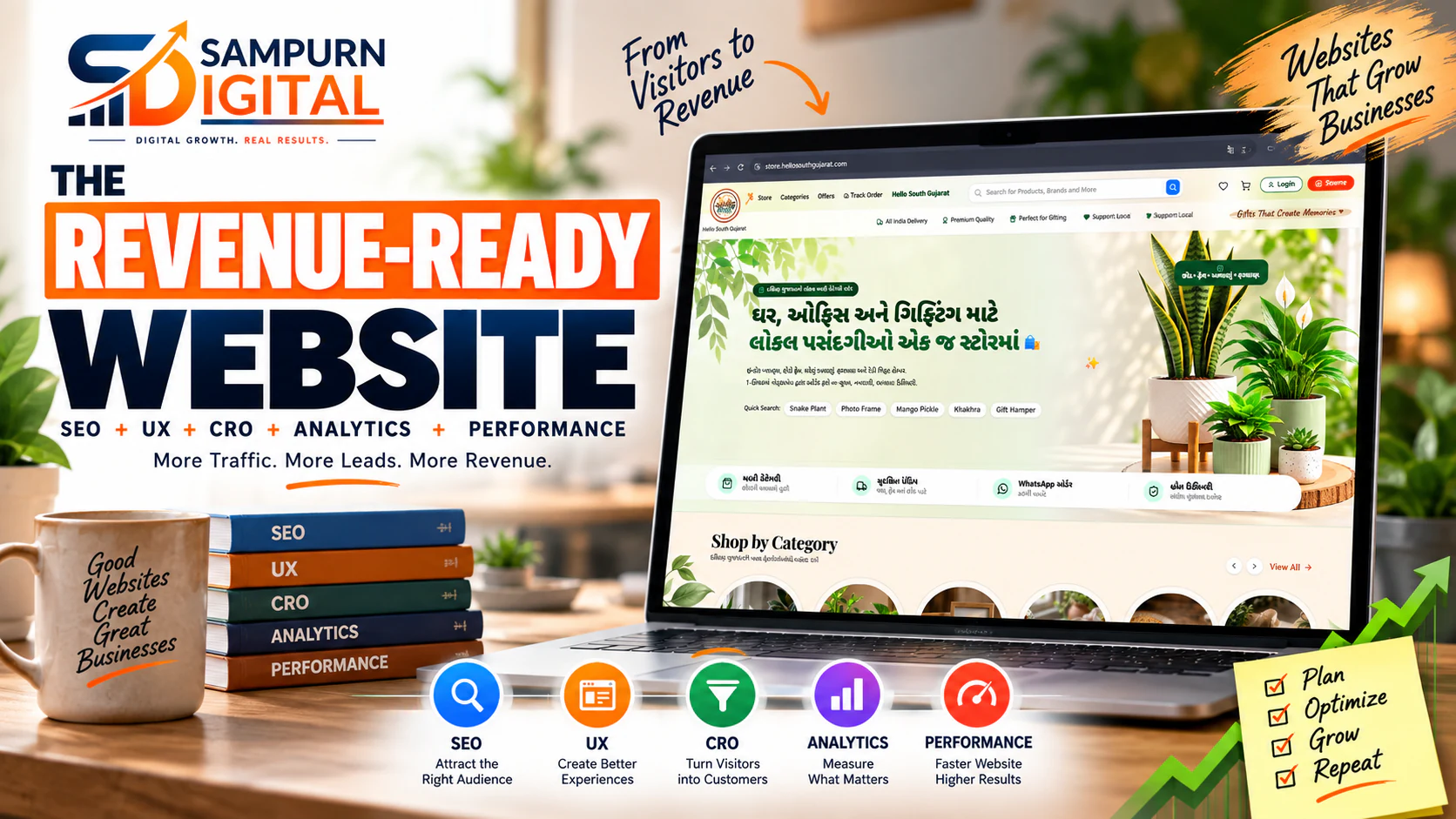
A website can have excellent design, strong SEO, fast loading speeds and thousands of visitors — and still fail to generate meaningful business results.
That is because a website is not a collection of pages.
For a growth-focused business, it is part of the revenue system.
The real question is not:
"Does our website look professional?"
It is:
"Does our website consistently turn the right traffic into measurable business outcomes?"
That requires several disciplines to work together:
When these systems are planned independently, problems appear.
SEO brings traffic to pages that don't convert.
Paid campaigns send expensive visitors to weak landing pages.
Users struggle to find information.
Analytics reports numbers but doesn't explain business impact.
A slow page reduces the effectiveness of every acquisition channel.
A revenue-ready website brings these components together.
What Is a Revenue-Ready Website?
A revenue-ready website is built around a simple business equation:
For example, imagine a service business receives:
If:
- 2% become leads
- 30% of leads are qualified
- 20% of qualified leads become customers
- Average customer value \= ₹50,000
Then:
Now imagine increasing conversion rate from:
The same traffic produces:
The business didn't necessarily need 2,500 additional visitors.
It improved the website's ability to monetize existing traffic.
That is the core idea behind a revenue-focused website strategy.
The Five Systems Behind a Revenue-Ready Website
A high-performing website should connect five major systems.
| System | Primary Job | Business Impact |
|---|---|---|
| SEO | Attract relevant organic traffic | More qualified discovery |
| UX | Help visitors understand and navigate | Less friction |
| CRO | Increase desired actions | More leads/sales |
| Analytics | Measure behaviour and outcomes | Better decisions |
| Performance | Keep experience fast and reliable | Better engagement and conversion |
The important point is that these systems are interconnected.
Improving one can affect the others.
SEO: Bring the Right People to the Website
Traffic isn't automatically valuable.
10,000 visitors looking for something you don't sell are less useful than 1,000 visitors actively looking for your solution.
SEO should therefore focus on:
- Search intent
- Topic relevance
- Service pages
- Content architecture
- Internal linking
- Technical accessibility
- Search visibility
- Local relevance where applicable
The goal is not:
The goal is:
Build SEO Around Business Intent
Consider a web development company.
Someone searches:
This may represent very early-stage research.
Another person searches:
That search is much closer to a buying decision.
Your website should support both audiences, but they shouldn't necessarily receive the same page.
A useful intent structure is:
A revenue-ready website gives each stage an appropriate destination.
UX: Make the Next Decision Easy
UX is not simply about making a website beautiful.
Good UX reduces the amount of effort required to answer:
If visitors have to work too hard to answer those questions, conversion suffers.
The 5-Second Website Test
When someone lands on an important page, they should quickly understand:
What do you offer?
Example:
Who is it for?
Why should they trust you?
Proof, results, testimonials, experience or relevant credentials.
What should they do?
The visitor shouldn't need to scroll through six sections to discover the purpose of the page.
UX Friction Has a Business Cost
Suppose:
but the page has:
- unclear messaging
- confusing navigation
- weak CTA
- slow loading
- poor mobile layout
- no proof
Even if the traffic is excellent, the website may underperform.
If the page converts at:
Improving it to:
doubles lead volume without doubling traffic.
That is why UX belongs inside the revenue conversation.
CRO: Turn More Existing Traffic Into Business
Conversion Rate Optimization asks:
"How can we increase the percentage of visitors who take the action we actually want?"
For a service business, that might be:
- Consultation request
- Lead form
- Phone call
- WhatsApp enquiry
- Demo booking
For e-commerce:
- Add to cart
- Checkout
- Purchase
For SaaS:
- Trial signup
- Demo
- Account creation
CRO starts with understanding where visitors drop out.
The Basic Conversion Formula
Example:
Now compare:
| Month | Visitors | Leads | Conversion Rate |
|---|---|---|---|
| January | 5,000 | 75 | 1.5% |
| February | 5,500 | 99 | 1.8% |
| March | 6,000 | 120 | 2.0% |
| April | 6,500 | 156 | 2.4% |
Traffic grew.
But the bigger improvement came from the website becoming more effective at converting visitors.
CRO Should Start With Friction, Not Button Colours
A common mistake is starting CRO with:
"Let's make the button green."
That's rarely the highest-impact question.
Start with:
Only after these fundamentals should you worry about minor visual experiments.
Analytics: Connect Website Activity to Revenue
Analytics should answer business questions.
Not just:
But:
- Which channels produce qualified leads?
- Which pages generate conversions?
- Which campaigns generate revenue?
- Where do visitors drop?
- Which landing pages perform best?
- Which traffic sources produce customers?
- What is the cost per qualified lead?
- Which pages assist conversions?
The objective is:
Build a Conversion Measurement Framework
For a service business, define events such as:
| Action | Tracking Event | Importance |
|---|---|---|
| Contact form | `generate_lead` | High |
| Consultation booked | `book_consultation` | Very High |
| Phone click | `phone_click` | High |
| WhatsApp click | `whatsapp_click` | Medium/High |
| Case study view | `view_case_study` | Medium |
| Service page view | `view_service` | Medium |
| Blog view | `view_content` | Low/Medium |
Not every event needs to be a primary conversion.
The purpose is to understand the customer journey.
Don't Stop at Lead Volume
Imagine two marketing campaigns:
Campaign A
Campaign B
If you only track lead volume:
If you track revenue:
This is why a revenue-ready website should connect website analytics with downstream business outcomes wherever practical.
Performance: Speed Is Part of Conversion
Website performance affects every marketing channel.
A slow page doesn't just create a technical problem.
It can affect:
- User experience
- Engagement
- Paid traffic efficiency
- Mobile experience
- Conversion opportunities
- SEO performance
Consider a paid campaign generating:
If the landing page experience is poor, improving ad targeting alone may not solve the problem.
The website itself may be the bottleneck.
Diagnose Performance Before Buying More Traffic
Suppose:
CPL:
Now improve the landing page and conversion rate.
If leads increase to:
New CPL:
The media budget stayed the same.
The website became more efficient.
This is why website performance and CRO should be part of paid growth discussions.
The Revenue-Ready Website Funnel
A strong website should support this journey:
If one stage is weak, the entire system suffers.
Build Different Pages for Different Jobs
One of the biggest mistakes is expecting every page to do everything.
Instead, assign jobs.
| Page Type | Main Job |
|---|---|
| Homepage | Explain positioning |
| Service Page | Capture commercial intent |
| Blog | Educate and attract organic traffic |
| Case Study | Build trust |
| Landing Page | Convert campaign traffic |
| Pricing Page | Reduce purchase uncertainty |
| Contact Page | Capture high-intent visitors |
| Resource Page | Generate consideration |
This creates a clearer customer journey.
Homepage ≠ Landing Page
A homepage typically has multiple audiences.
A campaign landing page should have a much narrower purpose.
For example:
Homepage
Includes:
- SEO
- Paid Ads
- Social Media
- Web Development
Campaign landing page
Focused on:
- The problem
- What the audit covers
- Expected benefits
- Proof
- CTA
Both are valuable.
They simply perform different jobs.
Build Trust Into the Conversion Journey
People rarely make important purchasing decisions based on one headline.
They look for evidence.
Useful proof can include:
- Case studies
- Testimonials
- Client logos
- Before/after results
- Process explanation
- Industry experience
- Certifications
- Reviews
- Transparent expectations
But proof should be relevant.
A generic:
is weak.
A stronger message is:
Specific evidence is easier to evaluate.
Make the Offer Easy to Understand
Your website should explain:
What?
What are you selling?
Who?
Who is it for?
Problem?
What problem does it solve?
Outcome?
What changes after buying?
Process?
How does it work?
Proof?
Why should the visitor believe you?
CTA?
What happens next?
This structure can be applied to service pages, landing pages and even product pages.
Build a Strong Service Page
A revenue-focused service page can follow this structure:
Hero
Clear service + audience + outcome.
Problem
What is currently going wrong?
Solution
How your service addresses it.
Deliverables
What does the customer actually receive?
Process
What happens after engagement?
Proof
Results, case studies and testimonials.
FAQs
Remove common objections.
CTA
Make the next action obvious.
Use Objection Handling as Part of UX
Potential customers may wonder:
If the website doesn't answer these questions, users may leave.
FAQ sections, process explanations, pricing guidance, case studies and clear expectations can reduce uncertainty.
Reduce Form Friction
Long forms aren't automatically bad.
The correct question is:
"Does every field justify the friction it creates?"
Compare:
Form A
- Name
- Phone
- Company
- Website
- Industry
- Company size
- Monthly revenue
- Marketing budget
- 10 additional questions
Form B
- Name
- Business email
- Phone
- Website
- What do you need help with?
For an initial consultation, Form B may create less friction.
For a highly qualified sales process, additional fields may be justified.
The correct form depends on the business model.
Build a Lead Quality Loop
More leads aren't always better.
Suppose:
Now:
Lead volume increased.
Revenue didn't.
Your optimization target should therefore be:
not simply:
Connect Marketing Channels to the Website
A revenue-ready website should support:
SEO
Google Ads
Meta Ads
Social
Post → Content → Service → Lead
The website is the common destination where these journeys become measurable.
SEO + UX + CRO Should Not Fight Each Other
Sometimes teams treat these as competing priorities.
For example:
SEO team: "Add more content."
UX team: "Remove unnecessary content."
CRO team: "Move the CTA higher."
The solution isn't choosing one department.
It's understanding the visitor.
The page should contain enough useful information to satisfy intent while remaining:
- Scannable
- Structured
- Relevant
- Easy to navigate
- Conversion-focused
Good architecture allows all three objectives to coexist.
Build an Internal Linking System
Internal links can guide users from:
to:
to:
For example:
Blog article:
Related guide:
Service:
CTA:
Internal linking therefore supports both SEO and conversion journeys.
Revenue-Ready Website Scorecard
Score your website from 0–2 for each category.
SEO
- Search intent alignment
- Technical crawlability
- Internal linking
- Content architecture
UX
- Navigation
- Mobile experience
- Clarity
- Trust
CRO
- CTA clarity
- Landing pages
- Forms
- Objection handling
Analytics
- Conversion tracking
- Attribution
- CRM connection
- Reporting
Performance
- Mobile speed
- Core Web Vitals
- Image optimization
- Script efficiency
Maximum score:
Interpretation
| Score | Status |
|---|---|
| 0–15 | Major revenue leakage |
| 16–24 | Needs foundational work |
| 25–32 | Functional growth foundation |
| 33–37 | Strong |
| 38–40 | Highly optimized foundation |
This isn't a universal industry benchmark.
It is a practical internal diagnostic framework for prioritizing work.
Prioritize Website Improvements by Business Impact
Don't fix everything simultaneously.
Use:
For example:
| Improvement | Impact | Confidence | Effort | Priority |
|---|---|---|---|---|
| Fix broken lead form | High | High | Low | Very High |
| Improve hero message | High | High | Low | Very High |
| Reduce image size | Medium | High | Low | High |
| Rewrite one FAQ | Low | Medium | Low | Medium |
| Change button radius | Low | Low | Low | Low |
This keeps the team focused on improvements that can materially affect performance.
Example: Finding Revenue Leakage
Imagine a business has:
Average customer value:
Revenue:
Now identify the weakest stage.
Scenario A: Traffic problem
Only 20% of target audience reaches the website.
SEO/paid/social strategy may need improvement.
Scenario B: Conversion problem
Traffic is strong but only 1.5% converts.
UX/CRO may be the priority.
Scenario C: Lead-quality problem
300 leads produce only 60 qualified leads.
Targeting, messaging and offer may need improvement.
Scenario D: Sales problem
60 qualified leads produce 12 customers.
The website may be fine; sales follow-up may be the bottleneck.
This is why website optimization should not happen in isolation.
What a Revenue Dashboard Should Show
A useful website growth dashboard can include:
Acquisition
- Organic users
- Paid users
- Social users
- Referral users
Engagement
- Key landing-page visits
- Engagement signals
- Returning visitors
Conversion
- Leads
- Calls
- Bookings
- Purchases
Quality
- Qualified leads
- Lead-to-opportunity rate
- Opportunity-to-customer rate
Business
- Customers
- Revenue
- Cost per acquisition
- Customer acquisition cost
The exact dashboard should reflect the business model.
Monthly Revenue-Ready Website Review
Run a monthly review with five questions.
What traffic grew?
Identify channels and pages.
What converted?
Find the pages and campaigns producing actions.
What improved?
Compare conversion rates and revenue metrics.
Where are visitors dropping?
Look for friction.
What should we change next?
Create a prioritized experiment or development backlog.
This turns the website into a continuously improving asset.
What Not to Do
Don't redesign everything because conversion dropped
First identify the cause.
Don't chase traffic without checking intent
More visitors can create more waste.
Don't judge performance using bounce rate alone
Look at business outcomes.
Don't install dozens of marketing scripts
Every script has potential performance and maintenance implications.
Don't create landing pages without tracking
An unmeasured campaign is difficult to optimize.
Don't optimize only for leads
Track lead quality and revenue.
Don't treat SEO, paid and social as separate website projects
They share the same destination.
The Revenue-Ready Website Development Checklist
Before launch, verify:
Strategy
- Business goals defined
- Target audiences defined
- Customer journeys mapped
- Primary conversion actions defined
SEO
- Keyword/topic architecture
- Search intent mapping
- Clean URLs
- Internal linking
- Metadata
- Technical SEO foundations
UX
- Clear navigation
- Mobile-first experience
- Clear page hierarchy
- Strong information architecture
- Trust elements
- Clear CTAs
CRO
- Service pages optimized
- Landing pages available
- Forms optimized
- Objections addressed
- Conversion paths defined
Analytics
- Analytics configured
- Events defined
- Conversion tracking tested
- Campaign attribution configured
- CRM integration reviewed
Performance
- Images optimized
- Scripts reviewed
- Caching configured
- Mobile performance tested
- Core Web Vitals reviewed
Growth
- CMS usable
- New landing pages can be created
- Content can scale
- Website can handle increasing traffic
- Maintenance process established
The Revenue-Ready Website Operating Model
The strongest websites are not "finished."
They operate as a continuous improvement system.
A practical cycle is:
For example:
This is much more effective than redesigning the website every two years without understanding what is actually causing poor performance.
When Should You Invest in a Website Audit?
Consider a detailed audit when:
- Traffic is increasing but leads aren't
- Paid traffic is expensive
- Organic rankings are strong but conversions are weak
- Visitors leave important pages quickly
- Mobile performance is poor
- Forms generate inconsistent results
- Analytics numbers don't match CRM data
- Marketing teams can't create landing pages quickly
- The website has become difficult to maintain
- You are preparing for a major redesign
An audit should identify business-impacting problems, not simply generate a long list of technical recommendations.
The Real Definition of a High-Performing Website
A high-performing website isn't necessarily the one with:
- The most animations
- The most pages
- The highest traffic
- The fanciest design
- The longest content
It is the website that efficiently moves the right people from:
to
to
to
to
while giving the business enough data to improve the process.
Ready to Make Your Website a Growth Asset?
Sampurn Digital can help audit and improve the complete website system — from SEO and UX to CRO, analytics and performance — so your website is built to support measurable business growth.