
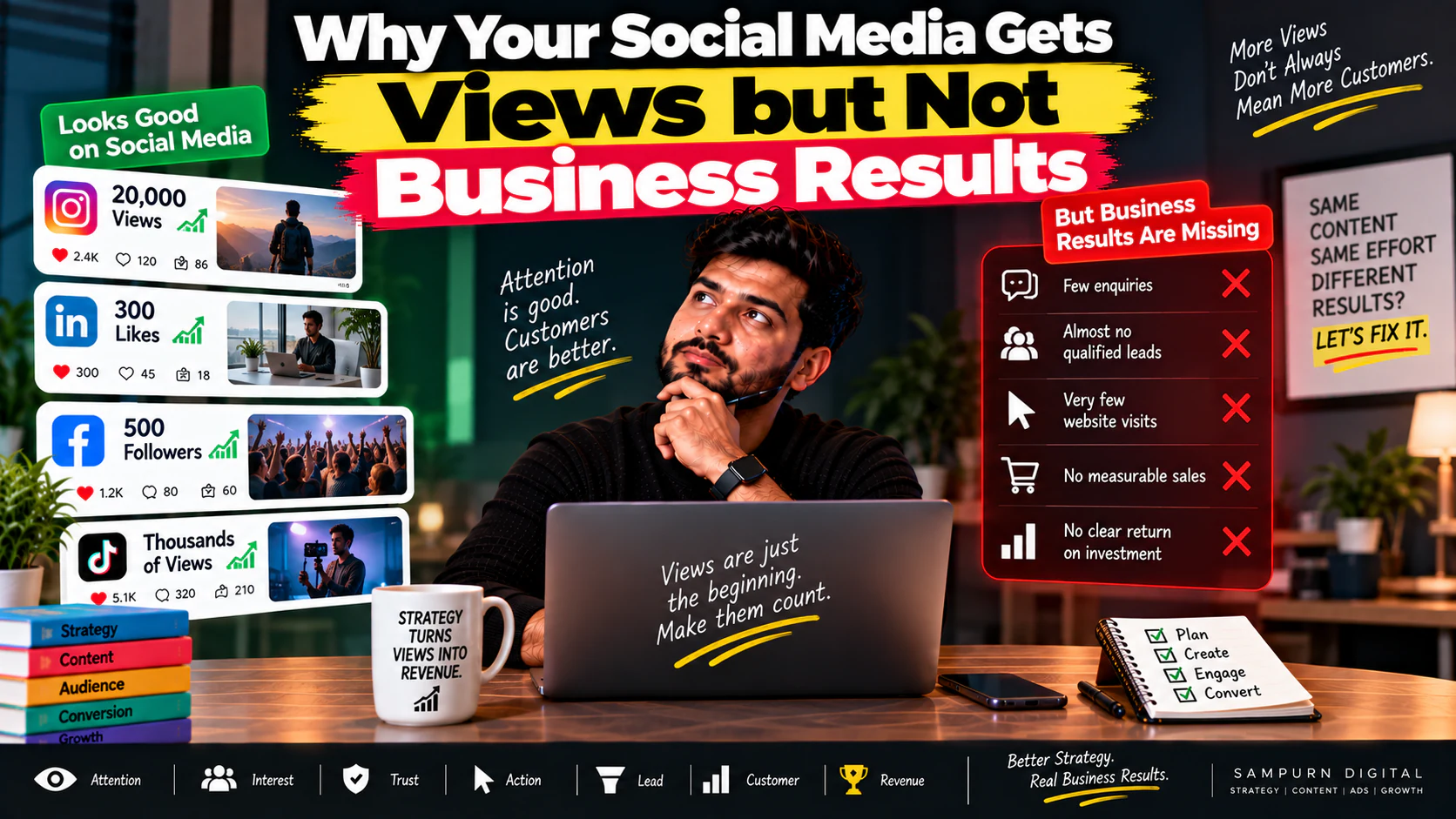
Your Instagram Reel gets 20,000 views.
A LinkedIn post gets 300 likes.
Your Facebook page gains 500 followers.
Your video reaches thousands of people.
And yet, when you check the business side of things, the numbers look very different:
- Few enquiries
- Almost no qualified leads
- Very few website visits
- No measurable sales
- No clear return on the time and money being spent
So the obvious question is:
The answer is usually not that social media “doesn't work.”
The bigger problem is that attention and business outcomes are not the same thing.
A person can watch your video for 15 seconds and never become a customer.
Someone can like ten of your posts and never enquire.
A post can go viral among people who have absolutely no intention of buying what you sell.
The goal of business social media is therefore not simply to maximize reach.
It is to build a system where:
Attention → Interest → Trust → Action → Lead → Customer → Revenue
This guide explains where that system usually breaks and what you should fix.
Views Are Not the Same as Business Results
Let's start with the most important distinction.
Social media platforms are designed to measure engagement.
Businesses need to measure outcomes.
These are different things.
Social media metrics include:
- Reach
- Impressions
- Views
- Likes
- Comments
- Shares
- Saves
- Followers
- Engagement rate
Business metrics include:
- Website visits
- Enquiries
- Leads
- Qualified leads
- Bookings
- Purchases
- Customers
- Revenue
- Customer acquisition cost
- Return on investment
The first group tells you whether people are interacting with your content.
The second tells you whether your marketing is contributing to the business.
You need both—but they should not be confused.
The Viral Post That Generated Nothing
Imagine a local interior design company publishes a Reel.
The Reel receives:
Sounds excellent.
The owner celebrates the result.
But after reviewing the numbers:
- Website visits: 180
- Enquiries: 3
- Qualified enquiries: 1
- Customers: 0
Was the Reel successful?
It depends on its purpose.
If the goal was brand awareness, 100,000 views may be valuable.
If the goal was generating interior design enquiries, the result is much weaker.
This is why every piece of social content needs a job.
Give Every Social Post a Job
Not every post needs to generate a lead immediately.
But every post should contribute to a larger business objective.
A useful content-job framework is:
| Content Job | Example |
|---|---|
| Attention | Short Reel solving a common problem |
| Education | Carousel explaining a process |
| Trust | Client case study |
| Authority | Expert opinion or analysis |
| Proof | Before/after result |
| Engagement | Question or discussion |
| Consideration | Service comparison |
| Conversion | Offer + CTA |
| Retention | Customer tips/support content |
The mistake is expecting every post to produce the same outcome.
A top-of-funnel educational Reel may create awareness.
A case study may create trust.
A service post may create enquiries.
A testimonial may remove hesitation.
The individual posts work together.
The Real Social Media Funnel
Business social media should be viewed as a journey.
Stage 1: Attention
Someone discovers you.
Metric: Reach, impressions, views
Stage 2: Interest
They interact with your content.
Metric: Saves, shares, profile visits, engagement
Stage 3: Consideration
They explore your brand.
Metric: Website visits, profile clicks, content consumption
Stage 4: Intent
They take a meaningful action.
Metric: Enquiries, WhatsApp clicks, calls, form submissions
Stage 5: Conversion
They become a customer.
Metric: Purchases, bookings, signed deals
Stage 6: Revenue
The marketing contributes to business value.
Metric: Revenue, CAC, ROI, LTV
The farther down this funnel you go, the closer you get to actual business impact.
Why Your Social Media Can Get Views but No Leads
There are several common reasons.
Your Content Is Designed for Everyone
Broad content often attracts broad attention.
For example:
“5 Productivity Tips You Need to Know”
This might attract students, employees, entrepreneurs, freelancers and almost anyone interested in productivity.
But if you sell enterprise HR software, most of those viewers are irrelevant.
The content got attention.
It didn't attract the right buyer.
Relevance Matters More Than Reach
Suppose two posts generate the following results.
Post A
100,000 views 2 leads
Post B
10,000 views 40 leads
If your objective is lead generation, Post B is dramatically more valuable.
This leads to an important principle:
The best audience is not necessarily the largest audience. It is the audience with the strongest business relevance.
Your Content Doesn't Solve a Buying Problem
People follow accounts that entertain them.
People contact businesses that can solve something important.
If your entire content strategy consists of:
- Good morning posts
- Festival greetings
- Generic motivational quotes
- Stock images
- Company announcements
- “Happy Monday”
- Generic industry facts
you may get some engagement.
But you're giving people very few reasons to think:
“I should talk to this company.”
Business content needs to demonstrate usefulness.
Replace Generic Posts With Problem-Solving Content
Instead of:
“We provide the best digital marketing services.”
Try:
“Your Google Ads generate 100 leads a month, but only 8 become qualified. Here's where the leakage usually happens.”
Instead of:
“We are experts in web development.”
Try:
“If your landing page gets 1,000 visitors but only 10 enquiries, these five elements deserve an audit.”
Instead of:
“Our team creates amazing social media content.”
Try:
“Why your Instagram gets 50,000 views but almost no enquiries—and what to change.”
The second version creates a reason for the right person to pay attention.
Your Audience Doesn't Know What You Sell
This sounds obvious, but it happens frequently.
Someone may know your brand.
They may follow you.
They may even enjoy your content.
But they still don't understand:
- What you sell
- Who you help
- What problem you solve
- Why you're different
- What they should do next
That's a positioning problem.
The 5-Second Test
Open your social profile and ask:
Can a new visitor answer these questions quickly?
If the answer is unclear, your social profile is making the visitor do too much work.
Your Profile Is Not Built to Convert
Your content may be excellent.
But if someone visits your profile and finds:
- Unclear bio
- No offer
- No website link
- No service explanation
- No proof
- No CTA
- Outdated information
the journey stops.
Your social profile should function as a mini landing page.
For example:
Weak bio
Digital marketing agency We make brands grow 🚀 Contact us for more information.
Stronger positioning
Helping service businesses generate qualified leads through SEO, paid ads, social media & conversion-focused websites. ↓ Request a growth audit
The second version tells the visitor what the business does and what to do next.
Your Content Has No CTA
You don't need to add:
“BUY NOW\!\!\!”
to every post.
But if you want business results, people need a next step.
Your CTA could be:
- Visit the website
- Download the guide
- Send a DM
- Request an audit
- Book a consultation
- Read the case study
- View the service
- Get a quote
- Subscribe
- WhatsApp the business
The CTA should match the user's level of intent.
Match CTA to Content
Educational post
CTA:
“Save this checklist for your next campaign.”
Problem-focused post
CTA:
“If you're facing this issue, send us a message.”
Case study
CTA:
“Want to see what this approach could look like for your business?”
Service post
CTA:
“Request a strategy consultation.”
The CTA should feel like the natural next step—not an interruption.
You Are Measuring Vanity Metrics
This is one of the biggest problems.
A monthly report might say:
Followers increased by 2,500.
That sounds impressive.
But what happened to the business?
Maybe:
- Leads decreased
- Website traffic stayed flat
- Qualified enquiries fell
- Revenue didn't change
The follower count alone doesn't answer whether social media worked.
Build a Social Media Measurement Ladder
Use four levels.
Level 1 — Attention
- Reach
- Impressions
- Views
Level 2 — Engagement
- Likes
- Comments
- Shares
- Saves
- Engagement rate
Level 3 — Intent
- Profile visits
- Website clicks
- DMs
- Calls
- Enquiries
- Form submissions
Level 4 — Business
- Qualified leads
- Customers
- Revenue
- CAC
- ROI
- LTV
The higher levels should increasingly influence your decisions.
Your Content Is Reaching the Wrong People
A post can perform extremely well and still be commercially useless.
Imagine a B2B cybersecurity company posts:
“10 Funny Things Every Developer Has Done”
It receives:
- 250,000 views
- 8,000 likes
- 1,500 shares
Fantastic reach.
But most viewers are students and developers who aren't buyers.
Meanwhile, a technical post:
“How Mid-Sized Companies Can Detect Unusual Login Activity Before It Becomes a Security Incident”
gets:
- 8,000 views
- 80 saves
- 15 website visits
- 5 qualified enquiries
Which post should the business create more of?
The second.
You Are Optimizing for the Algorithm Instead of the Customer
There is nothing wrong with understanding platform algorithms.
But algorithm optimization should support business strategy—not replace it.
If you constantly chase:
- Trending audio
- Viral formats
- Meme templates
- Shock hooks
- Engagement bait
you may build an audience that loves your content but has no interest in buying from you.
Ask:
Would I still consider this content successful if it received fewer views but reached exactly the people who could become customers?
If the answer is yes, your strategy is becoming more business-focused.
Your Content Is Too Promotional
The opposite problem also exists.
A company posts:
- Buy this
- Contact us
- Our services
- Our offer
- Our product
- Limited-time deal
every day.
People stop paying attention.
A better social strategy balances different content purposes.
For example:
40% Education
Teach something useful.
25% Trust
Show:
- Case studies
- Results
- Testimonials
- Team expertise
- Behind-the-scenes work
20% Engagement
Create useful conversations.
15% Conversion
Present:
- Offers
- Services
- Products
- Consultation
- CTA
These percentages are not universal rules.
The important idea is to avoid turning your entire social feed into a catalogue.
Your Content Does Not Build Trust
People rarely buy expensive services because of one Instagram post.
They need confidence.
They want to know:
- Can you solve my problem?
- Have you done this before?
- Do you understand my industry?
- Can I trust you?
- What happens after I contact you?
- Will I get measurable results?
That's why proof matters.
Turn Your Work Into Content
If you're a service business, your actual work is your content library.
Turn:
into:
- Problem
- Strategy
- Execution
- Result
- Lesson
Turn:
into:
- Reel
- Carousel
- LinkedIn post
- FAQ
- Story
Turn:
into:
- Case study
- Before/after
- Data visualization
- Expert commentary
You don't always need more ideas.
You often need to extract more content from the work you're already doing.
Your Social Media and Website Are Disconnected
A visitor sees your content.
They become interested.
They click your profile.
They visit your website.
Then the experience changes completely.
Maybe:
- The offer is unclear
- The website is slow
- The page doesn't match the post
- There is no obvious CTA
- The contact form is difficult
- There is no proof
The social media did its job.
The website failed to continue the journey.
Your social content and website should work as one experience.
A conversion-focused lead generation website architecture becomes especially important when social traffic is expected to produce enquiries.
The Social → Website → Lead Journey
A strong journey might look like:
This is much stronger than:
You're Not Repeating What Works
One successful post is useful.
But the real value comes from understanding why it worked.
Suppose one post generated:
- 25,000 views
- 700 saves
- 200 shares
- 50 profile visits
- 12 enquiries
Don't simply say:
“That Reel went viral.”
Analyze it.
Maybe it worked because:
- The problem was specific
- The hook was strong
- The audience was highly relevant
- The format was easy to consume
- The topic had buying intent
- The CTA was clear
Then create variations.
Turn One Winner Into Five Posts
Suppose this post performed well:
“Why your Google Ads get clicks but no customers.”
You could create:
- Why your landing page loses paid traffic
- 5 signs you're attracting the wrong search terms
- How to diagnose expensive leads
- What a good lead-generation funnel looks like
- Why cheap CPL can be misleading
Now one successful insight becomes a content series.
This is much more scalable than constantly starting from zero.
Your Content Strategy Has No Business Goal
Before publishing, define the purpose.
Ask:
What business outcome should this content support?
Possible goals:
- Awareness
- Audience building
- Authority
- Website traffic
- Lead generation
- Product sales
- Event registrations
- Recruitment
- Retention
If your business goal is lead generation, your content strategy should eventually create pathways toward lead generation.
Build a Content-to-Outcome Map
| Content Type | Immediate Goal | Business Role |
|---|---|---|
| Educational Reel | Reach | Awareness |
| How-to Carousel | Saves | Authority |
| Case Study | Trust | Consideration |
| Testimonial | Confidence | Conversion |
| Service Explanation | Intent | Lead generation |
| Offer Post | Action | Conversion |
This makes your content calendar much more strategic.
You Are Not Tracking Leads Properly
Suppose someone sees your Instagram post and later contacts you through WhatsApp.
If nobody records the source, your report may say:
“Organic social generated 0 leads.”
But that's not necessarily true.
The customer may simply have taken a different path.
For better measurement, track:
- Social profile clicks
- Website sessions
- UTM-tagged campaigns
- Form submissions
- WhatsApp clicks
- Phone calls
- DMs
- Lead source
- Customer source
The goal is to understand:
not just:
A Simple Social Media ROI Example
Suppose you spend ₹40,000 per month on social media.
That includes:
- Content production
- Design
- Video
- Management
- Promotion
Your social activity produces:
- 50 enquiries
- 15 qualified leads
- 5 customers
If those customers generate ₹3,00,000 in attributable gross revenue, you now have a business metric to evaluate.
Compare that with:
“We got 80,000 views this month.”
The second number may be useful.
The first is much closer to the commercial question.
For a deeper understanding of ROAS, ROI, CAC and LTV, your measurement framework should distinguish revenue, acquisition cost and customer value rather than treating every social metric equally.
Don't Expect Every Social Channel to Perform the Same
Different platforms can attract different audiences and serve different purposes.
For example:
- Instagram may be strong for visual discovery
- LinkedIn may be valuable for B2B authority
- Facebook may support community and remarketing
- YouTube may support long-form education
- Other platforms may be more relevant for specific audiences
The correct question isn't:
“Which platform is best?”
It is:
“Where does our target customer spend attention, and what type of content helps us move them toward a business outcome?”
Diagnose Your Social Media Using This Framework
When results are poor, don't immediately create more posts.
Find the broken stage.
Problem: Low reach
Investigate:
- Content topics
- Hooks
- Distribution
- Format
- Platform fit
Problem: High reach but low engagement
Investigate:
- Relevance
- Content quality
- Audience fit
- Topic selection
Problem: High engagement but low website traffic
Investigate:
- CTA
- Profile optimization
- Link placement
- Content intent
Problem: Website traffic but no enquiries
Investigate:
- Landing page
- Offer
- Trust
- UX
- CTA
- Message match
Problem: Lots of enquiries but few customers
Investigate:
- Lead quality
- Targeting
- Offer
- Sales follow-up
- Pricing
- Sales process
This is much more useful than simply saying:
“Our Instagram isn't working.”
A 30-Day Social Media Reset
If your social media is generating attention but little business value, don't delete everything and start over.
Use a structured reset.
Week 1 — Audit
Review the last 60–90 days.
Identify:
- Top posts by reach
- Top posts by saves
- Top posts by shares
- Top posts by profile visits
- Top posts by enquiries
- Worst-performing topics
- Audience quality
- Website traffic
- Lead sources
Create two lists:
and
The difference between them will be extremely valuable.
Week 2 — Reposition
Clarify:
- Target audience
- Core problems
- Content pillars
- Brand positioning
- Primary CTA
- Profile messaging
Your audience should quickly understand why they should follow you.
Week 3 — Build Content Around Problems
Create content around:
- Customer questions
- Buying objections
- Common mistakes
- Industry problems
- Case studies
- Results
- Comparisons
- How-to content
Avoid creating content simply because “we need to post today.”
Week 4 — Measure Business Outcomes
Track:
- Profile visits
- Website clicks
- Leads
- Qualified leads
- Enquiries
- Customers
- Revenue where attribution is available
Then compare these with your attention metrics.
The goal is to discover which content types create the strongest connection between attention and business value.
The Social Media Content Scorecard
Create a simple weekly dashboard.
| Metric | This Week | Previous Week |
|---|---|---|
| Reach | ||
| Video Views | ||
| Engagement Rate | ||
| Saves | ||
| Shares | ||
| Profile Visits | ||
| Website Clicks | ||
| Enquiries | ||
| Qualified Leads | ||
| Customers | ||
| Revenue |
Don't obsess over whether every number increases every week.
Look for patterns.
For example:
Shares ↑ Profile visits ↑ Enquiries ↑
That is a useful signal.
But:
Views ↑↑ Leads ↓
means you should investigate whether the content is attracting the wrong audience or failing to create intent.
What Good Social Media Actually Looks Like
Good business social media doesn't necessarily look like constant viral content.
It looks like a system where:
The audience is relevant
You attract people who can realistically become customers.
The content is useful
You solve real problems.
The brand is recognizable
People understand who you are and what you do.
The profile is clear
Visitors know what to do next.
The website continues the journey
Social traffic lands somewhere relevant.
The business tracks outcomes
Leads and customers are measured.
The team learns
Successful content is repeated and improved.
That's what turns social media from a publishing activity into a marketing channel.
The 10-Question Social Media Audit
Answer these honestly.
Who exactly are we trying to reach?
If the answer is “everyone,” start here.
What problems do they have?
List actual customer problems—not generic industry topics.
Why should they follow us?
What ongoing value do you provide?
What do we want them to do?
Define the primary CTA.
Which content creates the most relevant engagement?
Look beyond likes.
Which content creates website visits?
Identify patterns.
Which content generates enquiries?
This is critical.
Which leads become customers?
Connect social data to sales data.
Is the website ready to convert social traffic?
If not, fix the destination.
Are we learning from the data?
If every month starts with another random content calendar, the system isn't learning.
The Biggest Mindset Shift
The biggest change you can make is this:
Stop asking:
“How do we get more views?”
Start asking:
“How do we attract more of the right people and move them toward a valuable business action?”
That one question changes the entire social media strategy.
Your content topics change.
Your audience definition changes.
Your CTAs change.
Your profile changes.
Your reporting changes.
Your website journey changes.
And your idea of “success” changes.
SEO Publishing Information
Blog ID: SMM-01 Category: Social Media Marketing Stage: Understand Content Role: Education + problem awareness Publishing Sprint: Sprint 4
Primary Keyword: social media gets views but no business results
Supporting Keywords: social media views no leads; social media not generating sales; vanity metrics vs revenue
Search Intent: Problem Solving
Funnel Stage: Problem Aware
Pillar Page: Social Media Marketing Services
Suggested URL: `/blog/social-media-marketing/why-your-social-media-gets-views-but-not-business-results`
Meta Title: Why Your Social Media Gets Views but Not Business Results | Sampurn Digital
Meta Description: Learn why your social media gets views but not business results with a practical framework. Get clear steps, key insights and strategies to improve digital marketing performance.
H1: Why Your Social Media Gets Views but Not Business Results
Primary CTA: Get a social media growth strategy / Explore Social Media Marketing
