
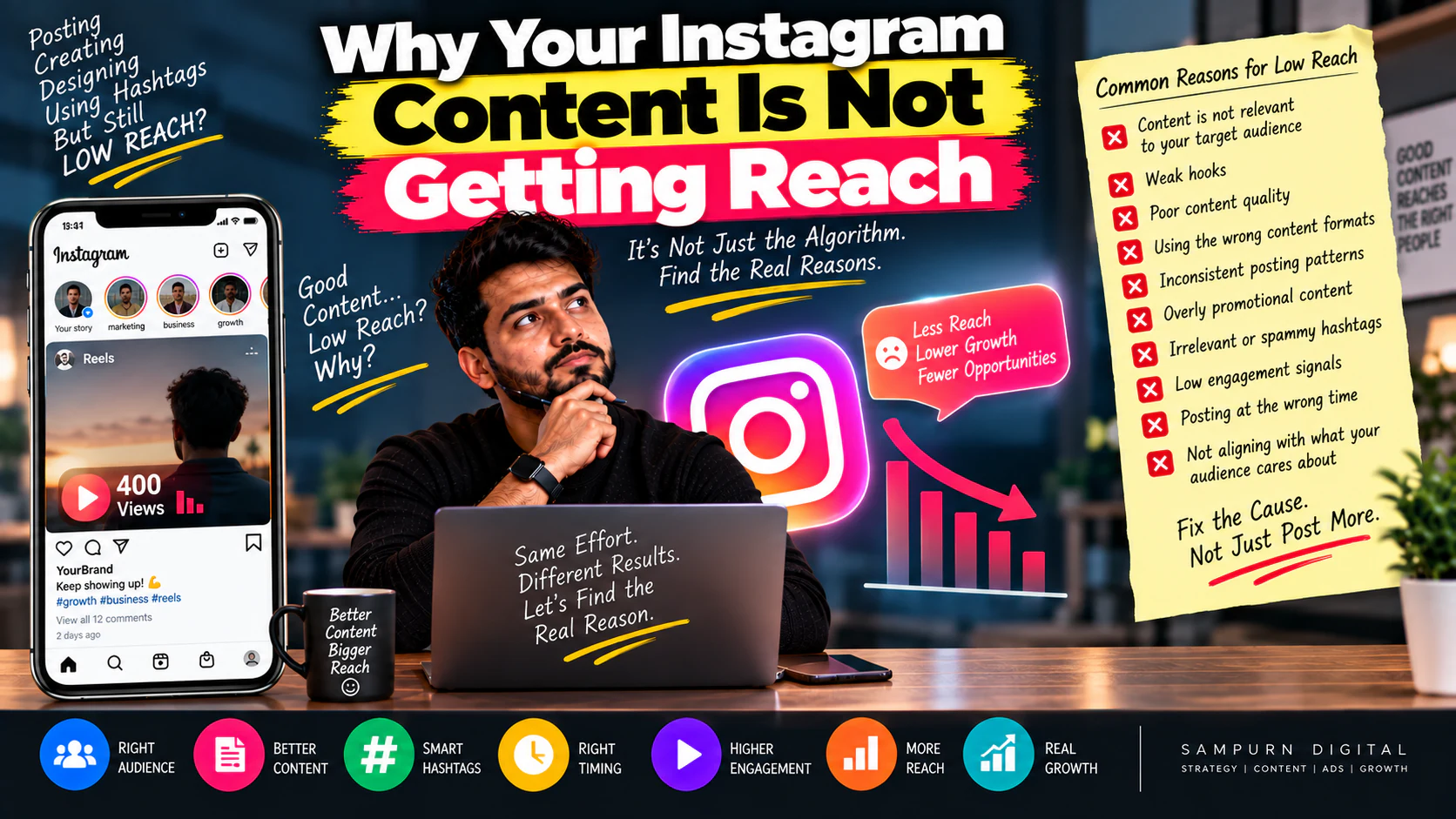
You publish consistently.
You create Reels.
You design carousels.
You write captions.
You use hashtags.
And yet your Instagram reach keeps disappointing you.
A post that took two hours to create gets 400 views.
A Reel that looked promising barely reaches your existing audience.
Then the team starts asking:
"Is Instagram suppressing our content?"
Sometimes the platform is not the real problem.
The bigger problem may be content relevance, audience fit, creative quality, distribution signals, or the type of content you're publishing.
Low reach is a symptom.
Your job is to find the cause.
This guide gives you a practical framework for diagnosing why your Instagram content is not getting reach—and what to fix before simply posting more.
First: Low Reach Does Not Automatically Mean Your Account Is Broken
Suppose your business has:
but a Reel reaches only:
It is tempting to conclude:
"Instagram isn't showing our content."
But that conclusion skips several important questions.
What happened with the 700 people?
- Did they watch?
- Did they scroll immediately?
- Did they watch most of the Reel?
- Did they share it?
- Did they save it?
- Did they visit your profile?
- Did they follow?
- Did they click?
- Did anyone enquire?
Reach is only the first layer.
A better diagnostic model is:
If you diagnose only reach, you may fix the wrong problem.
The Instagram Reach Diagnostic Framework
Before changing your content strategy, work through these seven areas:
- Audience
- Topic
- Hook
- Content quality
- Format
- Distribution
- Conversion
The important question is not:
"Why did this post get low reach?"
It is:
"At which stage did this content lose momentum?"
Your Content May Be Reaching the Wrong Audience
One of the most overlooked problems is audience mismatch.
Imagine a B2B software company creates a funny Reel that attracts 100,000 views.
Sounds great.
But most viewers are:
- Students
- Content creators
- Job seekers
- Other marketers
- General entertainment audiences
The Reel performs well.
The business doesn't.
That's not necessarily a successful content strategy.
Check Your Audience Fit
Look at your recent high-performing content.
Ask:
- Who engaged with it?
- Who followed because of it?
- Who commented?
- Who clicked?
- Who contacted you?
- Are these people potential customers?
Then compare that with your actual target audience.
A smaller audience of relevant buyers can be more valuable than a huge audience of people who will never purchase.
If you haven't clearly defined your audience beyond basic demographics, start there.
Your Topic May Not Be Interesting Enough
Sometimes the creative is fine.
The topic isn't.
Consider these two posts.
Post A
"5 Digital Marketing Tips"
Post B
"Why Your Ads Generate Leads That Your Sales Team Doesn't Want"
Both are about marketing.
But Post B contains a specific problem.
Specific problems create stronger reasons to pay attention.
Use the Customer Problem Test
Before publishing, ask:
If the answer is unclear, the topic probably needs refinement.
Instead of:
"Benefits of social media marketing"
try:
"Why Your Social Media Gets Views but Doesn't Generate Enquiries"
Instead of:
"Website design tips"
try:
"Why Visitors Leave Your Website Without Filling the Form"
The more specific the problem, the easier it becomes to create a useful piece of content.
Your Hook May Be Losing People
A strong idea can fail because the opening is weak.
This is particularly important for short-form video.
Imagine your Reel starts:
"Hello everyone. Today we are going to talk about five social media mistakes businesses make."
The viewer has little reason to stay.
Compare that with:
"If your Instagram gets views but zero enquiries, check these three things."
The second immediately establishes:
Build Hooks Around Four Elements
A practical hook can use:
Problem
"Your Instagram gets views but no leads."
Mistake
"Stop measuring your Instagram strategy by followers."
Curiosity
"The reason your best-looking posts may be underperforming."
Outcome
"How to turn social media attention into qualified enquiries."
You don't need to make every hook dramatic.
You need to make it relevant quickly.
Your Content May Be Too Generic
Generic content is one of the biggest reach problems for business accounts.
For example:
"Consistency is important on social media."
True.
Not particularly useful.
A stronger post might say:
"If you're publishing five times a week but repeating the same three topics, increasing posting frequency won't solve your reach problem. Audit your last 30 posts by topic before increasing volume."
Now the reader has:
- A specific problem
- A diagnostic action
- A useful idea
That's more valuable.
Add Specificity
Instead of:
"Create valuable content."
Explain:
Specificity turns advice into usable content.
Your Content Format May Not Match the Idea
Not every idea should become a Reel.
Not every idea should become a carousel.
Not every idea should be a static graphic.
Match the format to the job.
| Objective | Potential Format |
|---|---|
| Explain a process | Carousel |
| Demonstrate something | Reel/video |
| Share an opinion | Text-led post |
| Show transformation | Before/after |
| Tell a customer story | Video/carousel |
| Explain several steps | Carousel |
| Answer a quick question | Short video |
| Build trust | Case study |
The format doesn't rescue a weak idea.
But the wrong format can make a strong idea harder to consume.
Your First Visual May Be Weak
People often judge content before reading the caption.
For a carousel, the first slide matters.
For a Reel, the opening frame matters.
For a static post, the visual hierarchy matters.
Your first frame should help answer:
"Why should I spend the next few seconds on this?"
Weak:
Stronger:
Even better when appropriate:
The viewer immediately knows what they are getting.
Your Reels May Be Too Slow
If your Reel takes too long to reach the point, viewers may leave before the useful part begins.
Common problems:
- Long introductions
- Logo animation first
- Unnecessary greetings
- Repeating the title verbally
- Too much setup
- Slow transitions
- Excessive background footage
Try getting to the core idea faster.
Instead of:
"Hi guys, welcome back to another video. In today's video, we're going to discuss..."
Try:
"Your Reel isn't necessarily failing because of the algorithm. Here's what I would check first."
Then explain.
Your Content May Be Talking About Your Business Too Much
A business account naturally wants to promote itself.
But users don't open Instagram because they want to see advertisements all day.
Compare:
"We provide SEO services for businesses."
with:
"If your website ranks for traffic-heavy keywords but generates few enquiries, your keyword strategy may be attracting the wrong intent."
The second demonstrates expertise while solving a customer problem.
That creates a reason to follow the account.
Your Content Pillars May Be Too Narrow
If every post is about:
- Your service
- Your product
- Your offer
- Your company
- Your achievements
your feed can become repetitive.
Build multiple content pillars.
For example, a digital marketing company might use:
- Customer problems
- Educational content
- Practical frameworks
- Case studies
- Industry insights
- Common mistakes
- Service-related content
- Behind-the-scenes expertise
This gives the audience more reasons to return.
Your Content May Be Repetitive
Open your last 30 posts.
Write down the topic of each.
Then group them.
You might discover:
| Topic | Number of Posts |
|---|---|
| Marketing tips | 12 |
| Company updates | 7 |
| Services | 6 |
| Case studies | 2 |
| Customer problems | 2 |
| Industry insights | 1 |
You don't necessarily need more posts.
You need a better content distribution.
You're Measuring Individual Posts Instead of Patterns
One post can fail for many reasons.
Don't redesign your strategy because one Reel got low reach.
Instead, analyse:
Look for repeated patterns.
For example:
- Problem-led Reels consistently outperform generic tips.
- Case studies generate fewer views but more profile visits.
- Promotional posts get low reach.
- Educational carousels get high saves.
- Short videos outperform long videos.
That's actionable evidence.
Reach isn't only about views.
Ask:
"Would someone send this to another person?"
or:
"Would someone save this because they might need it later?"
Content that is genuinely useful often has stronger sharing or saving potential than content created purely for entertainment.
Examples:
- Checklist
- Framework
- Template
- Mistake list
- Comparison
- Step-by-step process
- Calculation
- Decision tree
Your Captions May Not Add Enough Value
The caption should not simply repeat what's already visible.
Use it to:
- Explain
- Add context
- Give an example
- Clarify the framework
- Address objections
- Provide next steps
For example, a carousel might explain what to check.
The caption can explain how to prioritise the findings.
Your Hashtag Strategy May Be Distracting You
Hashtags are often treated as the solution to poor reach.
They aren't a substitute for:
- Strong topics
- Good hooks
- Relevant audiences
- Useful content
- Strong creative
Don't spend hours changing hashtags while ignoring the actual content.
Treat hashtags as one distribution element—not your entire reach strategy.
Your Content May Be Too Promotional
Imagine your last 10 posts contain:
- 4 service promotions
- 3 product promotions
- 2 testimonials
- 1 educational post
The account is asking for attention without providing enough reasons to give it.
A stronger mix gives audiences value before asking them to buy.
Your CTA May Be Too Aggressive
Not every post needs:
"Book a call now."
For a cold audience, better CTAs may be:
- Save this checklist
- Follow for more practical insights
- Read the full guide
- Share this with your team
- Comment with your biggest challenge
Match the CTA to the user's level of intent.
You're Publishing for the Algorithm Instead of the Customer
This is a subtle trap.
You start thinking:
"What does Instagram want?"
instead of:
"What does my customer need?"
The algorithm can influence distribution.
But your content still needs to earn attention from humans.
Start with:
Then optimise distribution.
Your Posting Time May Not Be the Real Problem
Changing posting time from:
usually won't magically transform weak content into great content.
Timing can matter.
But don't use timing as the first explanation for consistently poor performance.
Test timing after you have confidence in:
- Audience
- Topic
- Creative
- Format
- Hook
Your Account May Have Weak Content Consistency
Consistency doesn't simply mean posting every day.
It means maintaining consistency in:
- Audience
- Topics
- Positioning
- Quality
- Content standards
If Monday's post targets CEOs, Tuesday targets students, Wednesday targets creators and Thursday targets consumers, your account can send mixed signals.
Consistency creates clearer positioning.
Your Content May Be Designed for Everyone
"Everyone" is rarely a useful social media audience.
Compare:
"Tips for businesses"
with:
"Lead-generation tips for Indian service businesses spending ₹50,000+ per month on digital marketing."
The second audience is much narrower.
That can be an advantage.
Check Whether Your Reach Problem Is Actually an Engagement Problem
Use this diagnostic.
Scenario A
Potential issue:
- Weak topic
- Weak hook
- Poor audience fit
- Weak creative
Scenario B
Potential issue:
- Content is being distributed but isn't resonating.
Scenario C
Potential issue:
- Weak CTA
- Weak profile
- Poor link journey
Scenario D
Potential issue:
- Landing page
- Offer
- Audience quality
- Conversion experience
Different symptoms require different fixes.
Audit Your Best Posts
Don't only study failures.
Take your top 10 posts.
For each, record:
- Topic
- Format
- Hook
- Length
- CTA
- Reach
- Shares
- Saves
- Comments
- Profile visits
- Clicks
- Leads
Then ask:
"What do these winners have in common?"
That's your evidence base.
Audit Your Worst Posts
Now do the same for your bottom 10.
Look for repeated patterns.
Maybe they all have:
- Generic hooks
- Promotional topics
- Weak first slides
- Long introductions
- No clear audience
- Similar formats
If the same problem appears repeatedly, it is no longer random.
Build a Content Performance Matrix
Use a simple matrix.
| Content Type | Reach | Engagement | Business Value | Decision |
|---|---|---|---|---|
| Problem-led Reels | High | High | High | Scale |
| Generic tips | Medium | Low | Low | Improve |
| Case studies | Low | Medium | High | Keep |
| Promotions | Low | Low | Medium | Rework |
| Tutorials | Medium | High | High | Scale |
This prevents you from killing content simply because it doesn't have the highest reach.
Separate Reach Winners From Business Winners
This is critical.
Suppose:
100,000 views ₹0 revenue
8,000 views 12 enquiries ₹2,40,000 revenue
Which one is more valuable?
The answer depends on your objective.
If your business goal is revenue, Reel B may be the better asset.
This is why a strong social strategy eventually connects content performance with business metrics.
What Should You Fix First?
Use this priority order.
Priority 1 — Audience
Are you speaking to the right people?
Priority 2 — Topic
Are you solving something they care about?
Priority 3 — Hook
Can they understand the value immediately?
Priority 4 — Creative
Is the content easy and interesting to consume?
Priority 5 — Format
Does the format suit the idea?
Priority 6 — Distribution
Are you giving the content opportunities to reach relevant audiences?
Priority 7 — Conversion
Can interested users take the next step?
Don't start with hashtags if your topic is irrelevant.
Don't redesign your logo if your hook is weak.
Don't increase posting frequency if your content strategy is broken.
A 30-Day Instagram Reach Recovery Plan
Week 1: Audit
Review the last 30–50 posts.
Identify:
- Top topics
- Weak topics
- Best formats
- Weak formats
- Best hooks
- Weak hooks
- Most shared posts
- Most saved posts
- Posts generating profile visits
Week 2: Rebuild
Choose:
- 3–5 content pillars
- 2–3 core formats
- 3 hook structures
- 2–3 CTA types
Create a repeatable system.
Week 3: Test
Run controlled tests.
For example:
Test 1: Problem hook vs curiosity hook
Test 2: Talking-head Reel vs carousel
Test 3: Educational CTA vs website CTA
Test 4: Short video vs longer explanation
Change one meaningful variable at a time.
Week 4: Analyse
Don't ask:
"Did our reach increase?"
Ask:
- Which topics improved?
- Which formats improved?
- Which hooks improved retention?
- Which posts generated shares?
- Which generated profile visits?
- Which generated clicks?
- Which generated leads?
Then build the next month's content around the evidence.
Instagram Reach Audit Checklist
Before publishing another batch of content, ask:
Audience
- Is this for our target customer?
- Does it address a real problem?
- Does our audience use this platform?
Topic
- Is the topic specific?
- Is it relevant?
- Does it provide a useful takeaway?
- Have we already covered it repeatedly?
Hook
- Is the first line strong?
- Is the first visual clear?
- Is the value obvious quickly?
Creative
- Is the design readable on mobile?
- Is the video easy to follow?
- Does the visual support the idea?
- Is there unnecessary content?
Engagement
- Would someone save this?
- Would someone share this?
- Is the CTA appropriate?
Business
- Does this support a business goal?
- Is there a logical next step?
- Can we measure the result?
When Should You Consider Paid Distribution?
Organic performance and paid distribution should not be treated as enemies.
A strong organic post can provide a useful creative signal.
For example:
- Publish educational content organically.
- Identify posts that attract relevant engagement.
- Turn strong concepts into paid creatives.
- Target appropriate audiences.
- Send traffic to the relevant conversion destination.
- Retarget interested users.
This creates a bridge between organic content and paid social.
But don't use advertising to permanently compensate for content that doesn't resonate.
When Low Reach Is Actually Fine
Not every post needs huge reach.
Suppose you sell a high-ticket B2B service.
Your ideal customer may be:
- 50 business owners
- 20 decision-makers
- 10 companies actively evaluating vendors
A niche post that reaches 3,000 relevant people may be far more valuable than an entertainment Reel reaching 300,000 irrelevant viewers.
For commercial accounts, relevance beats vanity.
The Real Instagram Reach Formula
Think of Instagram performance as a system:
×
×
×
×
×
×
If one major component is weak, overall performance can suffer.
That's why there isn't one universal "Instagram reach hack."
There is a system to diagnose.
SEO Publishing Information
| Field | Details |
|---|---|
| Blog ID | SMM-07 |
| Category | Social Media Marketing |
| Stage | Diagnose |
| Primary Keyword | why Instagram content is not getting reach |
| Supporting Keywords | Instagram reach problems; low Instagram reach; improve Instagram content performance |
| Search Intent | Problem Solving |
| Funnel Stage | Problem Aware |
| Pillar Page | Social Media Marketing Services |
| Suggested URL | `/blog/why-your-instagram-content-is-not-getting-reach` |
| Content Role | Diagnostic / problem-solving resource |
| Publishing Sprint | Sprint 4 |
| Primary CTA | Get a social media growth strategy |
| Secondary CTA | Explore Social Media Marketing |
| Meta Title | Why Your Instagram Content Is Not Getting Reach |
| Meta Description | Is your Instagram reach dropping? Diagnose low reach by checking your audience, topics, hooks, creative, formats, engagement and content strategy. |
| H1 | Why Your Instagram Content Is Not Getting Reach |
