
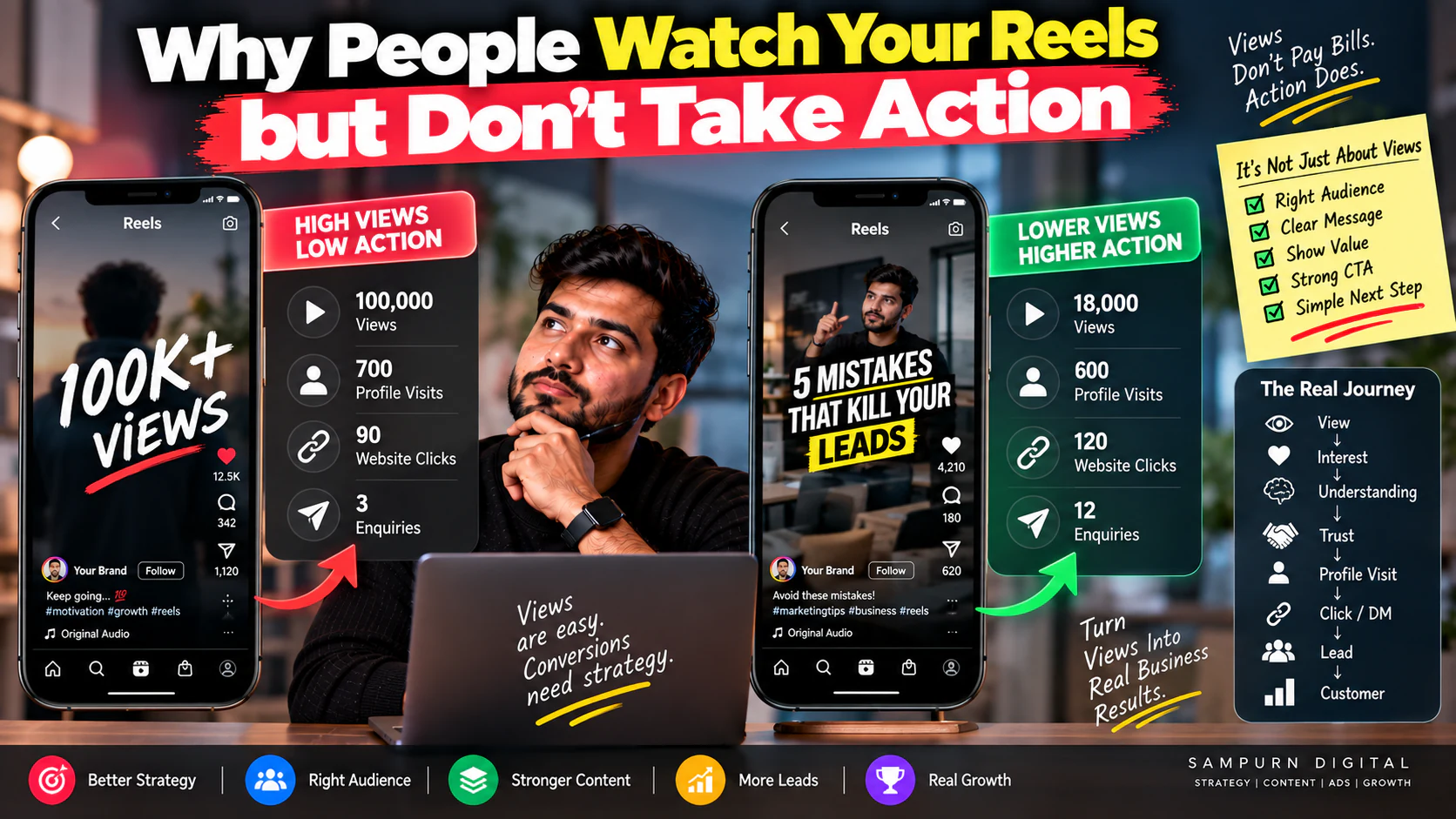
Your Reel gets 20,000 views.
Then 50,000.
Maybe one even crosses 100,000.
The team celebrates.
But when you check the actual business results:
- Few profile visits
- Almost no website clicks
- Very few DMs
- No meaningful enquiries
- No sales
That creates a frustrating question:
The problem usually isn't that your Reels are failing.
The problem is that views and conversion are two different outcomes.
A Reel can be excellent at getting attention while being terrible at moving someone toward a business decision.
The goal isn't simply to make people watch.
The goal is to create a journey:
If your Reels generate views but the journey stops after “View,” you have an attention problem disguised as a content success.
Let's diagnose where that journey is breaking.
Reels Get Views but No Leads: What Is Actually Happening?
Consider two businesses.
Business A
One Reel gets:
- 100,000 views
- 700 profile visits
- 90 website clicks
- 3 enquiries
Business B
One Reel gets:
- 18,000 views
- 600 profile visits
- 120 website clicks
- 12 enquiries
Which Reel performed better?
Business A looks impressive on Instagram.
Business B is much more valuable to the business.
That's the distinction between attention metrics and business metrics.
A view tells you that someone consumed part of your content.
It does not automatically tell you:
- They are your target customer
- They have the problem you solve
- They trust your business
- They understand your offer
- They want to buy
- They know what to do next
So instead of asking:
“How many views did this Reel get?”
start asking:
“What did the viewer do after watching?”
The Reel Conversion Funnel
A Reel normally has several stages between attention and revenue.
Stage 1: View
Someone sees the Reel.
Stage 2: Watch
They stay long enough to consume the message.
Stage 3: Understand
They recognize the problem, opportunity or insight you're presenting.
Stage 4: Trust
They begin believing that your business understands the problem.
Stage 5: Profile Visit
They want to know who created the content.
Stage 6: Click or DM
They take a measurable action.
Stage 7: Lead
They submit an enquiry, call, WhatsApp, form or other lead action.
Stage 8: Customer
The lead eventually becomes revenue.
Your Reel doesn't necessarily need to generate a lead directly.
But it should have a logical next step.
If the content creates curiosity but gives viewers nowhere meaningful to go, the funnel stops.
Your Reel Attracts the Wrong Audience
This is one of the biggest reasons for high views and low leads.
Imagine a digital marketing agency publishes:
“5 Instagram tricks that will instantly increase your followers.”
The Reel gets 80,000 views.
Most viewers are:
- Students
- New creators
- People looking for free tips
- Hobby accounts
- Other marketers
The agency's actual customers, however, are:
- Established businesses
- Founders
- Marketing managers
- E-commerce brands
- Service businesses
The Reel succeeded at generating attention.
But it attracted people who weren't likely to buy.
The lesson
Before creating a Reel, define:
Then create content specifically for that person.
Instead of:
“3 Instagram hacks everyone should know”
try:
“3 Instagram mistakes costing local businesses enquiries”
The second topic may attract fewer people.
But the people it attracts are more commercially relevant.
Your Hook Creates Curiosity but Not Buying Intent
A strong hook gets attention.
But attention alone isn't enough.
Consider:
“You won't believe what happened when we changed this button…”
This may create curiosity.
But what happens after the viewer watches?
They may enjoy the story and scroll away.
Now compare:
“Your website gets traffic but no enquiries? Check these 3 sections first.”
The second hook immediately identifies:
- A business problem
- A relevant audience
- A potential solution
This creates stronger problem relevance.
Your hook should therefore do more than stop the scroll.
It should attract the people who have a reason to care about your offer.
The Reel Solves the Problem but Doesn't Connect to Your Offer
This is extremely common.
A business publishes useful content.
The viewer learns something.
The Reel ends.
There is no connection between the lesson and the service.
For example:
Reel
“Here are five reasons your website isn't converting.”
Useful.
But then:
“Follow us for more tips.”
The business just spent money, effort and creative resources educating a potential customer — and then gave them a weak next step.
A better transition would be:
“If you're getting traffic but your website isn't generating enquiries, we can audit the conversion journey and identify where visitors are dropping off.”
Now the content connects naturally to the service.
The viewer understands:
Your CTA Is Missing
Some Reels simply end.
There is no:
- Follow
- Comment
- DM
- Website visit
- Download
- Booking
- Enquiry
- Next piece of content
The viewer therefore does what platforms train people to do:
Every Reel doesn't need a sales CTA.
But every Reel should have an appropriate next action.
Examples:
Cold audience
“Follow for practical growth strategies.”
Problem-aware audience
“Save this checklist before your next campaign.”
Warm audience
“DM ‘AUDIT’ and we'll show you what to check.”
High-intent audience
“Book a consultation to review your current funnel.”
The CTA should match the viewer's level of awareness.
Your CTA Is Too Aggressive for a Cold Audience
The opposite problem also happens.
A viewer sees your brand for the first time.
They watch a 20-second Reel.
Then you immediately say:
“Book a ₹50,000 strategy package today.”
That's a major jump.
The viewer may not know:
- Who you are
- Whether you understand their problem
- Whether you're credible
- What the service includes
- Whether you're worth the investment
A cold viewer often needs a smaller commitment first.
For example:
That's a more natural progression.
Your Reel Doesn't Build Enough Trust
Views create exposure.
They don't automatically create credibility.
A Reel explaining:
“Why Google Ads CPC is increasing”
may demonstrate knowledge.
But a Reel saying:
“We reduced wasted Google Ads spend by 31% after restructuring search terms and campaign intent”
adds something different:
Use trust-building elements such as:
- Case studies
- Before/after results
- Screenshots
- Client problems
- Process explanations
- Data
- Demonstrations
- Expert opinions
- Mistakes you've identified
- Real examples
You don't need to reveal confidential client information.
You can explain the problem, methodology and outcome without exposing sensitive details.
Your Profile Doesn't Continue the Journey
Imagine someone watches a Reel and thinks:
“This company actually understands my problem.”
They click your profile.
Then they see:
Bio: “Helping businesses grow online 🚀”
That's generic.
There is no clear answer to:
Your Reel has done its job.
Your profile has failed.
A conversion-focused profile should make the next decision easy.
For example:
Then provide an obvious next step.
Your Reel and profile should feel like one continuous experience, not two unrelated pieces of content.
The Landing Page Doesn't Match the Reel
This is another major conversion leak.
Suppose your Reel says:
“Get more qualified leads from Meta Ads.”
The viewer clicks your profile link.
They land on a generic homepage.
Now they have to figure out:
- Where to go
- What service you're talking about
- Whether you actually solve their problem
- How to contact you
Every extra decision creates friction.
The landing page should continue the promise made by the Reel.
For example:
Reel: “Meta Ads generating clicks but poor-quality leads?”
Landing page headline: “Generate Better-Quality Leads From Meta Ads”
The message feels connected.
That continuity matters.
For a deeper breakdown of what a conversion-focused page needs, see the guide on Landing Page Anatomy: What Every High-Converting Page Needs.
Your Audience Is Too Broad
A Reel about:
“How businesses should market online”
could theoretically appeal to everyone.
But that's exactly the problem.
It isn't particularly relevant to anyone.
Compare that with:
“How a ₹20 lakh/month D2C brand should split its Meta Ads budget.”
That's narrower.
But the viewer who fits that description is far more valuable.
Specificity often reduces raw reach while improving commercial relevance.
Don't optimize every Reel for maximum audience size.
Optimize some Reels for:
You're Optimizing for Views Instead of Qualified Actions
Suppose your content team has one KPI:
Naturally, they'll start creating content that produces views.
That could mean:
- Trending sounds
- Controversial hooks
- Entertainment
- Broad topics
- Celebrity references
- Generic tips
- Viral formats
Nothing is inherently wrong with those formats.
The problem occurs when they become the entire content strategy.
A business needs a mix of:
Reach content
Designed to attract new audiences.
Authority content
Designed to demonstrate expertise.
Trust content
Designed to reduce perceived risk.
Conversion content
Designed to create action.
If every Reel is a reach Reel, your account can become very popular without becoming commercially productive.
Your Content Encourages Passive Consumption
Some formats are extremely easy to consume.
People watch.
They laugh.
They nod.
Then they leave.
There is no reason to interact.
Compare:
“3 marketing mistakes businesses make.”
with:
“Which one of these three mistakes is costing your business leads? Comment 1, 2 or 3.”
The second creates participation.
Similarly, instead of:
“Here are five landing page tips.”
try:
“Check your landing page right now. If your headline doesn't clearly answer these three questions, fix it before spending more on ads.”
Now the content encourages an immediate action.
Your Offer Is Not Clear Enough
Sometimes the Reel is not the problem.
The offer is.
If someone watches ten of your Reels and still cannot explain:
your conversion problem is bigger than content.
Your audience should understand:
- What you offer
- Who it's for
- What problem it solves
- What outcome it supports
- Why your approach is different
- What they should do next
Content creates attention.
You Don't Have a Low-Friction Next Step
Not every viewer is ready to become a lead.
Give them intermediate actions.
For example:
This gives the audience multiple ways to progress.
Someone who isn't ready to buy today may still be willing to:
“Send me the checklist.”
That interaction can become the beginning of a sales journey.
Your Tracking Is Too Weak
If you only track views, you don't know where the funnel breaks.
At minimum, monitor:
- Views
- Watch time
- Completion rate
- Shares
- Saves
- Profile visits
- Link clicks
- DMs
- Leads
- Qualified leads
- Sales
Then calculate conversion rates.
Profile Visit Rate
Example:
1,000 profile visits ÷ 50,000 views × 100 \= 2%
Click Rate
Example:
100 clicks ÷ 1,000 profile visits × 100 \= 10%
Lead Conversion Rate
Example:
10 leads ÷ 100 clicks × 100 \= 10%
Qualified Lead Rate
Example:
6 qualified leads ÷ 10 leads × 100 \= 60%
Now you can diagnose the actual problem.
A Simple Reel Conversion Diagnostic
| What You See | Likely Problem |
|---|---|
| High views + low watch time | Weak opening or poor creative |
| High views + low profile visits | Weak relevance or curiosity |
| High profile visits + low clicks | Weak profile/offer |
| High clicks + low leads | Landing page or offer problem |
| High leads + poor lead quality | Audience targeting/content problem |
| High engagement + no commercial action | Content is entertaining but disconnected from buying intent |
| Low views + high lead rate | Content may be commercially strong but distribution is weak |
| High views + high leads | Strong content-to-offer alignment |
This is much more useful than simply saying:
“The Reel performed well.”
Don't Judge Every Reel by the Same KPI
Different Reels have different jobs.
A broad educational Reel may be designed to attract new people.
A case-study Reel may be designed to build trust.
A product demonstration may be designed to create demand.
A service Reel may be designed to generate enquiries.
Therefore, define the objective before publishing.
For example:
| Reel Type | Primary KPI |
|---|---|
| Awareness | Reach / qualified views |
| Educational | Saves / shares |
| Authority | Profile visits |
| Trust | Profile visits / website clicks |
| Offer | DMs / clicks |
| Conversion | Leads |
| Retargeting | Leads / sales |
This prevents your team from killing commercially useful content simply because it didn't go viral.
The Reel Conversion Framework
A practical business Reel can follow this structure:
Hook → Problem → Insight → Proof → Next Step
Hook
Stop the right person.
“Getting thousands of Reel views but no enquiries?”
Problem
Make the viewer recognize the issue.
“Your content may be optimized for attention instead of buyer intent.”
Insight
Explain why it happens.
“If your Reel attracts people interested in generic tips but your service is for established businesses, your reach can look impressive while your lead quality stays low.”
Proof
Demonstrate credibility.
“We've seen campaigns where reducing broad content and adding problem-specific content produced fewer views but significantly more relevant enquiries.”
Next Step
Tell them what to do.
“Audit your last 10 Reels. Don't just count views — check profile visits, clicks and leads.”
That's a complete content-to-action journey.
Example: Service Business Reel
Imagine you're a web development company.
Weak version
“5 website design trends you need to know in 2026.”
Potentially high reach.
But weak buying intent.
Better version
“Your website may look professional and still lose leads. Here are three things to check.”
Then:
- Is the headline clear?
- Is the CTA visible?
- Does the page answer the buyer's biggest objection?
Then:
“If your website gets traffic but doesn't generate enquiries, start by fixing these three areas.”
Now the Reel connects directly to a business problem.
Example: E-commerce Reel
Weak
“5 skincare products everyone needs.”
Broad audience.
Better
“If your skincare product gets clicks but customers don't add to cart, check these three things.”
Now the content is connected to:
The viewer has a business problem to solve.
Example: Local Business Reel
Imagine a premium dental clinic.
Weak
“Beautiful smile transformation 😍”
This may generate views.
Better
“Thinking about teeth whitening but worried about sensitivity? Here's what you should know before booking.”
This attracts people closer to the actual buying decision.
The Reel can then lead to:
Your Reel Should Match the Buyer's Awareness Level
A cold viewer doesn't need the same message as someone who has already visited your website.
Cold audience
Focus on:
- Problems
- Education
- Industry insights
- Mistakes
- Myths
CTA:
Warm audience
Focus on:
- Case studies
- Comparisons
- Processes
- Results
- Objections
CTA:
Hot audience
Focus on:
- Offers
- Pricing logic
- Results
- FAQs
- Service explanations
CTA:
This is where content strategy and paid retargeting can work together.
For a deeper look at moving audiences through cold, warm and retargeting stages, see Meta Ads Funnel Structure: Cold, Warm and Retargeting Audiences.
How to Fix Reels That Get Views but No Leads
Don't immediately delete the content.
Diagnose it.
Identify the audience
Ask:
Is the audience commercially relevant?
Check the hook
Does the opening attract:
buyers, or simply viewers?
Check the message
Does the Reel connect to a real problem your business solves?
Check the CTA
Is there a clear next step?
Check the profile
Does the profile explain:
- Who you help
- What you offer
- Why you're credible
- What to do next?
Check the landing page
Does the page continue the promise made by the Reel?
Check the offer
Would the viewer understand what they receive by taking action?
Check lead quality
Don't celebrate ten leads if nine are irrelevant.
A better KPI may be:
rather than:
A Better Way to Compare Reels
Imagine you have these results:
| Metric | Reel A | Reel B |
|---|---|---|
| Views | 100,000 | 20,000 |
| Profile Visits | 500 | 800 |
| Website Clicks | 50 | 160 |
| Leads | 2 | 12 |
| Qualified Leads | 1 | 8 |
Reel A looks like the winner if you're focused on reach.
But Reel B generated:
- More profile visits
- More clicks
- More leads
- More qualified leads
This is why content performance must be judged against business intent.
Build a Reel Content Portfolio
You don't need every Reel to sell.
A stronger strategy might look like:
40% Reach
Attract new audiences.
30% Authority
Show expertise.
20% Trust
Show proof and credibility.
10% Conversion
Create direct commercial actions.
The exact percentages can change by business and funnel stage.
The important principle is:
Test Creative Without Guessing
If your Reels consistently generate attention but weak action, don't randomly change everything.
Test one variable at a time:
- Hook
- Topic
- Opening visual
- Video length
- CTA
- Proof
- Offer
- Audience
- Format
For example:
Version A
“3 reasons your Instagram isn't generating leads.”
Version B
“Your Instagram might be attracting the wrong customers.”
Same general problem.
Different angle.
Track what changes.
For a more structured approach to testing creative rather than relying on assumptions, use the framework in How to Run Paid Ad Creative Testing Without Guessing.
A 30-Day Reel Conversion Improvement Plan
Week 1: Diagnose
Review your last 20 Reels.
Record:
- Views
- Watch time
- Shares
- Saves
- Profile visits
- Clicks
- DMs
- Leads
Identify your biggest drop-off.
Week 2: Fix the Message
Create Reels around:
- Customer problems
- Buying objections
- Specific use cases
- Common mistakes
- Before/after scenarios
- Case studies
Reduce generic content.
Week 3: Improve the Journey
Fix:
- Bio
- Profile CTA
- Link destination
- Landing page
- Lead form
- DM process
Make the journey from Reel to enquiry obvious.
Week 4: Test and Scale
Compare:
- High-view vs low-view content
- High-lead vs low-lead content
- Broad vs specific topics
- Educational vs commercial content
- Different CTAs
Then create more of the combinations producing qualified actions.
The 10-Point Reel Conversion Checklist
Before publishing, ask:
- Who is this Reel for?
- What specific problem does it address?
- Does the hook attract the right audience?
- Does the content demonstrate useful expertise?
- Is there a clear connection to our offer?
- Does the Reel build trust or proof?
- Is the CTA appropriate for the audience stage?
- Does the profile continue the message?
- Does the landing page continue the promise?
- Can we measure what happens after the view?
If you can't answer these questions, don't automatically publish more Reels.
Fix the funnel first.
The Real Goal Isn't More Reel Views
A Reel with 500,000 views sounds impressive.
But if those views produce zero business opportunities, the number can become a vanity metric.
Meanwhile, a Reel with 10,000 highly relevant views might generate:
- 300 profile visits
- 70 website clicks
- 12 enquiries
- 7 qualified leads
- 2 customers
That Reel may be dramatically more valuable.
So stop asking only:
“How many people watched?”
Start asking:
“How many relevant people moved one step closer to becoming customers?”
That's the difference between social content that gets attention and social content that supports business growth.
SEO Publishing Information
| Field | Details |
|---|---|
| Blog ID | SMM-09 |
| Category | Social Media Marketing |
| Stage | Diagnose |
| Primary Keyword | Reels get views but no leads |
| Supporting Keywords | Instagram Reels not converting; video views no leads; social content conversion |
| Search Intent | Problem Solving |
| Funnel Stage | Solution Aware |
| Pillar Page | Social Media Marketing Services |
| Suggested URL | `/blog/social-media-marketing/why-people-watch-your-reels-but-dont-take-action` |
| Content Role | Diagnostic / problem-solving resource |
| Publishing Sprint | Sprint 4 |
| CTA | Get a social media growth strategy / Explore Social Media Marketing |
| H1 | Why People Watch Your Reels but Don't Take Action |
| Meta Title | Why People Watch Your Reels but Don't Take Action |
| Meta Description | Learn why your Reels get views but no leads. Discover practical ways to improve audience quality, CTAs, profiles, landing pages and social conversions. |
