
A business starts posting on Instagram.
The team publishes three Reels every week.
They create carousels.
They post stories.
They gain followers.
Then, after three months, someone asks:
“So… how many customers did social media actually generate?”
Nobody has a clear answer.
This is one of the biggest problems with social media marketing for businesses.
The expectations are often wrong from the beginning.
Some businesses expect social media to generate immediate sales.
Others only track followers and likes.
Some expect one viral Reel to transform the business.
And others keep posting for months without knowing what success should look like.
The reality is more useful:
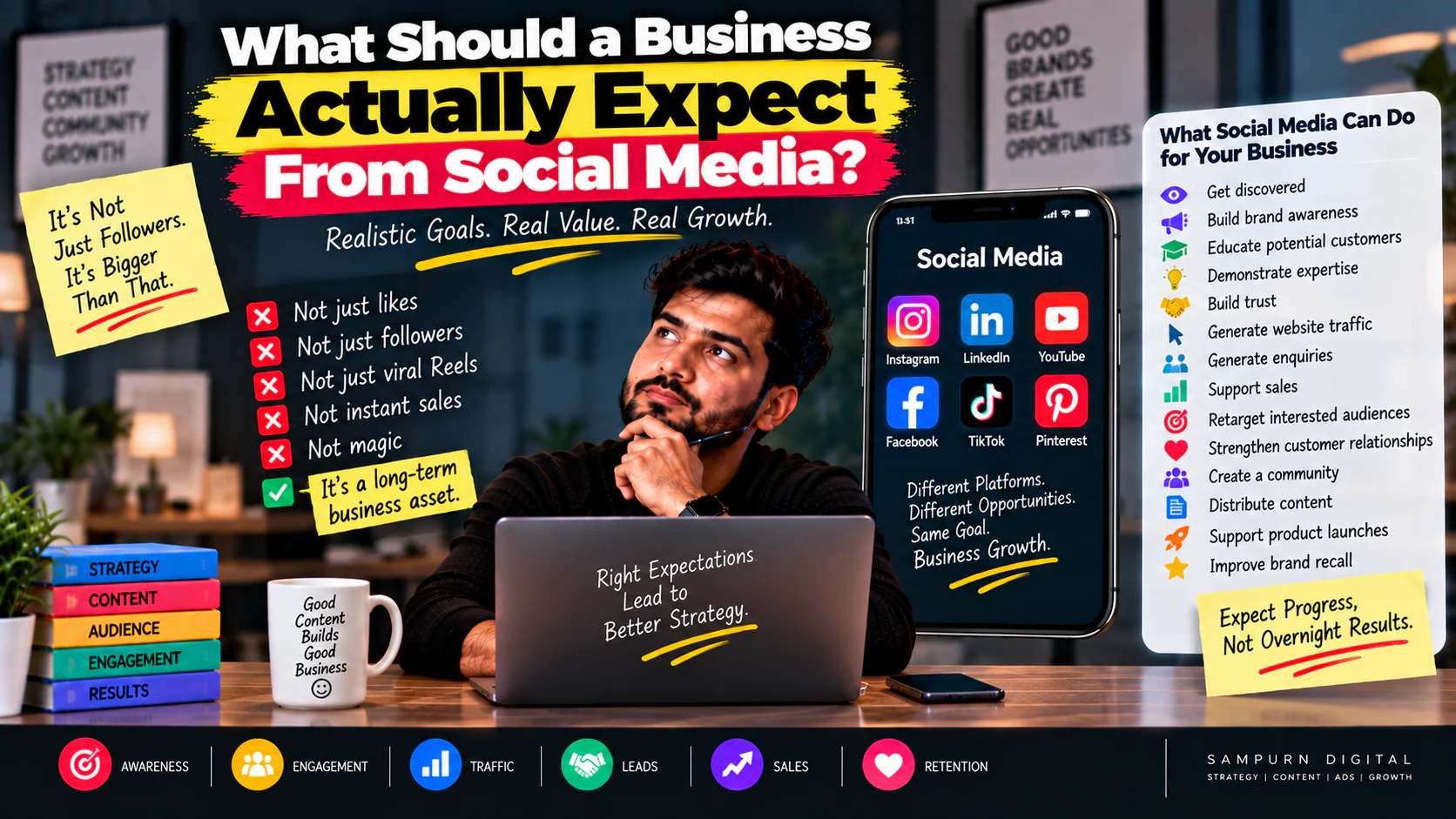
Social media can support awareness, trust, consideration, lead generation, sales and retention—but the expected result depends on your business model, audience, offer, content strategy and measurement system.
The right question isn't:
It is:
What Should Social Media Do for a Business?
Social media can perform several different jobs.
It can help you:
- Get discovered
- Build brand awareness
- Educate potential customers
- Demonstrate expertise
- Build trust
- Generate website traffic
- Generate enquiries
- Support sales
- Retarget interested audiences
- Strengthen customer relationships
- Create a community
- Distribute content
- Support product launches
- Improve brand recall
The important point is that not every account needs to achieve all of these simultaneously.
A B2B software company and a fashion e-commerce brand should not have identical social media goals.
The First Expectation to Set: Social Media Is Not One Thing
When someone says:
“We want social media to grow our business.”
that is too broad.
Grow what?
- Brand awareness?
- Followers?
- Website traffic?
- Leads?
- Sales?
- Revenue?
- Repeat purchases?
You need to define the outcome first.
A useful hierarchy is:
Different social strategies operate at different points in this journey.
Stage 1: Awareness
At the top of the funnel, people may not know your company exists.
Your objective is discovery.
Typical metrics include:
- Reach
- Impressions
- Video views
- Follower growth
- Brand searches
- Content distribution
For example, a new skincare brand may use educational Reels to introduce:
- Skin problems
- Ingredients
- Routines
- Product categories
The immediate result may not be a purchase.
The person may simply remember the brand.
That still has value.
Stage 2: Engagement
Now people start interacting with your content.
They may:
- Like
- Comment
- Save
- Share
- Follow
- Visit your profile
- Watch more videos
Engagement can be useful because it tells you whether the content is creating interest.
But engagement is still not the same as revenue.
A post with 1,000 likes can produce zero customers.
A post with 100 likes can produce five highly relevant enquiries.
So engagement should be interpreted in context.
Stage 3: Consideration
At this stage, the audience starts evaluating your business.
They may:
- Visit your website
- Read your content
- Watch case studies
- Compare solutions
- Send a DM
- Check reviews
- Explore your services
- Follow your account for several months
This is especially important for higher-consideration purchases.
For example:
A company looking for a digital marketing agency may not contact the agency after the first Reel.
They may first:
- Watch a Reel
- Visit the profile
- Read several posts
- Visit the website
- Read a case study
- Compare agencies
- Return through search or direct traffic
- Finally submit an enquiry
Social media influenced the journey even if the final conversion wasn't a social-platform click.
Stage 4: Conversion
Now the audience is ready to act.
Possible conversions include:
- Purchase
- Enquiry
- Demo request
- Consultation
- Booking
- WhatsApp message
- Phone call
- Lead form
- Registration
This is where social media becomes directly measurable as a lead or sales channel.
But conversion performance depends on more than content.
It also depends on:
- Offer
- Pricing
- Landing page
- Trust
- CTA
- Product
- Sales process
- Audience quality
Stage 5: Revenue
Ultimately, businesses need revenue.
A useful measurement chain is:
If your reporting stops at “reach,” you're measuring only the beginning of the journey.
What Should You Expect in the First 30 Days?
The first month should usually focus more on learning and establishing a baseline than demanding a dramatic business transformation.
You should expect to learn:
- Which topics attract attention
- Which formats perform
- Which hooks work
- Which audience segments respond
- Which content gets saved
- Which content gets shared
- Which posts drive profile visits
- Which posts drive website traffic
- Which CTAs generate action
You are building evidence.
For a new account, the first 30 days can be more valuable as a learning period than as a pure sales period.
What About 60–90 Days?
After enough content has been published, patterns should become clearer.
You should start identifying:
Content Winners
Topics and formats consistently producing strong results.
Audience Winners
Segments showing stronger engagement or conversion intent.
Business Winners
Content that produces meaningful actions such as:
- Enquiries
- Website visits
- DMs
- Leads
- Sales
Now the strategy can become more deliberate.
Instead of asking:
“What should we post this week?”
you can ask:
“Which proven topics should we expand?”
Don't Expect Every Post to Generate Leads
This is an unrealistic expectation.
Consider a simple content portfolio.
Post A — Educational
“5 mistakes businesses make when choosing a digital marketing agency.”
Goal:
Post B — Case Study
“How we improved qualified leads for a service business.”
Goal:
Post C — Service Post
“Need help improving your paid campaigns?”
Goal:
All three have a role.
If you judge all three only by leads generated that day, you're likely to eliminate useful top-of-funnel content.
A Better Social Media Content Mix
A business account can balance several content categories.
| Content Type | Main Purpose |
|---|---|
| Educational | Awareness + authority |
| Problem-solving | Relevance |
| Case studies | Proof |
| Testimonials | Trust |
| Behind-the-scenes | Brand connection |
| Industry insights | Authority |
| Product/service education | Consideration |
| Offers | Conversion |
| Customer content | Community |
| FAQs | Objection handling |
The exact mix depends on the business.
But the principle is simple:
Your content portfolio should support the entire customer journey.
What Should You Expect From Followers?
Followers can be useful.
But don't make follower growth the primary business objective unless audience growth itself is the goal.
Imagine:
Account A
100,000 followers 0.5% relevant audience 2 customers/month
Account B
8,000 followers 25% relevant audience 20 customers/month
Account B has a much smaller audience but potentially much stronger commercial value.
The question isn't:
“How many followers do we have?”
It is:
“How valuable is the audience we're building?”
What Is a Good Engagement Rate?
There is no single engagement rate that automatically means your social media is successful.
Why?
Because performance varies by:
- Platform
- Industry
- Audience size
- Content type
- Format
- Distribution
- Account maturity
- Campaign objective
Instead of chasing a universal benchmark, compare your account against its own historical performance.
For example:
Last quarter:
This quarter:
That's a useful improvement.
But if engagement rose while qualified enquiries fell, you still need to investigate.
What Should You Expect From Organic Social Media?
Organic social media generally works best as a compounding channel.
You create useful content.
That content attracts people.
Some follow.
Some share.
Some return.
Your library grows.
Your authority grows.
Your audience becomes more familiar with your brand.
Over time, your content can continue generating discovery and trust.
This is different from paid advertising, where traffic generally depends on continued media spending.
That doesn't mean organic social is “free.”
It requires:
- Strategy
- People
- Creative production
- Design
- Video
- Management
- Analysis
- Time
So the real cost is your content-production investment.
Organic Social vs Immediate Sales
Suppose you publish 100 useful posts over a year.
Some may produce:
- 100 views
- 500 views
- 5,000 views
- 50,000 views
But the larger asset is the content library.
A potential customer discovering your company today may browse:
- Your educational posts
- Your case studies
- Your testimonials
- Your FAQs
- Your service explanations
The content created months ago can still contribute to the decision.
That is one reason consistency matters.
What Should You Expect From Paid Social?
Paid social works differently.
You can put money behind:
- Awareness
- Traffic
- Leads
- Sales
- Retargeting
- Product promotion
Paid social can generate faster traffic than organic content, but faster traffic does not automatically mean profitable growth.
You still need:
- Strong creative
- Correct audience
- Relevant offer
- Good landing page
- Accurate tracking
- Conversion optimization
For businesses combining organic content with paid acquisition, the two systems can reinforce each other.
For example:
Social Media Is Not a Substitute for a Good Offer
This is important.
If your product is poorly positioned, social media won't magically fix it.
If your service has no clear differentiation, posting more won't solve the problem.
If your website is difficult to use, social traffic won't automatically convert.
If your sales team takes three days to respond to a lead, social media cannot control that part of the journey.
Marketing performance is interconnected.
Your Website Matters
Imagine your Reel performs well.
10,000 people see it.
500 visit your profile.
100 click your website.
Then they land on a confusing homepage.
There is:
- No clear headline
- No obvious CTA
- Poor mobile experience
- No proof
- Slow loading
- No relevant offer
The social strategy generated interest.
The website lost it.
This is why your conversion-focused website architecture matters when social media is expected to generate leads.
Social media and your website should be designed as connected parts of the customer journey.
What Should a Local Business Expect?
A local business may have different goals from a national brand.
For a restaurant, social media might support:
- Discovery
- Menu awareness
- Offers
- Reservations
- Reviews
- Local community
- Repeat visits
For a dentist:
- Education
- Trust
- Expertise
- Consultation enquiries
- Reviews
For a real estate company:
- Property discovery
- Market education
- Buyer confidence
- Enquiries
- Site visits
The right KPI depends on what the business actually sells.
What Should a B2B Business Expect?
B2B businesses often have longer buying cycles.
A person may see your LinkedIn post today and become a customer six months later.
That doesn't mean the social post had no value.
Social media may contribute to:
- Brand familiarity
- Authority
- Trust
- Thought leadership
- Employee advocacy
- Website discovery
- Sales enablement
- Demand generation
For B2B, judging social media only on immediate last-click conversions can understate its contribution.
But that doesn't mean measurement should be abandoned.
It means you need a more complete attribution approach.
What Should an E-commerce Business Expect?
E-commerce can often connect social activity to direct commercial actions more quickly.
Potential metrics include:
- Product page visits
- Add to carts
- Checkout starts
- Purchases
- Revenue
- ROAS
- Customer acquisition cost
- Repeat purchase rate
For example:
A product Reel may generate:
10,000 views → 500 profile visits → 100 product visits → 15 purchases.
Now the content has a measurable commercial journey.
The Difference Between Content Performance and Business Performance
This distinction is critical.
Content Performance
Ask:
“Did people like the content?”
Metrics:
- Views
- Likes
- Shares
- Saves
- Comments
Business Performance
Ask:
“Did this activity contribute to business growth?”
Metrics:
- Leads
- Qualified leads
- Customers
- Revenue
- CAC
- ROI
You need to understand both.
Don't Throw Away High-Value Content Because It Has Low Reach
Some content is valuable precisely because it targets a narrow audience.
A post about:
“How manufacturers should evaluate industrial ERP software”
may never achieve the reach of:
“10 productivity hacks.”
But if one ERP buyer discovers your company through that post and becomes a ₹10 lakh customer, the content may be commercially valuable.
This is why audience quality beats vanity reach.
What Should You Expect From Social Media Leads?
Not every lead should be treated equally.
Suppose you generate:
100 social media leads.
After qualification:
30 are relevant.
After sales conversations:
10 are genuine opportunities.
After closing:
3 become customers.
Now your real funnel is:
If you only report:
“We generated 100 leads.”
you are missing most of the story.
Track the full journey.
Use Business Metrics That Match Your Goal
A useful framework:
Awareness Goal
Track:
- Reach
- Impressions
- Video views
- Brand searches
Engagement Goal
Track:
- Saves
- Shares
- Comments
- Engagement rate
Traffic Goal
Track:
- Profile visits
- Website clicks
- Landing-page sessions
Lead Goal
Track:
- Leads
- Cost per lead
- Qualified leads
- Cost per qualified lead
Sales Goal
Track:
- Customers
- Revenue
- CAC
- ROAS/ROI
Don't use a sales KPI for an awareness campaign—or an awareness KPI as proof of revenue.
How Long Does Social Media Take to Work?
There is no universal timeline.
Results depend on:
- Starting audience
- Industry
- Competition
- Content quality
- Posting consistency
- Offer
- Distribution
- Paid support
- Sales cycle
- Website
- Conversion process
However, businesses should generally think in learning cycles, not overnight transformations.
A practical approach is:
Month 1
Establish content themes, baseline metrics and audience signals.
Months 2–3
Double down on successful topics and improve weak areas.
Months 3–6
Expand proven content, distribution and conversion pathways.
The exact timeline will vary.
The important principle is to avoid judging an entire strategy from a handful of posts.
The “One Viral Post” Problem
One viral post creates a dangerous expectation.
The team sees:
and assumes:
“We've figured it out.”
Then the next ten posts get:
- 8,000
- 12,000
- 5,000
- 9,000
- 15,000
The team thinks the strategy failed.
But social media performance naturally fluctuates.
Instead of asking:
“Can we go viral again?”
ask:
“Can we repeatedly produce relevant content that contributes to our goals?”
Consistency beats dependence on one viral event.
What Should a Monthly Social Media Report Include?
A useful report should contain more than follower growth.
Section 1 — Audience
- Followers
- Reach
- Audience growth
- Audience quality
Section 2 — Content
- Top posts
- Top formats
- Top topics
- Shares
- Saves
- Engagement
Section 3 — Intent
- Profile visits
- Website clicks
- DMs
- Calls
- Enquiries
Section 4 — Business
- Leads
- Qualified leads
- Customers
- Revenue
- CAC/ROI where measurable
Section 5 — Learnings
Explain:
- What worked
- What failed
- Why
- What should change next month
The final section is often the most valuable.
A Practical Social Media Goal-Setting Framework
Use this five-step process.
Define the Business Goal
Example:
Generate 30 qualified enquiries per month.
Define the Social Role
Example:
Use social media to create awareness, demonstrate expertise and generate qualified website traffic.
Define Content Objectives
Example:
- 40% educational
- 25% authority/proof
- 20% engagement
- 15% conversion
Define KPIs
Primary:
Secondary:
- Profile visits
- Website clicks
- Saves
- Shares
- Reach
Review Monthly
Ask:
What content contributed most to the desired outcome?
Then improve the strategy.
What Should You Stop Expecting From Social Media?
Stop expecting:
Every post to go viral
It won't.
Every follower to become a customer
They won't.
High engagement to guarantee sales
It doesn't.
Organic content to produce instant results
Usually not.
One platform to solve every marketing problem
It won't.
More posts to automatically produce more revenue
Volume alone isn't strategy.
Followers to equal business growth
They don't.
Instead, expect social media to become a strategic channel with a measurable role in your customer journey.
The Social Media Expectation Matrix
Use this when setting goals.
| Business Situation | Primary Social Goal | Key Metrics |
|---|---|---|
| New brand | Awareness | Reach, views, searches |
| Established brand | Authority | Saves, shares, profile activity |
| Service business | Lead generation | Enquiries, qualified leads |
| E-commerce | Sales | Purchases, revenue, CAC |
| B2B | Demand generation | Engagement, traffic, leads |
| Local business | Discovery + enquiries | Calls, visits, bookings |
| Community-led brand | Community | Comments, UGC, retention |
This immediately makes social media goals more realistic.
A Better Way to Ask “Is Social Media Working?”
Don't ask only:
“Did followers increase?”
Ask these seven questions:
- Are we reaching the right audience?
- Are people engaging with useful content?
- Are more people visiting our profile?
- Are they taking meaningful actions?
- Are we generating qualified leads or purchases?
- Are those leads becoming customers?
- Is the channel contributing economically to the business?
If the answer to several of these is yes, social media may be working even if follower growth isn't spectacular.
The Social Media Growth Loop
A mature social strategy follows a continuous loop:
Then repeat.
The analytics aren't there just to create reports.
They're there to improve the next decision.
Your 90-Day Social Media Plan
If you are starting or rebuilding your strategy, use this structure.
Days 1–30: Establish
Focus on:
- Audience research
- Positioning
- Content pillars
- Profile optimization
- Baseline metrics
- Consistent publishing
Don't obsess over scale yet.
Days 31–60: Identify
Find:
- Winning topics
- Winning formats
- Winning hooks
- Winning CTAs
- High-quality audience signals
- High-intent content
Start producing more variations of what works.
Days 61–90: Optimize
Focus on:
- Conversion paths
- Website experience
- Lead generation
- Retargeting
- Paid amplification
- Content repurposing
- Better measurement
Now you should have enough evidence to make more confident decisions.
SEO Publishing Information
Blog ID: SMM-02 Category: Social Media Marketing Stage: Understand Content Role: Education + problem awareness Publishing Sprint: Sprint 4
Primary Keyword: social media marketing expectations for business
Supporting Keywords: social media goals for business; realistic social media results; social media ROI expectations
Search Intent: Informational
Funnel Stage: Problem Aware
Pillar Page: Social Media Marketing Services
Suggested URL: `/blog/social-media-marketing/what-should-a-business-actually-expect-from-social-media`
Meta Title: What Should a Business Actually Expect From Social Media? | Sampurn Digital
Meta Description: Learn what a business should actually expect from social media with a practical framework for goals, content, engagement, leads, sales, ROI and realistic growth.
H1: What Should a Business Actually Expect From Social Media?
Primary CTA: Get a social media growth strategy / Explore Social Media Marketing
