
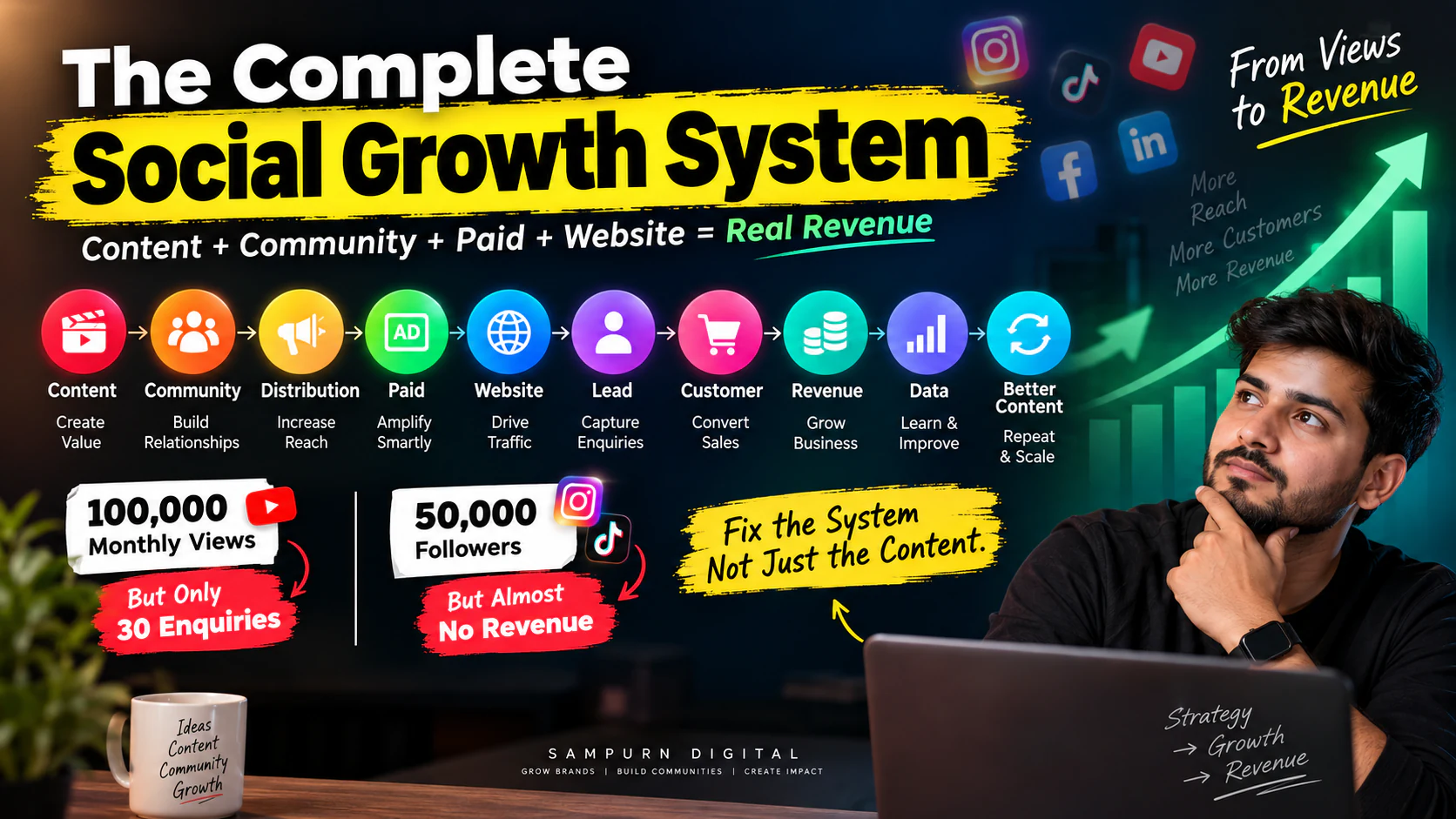
Most businesses don't have a social media problem.
They have a social media system problem.
They post consistently.
They run Reels.
They boost some posts.
They reply to comments.
They occasionally run Meta Ads.
They send people to their website.
But these activities often operate separately.
The content team wants reach.
The community manager wants engagement.
The paid team wants cheap clicks.
The website team wants conversions.
The business owner wants revenue.
And nobody is looking at the complete journey.
That's why a business can have:
but only:
but almost no measurable revenue from social.
The solution isn't necessarily “post more.”
The solution is to build a social growth system where every major component has a defined job:
This is the complete social growth system.
What Is a Social Growth System?
A social growth system is the connected process through which social media creates business value.
It combines four major components:
Content
Creates attention and communicates expertise.
Community
Turns attention into relationships and trust.
Paid
Expands distribution and accelerates proven content.
Website
Turns qualified attention into measurable business action.
Underneath all four sits:
Without that layer, you don't have a growth system.
You have disconnected marketing activities.
The Four-Part Social Growth Model
Think of the system like this:
Then the loop starts again.
This is much more powerful than:
“We need 30 Instagram posts this month.”
Start With the Business Goal
Before building a social strategy, define the business outcome.
Possible goals:
- Brand awareness
- Qualified traffic
- Leads
- Sales
- App installs
- Store visits
- Enquiries
- Community growth
- Customer retention
Your goal changes your social strategy.
For example:
Goal: Awareness
Prioritize:
- Reach
- Video views
- Audience growth
- Brand recall
Goal: Lead generation
Prioritize:
- Qualified traffic
- Landing-page conversion
- Leads
- CPL
- Lead quality
Goal: E-commerce revenue
Prioritize:
- Product discovery
- Add-to-cart
- Purchase
- CPA
- ROAS
- Customer value
Don't start with the platform.
Start with the business objective.
Social Media Is Not the Funnel
This is one of the most important concepts.
Your social profile isn't the entire customer journey.
A typical journey might be:
Social media is one part of the system.
The website is another.
Paid distribution is another.
Sales follow-up is another.
If one part breaks, overall performance suffers.
Build the System Around Customer Intent
Your audience isn't at the same stage.
Some people:
Others:
Others:
Others:
Others:
Your content should reflect these stages.
The Social Content Funnel
A practical structure:
TOFU — Attention
Content:
- Reels
- Short videos
- Opinions
- Educational posts
- Industry insights
Objective:
MOFU — Trust
Content:
- Case studies
- Tutorials
- Frameworks
- FAQs
- Behind-the-scenes
- Customer stories
Objective:
BOFU — Action
Content:
- Offers
- Service explainers
- Product demonstrations
- Testimonials
- Comparisons
- Consultation CTAs
Objective:
Not every post needs to sell.
But every content system needs a path toward the business goal.
Content Is the Fuel
A social growth system starts with useful content.
But useful doesn't mean:
“Post motivational quotes every Monday.”
Your content should answer:
Create around:
Problems
“What is going wrong?”
Questions
“What does the customer want to know?”
Objections
“Why aren't they buying?”
Desires
“What outcome do they want?”
Proof
“Why should they believe you?”
Decisions
“How should they choose?”
These categories generate commercially useful content.
Build Content Pillars
Choose 4–6 recurring content pillars.
For a digital marketing agency, for example:
Pillar 1 — Education
SEO, Ads, Social, Web
Pillar 2 — Diagnostics
Why campaigns fail.
Pillar 3 — Proof
Results and case studies.
Pillar 4 — Strategy
Frameworks and decision-making.
Pillar 5 — Brand
People, process and philosophy.
Pillar 6 — Conversion
Services, audits and consultations.
Now the team isn't guessing what to publish every day.
Build Around One Core Topic
One strong business topic can generate many assets.
Example:
Create:
- 1 blog
- 3 Reels
- 1 carousel
- 2 LinkedIn posts
- 1 Story sequence
- 1 checklist
- 1 email
- 1 paid ad
That's a content engine.
Not:
This approach also connects naturally with a broader social + SEO content engine, where search insights and social performance continuously inform each other.
Build Content for Different Jobs
Not every post should chase the same metric.
Reach content
Designed to be discovered.
Save content
Designed to be useful later.
Share content
Designed to be passed to someone else.
Conversation content
Designed to generate comments or DMs.
Conversion content
Designed to generate action.
This gives your content portfolio balance.
Community Is the Missing Layer
Many businesses think social media means:
But the audience is talking back.
Comments contain:
- Questions
- Objections
- Buying signals
- Product feedback
- Competitor comparisons
- Content ideas
Your community isn't just something to “manage.”
It's a source of business intelligence.
Build a Community Response System
Create response categories.
Category 1 — Information
“What's the price?”
Category 2 — Problem
“I'm facing this issue.”
Category 3 — Buying signal
“How can I get this?”
Category 4 — Objection
“Is this actually worth it?”
Category 5 — Negative feedback
“This didn't work for me.”
This turns community management into a structured process.
Track More Than Comments
Community quality can be measured through:
- Meaningful comments
- DMs
- Questions
- Product enquiries
- Profile visits
- Mentions
- Saves
- Shares
- Repeat interactions
- Leads generated from conversations
A post with 300 comments isn't automatically better than a post with 30.
The quality of those interactions matters.
Use Community Insights to Create Content
Suppose you receive 15 DMs asking:
“How much should I spend on Google Ads?”
That's not merely customer support.
It's content research.
Create:
Reel: “How much should a small business spend on Google Ads?”
Carousel: “₹20K vs ₹50K vs ₹1L ad budgets”
Blog: “How to Plan a Google Ads Budget”
Now community activity feeds the content engine.
Paid Social Is the Distribution Accelerator
Organic content has a major advantage:
Paid social has another:
Don't treat paid and organic as completely separate systems.
Use organic content to generate signals.
Then identify strong performers.
Then test whether paid amplification can produce business results.
Organic vs Paid: Different Jobs
Organic
Useful for:
- Trust
- Community
- Brand personality
- Testing ideas
- Consistent visibility
Paid
Useful for:
- Reach at scale
- Audience targeting
- Retargeting
- Lead generation
- Product promotion
- Accelerating proven creatives
The strongest systems often use both.
Don't Boost Everything
A common mistake:
“This post got good engagement. Let's boost it.”
Instead ask:
Was it:
- Strong hook?
- Strong topic?
- Relevant audience?
- Emotional reaction?
- High commercial intent?
- Strong offer?
Then decide whether the asset is appropriate for paid distribution.
Organic success is a signal.
It is not an automatic reason to spend money.
Build a Paid Amplification Pipeline
Use:
This reduces the risk of paying to distribute weak creative.
For the broader paid system, connect this process with your complete paid growth system: ads + landing pages + tracking + CRO.
Build the Website as the Conversion Layer
Your social profile isn't always the best place to close a sale.
For meaningful conversion actions, your website should make the next step obvious.
For example:
A beautiful website isn't enough.
The destination must be relevant to the traffic source.
Don't Send Every Click to the Homepage
Suppose your Reel is about:
Sending visitors to:
creates unnecessary friction.
A better destination may be:
with:
- Clear headline
- Problem
- Audit benefits
- Process
- Proof
- FAQs
- CTA
Your social content creates the expectation.
Your landing page should continue the conversation.
Website Conversion Rate Matters
Suppose paid and organic social generate:
Your website generates:
Conversion rate:
Now improve the page to:
The same traffic could generate:
You doubled leads without doubling traffic.
That's why social growth cannot be evaluated separately from website conversion.
A conversion-ready lead generation website architecture can become a major multiplier for social traffic.
Build the Complete Social Journey
A strong system looks like:
But it doesn't always happen in that order.
Someone might:
See Reel
Visit website
Leave
See retargeting ad
Read case study
Return
Submit enquiry
The system needs to support multiple journeys.
Add Retargeting
Not everyone converts on the first interaction.
Build audiences where appropriate around:
- Website visitors
- Video viewers
- Social engagers
- Profile visitors
- Lead-form interactions
- Product viewers
Then change the message.
Don't show the same awareness content to someone who has already visited your pricing page.
Move the user forward.
Use Message Progression
Cold audience
Problem:
“Why are your ads getting clicks but no customers?”
Warm audience
Education:
“Here are the 5 reasons this happens.”
Hot audience
Proof:
“Here's how we fixed the funnel.”
Conversion
Offer:
“Request a paid marketing audit.”
The audience should experience progression, not repetition.
Build a Content → Paid → Website Loop
This is one of the most important operating loops.
Step 1
Publish organic content.
Step 2
Measure response.
Step 3
Identify strong topics/hooks.
Step 4
Create paid variations.
Step 5
Send qualified traffic to the right destination.
Step 6
Measure conversions.
Step 7
Use results to improve the next content.
This creates compounding learning.
Track the Right Metrics
A social growth system needs metrics at multiple levels.
Attention
- Reach
- Impressions
- Video views
- Watch time
Engagement
- Saves
- Shares
- Comments
- Engagement rate
Intent
- Profile visits
- Website clicks
- DMs
- Product views
Conversion
- Leads
- Purchases
- Bookings
- Qualified leads
Business
- Revenue
- CAC
- ROAS
- Customer value
Don't stop at followers.
Build a Social ROI Model
Suppose:
Social-generated revenue:
Social marketing cost:
Basic return:
But separate:
- Organic contribution
- Paid contribution
- Assisted conversions
- Direct conversions
This gives a more realistic view of performance.
Measure Lead Quality
Suppose social produces:
But only:
Your headline CPL might look fantastic.
But the actual qualified CPL is:
If spend \= ₹50,000:
This is much more useful for a service business than simply reporting:
Create a Social Growth Dashboard
Track weekly:
| Area | Metric |
|---|---|
| Audience | Followers |
| Reach | Total reach |
| Content | Top posts |
| Video | Watch time |
| Engagement | Saves + shares |
| Intent | Profile visits |
| Traffic | Website clicks |
| Leads | Total leads |
| Quality | Qualified leads |
| Sales | Customers |
| Revenue | Attributed revenue |
| Paid | Spend |
| Efficiency | CPL / CAC / ROAS |
Then add:
and
That makes the dashboard useful.
Don't Measure Every Platform the Same Way
Instagram may be strongest for:
LinkedIn may be strongest for:
Facebook may be useful for:
YouTube may be useful for:
The metric should reflect the platform's job.
Don't compare:
as if they represent the same business outcome.
Choose Platforms Based on Business Fit
Before expanding channels, answer:
- Is our audience there?
- Can we create native content for it?
- Does the platform support our objective?
- Can we maintain consistency?
- Can we measure business outcomes?
If the answer is no, another platform may not help.
Choosing the right social platform is a strategic decision—not a popularity contest.
Build a Content Production Workflow
A growth system needs operational consistency.
Use:
Every asset should have:
- Owner
- Deadline
- Status
- Objective
- CTA
- Format
- Tracking
- Performance result
This prevents social media from becoming a daily emergency.
Build a Weekly Operating Rhythm
Monday
Performance review.
Tuesday
Content planning.
Wednesday
Production.
Thursday
Editing and approvals.
Friday
Publishing + analysis.
Daily
Community monitoring.
The exact schedule can change.
The principle is:
Create a Content Scorecard
For each asset, track:
Content
Topic
Hook
Opening message
Format
Reel / carousel / post
Reach
Distribution
Engagement
Saves / shares / comments
Intent
Clicks / DMs
Conversion
Leads / sales
Learning
What should we repeat?
This creates an internal content intelligence database.
Build a Winner Library
Every month, save:
Best hooks
Which openings worked?
Best topics
Which problems resonated?
Best formats
Reel? Carousel? Post?
Best CTAs
Which actions generated response?
Best offers
Which propositions converted?
Best audiences
Which audience segments produced quality?
Over time, your team stops starting from zero.
Build a Testing Framework
Don't change five things at once.
Test:
Hook
A vs B
Format
Reel vs carousel
CTA
“Read the guide” vs “Request an audit”
Offer
Free checklist vs consultation
Audience
Broad vs niche
Then measure.
If everything changes simultaneously, you won't know what caused the improvement.
Use a Simple Experiment Log
| Test | Hypothesis | Result | Decision |
|---|---|---|---|
| Hook A vs B | B creates more watch time | B wins | Use B |
| Reel vs carousel | Reel creates more reach | Reel wins | Increase Reels |
| CTA A vs B | B creates more leads | B wins | Keep B |
| Broad vs niche | Niche produces better leads | Niche wins | Increase niche audience |
Now testing becomes institutional knowledge.
Connect Organic Content to Paid Creative Testing
Suppose you have:
After measurement:
- 5 are strong
- 10 are average
- 5 are weak
Don't put all 20 into paid campaigns.
Start with the five strong candidates.
Then create variations:
- New opening
- Different headline
- Different CTA
- Shorter edit
- Testimonial version
This creates a pipeline from organic learning to paid acquisition.
Build Community Into the Funnel
Community shouldn't be a separate department.
For example:
A user comments:
“Does this work for small businesses?”
Your response:
User visits website
Reads article
Returns later
Requests consultation
The community interaction became part of the acquisition journey.
Use Social Proof Everywhere
Strong social proof can come from:
- Customer testimonials
- Case studies
- Screenshots
- Reviews
- Before/after results
- Expert opinions
- User-generated content
- Client stories
Don't simply say:
“We are experts.”
Show evidence.
Build a Proof Content Pillar
For example:
Monday
Educational Reel
Tuesday
Customer result
Wednesday
Founder insight
Thursday
How-to carousel
Friday
Case study
Now the audience sees:
rather than endless promotional posts.
Use Customer Stories as Content
Instead of saying:
“Our website service is excellent.”
Tell a story:
The business relied mostly on referrals.
The website generated little enquiry volume.
The website structure and conversion journey were improved.
More relevant enquiries.
Traffic wasn't the only problem.
This is more persuasive because it demonstrates the process.
Build a Social-to-Search Loop
Someone discovers your brand on Instagram.
Later they search your company.
Or they see a problem-solving Reel and search the topic on Google.
That means social can create demand that later appears as:
- Branded searches
- Organic searches
- Direct visits
- Returning users
Your channels don't operate in isolation.
They influence each other.
Build a Search-to-Social Loop
The reverse also happens.
You discover through SEO that customers are searching:
Create:
- SEO article
- Reel
- Carousel
- LinkedIn post
- FAQ
- Service-page section
Now search demand informs social content.
This is why an integrated social + SEO content strategy is more scalable than separate editorial calendars.
Build a Content Distribution Matrix
| Asset | Organic Social | Paid | Website | Search |
|---|---|---|---|---|
| Reel | ✓ | ✓ | — | — |
| Blog | ✓ | — | ✓ | ✓ |
| Case study | ✓ | ✓ | ✓ | ✓ |
| Carousel | ✓ | ✓ | — | — |
| Lead magnet | ✓ | ✓ | ✓ | — |
| Service page | ✓ | ✓ | ✓ | ✓ |
Not every asset belongs everywhere.
Use the appropriate distribution channel for the job.
Build the System Around One Core Message
Your brand shouldn't sound completely different on every channel.
Define:
Positioning
What do we stand for?
Audience
Who do we serve?
Problem
What do we solve?
Promise
What outcome do we create?
Proof
Why should customers believe us?
Personality
How do we communicate?
Then adapt the presentation for each platform.
Build a Social Growth Funnel for a Service Business
Here's a practical example.
Stage 1 — Discovery
Reel:
Stage 2 — Education
Carousel:
Stage 3 — Website
Blog:
Stage 4 — Retargeting
Ad:
Now social, paid, content and website work as one system.
Build a Social Growth Funnel for E-commerce
Product page
Retargeting
Testimonials
Offer
Purchase
Retention
UGC
New content
The customer becomes part of the next content cycle.
That's how growth can compound.
Build a Local Business Social System
Suppose you're promoting a local business.
Prioritize:
- Local creators
- Location-based content
- Customer stories
- Google Business visibility
- Local offers
- Community engagement
- WhatsApp enquiries
- Local landing pages
The objective isn't millions of views.
It may be:
instead of:
Relevance wins.
Create a 90-Day Social Growth Roadmap
Month 1 — Foundation
Build:
- Audience definition
- Platform strategy
- Content pillars
- Tracking
- Website destinations
- Dashboard
Goal:
Month 2 — Optimization
Test:
- Hooks
- Formats
- CTAs
- Topics
- Audiences
Goal:
Month 3 — Scale
Increase:
- Winning content
- Paid amplification
- Retargeting
- Creator partnerships
- Conversion optimization
Goal:
What to Fix First When Results Are Weak
Use this diagnostic order.
Problem 1: Low reach
Check:
- Platform fit
- Content quality
- Hooks
- Publishing consistency
Problem 2: Good reach, low engagement
Check:
- Topic relevance
- Content usefulness
- Audience fit
Problem 3: Good engagement, low clicks
Check:
- CTA
- Offer
- Profile
- Message clarity
Problem 4: Good clicks, low leads
Check:
- Landing page
- Form
- Offer
- Page-message match
Problem 5: Good leads, poor sales
Check:
- Lead quality
- Sales follow-up
- Pricing
- Offer
- Qualification
Don't solve a reach problem with more landing-page optimization.
Diagnose the actual bottleneck.
The Social Growth Equation
A useful mental model:
× Trust
× Distribution
× Conversion
× Measurement
If one factor approaches zero, the overall system suffers.
For example:
Amazing content × strong community × weak website conversion \= weak business result.
Great website × massive paid budget × irrelevant audience \= expensive traffic.
Growth requires the system to work together.
Build a Weekly Social Growth Review
Every week ask:
Content
What performed best?
Audience
Who responded?
Community
What questions appeared?
Paid
Which creatives produced quality results?
Website
Where did users drop?
Conversion
How many qualified leads were generated?
Revenue
What business result can we attribute or reasonably connect?
Learning
What should we do more of?
Decision
What should we stop doing?
This is where the system becomes operational.
The 12-Metric Executive Scorecard
For leadership, keep it simple.
Track:
- Reach
- Engagement
- Video watch time
- Saves
- Shares
- Profile visits
- Website clicks
- Leads
- Qualified leads
- Customers
- Revenue
- Acquisition cost
Then add:
That's far more useful than a 50-page social report nobody reads.
What a Mature Social Growth System Looks Like
At maturity, the business has:
Strategy
Clear audience and objectives.
Content
Repeatable content pillars.
Community
Structured engagement and feedback.
Paid
Controlled amplification and acquisition.
Website
Conversion-ready destinations.
Tracking
Reliable attribution.
Analytics
Weekly decision-making.
Testing
Continuous experimentation.
Production
Repeatable workflows.
Scale
Budget and effort move toward proven winners.
That's the difference between:
and:
The Complete Social Growth System
Put everything together:
BUSINESS GOAL
What are we trying to achieve?
AUDIENCE
Who are we trying to influence?
CONTENT
What should they learn, feel or believe?
COMMUNITY
How do we build relationships?
ORGANIC DISTRIBUTION
How do we create consistent visibility?
PAID DISTRIBUTION
Which proven ideas deserve additional reach?
WEBSITE
Where should interested users go?
CONVERSION
What action should they take?
SALES
How are leads converted?
ANALYTICS
What happened?
LEARNING
Why did it happen?
OPTIMIZATION
What should we change?
SCALE
Where should we increase investment?
Then repeat.
The Complete Social Growth Checklist
Strategy
- Business objective defined
- Audience defined
- Customer problems documented
- Funnel stages mapped
- Platforms selected
Content
- Content pillars defined
- Core topics identified
- Hooks tested
- Formats tested
- CTAs mapped
Community
- Response process defined
- DMs monitored
- Questions captured
- Buying signals tracked
- Feedback converted into content ideas
Paid
- Organic winners identified
- Paid tests structured
- Audiences defined
- Retargeting configured
- Creative testing running
Website
- Social traffic has relevant destinations
- Landing pages are conversion-ready
- CTAs are clear
- Forms work
- Tracking is configured
Measurement
- Reach tracked
- Engagement tracked
- Traffic tracked
- Leads tracked
- Qualified leads tracked
- Sales tracked
- Revenue tracked
Optimization
- Weekly review exists
- Winners documented
- Tests documented
- Weak content diagnosed
- Budget shifted toward proven opportunities
