
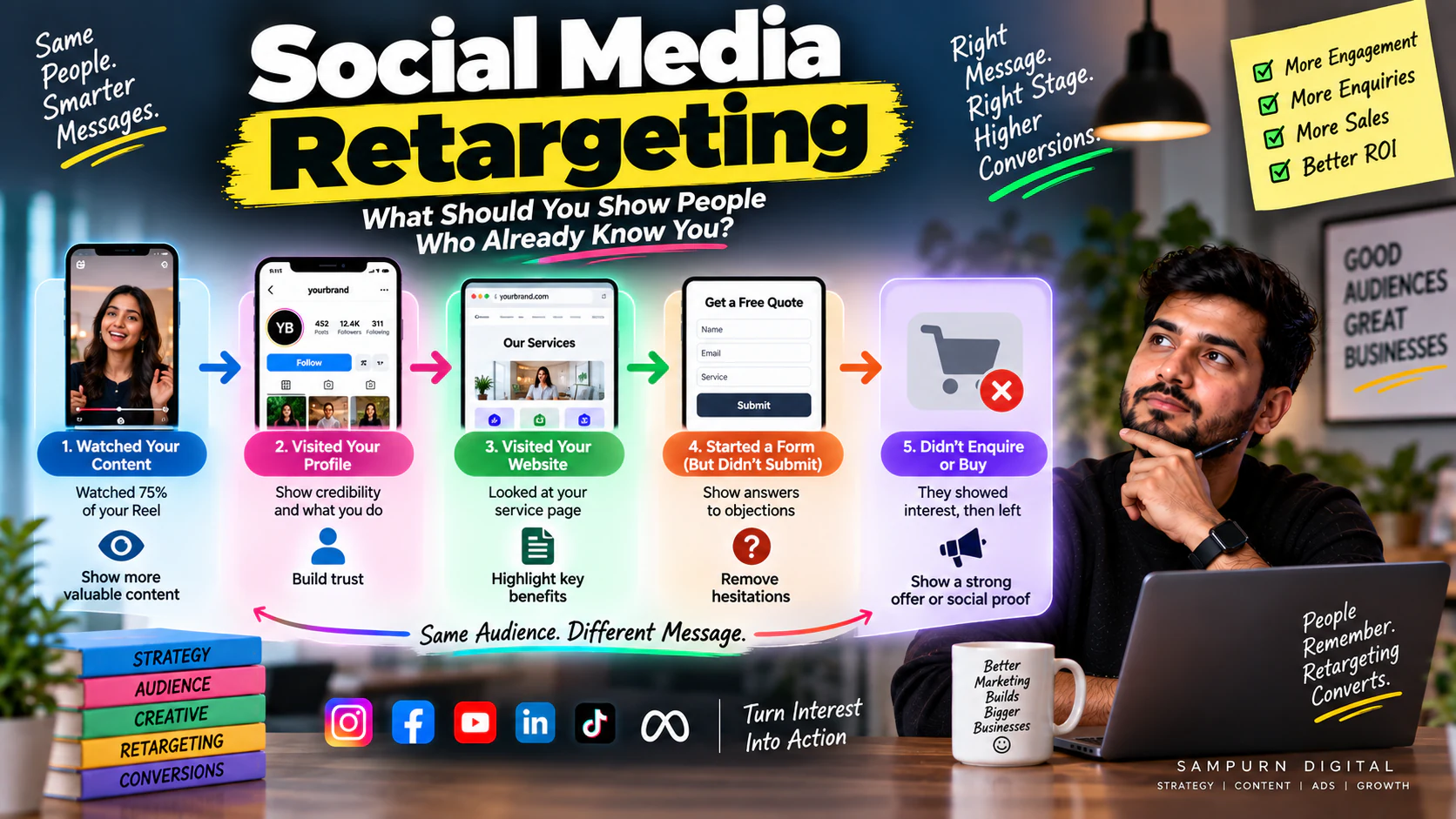
Someone watches 75% of your Reel.
They visit your Instagram profile.
Then they visit your website.
Maybe they even look at your service page.
And then…
Nothing.
They don't enquire.
They don't buy.
They disappear.
This is where social media retargeting becomes valuable.
The mistake is assuming that because someone has already interacted with your brand, you should simply show them the same ad again.
You shouldn't.
A person who has never heard of your business needs a reason to pay attention.
A person who has already watched your content may need proof.
Someone who visited your service page may need an answer to one final objection.
Someone who started a form but didn't submit may need a completely different message.
This guide explains how to build that system.
What Is Social Media Retargeting?
Social media retargeting means showing advertising messages to people who have already interacted with your brand, content, website, products, or other measurable touchpoints.
Instead of treating everyone as a completely new prospect, you use previous behavior to determine what message they should see next.
For example:
Saw your Reel.
Watched several Reels.
Visited your service page.
Submitted an enquiry.
This is the basic principle:
The more someone knows about you, the less you should spend your ad space explaining who you are.
Why Retargeting Is Different From Cold Advertising
Cold audiences have little or no previous relationship with your brand.
Your message might need to answer:
- Who are you?
- What problem do you solve?
- Why should I care?
- Is this relevant to me?
Retargeting audiences may already know the answers.
Their questions are different:
- Can I trust you?
- Will this work for my situation?
- How much does it cost?
- What makes you different?
- What happens next?
- Is it worth taking action now?
That means your creative should evolve.
Cold audience
Warm audience
Hot audience
That is the foundation of an effective social retargeting funnel.
Not Everyone Who Knows You Is Equally Valuable
This is one of the most important concepts.
Someone who watched two seconds of a Reel is not equivalent to someone who:
- Watched multiple videos
- Visited your profile
- Clicked your website
- Read a service page
- Viewed pricing
- Started a form
- Added a product to cart
- Requested information
They have different levels of intent.
So don't create one giant audience called:
Instead, segment users by behavior.
A Practical Social Retargeting Audience Ladder
Think of your audience like this:
Level 1 — Light Awareness
People who:
- Saw your content
- Watched part of a video
- Engaged with a post
Their mindset
"I've seen this brand."
Best message
Problem awareness and useful education.
Level 2 — Engaged Audience
People who:
- Watched a significant portion of videos
- Saved content
- Shared content
- Followed the account
- Frequently interacted
Their mindset
"This brand seems relevant."
Best message
Expertise, proof and useful insights.
Level 3 — Website Visitors
People who visited your:
- Homepage
- Blog
- Service pages
- Product pages
Their mindset
"I'm researching."
Best message
Benefits, proof, comparison and differentiation.
Level 4 — High-Intent Visitors
People who visited:
- Pricing
- Contact
- Service details
- Product detail
- Booking pages
Their mindset
"I'm seriously considering this."
Best message
Objection handling, case studies, guarantees where applicable and strong CTAs.
Level 5 — Conversion Attempts
People who:
- Started a form
- Started checkout
- Added a product to cart
- Requested information
- Took another high-intent action
Their mindset
"I was close, but something stopped me."
Best message
Remove friction.
Answer objections.
Make the next step easier.
What Should You Show Each Audience?
Here's a simple framework.
| Audience | What They Know | What To Show |
|---|---|---|
| Content viewers | Your content | More useful problem-solving content |
| Engagers | Your brand + topic | Expertise + proof |
| Website visitors | Your business | Benefits + differentiation |
| Service-page visitors | Your offer | Case studies + objections |
| Form starters | Your offer + intent | Friction removal + strong CTA |
| Existing leads | Your business | Follow-up / nurture |
| Customers | Your business deeply | Retention + cross-sell |
This is far better than showing everyone the same "Contact Us" advertisement.
Retargeting Is About Moving People Forward
A good retargeting campaign answers:
What does this person need to see next?
Suppose someone watched a Reel about:
Don't immediately show:
"Hire us today."
Instead, move them forward.
That is a journey.
The Biggest Retargeting Mistake: Showing the Same Message Again
Imagine someone has already watched three of your videos.
Your next ad says:
"Did you know we provide digital marketing services?"
They already know.
You're wasting valuable attention.
Instead:
First interaction
Second interaction
Third interaction
Fourth interaction
Fifth interaction
The message should become progressively more commercially specific.
Build Retargeting Around User Intent
One of the simplest ways to plan your campaigns is to ask:
Then determine the next message.
Watched content
Show:
Engaged repeatedly
Show:
Visited website
Show:
Visited service page
Show:
Visited contact page
Show:
Started form
Show:
This creates behavioral continuity.
Retargeting Creative #1: Educational Content
Educational retargeting is useful when the audience knows your brand but is not ready to buy.
Example:
"Before increasing your ad budget, check these three numbers."
Then explain:
- Conversion rate
- Cost per qualified lead
- Lead-to-sale rate
The goal is not necessarily immediate conversion.
The goal is to increase confidence.
Retargeting Creative #2: Case Studies
Once someone understands the problem, proof becomes more important.
A good case-study ad can follow:
For example:
"A service business was generating leads from Meta Ads but struggling with lead quality. We changed the audience structure, creative messaging and landing-page journey."
Then explain what changed.
Avoid making the case study only about impressive numbers.
Show the reasoning.
That helps prospects understand how your expertise applies to their situation.
Retargeting Creative #3: Objection Handling
A prospect may already want your service but still have concerns.
Common objections include:
- "Is this right for my business?"
- "How much will this cost?"
- "How long will it take?"
- "Will I get quality leads?"
- "Can I trust the agency?"
- "What exactly do you do?"
- "What happens after I enquire?"
Create retargeting ads specifically around these questions.
For example:
"Wondering what actually happens after you hire a digital marketing agency?"
Then explain:
- Audit
- Strategy
- Implementation
- Measurement
- Optimization
- Reporting
Reducing uncertainty can be more valuable than repeating benefits.
Retargeting Creative #4: Comparison Content
Some prospects are evaluating alternatives.
You can create content such as:
- Agency vs freelancer
- Organic vs paid
- Google Ads vs Meta Ads
- Traffic vs lead generation
- Cheap leads vs qualified leads
- One-off campaign vs ongoing optimization
The goal isn't to attack competitors.
The goal is to help the prospect make a better decision.
This is especially useful for solution-aware audiences.
Retargeting Creative #5: Offer-Focused Ads
For high-intent audiences, the message can become more direct.
For example:
"If you've already reviewed our paid advertising resources and want to know what's holding your campaigns back, request a performance marketing audit."
Now the CTA makes sense because the person has already received educational content.
Retargeting Creative #6: Social Proof
Use:
- Testimonials
- Reviews
- Client stories
- Before/after examples
- Screenshots where appropriate
- Results
- Process proof
- Expertise
But don't make every retargeting ad:
"We are the best agency."
Instead, demonstrate why someone should trust you.
Build a Message Ladder
A useful retargeting structure is:
Stage 1
"You may be losing leads after they click your ad."
Stage 2
"Here are three reasons landing pages fail."
Stage 3
"Here's how we structure a conversion-focused landing page."
Stage 4
"Here's how the framework was applied."
Stage 5
"Get your landing page reviewed."
The audience moves from:
Frequency Matters
Retargeting has one major risk:
If the same person sees the same creative repeatedly, performance can deteriorate.
Watch:
- Frequency
- CTR
- CPC
- Conversion rate
- Negative feedback
- Drop in engagement
If frequency rises while response falls, consider:
- Expanding the audience
- Shortening the retargeting window
- Adding new creatives
- Changing the message
- Moving high-intent users into a different campaign
Retargeting should feel relevant—not stalker-like.
Retargeting Windows Should Match the Buying Cycle
There is no universal "best" retargeting window.
It depends on how quickly your customers make decisions.
Fast purchase
Shorter windows may make sense.
High-ticket service
A longer consideration period may be normal.
For example, someone buying a ₹999 product may decide quickly.
Someone considering a ₹2,00,000 annual marketing engagement may need weeks of research.
Your retargeting strategy should reflect that difference.
Example: A Service Business Retargeting Funnel
Imagine a digital marketing agency.
A prospect watches a Reel about SEO.
Day 1–7
Show:
Day 8–14
Show:
Day 15–30
Show:
High-intent behavior
Show:
This creates a logical sequence.
The exact timing should depend on audience size, buying cycle and campaign economics.
Example: E-commerce Retargeting Funnel
Imagine an online fashion store.
A user:
The messaging should change.
Product viewer
Show:
- Product benefits
- Styling ideas
- Reviews
Cart abandoner
Show:
- Product reminder
- Objection handling
- Shipping information
- Relevant offer if commercially justified
The second audience has much stronger purchase intent.
So it deserves a different campaign.
Don't Retarget Everyone Forever
Another common mistake is allowing audiences to remain in retargeting indefinitely.
If someone interacted with your business six months ago, their intent may no longer be meaningful.
Use exclusions and appropriate windows.
For example:
can receive stronger conversion messaging.
can receive broader consideration content.
may need to return to more general education.
Your audience architecture should reflect recency.
Exclusions Are Just as Important as Retargeting
Good retargeting requires good exclusions.
For example:
If someone already became a customer, you may not want to keep showing them the acquisition ad.
If someone submitted your lead form, exclude them from the "request a consultation" campaign and move them into the appropriate follow-up journey.
Think:
This improves relevance and reduces wasted impressions.
Retargeting + Cold Acquisition Should Work Together
Retargeting should not operate independently.
Your full system can look like:
Problem-focused ads
Educational + proof content
Offer + differentiation
Objection handling + CTA
Follow-up / retention
This is a complete paid social journey.
For the broader cold/warm/retargeting campaign architecture, connect this strategy with Meta Ads Funnel Structure: Cold, Warm and Retargeting Audiences.
How Much Budget Should Retargeting Get?
Don't start with an arbitrary percentage just because someone says:
"Put 20% of your budget into retargeting."
Your budget depends on:
- Total traffic
- Audience size
- Buying cycle
- Average order value
- Lead volume
- Conversion rate
- Frequency
- Campaign objective
If your business generates only 500 relevant visitors per month, there may not be enough audience volume to justify a large retargeting budget.
If you have 100,000 monthly visitors, the situation is very different.
A simple principle
Don't force a fixed budget into an audience that is too small.
A Simple Retargeting Budget Example
Suppose your business spends:
on paid social.
You could initially test a small portion against warm/high-intent audiences rather than immediately allocating a large fixed percentage.
For example, an illustrative test might use:
for retargeting while the rest supports acquisition.
But this is not a universal rule.
If your retargeting pool is tiny, even ₹500/day may create excessive frequency.
The correct allocation depends on audience size and economics.
Measure Retargeting Differently From Cold Campaigns
Cold campaigns often focus heavily on:
- CTR
- CPC
- Landing-page conversion
- Cost per lead
Retargeting should also examine:
- Conversion rate
- Cost per conversion
- Assisted conversions
- Qualified leads
- Revenue
- Frequency
- Time to conversion
The question isn't simply:
"Did people click?"
It is:
"Did previous interactions make the person more likely to convert?"
Calculate Retargeting Conversion Rate
Suppose:
Then:
Now compare that with your cold traffic.
If cold traffic converts at 2%, retargeting may be showing the expected benefit of reaching a warmer audience.
But don't automatically assume retargeting caused every conversion.
Some people may have converted anyway.
That is why attribution and proper measurement matter.
Track Lead Quality, Not Just Conversion Volume
Suppose:
Campaign A
100 leads
20 qualified
Campaign B
50 leads
25 qualified
Campaign B generates fewer leads.
But:
If your sales team cares about qualified opportunities, B may be much more valuable.
Retargeting often allows more specific messaging, which can help pre-qualify users before they enquire.
Build a Retargeting Creative Matrix
| Audience | Message | Creative | CTA |
|---|---|---|---|
| Video viewers | Problem | Educational Reel | Learn more |
| Engagers | Solution | Expert video | See how |
| Website visitors | Differentiation | Carousel/video | Explore service |
| Service visitors | Proof | Case study | View results |
| High-intent visitors | Objections | FAQ video | Get answers |
| Form starters | Friction | Direct-response ad | Complete enquiry |
This gives your team a repeatable framework.
A Simple Retargeting Decision Tree
Did the person only consume content?
Did they repeatedly engage?
Did they visit your website?
Did they visit a high-intent page?
Did they start but not complete conversion?
Did they convert?
This is much more useful than:
"Let's retarget everyone who engaged."
30-Day Social Retargeting Setup
Week 1 — Map the Journey
List:
- Content viewers
- Engagers
- Website visitors
- Product/service visitors
- High-intent users
- Leads
- Customers
Define what each group should see next.
Week 2 — Build Creative
Create at least:
- 2 educational creatives
- 2 proof creatives
- 2 objection-handling creatives
- 1 direct CTA creative
Adapt the number according to your audience size and budget.
Week 3 — Launch
Check:
- Audience size
- Overlap
- Exclusions
- Tracking
- Landing pages
- Conversion events
Do not launch until you know where each audience goes.
Week 4 — Optimize
Review:
- Frequency
- CTR
- Conversion rate
- Cost per conversion
- Qualified lead rate
- Revenue
Then refresh the weakest creative or audience segment.
Retargeting Checklist
Before launching, confirm:
Audience
- Audience segments are behavior-based
- Retargeting windows match the buying cycle
- High-intent users are separated
- Customers/leads are appropriately excluded
Creative
- Message changes by audience stage
- Educational content exists
- Proof content exists
- Objection-handling content exists
- Strong CTA exists
Funnel
- Each audience has a next step
- Landing pages match the ad
- Conversion tracking is working
- Lead quality can be measured
Optimization
- Frequency is monitored
- Creative fatigue is monitored
- Qualified leads are tracked
- Revenue is tracked where possible
Common Social Retargeting Mistakes
Retargeting everyone with the same ad
Problem: The message doesn't reflect intent.
Fix: Segment audiences by behavior.
Selling too aggressively too early
Problem: A person who only watched one Reel gets a hard sales pitch.
Fix: Build familiarity first.
Ignoring high-intent audiences
Problem: Someone visits your service page but receives the same generic content as everyone else.
Fix: Create a specific high-intent segment.
Forgetting exclusions
Problem: Customers continue seeing acquisition ads.
Fix: Build exclusions into campaign architecture.
Letting frequency rise unchecked
Problem: People repeatedly see the same creative.
Fix: Refresh creative and adjust audience windows.
Measuring only clicks
Problem: Cheap traffic looks successful.
Fix: Track conversions, qualified leads and revenue.
Sending every audience to the homepage
Problem: The landing experience doesn't match the user's intent.
Fix: Build destination continuity.
A high-intent visitor deserves a high-intent destination.
The Real Purpose of Retargeting
Retargeting isn't simply:
"Show ads to people who visited us."
It is:
"Use what we know about a person's previous interaction to give them a more relevant next message."
That distinction changes the entire strategy.
If someone only knows your brand, educate them.
If they understand the problem, demonstrate your solution.
If they understand your solution, provide proof.
If they are evaluating your offer, remove objections.
If they are ready, make the next action easy.
That's how social retargeting should work.
SEO Publishing Information
Blog ID: SMM-18 Category: Social Media Marketing Stage: Improve Primary Keyword: social media retargeting strategy Supporting Keywords: Meta retargeting strategy; warm audience ads; social retargeting funnel Search Intent: Commercial Investigation Funnel Stage: Solution Aware Pillar Page: Social Media Marketing Services Suggested URL: `/blog/social-media-marketing/social-media-retargeting-what-should-you-show-people-who-already-know-you` Content Role: Optimization / measurement resource Publishing Sprint: Sprint 4 CTA: Get a social media growth strategy / Explore Social Media Marketing
Meta Title: Social Media Retargeting: What Should You Show?
Meta Description: Learn social media retargeting with a practical framework for warm audiences, creative messaging, funnel stages, exclusions, frequency, tracking and conversions.
H1: Social Media Retargeting: What Should You Show People Who Already Know You?
