
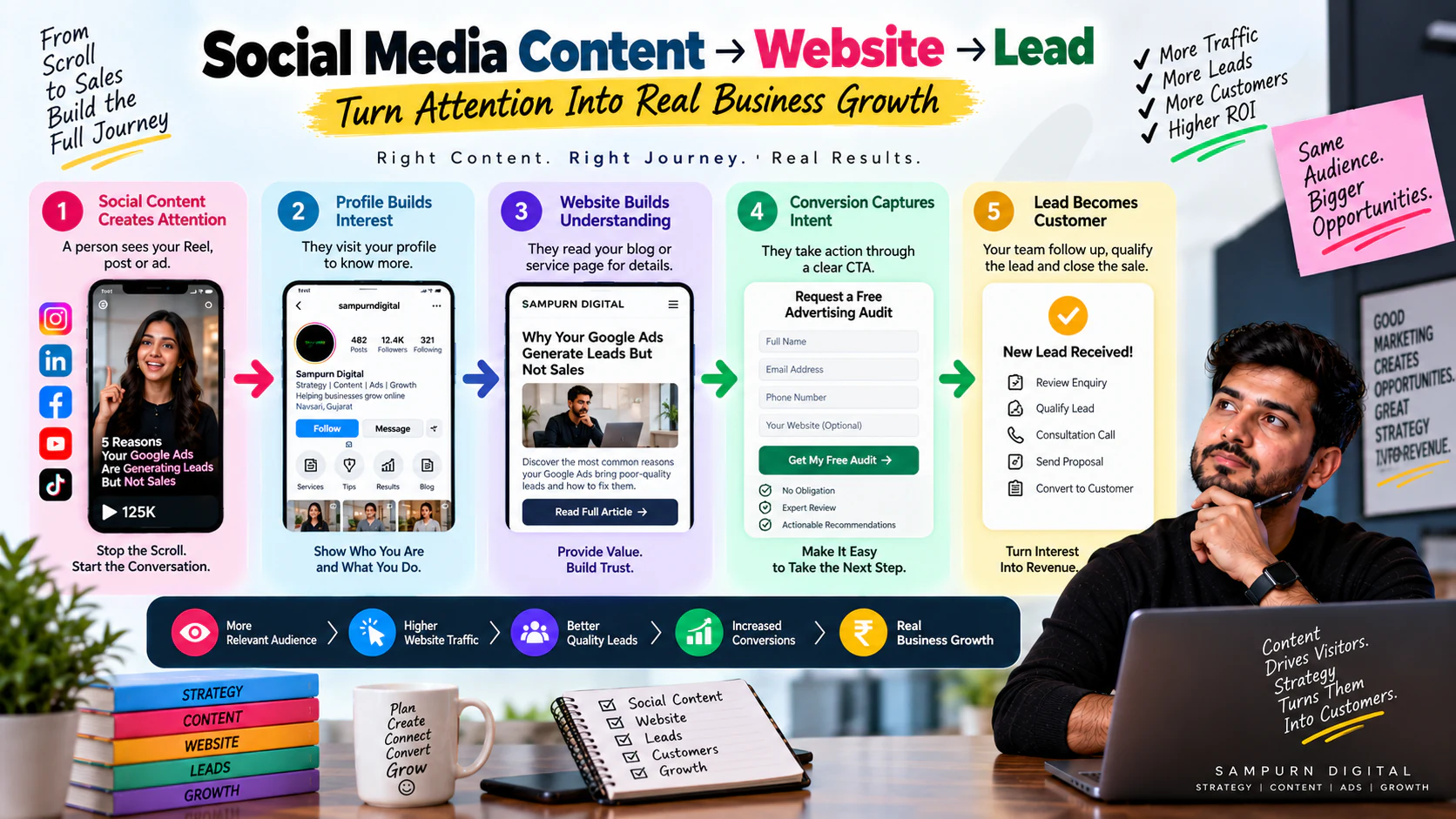
A person watches your Reel.
They like it.
Maybe they even visit your profile.
Then they disappear.
For many businesses, this is where the social media strategy ends.
And that is the problem.
Social media can create attention, but attention alone does not create a predictable lead-generation system.
The real opportunity begins when you connect:
Instead of treating Instagram, LinkedIn, Facebook, or other social channels as isolated publishing platforms, build them into the larger customer journey.
A prospect might discover your business through a Reel, read a blog article two days later, visit your service page the following week, and finally submit an enquiry after seeing a case study.
If your social content, website, and conversion path are disconnected, that journey becomes difficult to complete.
If they are connected, every stage can support the next.
This guide explains how to build that system.
What Does Social Media → Website → Lead Actually Mean?
The model is simple:
Think about a service business.
A potential customer sees a Reel:
“5 reasons your Google Ads are generating leads but not sales.”
The Reel creates a problem-awareness moment.
The viewer visits the profile.
The profile points toward a detailed article:
“Why Your Google Ads Produce Poor-Quality Leads”
The article explains the problem in greater depth.
Inside the article is a relevant CTA:
“Request a paid advertising audit.”
The visitor reaches the service page.
They understand the process.
They submit the enquiry.
Now social media has become part of a lead-generation journey.
Why Social Media Alone Is Often Not Enough
Social platforms are excellent for:
- Discovery
- Attention
- Education
- Engagement
- Brand familiarity
- Community building
- Demand generation
But a website is usually better suited for:
- Detailed explanations
- Service information
- Case studies
- Comparisons
- FAQs
- Proof
- Lead magnets
- Forms
- Conversion-focused CTAs
This creates a useful division:
Social media
Website
Conversion page
That is why the website should not simply be the place your social profile links to.
It should be designed to continue the conversation.
The Complete Social-to-Lead Funnel
A practical funnel looks like:
Each stage has a different job.
If one stage fails, the entire journey can become inefficient.
Start With the Customer Problem
Do not start by choosing a landing page.
Start with the problem your audience is experiencing.
For example:
Problem
“Our website gets visitors but very few enquiries.”
Create social content around:
- Why traffic does not convert
- Website mistakes
- CTA problems
- Landing-page friction
- Weak offers
- Poor messaging
Then connect that content to a deeper resource.
For example:
“Your website may not have a traffic problem.”
“Why Your Website Gets Traffic but Not Leads”
Conversion-focused website development
Request a website conversion review
Now the journey has continuity.
Match the Social Content to the Destination
This is one of the most important rules.
Suppose your Reel says:
“3 reasons your Meta Ads generate clicks but no conversions.”
Do not send that person to:
Instead, send them to something relevant:
The closer the message match, the less cognitive friction the visitor experiences.
The Message-Match Test
Before connecting a social post to a website page, ask:
Question 1
Does the website page discuss the same problem?
Question 2
Does it use similar terminology?
Question 3
Does it provide more depth?
Question 4
Does it give the visitor a logical next step?
If the answer is yes to all four, you have strong message continuity.
Give People a Reason to Leave Social Media
People are comfortable scrolling.
You need a reason for them to leave the platform.
Weak CTA:
“Visit our website.”
Why should they?
Better:
“Get the complete 10-point checklist.”
Better:
“See the full breakdown with examples.”
Better:
“Use this free audit checklist to identify where your campaign is leaking budget.”
The CTA should communicate the value of the next step.
Build a CTA Ladder
Different audiences require different levels of commitment.
Level 1 — Engagement
- Save this
- Share this
- Follow for more
- Comment your experience
Level 2 — Exploration
- Read the full guide
- Visit the website
- See the case study
- Watch the complete explanation
Level 3 — Lead generation
- Download the checklist
- Get the template
- Request the audit
- Submit your details
Level 4 — Sales
- Book a consultation
- Request a proposal
- Speak with an expert
Do not force a Level 4 CTA onto someone who just discovered your business.
Build the relationship.
Build Landing Pages for Specific Intent
One of the biggest mistakes is sending every social visitor to the homepage.
The homepage has to serve many audiences.
A campaign landing page has one job.
For example:
The page can then explain:
- What the audit covers
- Who it is for
- Common problems identified
- What the customer receives
- Relevant proof
- FAQs
- CTA
The visitor doesn't have to figure out what to do.
The page continues the conversation.
Build the Website Page Around Visitor Intent
A conversion-focused page should answer the questions a social visitor is likely to have.
A useful structure is:
Headline
What is the visitor going to get?
Problem
Why does this matter?
Solution
How do you help?
Process
What happens next?
Proof
Why should they trust you?
Deliverables
What exactly do they receive?
Objections
What concerns might stop them?
CTA
What should they do now?
FAQ
Answer remaining questions.
The visitor should never have to hunt for basic information.
Use Social Content to Pre-Sell the Website
Your social content can answer some questions before the user even reaches your website.
For example:
Reel
“Why your landing page isn't converting.”
The Reel explains:
- Weak headline
- Unclear offer
- Missing proof
- Too many CTAs
When the visitor clicks through, the landing page can expand on those ideas.
This means the website visitor arrives educated rather than completely cold.
That can make the conversion process more efficient.
Use Different Content for Different Funnel Stages
Not every social post should lead directly to a service page.
Problem-Aware Content
Example:
“Why your Instagram gets views but no enquiries.”
Destination:
Goal:
Build awareness.
Solution-Aware Content
Example:
“How to build a Reels strategy for lead generation.”
Destination:
Goal:
Build expertise.
Product-Aware Content
Example:
“What happens during a social media strategy audit?”
Destination:
Goal:
Build confidence.
High-Intent Content
Example:
“Want us to identify why your social content isn't generating enquiries?”
Destination:
Goal:
Generate a lead.
This is why a single social profile link is rarely enough to serve every type of audience.
Create Content-to-Page Mapping
Build a simple mapping document.
| Social Content | Audience Intent | Website Destination | CTA |
|---|---|---|---|
| Why Reels get views but no leads | Problem | Educational article | Read guide |
| How to build a Reels strategy | Solution | Strategy article | Learn more |
| Social media audit checklist | Solution | Audit page | Get audit |
| Client case study | Product aware | Case study | See results |
| Service process | Product aware | Service page | Explore service |
| Common social media mistakes | Problem | Blog | Read more |
| Strategy consultation | High intent | Lead page | Book consultation |
Now content managers and social media teams know exactly where important posts should lead.
Make Your Profile Part of the Funnel
Your profile is not just a branding page.
It is a transition point.
A visitor should understand:
For example:
Bio
Helping service businesses generate more qualified leads through SEO, paid media and conversion-focused digital marketing.
Pinned content
Post 1: What we do
Post 2: How our process works
Post 3: Client results / proof
Link
Send visitors toward the most important current destination.
This creates continuity between the content they just watched and the action you want them to take.
Don't Make the Website Do Too Much
A social visitor should not need to understand your entire company before taking the next step.
Avoid sending them into a maze of:
- 15 navigation options
- Multiple competing CTAs
- Unrelated services
- Generic company information
- Huge paragraphs
- Unclear forms
Give them a focused path.
For example:
That is much easier to navigate.
Use Proof at the Right Point
People who discover your business through social media may not trust you immediately.
Proof helps close that gap.
Useful proof includes:
- Case studies
- Testimonials
- Client logos where appropriate
- Before/after examples
- Screenshots
- Process examples
- Demonstrations
- Results with context
For example:
Instead of:
“We deliver great marketing results.”
Show:
“The campaign generated 120 leads over the measured period, with lead quality tracked separately.”
Specific evidence is stronger than generic claims.
Never exaggerate or manufacture results.
Reduce Form Friction
The final conversion step matters.
If a visitor has to complete a form with 15 fields, many will abandon it.
Ask only for information that is actually useful.
For a service enquiry, this might include:
- Name
- Work email
- Company
- Website
- Main challenge
- Approximate budget or current marketing activity, when relevant
The exact fields should depend on your sales process.
The principle is:
Build the Thank-You Experience
The journey should not stop after:
Use the thank-you page strategically.
It could explain:
What happens next
- Your enquiry is reviewed.
- The team assesses the information provided.
- A suitable next step is identified.
- The team contacts you.
You can also provide:
- A relevant guide
- A case study
- A booking option
- Additional qualification questions
This keeps the prospect engaged while the sales process begins.
Track the Entire Journey
You cannot improve what you cannot see.
Track the path:
This lets you identify where the funnel is breaking.
A Practical Funnel Diagnostic
High Reel views + low profile visits
Potential issue:
High profile visits + low website clicks
Potential issue:
High website visits + low conversions
Potential issue:
High leads + low qualified leads
Potential issue:
High qualified leads + low sales
Potential issue:
This is much more useful than simply saying:
“Our social media isn't converting.”
Example: A Service Business Lead Journey
Imagine a web development company targeting businesses with outdated websites.
Social Reel
“If your website looks professional but still doesn't generate enquiries, check these four things.”
The Reel discusses:
- Weak CTA
- Poor service messaging
- Lack of proof
- Confusing navigation
Profile CTA
“See our website conversion checklist.”
Website article
A detailed guide explaining each issue.
Internal CTA
“Want us to identify the issues on your website?”
Service page
Conversion-focused website development.
Proof
Before/after examples and relevant project outcomes.
Lead form
Request a website review.
Sales process
Qualification → consultation → proposal.
That is a complete journey.
Example: A Digital Marketing Agency Journey
- Campaign management
- Tracking
- Landing-page optimization
- Conversion optimization
CTA
“Request a performance marketing audit.”
Now multiple pieces of content work together.
Social Media → Website → Lead Tracking Framework
Create a monthly report with these columns:
| Metric | Example |
|---|---|
| Social reach | 150,000 |
| Profile visits | 4,500 |
| Website clicks | 900 |
| Landing-page visitors | 820 |
| Leads | 41 |
| Qualified leads | 24 |
| Sales opportunities | 12 |
| Customers | 5 |
| Revenue | ₹4,50,000 |
Now you can ask much better questions.
Not:
“Did Instagram perform well?”
But:
“Which social content produced qualified business opportunities?”
That is the level at which social media becomes measurable as a business channel.
Calculate Your Funnel Conversion Rates
Suppose:
You can calculate:
View-to-profile rate
500 ÷ 10,000 × 100
\= 5%
Website-to-lead rate
10 ÷ 100 × 100
\= 10%
Lead qualification rate
6 ÷ 10 × 100
\= 60%
Lead-to-customer rate
2 ÷ 10 × 100
\= 20%
Now you have specific areas to improve.
What If Social Traffic Does Not Convert?
Don't immediately change the content.
Diagnose the system.
Check:
Audience quality
Are the right people clicking?
Message match
Does the landing page continue the social message?
Offer
Is there a compelling reason to take action?
Trust
Does the page provide enough evidence?
UX
Is the page easy to understand and use?
CTA
Is the next step obvious?
Form
Is there unnecessary friction?
Follow-up
What happens after someone submits?
This prevents you from blaming social media for a website or sales problem.
Organic Social and Paid Social Can Share the Same Journey
The same website infrastructure can support both organic and paid traffic.
For example:
Educational article
Service page
Lead
And:
Dedicated landing page
Lead
You can also retarget people who interacted with your social content or visited important pages, depending on your tracking setup and platform capabilities.
For businesses running paid acquisition, this becomes especially useful when building a broader Meta Ads funnel.
Don't Send Every Post to a Landing Page
Not every social post needs an external click.
Some content should simply:
- Educate
- Entertain
- Build familiarity
- Generate conversation
- Earn saves
- Generate shares
- Build authority
The goal is not to force every viewer off the platform.
The goal is to create a logical path when the viewer has enough intent to take the next step.
That distinction keeps your content from becoming overly promotional.
Build a Content-to-Conversion Matrix
A useful planning framework is:
| Content Type | Primary Job | Destination |
|---|---|---|
| Problem Reel | Awareness | Blog |
| Educational carousel | Education | Guide |
| Case study | Trust | Case study |
| Comparison | Consideration | Detailed article |
| FAQ Reel | Objection handling | Service/FAQ page |
| Product/service Reel | Intent | Service page |
| Offer post | Conversion | Lead page |
This gives your content team a clear rule:
Choose the destination while planning the post.
Use Internal Links to Continue the Journey
Your website should also behave like a journey.
A visitor who lands on:
could discover related resources about:
- Social media strategy
- Reels
- Audience targeting
- Content planning
- Paid social
- Conversion optimization
Then relevant links can lead toward a service page.
This turns one social click into multiple useful website interactions.
Build the System Around Intent, Not Platforms
The strategy should not be:
as completely separate systems.
Instead, think:
Discovery
Social content.
Education
Website content.
Evaluation
Case studies + service pages.
Conversion
Lead form / consultation.
Nurture
Email / remarketing / sales follow-up.
The platform is the distribution mechanism.
The customer journey is the strategy.
10 Questions to Audit Your Social-to-Lead Journey
Ask:
- Does every important social campaign have a defined business objective?
- Do high-intent posts have a clear destination?
- Does the destination match the social message?
- Is the website page easy to understand?
- Is the value proposition obvious?
- Is there enough proof?
- Is the CTA clear?
- Is the form simple enough?
- Are leads being tracked back to the source?
- Does the sales team know where the lead came from?
If several answers are “no,” you have opportunities to improve the funnel.
A 30-Day Implementation Plan
Week 1 — Map the Journey
Identify:
- Top customer problems
- Main social content themes
- Existing website pages
- Service pages
- Lead magnets
- Conversion points
Create the basic map:
Week 2 — Fix the Destinations
For your most important social topics, identify the best destination.
Create or improve:
- Blog articles
- Landing pages
- Service pages
- Case studies
- Lead forms
Week 3 — Align Content
Update your social calendar.
For each important post, define:
- Goal
- Audience
- Topic
- Funnel stage
- Destination
- CTA
- KPI
Your monthly social calendar should now connect directly to the website journey.
Week 4 — Measure and Improve
Review:
- Views
- Profile visits
- Clicks
- Website sessions
- Leads
- Qualified leads
- Sales opportunities
Then identify the weakest step.
Fix that step first.
Common Mistakes to Avoid
Sending every visitor to the homepage
Problem: Too many choices.
Better: Send users to the most relevant destination.
Using generic CTAs
Problem: “Visit our website” gives little motivation.
Better: Explain what they will get.
Creating social content without a destination
Problem: High-intent users have nowhere to go.
Better: Map important content to relevant website assets.
Treating clicks as the final goal
Problem: Traffic can look impressive while producing no revenue.
Better: Track the journey through qualified leads and sales.
Making the landing page about the company
Problem: The visitor clicked because of their problem.
Better: Continue the problem → solution conversation.
Ignoring the sales process
Problem: Marketing generates leads but nobody knows what happens next.
Better: Define lead qualification and follow-up.
The Simple Formula
A strong social-to-lead system can be summarized as:
×
×
×
×
×
\=
If any major component is weak, the result can suffer.
SEO Publishing Information
Blog ID: SMM-15 Category: Social Media Marketing Stage: Build Primary Keyword: social media to website lead generation funnel Supporting Keywords: social media lead funnel; social traffic to website; social media conversion journey Search Intent: Commercial Investigation Funnel Stage: Solution Aware Pillar Page: Social Media Marketing Services Suggested URL: `/blog/social-media-marketing/social-media-content-website-lead-how-to-build-the-journey` Content Role: Implementation / how-to resource Publishing Sprint: Sprint 4 CTA: Get a social media growth strategy / Explore Social Media Marketing
Meta Title: Social Media → Website → Lead: How to Build the Journey
Meta Description: Learn how to connect social media content to your website and build a conversion journey that turns social traffic into qualified leads and sales opportunities.
H1: Social Media Content → Website → Lead: How to Build the Journey
