
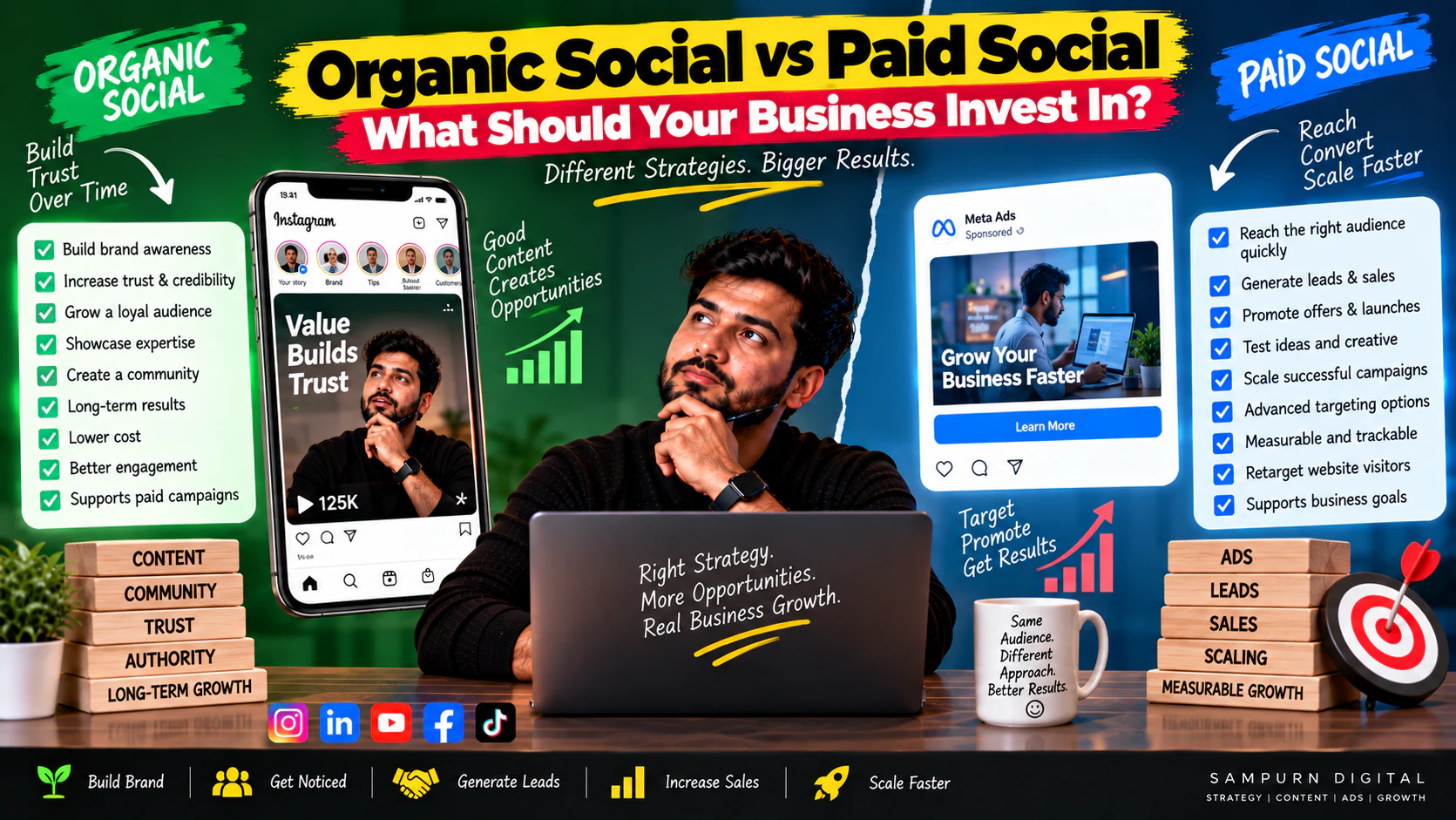
A business can post consistently for six months and still struggle to generate meaningful leads.
Another business can spend ₹1 lakh on social ads and discover that the traffic is expensive, the leads are weak, and the sales team is frustrated.
So which is better?
The better question is:
What does your business need social media to accomplish right now?
Organic social and paid social solve different problems.
Organic social helps you build attention, trust, authority, community and long-term audience value.
Paid social helps you buy targeted reach, traffic, leads, conversions and faster testing opportunities.
For many businesses, the strongest strategy is not choosing one permanently. It is knowing when to use organic, when to use paid, and how the two systems can strengthen each other.
This guide explains how to make that decision.
Organic Social vs Paid Social: The Short Answer
Here is the simplest way to think about it:
| Business need | Better starting point |
|---|---|
| Build credibility | Organic social |
| Grow a long-term audience | Organic social |
| Educate potential customers | Organic social |
| Test content topics | Organic social |
| Reach a new audience quickly | Paid social |
| Generate leads at scale | Paid social |
| Promote an offer | Paid social |
| Retarget website visitors | Paid social |
| Validate creative quickly | Paid social |
| Build trust before asking for a sale | Organic + paid |
| Scale a proven offer | Paid + strong organic support |
Neither channel automatically produces business results.
The outcome depends on your offer, audience, creative, landing experience, targeting, follow-up and measurement system.
What Is Organic Social?
Organic social is the content and interaction you generate without paying the platform to distribute each impression.
Examples include:
- Instagram Reels
- LinkedIn posts
- Instagram carousels
- Facebook posts
- Stories
- Educational videos
- Customer stories
- Founder content
- Community discussions
- Comments and replies
- Behind-the-scenes content
- Case studies
- Product education
Suppose a digital marketing agency publishes a LinkedIn post explaining:
“Why your Google Ads leads are increasing but sales are falling.”
The company doesn't pay LinkedIn to distribute that post.
People discover it through their feed, shares, followers, comments or other organic distribution.
If the post performs well, it can generate:
But organic distribution is not guaranteed.
A great post can reach thousands of people.
A weak post may reach only a small percentage of your existing audience.
That is one of the fundamental differences between organic and paid social.
What Is Paid Social?
Paid social uses advertising platforms to purchase targeted distribution.
Examples include:
- Meta Ads
- Instagram Ads
- Facebook Ads
- LinkedIn Ads
- YouTube Ads
- Other social advertising platforms
Instead of waiting for an algorithm to distribute your content, you pay to put your message in front of a selected audience.
For example:
A B2B software company may want to reach:
- Founders
- Marketing managers
- Companies with 50–500 employees
- People in selected cities
- Specific industries
A paid campaign can be designed around those targeting requirements.
A ₹50,000 campaign might generate:
The important word is might.
Paying for traffic does not guarantee profitable traffic.
Organic Social vs Paid Social: The Real Difference
The biggest difference is not simply “free vs paid.”
It is distribution control and business objective.
Organic social
You create the content first and earn distribution.
Paid social
You create the content and purchase additional targeted distribution.
Think of organic as building an owned attention engine.
Think of paid as building a distribution engine.
The strongest businesses often connect the two.
Organic Social Takes Time — But Builds an Asset
One of the biggest advantages of organic social is that good content can continue creating value after publication.
Imagine you publish 100 useful LinkedIn posts over one year.
Even if individual posts have different performance levels, you have created a library of:
- Expertise
- Opinions
- Educational content
- Customer questions
- Proof
- Brand messaging
- Creative ideas
A prospect researching your company may see several pieces of content before contacting you.
That creates familiarity.
And familiarity can reduce the amount of convincing required during the sales process.
But there is a catch
Organic social usually requires:
- Consistency
- Good creative
- Audience understanding
- Strong positioning
- Community interaction
- Content testing
- Patience
Posting three times and declaring that “organic doesn't work” is not a strategy.
Paid Social Gives You Speed
Suppose you launch a new service.
You don't want to wait six months to find out whether people respond to the offer.
You could create several ad variations and put them in front of a relevant audience.
For example:
Offer A: Free marketing audit
Offer B: 30-minute strategy consultation
Offer C: Downloadable marketing checklist
You can compare:
- CTR
- CPC
- Landing-page conversion rate
- Cost per lead
- Lead quality
- Sales conversion
- Customer acquisition cost
Paid social can therefore become a market feedback mechanism.
But speed comes with cost.
If the offer, audience or conversion path is weak, paid social can help you discover the problem quickly — while also spending money while you discover it.
The Biggest Mistake: Comparing Organic and Paid by the Same Metrics
This creates bad decisions.
A company may say:
“Our organic post generated 20,000 views but our ad generated only 8,000.”
That doesn't tell you which performed better.
Another company might say:
“Our ad generated 100 leads, while organic generated only 15.”
Again, incomplete.
The business should compare channels against their actual objective.
For example:
Organic objective
Build authority.
Relevant metrics:
- Reach
- Engagement quality
- Profile visits
- Saves
- Shares
- Qualified website visits
- Branded searches
- Assisted conversions
Paid objective
Generate customers.
Relevant metrics:
- Spend
- CTR
- CPC
- Landing-page conversion rate
- CPL
- Qualified lead rate
- CAC
- Revenue
- ROAS
The metric that matters most is determined by the job you hired the channel to do.
When Should a Business Prioritize Organic Social?
Organic social is usually the better starting point when you need to build trust before conversion.
This is especially important for:
B2B businesses
A B2B buyer may research your company several times before contacting you.
Your content can demonstrate:
- Expertise
- Experience
- Industry knowledge
- Problem understanding
- Results
- Point of view
High-ticket services
If a customer is considering spending ₹2 lakh, ₹5 lakh or ₹10 lakh, a single advertisement may not create enough confidence.
Organic content can support the decision.
Founder-led businesses
Founder expertise can become a major content advantage.
For example:
“We audited 47 lead-generation websites. Here are the five problems we saw repeatedly.”
That is much stronger than:
“We provide the best website development services.”
New brands
If nobody knows who you are, content can help establish your positioning before aggressive advertising.
When Should a Business Prioritize Paid Social?
Paid social becomes more attractive when you need speed, controlled distribution or scalable acquisition.
Consider paid social when:
You have a proven offer
If customers already buy the product or service organically, paid distribution can help you reach more potential customers.
You have enough conversion data
You should know what happens after someone clicks.
If 1,000 people click your ad but only 2 become customers, increasing the budget won't magically solve the economics.
You need predictable traffic
Organic reach can fluctuate.
Paid campaigns provide more control over distribution.
You have a strong landing page
Paid traffic should not be sent blindly to a weak website.
Your landing experience should clearly communicate:
- Problem
- Solution
- Benefits
- Proof
- Offer
- CTA
For service businesses, this is where a [lead-generation website architecture built around conversion](https://www.sampurndigital.com/blog/lead-generation-website-architecture-for-service-businesses) becomes important.
You have enough budget to test
Paid social rarely deserves a strategy based on one ad and ₹2,000.
Testing requires enough budget to learn.
A Simple Budget Decision Framework
Instead of asking:
“Should I spend money on organic or paid?”
Ask these five questions.
Question 1: Is the offer proven?
No → Focus more heavily on organic content, customer research and offer validation.
Yes → Paid distribution becomes more attractive.
Question 2: Can you explain the value clearly?
No → Improve positioning first.
Yes → Continue.
Question 3: Does the website convert?
No → Fix the conversion journey.
Yes → Paid traffic becomes safer to test.
Question 4: Can you measure leads and revenue?
No → Fix tracking.
Yes → Continue.
Question 5: Do you need speed?
No → Organic can carry more of the workload.
Yes → Consider paid distribution.
This prevents a common mistake:
Example: A Local Service Business
Imagine a dental clinic in Mumbai.
Its organic strategy could include:
- Dental care education
- Before/after explanations where appropriate
- Dentist Q\&A videos
- Treatment FAQs
- Patient education
- Clinic introductions
- Common misconceptions
Paid campaigns could then target:
- People in relevant geographic areas
- Specific treatment interests
- Website visitors
- People who previously interacted with the brand
Organic builds familiarity.
Paid creates additional distribution.
The website handles conversion.
The CRM or sales process handles follow-up.
That is a system.
Example: A B2B Digital Marketing Agency
Suppose an agency sells a ₹1.5 lakh/month performance marketing service.
Trying to sell immediately through every social post may not work.
Instead, organic content could establish expertise:
Post 1: Why CPL is rising
Post 2: How to identify wasted ad spend
Post 3: Landing-page mistakes
Post 4: Paid campaign audit checklist
Post 5: Client case study
Then paid advertising can promote the strongest offer or content to carefully selected audiences.
The journey becomes:
That is much stronger than:
Example: E-commerce Brand
An e-commerce brand may use organic social to create:
- Product demonstrations
- Styling ideas
- UGC
- Reviews
- Tutorials
- Comparisons
- Founder stories
- Customer content
Paid social can then amplify:
- Best-selling products
- Promotional offers
- New launches
- Retargeting campaigns
- High-performing creatives
This creates an important feedback loop:
Your organic feed becomes a testing environment.
Your paid campaigns become a scaling environment.
Don't Treat Organic and Paid as Separate Departments
This is one of the biggest opportunities businesses miss.
Suppose an organic Reel generates unusually high:
- Watch time
- Shares
- Saves
- Comments
- Profile visits
Instead of simply celebrating the post, ask:
Can this creative become an advertisement?
The reverse also works.
Suppose an advertisement generates an unusually high conversion rate.
Ask:
Can we turn the underlying idea into organic content?
For example:
Paid ad: “3 reasons your website gets traffic but no leads.”
Turn it into:
- LinkedIn post
- Instagram carousel
- Reel
- Blog article
- Case-study topic
One winning idea can therefore become a content asset across multiple channels.
Organic Social vs Paid Social by Business Stage
Your strategy should change as the business matures.
Stage 1: Unknown offer
Priority:
Understand what people respond to.
Stage 2: Offer validation
Priority:
Test messaging, creative and audience.
Stage 3: Proven acquisition
Priority:
Increase distribution while continuing to build trust.
Stage 4: Scale
Priority:
At this point, the question is no longer “organic or paid?”
It becomes:
How efficiently can the entire acquisition system turn attention into revenue?
How Much Should You Spend on Organic Social?
Organic isn't actually free.
Even without media spend, you may pay for:
- Strategy
- Copywriting
- Design
- Video production
- Editing
- Community management
- Tools
- Management time
Suppose a company spends:
but generates no measurable business outcome.
That is still a marketing expense.
So organic should also have business objectives.
For example:
Goal: Generate qualified website visits.
Track:
Content → Profile visit → Website visit → Lead
Don't stop at:
Content → Likes
How Much Should You Spend on Paid Social?
There is no universal “correct” budget.
Your budget should be connected to your economics.
For example:
Average customer value \= ₹50,000
Gross contribution available for acquisition \= ₹20,000
Target CAC \= ₹8,000
If your campaign generates:
100 leads at ₹500 CPL
Total spend \= ₹50,000
If 10% become customers:
10 customers
CAC \= ₹5,000
That may be healthy.
But if only 2% become customers:
2 customers
CAC \= ₹25,000
The same ₹500 CPL can therefore represent either a good or bad campaign.
The Funnel Matters More Than the Channel
Consider two businesses.
Business A
Organic social → weak website → confusing form → slow sales follow-up
Business B
Paid social → clear landing page → strong offer → fast follow-up → CRM tracking
Business B may produce better results even though paid traffic is more expensive.
Why?
Because marketing performance is a system.
A useful simplified formula is:
Improving only traffic is not enough.
Organic Social Is Not a Replacement for Paid
Some businesses say:
“We don't want to pay for ads. We'll just grow organically.”
That can work — but it depends on the business model.
If you need to reach a specific audience quickly, paid distribution may be extremely useful.
Likewise, paid social shouldn't replace organic trust-building.
A prospect may see your advertisement today and visit your profile tomorrow.
If the profile contains:
- Weak content
- No proof
- No positioning
- Inconsistent posting
- Unclear offer
the paid campaign may lose some of its effectiveness.
Your organic presence can become part of the conversion experience.
Organic Social Is Not Automatically Better Because It Is “Free”
This is another common misconception.
Imagine:
Content production \= ₹80,000/month
Organic-generated qualified leads \= 20
Cost per qualified lead \= ₹4,000
Now imagine:
Paid spend \= ₹1,00,000
Qualified leads \= 50
Cost per qualified lead \= ₹2,000
Paid isn't necessarily worse because money was spent on media.
Likewise, organic isn't automatically better because the platform didn't charge for impressions.
Paid Social Is Not Automatically Better Because It Is “Scalable”
You can scale a bad campaign too.
Suppose:
Monthly spend \= ₹1 lakh
Customers \= 5
CAC \= ₹20,000
Increasing spend to ₹5 lakh doesn't automatically produce 25 profitable customers.
You may instead get:
₹5 lakh spend → 18 customers → ₹27,778 CAC
Scaling exposes weaknesses in:
- Audience size
- Creative fatigue
- Offer quality
- Landing-page conversion
- Lead quality
- Sales capacity
Before increasing budget, understand the economics.
The Best Strategy for Many Businesses: Organic + Paid
For many established businesses, the most useful model is:
Organic
Paid
Website
Sales/CRM
Analytics
That creates a complete journey:
This is much closer to how social media should operate inside a business.
A Practical 90-Day Organic + Paid Plan
Month 1: Learn
Focus on:
- Audience research
- Content testing
- Offer clarity
- Creative testing
- Website conversion basics
- Tracking setup
Don't rush to scale.
Your objective is to discover:
Month 2: Validate
Identify:
- Best-performing topics
- Best hooks
- Best formats
- Best audiences
- Strongest offers
- Highest-quality traffic sources
Run small paid tests around promising concepts.
Your objective becomes:
Month 3: Scale
Increase investment behind proven combinations.
For example:
Then measure:
- Cost per qualified lead
- Sales conversion
- CAC
- Revenue
- ROAS where appropriate
Your objective becomes:
Use This Decision Matrix
| Situation | Organic | Paid |
|---|---|---|
| Brand is unknown | High | Medium |
| Offer is unproven | High | Low |
| Offer is proven | Medium | High |
| Need immediate reach | Low | High |
| Need long-term authority | High | Medium |
| High-ticket service | High | Medium/High |
| E-commerce promotion | Medium | High |
| Founder-led B2B | High | Medium |
| Retargeting | Low | High |
| Content testing | High | High |
| Scaling acquisition | Medium | High |
| Limited budget | High | Controlled testing |
The answer is rarely permanent.
Your allocation should change as your business changes.
Five Questions to Ask Before Spending More on Social
Before increasing either content production or ad spend, ask:
Who exactly are we trying to reach?
If the audience is vague, the strategy will be vague.
What problem are we solving?
Your content and advertisements need a meaningful reason to exist.
What action should people take?
Examples:
- Follow
- Save
- Visit website
- Download
- Enquire
- Book
- Purchase
What happens after that action?
A lead without follow-up is not a growth system.
Can we measure the final business outcome?
If you cannot connect social activity to meaningful outcomes, you are likely optimizing too high in the funnel.
Don't Choose a Channel Before Choosing a Business Goal
This is the biggest lesson.
Don't begin with:
“Should we do Instagram ads?”
Begin with:
“We need 40 qualified leads per month at a CAC below ₹8,000.”
Then work backward.
Maybe the system requires:
The channel should serve the business objective.
Not the other way around.
