
Posting consistently is not the same as having a social media strategy.
A business can publish four Reels every week, share carousels, post stories daily, and still have no clear idea whether its social media activity is actually helping the business.
The problem is usually not a lack of content ideas.
It is the lack of a social media content calendar connected to business goals.
A strategic content calendar should answer five questions before a post goes live:
- What business goal does this content support?
- Who is this content for?
- What stage of the buyer journey does it address?
- What action should the audience take?
- How will we know whether it worked?
Without those answers, a content calendar becomes a list of dates and post ideas.
With them, it becomes an operating system for social media.
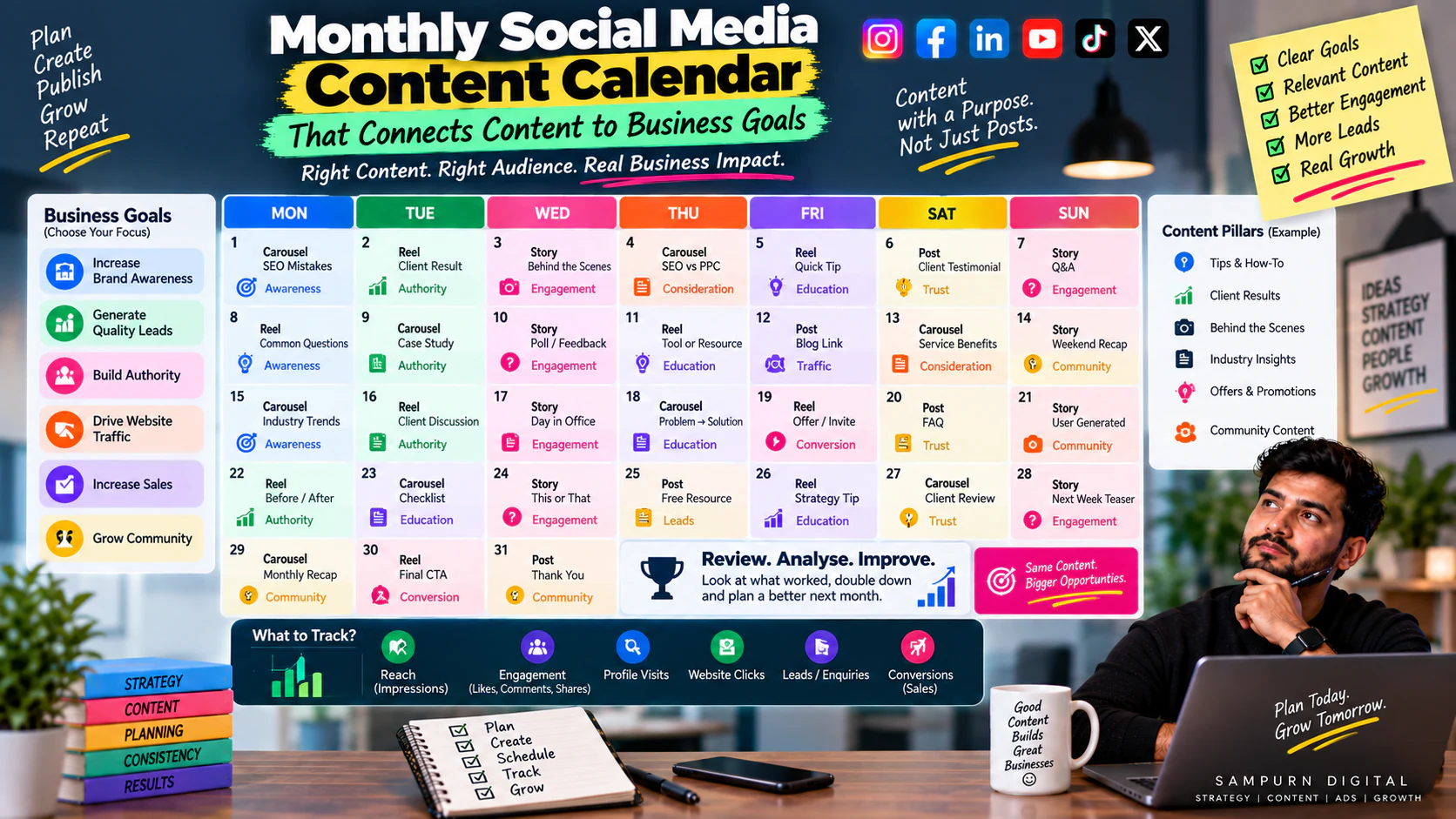
This guide shows you how to build a monthly social media content calendar for business goals, including the content mix, weekly planning process, KPIs, examples, and a practical template you can reuse every month.
What Is a Strategic Social Media Content Calendar?
A strategic social media content calendar is a planned system that connects:
A basic calendar might look like this:
| Date | Platform | Post |
|---|---|---|
| Monday | Carousel | |
| Wednesday | Reel | |
| Friday | Text post | |
| Sunday | Story |
That tells your team when to publish.
It does not tell them why they are publishing.
A strategic calendar adds business context:
| Date | Goal | Audience | Topic | Format | CTA | KPI |
|---|---|---|---|---|---|---|
| Monday | Awareness | New audience | Common SEO mistakes | Carousel | Save | Reach |
| Tuesday | Authority | Business owners | SEO audit example | Reel | Follow | Watch time |
| Thursday | Consideration | Interested prospects | SEO vs PPC | Carousel | Read article | Profile visits |
| Saturday | Conversion | Warm audience | SEO audit offer | Post | Enquire | Leads |
Now every piece of content has a job.
That distinction is critical.
A posting schedule manages activity. A strategic content calendar manages outcomes.
Start With the Business Goal
Do not begin your calendar by asking:
“What should we post this month?”
Start with:
“What does the business need social media to help achieve this month?”
Typical goals include:
Brand awareness
You want more relevant people to discover the business.
Useful metrics:
- Reach
- Impressions
- Video views
- Follower growth
- Profile visits
Authority
You want prospects to see the company as knowledgeable and credible.
Useful metrics:
- Saves
- Shares
- Comments
- Content engagement
- Profile visits
- Returning viewers
Website traffic
You want social audiences to consume deeper content on your website.
Useful metrics:
- Link clicks
- Landing-page visits
- Blog traffic
- Engaged sessions
Lead generation
You want qualified prospects to raise their hand.
Useful metrics:
- Leads
- Landing-page conversion rate
- Cost per lead if paid promotion is involved
- Qualified lead rate
Sales
You want social activity to contribute directly to revenue.
Useful metrics:
- Enquiries
- Sales opportunities
- Customers
- Revenue
- Customer acquisition cost
Retention
You want existing customers to stay engaged and continue using the product or service.
Useful metrics:
- Returning customers
- Engagement from existing customers
- Product usage
- Customer interactions
The mistake is trying to make every post achieve every goal.
Instead, give each post a primary job.
Turn Business Goals Into Content Jobs
Once you know the monthly business priorities, translate them into content roles.
For example, suppose a digital marketing agency wants to generate more qualified website leads.
A useful content mix might be:
| Content Job | Purpose |
|---|---|
| Educational | Attract people with relevant problems |
| Authority | Demonstrate expertise |
| Proof | Reduce uncertainty |
| Consideration | Help prospects compare solutions |
| Conversion | Give qualified prospects a next step |
| Engagement | Create conversations and learn audience needs |
This prevents a common problem:
Your audience should not feel like every post is an advertisement.
At the same time, useful content without a commercial path can create attention without business results.
The calendar needs both.
Connect the Calendar to Your Content Pillars
Your content pillars provide the subjects.
Your business goals determine how you use those subjects.
For example, a digital marketing agency might have these pillars:
- SEO
- Paid advertising
- Social media
- Website conversion
- Digital strategy
Now turn those pillars into different content jobs.
SEO pillar
“5 reasons your website traffic is not converting”
“How we diagnose an SEO traffic drop”
“SEO vs Google Ads: which should a growing business invest in?”
“Before-and-after SEO case study”
“Signs your business needs an SEO audit”
The subject remains SEO.
The business purpose changes.
That is how a content pillar system becomes commercially useful.
Map Content to the Customer Journey
A strong monthly calendar should not speak only to people who are ready to buy.
It should support different stages of awareness.
Stage 1: Problem Aware
The person knows something is wrong.
Examples:
- “Why are my Instagram views falling?”
- “Why is my website getting traffic but no leads?”
- “Why are Google Ads becoming expensive?”
Content objective:
Stage 2: Solution Aware
They understand the problem and are exploring solutions.
Examples:
- “SEO vs PPC for a service business”
- “Organic vs paid social”
- “Landing page vs homepage for ad traffic”
Content objective:
Stage 3: Product/Service Aware
They understand the type of solution they need.
Examples:
- “What should a professional SEO audit include?”
- “What does a performance marketing agency actually manage?”
- “What should a social media strategy include?”
Content objective:
Stage 4: Ready to Act
They are looking for the next step.
Examples:
- Case studies
- Audit offers
- Consultation invitations
- Service comparisons
- Pricing-related education
- Process explanations
Content objective:
A monthly calendar should contain content across these stages instead of repeatedly targeting the same audience.
Decide Your Monthly Content Mix
There is no universal percentage that every business must follow.
Instead, build your mix according to your business goal.
For a service business publishing around 20 main social posts per month, an example structure could be:
| Content Type | Posts | Purpose |
|---|---|---|
| Educational | 6 | Reach + problem awareness |
| Authority | 4 | Expertise |
| Engagement | 3 | Conversation + audience insight |
| Proof | 3 | Trust |
| Consideration | 2 | Solution evaluation |
| Conversion | 2 | Leads |
Total:
This is not a rigid formula.
If the business is launching a new service, conversion content may increase.
If the brand is new and has little audience awareness, educational and authority content may dominate.
The correct question is not:
“What percentage should every business use?”
It is:
“What content mix best supports this month's business objective?”
Choose the Right Formats
The same topic can perform very differently depending on format.
For example:
Topic:
“Why your website gets traffic but no leads”
You could turn it into:
“3 reasons your website traffic isn't turning into enquiries.”
“7 website conversion problems killing your leads.”
Poll:
“What's harder for your business?”
- Getting traffic
- Converting traffic
A detailed breakdown of a common conversion problem.
A complete guide to diagnosing traffic-to-lead performance.
The topic stays consistent.
The format changes based on the platform and audience behaviour.
Build the Calendar Around Weekly Themes
A monthly calendar becomes easier to manage when every week has a strategic purpose.
For example:
Week 1 — Problem Awareness
Focus:
- Common problems
- Mistakes
- Myths
- Diagnostic content
Goal:
Get the right audience to recognize their problem.
Week 2 — Education
Focus:
- Frameworks
- How-to content
- Tutorials
- Checklists
Goal:
Demonstrate expertise.
Week 3 — Proof + Consideration
Focus:
- Case studies
- Before/after examples
- Comparisons
- Process explanations
Goal:
Help prospects evaluate the solution.
Week 4 — Conversion
Focus:
- FAQs
- Objection handling
- Service explanations
- Offers
- Consultation CTA
Goal:
Convert interested audiences into enquiries.
This creates a natural progression:
Create a 30-Day Content Calendar
Here is an example for a digital marketing agency.
| Day | Content | Format | Funnel Stage | CTA |
|---|---|---|---|---|
| 1 | Why your website gets traffic but no leads | Carousel | Problem | Save |
| 2 | 3 SEO mistakes businesses make | Reel | Problem | Follow |
| 4 | SEO audit checklist | Carousel | Education | Save |
| 6 | Client result / case study | Carousel | Trust | Learn more |
| 8 | SEO vs Google Ads | Carousel | Consideration | Comment |
| 10 | Behind-the-scenes strategy process | Reel | Authority | Follow |
| 12 | Common SEO myth | Static/Reel | Awareness | Share |
| 14 | Website conversion checklist | Carousel | Education | Save |
| 16 | Client question answered | Reel | Consideration | DM |
| 18 | Before/after performance example | Carousel | Trust | Learn more |
| 20 | How we structure a marketing strategy | Reel | Authority | Save |
| 22 | 5 signs you need an SEO audit | Carousel | Problem | Save |
| 24 | FAQ: How long does SEO take? | Reel | Consideration | Comment |
| 26 | Marketing dashboard example | Carousel | Authority | Save |
| 28 | Common mistake businesses make | Reel | Problem | Share |
| 29 | Service/process explanation | Carousel | Product aware | Enquire |
| 30 | Consultation / audit CTA | Post | Conversion | Book a call |
Stories can run alongside these posts for:
- Polls
- Questions
- Testimonials
- Behind-the-scenes content
- Quick tips
- Product/service reminders
- Website links
- FAQs
The key is that the month has a narrative, rather than 30 unrelated ideas.
Give Every Post One Primary CTA
A social media post can have several possible actions.
But that does not mean it should ask the audience to do everything.
Avoid:
Like, comment, share, save, follow, visit our website, download the guide and contact us.
That creates friction.
Instead, choose one primary action.
Awareness content
CTA:
Educational content
CTA:
Engagement content
CTA:
Website traffic content
CTA:
Lead-generation content
CTA:
Sales content
CTA:
The CTA should match the audience's level of intent.
Connect Social Content to Your Website
Your social calendar should not operate as a completely separate marketing system.
Connect important posts to relevant website assets.
For example:
Now social media becomes part of a larger customer journey.
This is particularly important for service businesses where the customer may need several interactions before making contact.
For a broader integrated approach, your social calendar can also sit inside an integrated digital marketing strategy rather than operating independently.
Add Campaigns and Business Moments
Your calendar should include more than evergreen educational content.
Look at the month ahead.
Identify:
- Product launches
- Service launches
- Offers
- Events
- Webinars
- Festivals
- Industry events
- Seasonal buying periods
- Company milestones
- Customer announcements
Then decide which moments deserve content.
For example, if a service business is launching a new SEO audit package:
Two weeks before
Educational content about SEO problems.
One week before
Explain what an audit identifies.
Launch week
Introduce the service.
Following week
Answer objections and FAQs.
Final phase
Use proof, urgency, or limited availability if genuinely applicable.
This is much stronger than suddenly posting:
“Our new service is live. Contact us today\!”
Use a Content Calendar That Your Team Can Actually Operate
A calendar should contain enough information that a writer, designer, video editor, social media manager, and client can understand what needs to happen.
A useful spreadsheet can include:
| Column | Purpose |
|---|---|
| Date | Publishing date |
| Platform | Instagram, LinkedIn, Facebook, etc. |
| Content Pillar | Subject area |
| Business Goal | Why the post exists |
| Funnel Stage | Audience intent |
| Topic | Core idea |
| Hook | Opening message |
| Format | Reel, carousel, image, etc. |
| Caption | Final copy |
| CTA | Desired action |
| Landing Page | Destination if applicable |
| Creative Status | Production progress |
| Approval | Client/team approval |
| Published | Final status |
| Reach | Performance |
| Engagement | Performance |
| Clicks | Traffic |
| Leads | Business outcome |
| Notes | Learning |
This turns the calendar into a lightweight content management system.
A Simple Monthly Planning Template
Before starting each month, fill this out:
Business objective
Example:
Generate more qualified enquiries for performance marketing services.
Primary audience
Example:
Business owners already spending on Google or Meta Ads but unhappy with lead quality.
Main content pillars
- Paid advertising
- Landing pages
- Tracking
- Conversion optimization
- Growth strategy
Primary funnel goal
Main CTA
Supporting content goals
- Build authority
- Demonstrate expertise
- Educate prospects
- Create trust
- Address objections
Now your calendar has direction before you create a single post.
How Many Posts Should You Publish Per Month?
More content is not automatically better.
Suppose your team publishes:
versus:
If the second system produces better engagement, website visits, qualified enquiries, and revenue, it is the stronger strategy.
Choose frequency based on:
- Audience behaviour
- Platform
- Available resources
- Content quality
- Business goals
- Production capacity
- Historical performance
A practical starting point for many businesses is to establish a sustainable cadence and improve it based on performance.
The important word is sustainable.
A calendar that looks impressive for two weeks and collapses in week three is not a strategy.
Build the Calendar Backwards From the Goal
This is one of the most useful planning techniques.
Instead of:
Use:
For example:
That is strategic content planning.
Use a Content Score Before Adding Ideas
If your team has 100 content ideas, do not automatically add all of them to the calendar.
Score each idea from 1–5 on:
| Factor | Score |
|---|---|
| Audience relevance | /5 |
| Business relevance | /5 |
| Expertise/authority | /5 |
| Funnel relevance | /5 |
| Content differentiation | /5 |
| Conversion potential | /5 |
Total:
For example:
Idea A
“5 Instagram caption tips”
- Audience relevance: 3
- Business relevance: 2
- Authority: 3
- Funnel relevance: 2
- Differentiation: 2
- Conversion potential: 1
Idea B
“Why your Reels get views but no enquiries”
- Audience relevance: 5
- Business relevance: 5
- Authority: 4
- Funnel relevance: 5
- Differentiation: 4
- Conversion potential: 4
Idea B deserves priority.
This simple scoring system prevents teams from filling calendars with content simply because it sounds interesting.
Your Monthly Calendar Should Have Content Dependencies
Some posts should naturally lead into others.
For example:
Post 1: Why your website gets traffic but no leads
Post 2: 7 conversion problems to check
Post 3: Landing-page structure
Post 4: Case study
Post 5: How to request a conversion audit
Now the content creates a learning sequence.
Instead of treating every post as an isolated campaign, you build a content journey.
This also makes repurposing easier.
One strong topic can become:
- Reel
- Carousel
- Story
- LinkedIn post
- Blog article
- Lead magnet
- Webinar topic
How to Plan One Week of Content
A practical weekly system could look like this:
Monday — Problem
Identify a pain point.
Tuesday — Education
Explain how to diagnose or solve it.
Wednesday — Engagement
Ask the audience a relevant question.
Thursday — Authority
Share a framework, example, or expert opinion.
Friday — Proof
Show a case study, result, testimonial, or process.
Saturday — Lightweight content
Behind the scenes, culture, FAQ, or quick tip.
Sunday — Conversion/recap
Direct interested people toward the next step.
You do not need to use this exact schedule.
The principle is what matters:
How to Measure the Calendar at the End of the Month
Do not review only follower growth.
Divide your reporting into four levels.
Level 1: Attention
Measure:
- Reach
- Impressions
- Views
- Watch time
Question:
Level 2: Engagement
Measure:
- Saves
- Shares
- Comments
- Replies
- Profile visits
Question:
Level 3: Intent
Measure:
- Link clicks
- Website sessions
- Landing-page visits
- Enquiries
- DMs
Question:
Level 4: Business
Measure:
- Qualified leads
- Sales opportunities
- Customers
- Revenue
- Customer acquisition cost
Question:
This prevents the classic mistake of declaring success because a Reel received 100,000 views while generating zero meaningful business outcomes.
Calculate Your Content Conversion Rate
If a post or campaign sends users to a landing page:
Example:
1,000 visitors arrive from social media.
40 submit an enquiry.
Now compare that with another content campaign.
Campaign B:
600 visitors
42 enquiries
Campaign B generated fewer visitors but more leads.
That is why the calendar should be evaluated on business quality, not just content volume.
Review the Calendar Monthly
At the end of every month, create four lists.
Keep
Content that consistently performs well.
Improve
Content with potential but weak execution.
Stop
Content that repeatedly fails to attract relevant audiences or business outcomes.
Scale
Content formats or topics that demonstrate strong repeatable performance.
For example:
Keep: SEO diagnostic carousels
Improve: Generic motivational posts
Stop: Broad industry news with little relevance
Scale: Short videos answering sales objections
This creates a feedback loop:
Common Social Media Calendar Mistakes
Mistake 1: Filling dates before defining goals
A full calendar can still be strategically empty.
Fix: Define the monthly business objective first.
Mistake 2: Making every post promotional
People stop paying attention when every post asks for a sale.
Fix: Build educational, authority, proof, and conversion content together.
Mistake 3: Chasing trends without relevance
A trending format does not automatically make sense for your business.
Fix: Use trends only when they help communicate a relevant business message.
Mistake 4: Measuring only reach
Reach tells you how many people saw something.
It does not tell you whether they became customers.
Fix: Connect content metrics to traffic, leads, qualified opportunities, and revenue where possible.
Mistake 5: Publishing identical content everywhere
Instagram, LinkedIn, Facebook, and other platforms can have different audience expectations.
Fix: Keep the strategic idea consistent while adapting the execution.
Mistake 6: Planning the whole month and never reviewing performance
A calendar should not become a prison.
If a particular content pattern is clearly working, create more of it.
If something repeatedly fails, change it.
Fix: Review performance weekly and formally reassess monthly.
The 30-Day Social Media Calendar Checklist
Before finalizing your monthly calendar, check:
Strategy
- Monthly business goal defined
- Primary audience identified
- Content pillars selected
- Funnel stages mapped
- Primary CTA defined
Content
- Educational content included
- Authority content included
- Proof included
- Engagement content included
- Conversion content included
- Content formats diversified
- Topics connected to audience problems
Commercial journey
- Important posts connect to website assets
- Landing pages are relevant
- CTAs match audience intent
- Sales objections are addressed
- Case studies/proof are included
Measurement
- KPIs defined
- Reach tracked
- Engagement tracked
- Clicks tracked
- Leads tracked
- Qualified leads tracked where possible
- Monthly review process defined
If these boxes are checked, your calendar is doing more than organizing posts.
It is supporting a marketing system.
A Better Way to Think About Your Social Media Calendar
Your social media calendar should not be:
It should be:
Every post does not need to generate a lead.
Some posts create awareness.
Some build authority.
Some generate engagement.
Some educate.
Some create trust.
Some move people to your website.
Some convert existing demand.
Together, they create the system.
The strongest calendars therefore connect:
Business goals ↓ Audience problems ↓ Content pillars ↓ Funnel stages ↓ Formats ↓ CTAs ↓ Website journey ↓ Measurement ↓ Next month's decisions
That is the difference between posting consistently and using social media strategically.
SEO Publishing Information
Blog ID: SMM-13 Category: Social Media Marketing Stage: Build Primary Keyword: social media content calendar for business goals Supporting Keywords: monthly social media calendar; strategic content calendar; social media planning Search Intent: Informational Funnel Stage: Solution Aware Pillar Page: Social Media Marketing Services Suggested URL: `/blog/social-media-marketing/monthly-social-media-content-calendar-that-connects-content-to-business-goals` Content Role: Implementation / how-to resource Publishing Sprint: Sprint 4 CTA: Get a social media growth strategy / Explore Social Media Marketing
Meta Title: Monthly Social Media Content Calendar for Business Goals
Meta Description: Learn how to build a monthly social media content calendar connected to business goals, audience intent, content pillars, CTAs, KPIs and lead generation.
H1: Monthly Social Media Content Calendar That Connects Content to Business Goals
