
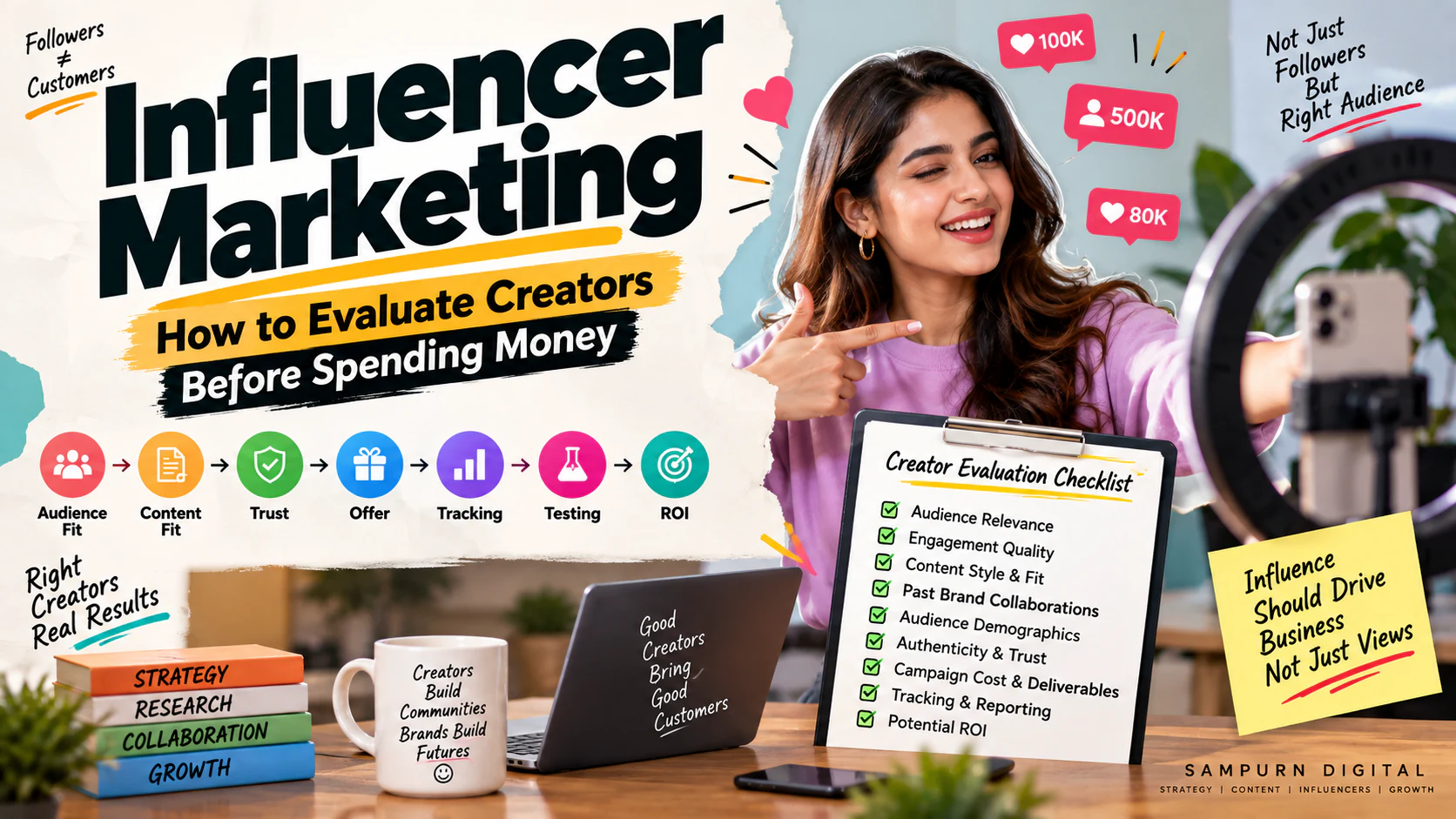
A creator has 500,000 followers.
Their Reels get hundreds of thousands of views.
Their comments look active.
They quote ₹75,000 for one campaign.
So should your business pay them?
Follower count can be impressive and still be commercially useless.
A creator can have:
- 500,000 followers
- 80,000 views per Reel
- 5,000 likes
- 300 comments
…and generate almost no qualified customers.
Meanwhile, a creator with 35,000 highly relevant followers might generate:
- 8,000 views
- 600 profile visits
- 150 website visits
- 25 enquiries
- 7 customers
The second creator could be dramatically more valuable.
That's why effective influencer marketing isn't:
It's:
This guide explains how to evaluate creators before spending money, how to compare influencer proposals, what numbers to ask for, how to structure a campaign, and how to calculate whether influencer marketing is actually working.
What Makes an Influencer Valuable?
The best creator isn't necessarily the person with the largest audience.
A commercially useful creator sits at the intersection of five factors:
×
×
×
×
If any one of these is extremely weak, the campaign can struggle.
For example:
Creator A
Followers: 500K Audience relevance: Low Engagement: High Business relevance: Low
Creator B
Followers: 45K Audience relevance: Very high Engagement: Strong Business relevance: High
For a specialized B2B or local business, Creator B may be the better choice.
Start With the Audience, Not the Creator
Before looking at follower count, answer:
Define:
- Age range
- Location
- Gender where relevant
- Language
- Profession
- Interests
- Buying situation
- Income level where relevant
- Business type
- Problem they are trying to solve
For example, suppose you run a premium interior design company in Ahmedabad.
Your target audience might be:
A creator with a large nationwide student audience isn't automatically useful.
Even if their engagement rate looks excellent.
Audience Fit Score
Create a simple score before contacting creators.
| Factor | Weight |
|---|---|
| Geographic fit | 20% |
| Demographic fit | 15% |
| Interest/topic fit | 25% |
| Buying intent | 25% |
| Language/cultural fit | 15% |
Score each factor from 1–5.
Example:
Creator A
Geographic fit: 5 Demographic fit: 4 Interest fit: 5 Buying intent: 4 Language fit: 5
Weighted score:
That's much more useful than saying:
“Creator A has 100K followers.”
Understand the Difference Between Followers and Reach
These numbers are not the same.
Followers
People who follow the creator.
Reach
Unique accounts that saw the content.
Impressions
Total times the content was displayed.
Views
Video plays or content views according to the platform's definition.
A creator with:
may only reach:
on a particular post.
Another creator with:
may regularly reach:
That's why you should ask for historical performance—not just follower count.
Ask Creators for Their Analytics
Before paying for a significant campaign, ask for relevant analytics.
Ideally request screenshots or platform-generated media kits showing:
- Follower demographics
- Top audience locations
- Age distribution
- Gender distribution where relevant
- Average Reel reach
- Average Story views
- Average post reach
- Engagement
- Profile visits
- Link clicks where available
- Recent campaign performance
Don't ask only:
“How many followers do you have?”
Ask:
“Can you share your last 30-day audience and content performance insights?”
That one question can eliminate many poor-fit creators.
Check Audience Geography
This is especially important for local businesses.
Suppose you're a Surat-based business.
Creator A:
| Location | Audience |
|---|---|
| Surat | 42% |
| Ahmedabad | 18% |
| Mumbai | 10% |
| Other | 30% |
Creator B:
| Location | Audience |
|---|---|
| Delhi | 31% |
| Mumbai | 22% |
| Bengaluru | 18% |
| Surat | 2% |
Creator A is probably more useful for a Surat-focused campaign—even if Creator B has five times more followers.
For local businesses:
Check Audience Quality
Follower count can be misleading.
You want to know:
Look for warning signs.
Warning sign 1
Sudden follower spikes.
Warning sign 2
Huge follower count but very low views.
Warning sign 3
Generic comments such as:
- Nice
- Amazing
- Wow
- Great content
with little meaningful discussion.
Warning sign 4
Audience geography doesn't match your market.
Warning sign 5
Engagement is unusually high but doesn't translate into profile visits or clicks.
Warning sign 6
Creator refuses to share basic audience information.
None of these automatically proves fraud.
But they should trigger deeper investigation.
Don't Obsess Over Engagement Rate Alone
Engagement rate is useful.
It isn't enough.
A creator may have:
but an audience that has almost no interest in your product.
Another creator may have:
but a highly relevant audience with strong buying intent.
Always evaluate:
rather than engagement alone.
Evaluate the Creator's Content
Look at their last 20–30 posts.
Don't just look at their best-performing content.
Look for:
- Consistency
- Quality
- Audience response
- Topic relevance
- Storytelling ability
- Brand integration
- Video quality
- Comment quality
- Posting frequency
Then ask:
If the answer is no, the audience may notice the advertisement immediately.
Look at Sponsored Content
This is one of the most useful checks.
Find previous brand collaborations.
Ask:
- Did the creator explain the product properly?
- Did the audience respond?
- Did the content feel natural?
- Was the CTA clear?
- Did comments show purchase interest?
- Did people ask questions?
- Did the creator make the product memorable?
A creator's previous sponsorships can reveal how they actually behave when money enters the relationship.
Check Brand Fit
Imagine your brand is premium.
But the creator's content is:
- highly promotional
- discount-heavy
- inconsistent
- low production quality
- unrelated to your positioning
Even if the campaign generates reach, it could weaken brand perception.
Create a simple brand-fit score.
| Factor | Score / 5 |
|---|---|
| Brand values | |
| Visual style | |
| Tone | |
| Audience | |
| Product category | |
| Content quality |
Target:
for strategic campaigns.
Evaluate Creator Trust
Influencer marketing works because people trust the creator.
So ask:
Look at comments.
Compare:
Weak signal
“Nice 🔥”
Strong signal
“Where can I buy this?”
“Does this work for a 2BHK?”
“What is the price?”
“Can you share the website?”
The second group demonstrates commercial curiosity.
That's much more valuable.
Micro vs Macro vs Nano Influencers
Don't assume bigger is better.
A simple way to categorize creators:
Nano
Very small audience.
Useful for:
- Local communities
- Highly specific niches
- Community trust
Micro
Smaller but often highly focused audience.
Useful for:
- Niche products
- Local businesses
- Specialized categories
- Strong engagement
Macro
Large audience.
Useful for:
- Awareness
- Product launches
- Broad market reach
Celebrity / Large creator
Massive distribution.
Useful when:
- Brand awareness is the primary objective
- Budget is substantial
- Distribution scale matters
Your choice should follow the objective.
Match Creator Type to Campaign Objective
Use this framework.
| Goal | Creator Type |
|---|---|
| Local awareness | Local micro creators |
| Niche authority | Micro / expert creators |
| Product education | Subject-matter creators |
| Mass awareness | Macro creators |
| Social proof | Trusted niche creators |
| UGC production | Content-focused creators |
| Lead generation | Relevant creators with action-oriented audiences |
This prevents the common mistake of hiring the most famous person available.
Calculate Cost Per Reach
Suppose Creator A charges:
Expected reach:
Cost per 1,000 reached:
More simply:
So:
Now compare Creator B:
Fee:
Expected reach:
Cost per 1,000:
Creator A is cheaper on a pure reach basis.
But that's still not enough.
Calculate Cost Per Meaningful Action
Suppose:
Creator A
₹40,000 campaign
- 80,000 reach
- 1,200 profile visits
- 200 website clicks
- 10 leads
Cost per lead:
Creator B
₹20,000 campaign
- 25,000 reach
- 800 profile visits
- 180 website clicks
- 15 leads
Cost per lead:
Creator B has:
- lower reach
- lower spend
- more leads
- dramatically lower CPL
So Creator B is commercially stronger.
Track Influencer Traffic Properly
Never rely entirely on:
“People saw the post.”
Give every meaningful creator campaign its own tracking.
Use:
- UTM parameters
- Dedicated landing pages
- Creator-specific coupon codes
- Creator-specific enquiry forms
- WhatsApp keywords
- Unique referral codes
Example:
Creator:
Campaign:
Tracking:
utm\_source=instagram utm\_medium=influencer utm\_campaign=sep2026 utm\_content=creator\_a
Now your analytics can distinguish traffic generated by the campaign.
Use Unique Landing Pages When Appropriate
Suppose you're running campaigns with three creators.
Instead of sending everyone to the homepage, create:
Or use campaign parameters if separate pages aren't necessary.
The goal is simple:
This becomes particularly important when you are spending ₹50,000, ₹1 lakh or more.
Give Every Creator a Unique Offer
For e-commerce, this can be:
For service businesses, it could be:
“Mention [Creator Name] when enquiring.”
For local businesses:
“Show this Story to receive the campaign offer.”
Now you can attribute conversions.
Without attribution, influencer marketing becomes:
“We think it worked.”
That's not a strategy.
Build an Influencer Campaign Funnel
A campaign can be structured like this:
Your job isn't just to maximize the first step.
You need to improve the entire journey.
If the creator generates 100 clicks but your landing page converts only 1%, the problem may not be the influencer.
It may be the conversion experience.
That's why influencer campaigns should connect to a proper lead generation website architecture when the goal is enquiries rather than awareness.
Evaluate the Offer Before Blaming the Creator
Suppose:
- 50,000 people saw your campaign
- 1,000 clicked
- 15 purchased
Your click-through rate may be acceptable.
But your conversion rate is:
The creator may not be the problem.
The offer could be:
- unclear
- expensive
- poorly presented
- badly timed
- difficult to purchase
- targeted at the wrong intent level
Influencer performance must be evaluated alongside:
Use a Creator Evaluation Scorecard
Before approving a creator, score them.
Audience
- Audience relevance: /10
- Geographic fit: /10
- Demographic fit: /10
Content
- Content quality: /10
- Brand fit: /10
- Storytelling: /10
Performance
- Average reach: /10
- Engagement quality: /10
- Click potential: /10
Commercial
- Previous campaign performance: /10
- Pricing efficiency: /10
- Conversion potential: /10
Maximum:
Set your own approval threshold.
For example:
The exact threshold isn't universal.
The framework is what matters.
Ask the Right Questions Before Signing
Send the creator or agency a structured questionnaire.
Audience
- What percentage of your audience is in our target location?
- What are the main age groups?
- What are the top audience interests?
- Which language does your audience primarily engage with?
Performance
- What is your average Reel reach?
- What is your average Story reach?
- What are your typical profile visits?
- What is your average link-click performance?
Commercial
- Which similar brands have you worked with?
- Can you share previous campaign results?
- What deliverables are included?
- How many revisions are included?
- Will the content remain live?
- Can the brand reuse the content?
Paid usage
- Can the brand run the creator's content as an ad?
- Is whitelisting/creator authorization included?
- For how long?
These questions can save substantial money.
Understand What You're Actually Buying
An influencer quote might say:
But what exactly does that include?
Maybe:
- 1 Reel
- 2 Stories
Or perhaps:
- 1 Reel
- 3 Stories
- 30 days usage rights
- Ad usage rights
- Raw footage
- Link in bio
- Exclusivity
These are very different packages.
Always separate:
Content Usage Rights Matter
Suppose you pay ₹40,000 for a creator Reel.
Then you discover the content performs extremely well organically.
You want to use it as a paid advertisement.
Can you?
Maybe not.
The contract may limit usage.
Clarify:
- Organic usage
- Paid advertising usage
- Duration
- Platforms
- Geographic restrictions
- Editing rights
- Raw footage rights
- Whitelisting / creator authorization
A low upfront fee can become expensive if usage rights are restrictive.
Consider Long-Term Partnerships
One-off campaigns can work.
But long-term creator relationships can be stronger.
Why?
Because the audience gets used to the association.
Instead of:
you can build:
For example:
Month 1:
Product introduction
Month 2:
How-to content
Month 3:
Customer use case
Month 4:
Results / testimonial
This creates a stronger narrative.
Don't Over-Control the Creator
You know your product.
The creator knows their audience.
If your brief says:
“Read this exact 180-word script exactly as written.”
you may destroy the creator's natural communication style.
Give creators:
Must say
- Key benefit
- Product name
- Offer
- CTA
- Mandatory facts
Must avoid
- Incorrect claims
- Competitor comparisons if restricted
- Unapproved promises
- Misleading statements
Creative freedom
Let the creator decide:
- Hook
- Delivery
- Storytelling
- Visual style
- Natural language
The best campaigns often feel native to the creator's content.
Build a Strong Influencer Brief
A good brief should contain:
Campaign
Campaign objective
Audience
Who we're trying to reach
Product
What is being promoted
Problem
What problem does it solve?
Key benefit
What should viewers remember?
Proof
What evidence supports the claim?
Offer
What should viewers receive?
CTA
What should they do next?
Mandatory points
What must be included?
Restrictions
What must not be said?
Deliverables
Exact number of:
- Reels
- Stories
- Posts
- Links
Tracking
Unique URL/code/keyword
This protects both sides.
Use a Test-Before-Scale Strategy
Don't start with:
unless you already have strong evidence.
Start smaller.
For example:
Test
₹25,000–₹50,000
3–5 creators
Different audience sizes
Different creative approaches
Measure:
- Reach
- Engagement
- Clicks
- Leads
- Qualified leads
- Sales
Then identify winners.
Scale
Increase spend toward creators and content angles that demonstrate commercial value.
This is much safer than betting the entire budget on one creator.
Test Different Creator Profiles
Suppose you have ₹1 lakh.
Don't automatically spend:
Consider testing:
- 2 micro creators
- 2 niche creators
- 1 larger creator
Now you can compare:
This creates your own benchmark.
Example: ₹1 Lakh Influencer Test
Imagine:
| Creator | Spend | Reach | Clicks | Leads | Sales |
|---|---|---|---|---|---|
| A | ₹20K | 30K | 90 | 5 | 1 |
| B | ₹20K | 22K | 150 | 12 | 3 |
| C | ₹20K | 40K | 100 | 6 | 1 |
| D | ₹20K | 18K | 170 | 15 | 4 |
| E | ₹20K | 60K | 80 | 3 | 0 |
Who won?
Creator E had the highest reach.
Creator D produced the strongest business result.
That's exactly why follower count and reach should not be your final decision criteria.
Calculate Revenue and ROI
Suppose Creator D generated:
15 leads
4 customers
Average order value:
₹18,000
Revenue:
Campaign cost:
Basic ROAS:
So:
But don't stop there.
If your gross margin is only 25%, the economics may be very different.
Influencer ROI should ultimately be evaluated against the business's actual unit economics.
Separate ROAS From Profitability
Revenue isn't profit.
Suppose:
Revenue:
₹72,000
Campaign:
₹20,000
Product/service delivery cost:
₹35,000
Other selling costs:
₹8,000
Remaining contribution:
The campaign generated revenue.
But the actual economic return may be weak.
So evaluate:
when enough data is available.
Influencer Marketing for Service Businesses
Influencer marketing isn't only for fashion and food.
It can work for:
- Interior design
- Real estate
- Education
- Fitness
- Beauty
- Hospitality
- Healthcare marketing where appropriate
- Local services
- Business services
- Professional expertise
But the content format changes.
For a service business, consider:
Educational collaboration
Creator interviews an expert.
Problem-solving content
Creator explains a common customer problem.
Case study
Show transformation or outcome.
Experience content
Creator documents the service experience.
Expert collaboration
Creator and business expert create content together.
This can build authority rather than simply pushing a product.
Local Influencer Campaigns
Local businesses should pay particular attention to:
- City
- Neighborhood
- Language
- Local culture
- Local purchasing behavior
A creator with:
can outperform a creator with:
for a local restaurant, salon, clinic, real estate project or service business.
The question is:
Red Flags That Should Make You Pause
Be cautious when a creator:
- refuses to share analytics
- guarantees a specific number of sales
- focuses only on follower count
- has suspicious follower growth
- has inconsistent engagement
- has an audience unrelated to your target
- has too many competing brand promotions
- cannot explain previous campaign results
- demands full payment before clearly defining deliverables
- refuses reasonable tracking
- won't clarify content usage rights
No single red flag proves a creator is unsuitable.
But multiple red flags should trigger deeper evaluation.
Don't Buy Guaranteed Sales
Be extremely cautious with promises like:
“We'll guarantee 100 sales.”
Influencer marketing involves variables outside the creator's control:
- Offer
- Pricing
- Product
- Website
- Seasonality
- Audience intent
- Creative
- Checkout
- Follow-up
A creator can influence attention and trust.
They cannot control every step of your sales funnel.
Instead, establish measurable campaign targets around:
- Reach
- Clicks
- Leads
- Qualified leads
- Sales
- Revenue
Build an Influencer Testing Matrix
Track each campaign consistently.
| Creator | Audience Fit | Reach | CTR | Leads | CPL | Sales | Revenue | ROI |
|---|---|---|---|---|---|---|---|---|
| A | 8/10 | 30K | 0.30% | 5 | ₹4K | 1 | ₹18K | 0.9× |
| B | 9/10 | 22K | 0.68% | 12 | ₹1.67K | 3 | ₹54K | 2.7× |
| C | 6/10 | 40K | 0.25% | 6 | ₹3.33K | 1 | ₹18K | 0.9× |
| D | 10/10 | 18K | 0.94% | 15 | ₹1.33K | 4 | ₹72K | 3.6× |
Now you can make an evidence-based decision.
Turn Winning Creators Into a Scalable System
Once you identify a winner, don't simply repeat the exact same campaign.
Test:
Same creator + new hook
Same creator + new product angle
Same creator + new offer
Same creator + testimonial
Same creator + educational content
Same creator + paid amplification
This creates a creative testing system.
And once you have organic creator content that performs well, you can consider feeding those proven assets into your paid social strategy rather than starting paid creative testing from zero.
Influencer Content Can Become Paid Creative
This is one of the most valuable opportunities.
Suppose a creator publishes a Reel organically.
It generates:
- Strong watch time
- High engagement
- 200 clicks
- 25 leads
You now have a signal.
Instead of stopping there:
This connects influencer marketing with your wider performance marketing funnel.
Build a Retargeting Layer
Not everyone who sees creator content will buy immediately.
Some will:
- Watch
- Visit profile
- Click
- Browse
- Leave
You can use retargeting to continue the conversation where appropriate.
For example:
This is where influencer campaigns can become more than one-off awareness activities.
They can become an acquisition funnel.
Use a 30-Day Influencer Campaign Plan
Week 1 — Research
Shortlist:
Evaluate:
- Audience
- Location
- Content
- Engagement
- Previous sponsorships
Week 2 — Shortlist
Select:
Request:
- Media kit
- Analytics
- Rates
- Deliverables
- Usage rights
Week 3 — Test
Run:
- Cost
- Reach
- Clicks
- Leads
- Sales
- Revenue
Then choose:
The Influencer Selection Checklist
Before spending money, confirm:
Audience
- Audience matches target market
- Geography matches
- Demographics match
- Interests match
- Buying intent appears relevant
Content
- Content quality is strong
- Brand fit is strong
- Creator communicates naturally
- Previous sponsored content looks credible
Performance
- Recent analytics reviewed
- Average reach checked
- Engagement quality checked
- Previous campaign data requested
Commercial
- Deliverables documented
- Fee documented
- Usage rights documented
- Paid usage clarified
- Tracking method established
- CTA established
Measurement
- Unique URL/code created
- Leads can be attributed
- Sales can be tracked
- ROI calculation defined
If several boxes remain unchecked, don't rush into payment.
The 10-Point Creator Decision Test
Before final approval, ask:
- Does this creator reach our actual audience?
- Is their audience concentrated in our market?
- Does their content fit our brand?
- Do people trust their recommendations?
- Is engagement meaningful?
- Do previous brand collaborations look credible?
- Can we track the campaign?
- Are the deliverables worth the price?
- Do we have the required usage rights?
- Is there a realistic path from attention to revenue?
If you can't confidently answer several of these questions, the creator isn't ready for approval.
