
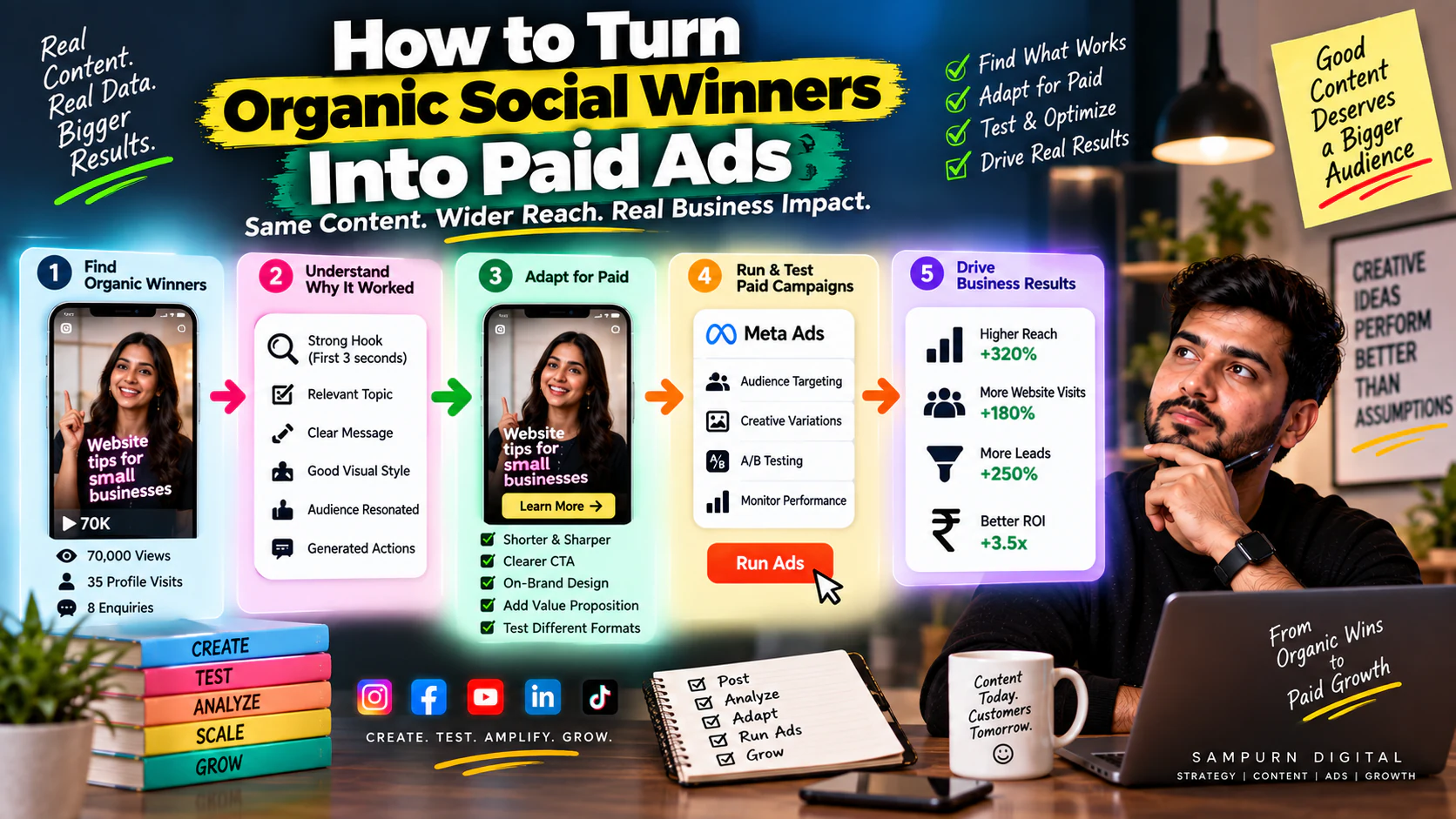
You publish a Reel organically.
It gets 8,000 views.
Another gets 70,000.
One gets 12,000 views but generates 35 profile visits and 8 enquiries.
Now you have a question:
Sometimes, yes.
But there is a major mistake businesses make when turning organic content into paid ads:
They simply take the post that performed well and press Boost.
That is not a paid creative strategy.
Organic and paid social have different jobs.
Organic content helps you discover what your audience responds to.
Paid advertising helps you deliberately put a message in front of a defined audience and drive a business outcome.
The real opportunity is to use organic content as a creative learning laboratory.
Find what works.
Understand why it works.
Adapt it for paid distribution.
Then test it against other creatives.
This guide explains how to turn organic social winners into paid ads without assuming that every viral post deserves an advertising budget.
What Does "Organic Winner" Actually Mean?
An organic winner is not necessarily the post with the highest reach.
A winning post should be judged against its objective.
For example:
Awareness winner
- High relevant reach
- Strong watch time
- High completion
- Strong shares
Engagement winner
- Saves
- Shares
- Comments
- Meaningful conversations
Traffic winner
- Profile visits
- Link clicks
- Website sessions
Lead-generation winner
- DMs
- Enquiries
- Qualified leads
- Sales opportunities
This matters because:
A funny Reel might generate huge organic reach.
A specific educational Reel might generate fewer views but attract exactly the audience you want.
For paid acquisition, the second may be more valuable.
Why Organic Winners Can Be Useful Paid Creative Candidates
Organic content gives you something paid advertising often lacks:
Before spending a significant budget, you can observe:
- Which hooks stop attention
- Which topics generate interest
- Which messages create discussion
- Which formats people consume
- Which problems resonate
- Which CTAs create action
This does not guarantee paid success.
But it can reduce some of the guesswork involved in creative development.
Think of organic content as a signal generator, not a guaranteed ad-testing system.
Organic Reach and Paid Reach Are Different
An organic post may perform well because:
- Existing followers already trust you
- People share it with friends
- The platform distributes it to similar users
- The topic fits current conversations
- Your audience knows the creator
A paid ad reaches people who may have never heard of you.
That changes the environment.
A Reel that works for followers may need a different hook for a cold audience.
This is why:
Instead:
Identify Your Organic Winners
Start by reviewing your recent content.
Create a table like:
| Content | Reach | Saves | Shares | Profile Visits | Leads |
|---|---|---|---|---|---|
| Reel A | 12,000 | 240 | 85 | 180 | 5 |
| Reel B | 65,000 | 310 | 90 | 110 | 1 |
| Reel C | 9,500 | 420 | 150 | 260 | 11 |
| Reel D | 18,000 | 180 | 55 | 90 | 2 |
Which is the winner?
If the objective is awareness, B may be interesting.
If the objective is lead generation, C is much more interesting.
Always start with the business objective.
Score Organic Content
You can create a simple creative score.
For example:
- Relevance × 30%
- Engagement quality × 20%
- Intent × 25%
- Conversion contribution × 25%
The exact weighting can change depending on your goal.
The important point is to avoid ranking content by views alone.
A post that generates:
may deserve more attention than:
Understand Why the Content Worked
Don't just save the URL.
Break the creative apart.
Ask:
Hook
What made people stop?
Topic
What problem was being discussed?
Angle
What perspective made it interesting?
Format
Was it:
- Talking head?
- Screen recording?
- Before/after?
- Carousel?
- Demonstration?
Proof
Was there evidence?
Emotion
Did it create:
- Curiosity?
- Concern?
- Surprise?
- Confidence?
- Urgency?
CTA
What action did people take?
You are looking for the underlying creative pattern.
Example: Breaking Down an Organic Winner
Suppose a Reel generated strong results.
The Reel says:
“Your Google Ads may be generating leads—but your sales team may still hate them.”
Why might it work?
Hook
Creates tension.
Audience
Targets businesses running paid advertising.
Problem
Lead quality.
Angle
Marketing and sales alignment.
Curiosity
The viewer wants to know why.
Commercial relevance
The problem costs money.
The lesson is not simply:
“This exact Reel works.”
The deeper lesson might be:
Business pain + specific audience + tension-based hook + financial consequence
Now you can build multiple paid creatives from that pattern.
Decide Whether the Winner Is Suitable for Paid Ads
Ask five questions.
Is the audience commercially relevant?
If the content attracted mostly entertainment-seeking users, it may not be useful for lead generation.
Is the problem connected to your offer?
If not, paid traffic may generate attention without business value.
Can the message work with a cold audience?
A follower may understand your context.
A stranger may not.
Is the content adaptable?
Can you shorten, rewrite or restructure it?
Is there a clear next step?
If someone becomes interested, where should they go?
If the answer to these questions is mostly yes, the creative is worth testing.
Separate the Hook From the Core Idea
One of the easiest ways to turn organic content into paid creative is to extract the core idea.
Suppose the organic Reel is:
“5 reasons your website isn't generating leads.”
The core idea is:
Now create multiple paid hooks.
Hook 1
“Getting website traffic but no enquiries?”
Hook 2
“Your website may be losing leads you already paid to acquire.”
Hook 3
“5 website mistakes that can quietly reduce conversions.”
Hook 4
“Before spending more on ads, check your website.”
Same core topic.
Different entry points.
Now you have multiple paid creative concepts.
Rewrite for the Cold Audience
Organic content can assume familiarity.
Paid ads should usually provide context faster.
Organic:
“Here's another mistake we see clients make.”
Paid:
“If your business is spending money on Google or Meta Ads but your website isn't converting visitors into enquiries, this may be the problem.”
The second version explains:
- Who
- What problem
- Why it matters
without assuming the viewer knows you.
Create a Paid Version Instead of Copying the Organic Post
Sometimes the best approach is not to promote the original post.
Rebuild it.
For example:
Organic version
45-second educational Reel.
Paid version
25-second version:
“Paying for traffic but not getting enough enquiries?”
“Your landing page may be creating the bottleneck.”
- Weak headline
- Unclear offer
- Poor CTA
Brief example.
“See our landing-page checklist.”
Now the idea has been adapted for paid traffic.
Create Multiple Variations
Do not put the entire budget behind one creative.
Turn one organic winner into a creative family.
For example:
Concept
Landing-page conversion problems.
Create:
Version A: Problem hook
Version B: Financial-loss hook
Version C: Before/after hook
Version D: Founder explanation
Version E: Screen-recording audit
Version F: Customer question
You now have a structured creative test rather than one ad.
Keep the Creative Concept, Change the Presentation
A strong concept can be presented in several ways.
Talking-head version
Founder explains the issue.
Screen-recording version
Show the actual website problem.
Whiteboard version
Draw the conversion journey.
Case-study version
Show what changed.
Carousel version
Explain the framework visually.
Voice-over version
Show examples while explaining them.
The goal is to determine whether the idea or the presentation is driving performance.
Match the Ad to the Funnel Stage
An organic winner can be adapted for different audiences.
Cold audience
Focus on:
- Problem
- Education
- Curiosity
- Awareness
CTA:
Warm audience
Focus on:
- Proof
- Comparison
- Process
- Objections
CTA:
Retargeting audience
Focus on:
- Case studies
- Testimonials
- Offer
- Risk reduction
- Strong CTA
CTA:
This creates a much stronger paid funnel than showing the same creative to everyone.
Connect the Ad to the Right Destination
This is where many campaigns fail.
Suppose your winning organic content is:
“Why your Meta Ads generate clicks but no leads.”
Do not send traffic to your generic homepage.
Send it to something relevant:
or:
or:
The message should continue.
Think:
If these three don't match, performance can suffer.
Use the Same Problem Across the Funnel
Suppose the ad starts with:
“Your paid ads generate leads but sales can't close them.”
The landing page should continue that conversation.
Landing-page headline
“Turn More Paid Leads Into Qualified Sales Opportunities.”
Then explain:
- Lead quality
- Campaign targeting
- Search terms
- Landing pages
- Tracking
- Qualification
The user should feel:
“Yes, this is exactly what I clicked for.”
That is message continuity.
Use Organic Content to Find Angles, Not Just Creatives
A powerful organic-to-paid workflow is:
For example, you discover that:
“Marketing leads are not the same as sales-ready leads.”
generates unusually strong engagement.
That tells you something about the audience's concern.
Now build paid creative around that insight.
The real asset is the angle.
Test Paid Creative Properly
Once the organic winner is adapted, treat it like a paid experiment.
Test:
- Hook
- Creative format
- Message
- Offer
- CTA
- Audience
- Landing page
But don't change everything simultaneously.
For example:
Test 1
Same audience + same landing page + different hooks.
Then:
Test 2
Winning hook + different creative formats.
Then:
Test 3
Winning creative + different landing pages.
This gives you cleaner information.
For a deeper framework, connect this process with paid ad creative testing without guessing.
Watch for Creative Fatigue
An organic winner can become a poor paid ad after repeated exposure.
Watch for:
- Falling CTR
- Rising CPC
- Lower engagement
- Reduced conversion rate
- Increasing frequency
- Negative feedback
If performance declines, don't immediately conclude the concept is dead.
You may only need:
- New hook
- New opening frame
- New visual
- New edit
- New proof
- New CTA
Keep the underlying winning idea while refreshing the presentation.
Know When NOT to Turn an Organic Winner Into an Ad
Do not promote a post simply because it went viral.
Avoid using organic content as paid creative when:
It attracted the wrong audience
Lots of views from people who cannot buy.
It depends on existing followers
The message requires context unavailable to strangers.
It has entertainment value but no commercial relevance
Great for reach.
Weak for acquisition.
It has no logical offer
There is nowhere meaningful to send the audience.
The result was a one-off trend
The performance came from a temporary event rather than a repeatable insight.
It cannot be adapted
Some content works because of its exact organic context.
Not everything should become an advertisement.
Organic Winner vs Paid Winner
These are different concepts.
Organic winner
The audience voluntarily engaged with the content.
Paid winner
The creative produces efficient results when intentionally distributed to a defined audience.
A post can be:
or:
This is why paid testing still matters.
Organic performance is a signal.
It is not proof.
Build an Organic-to-Paid Creative Scorecard
Use:
| Factor | Score / 5 |
|---|---|
| Audience relevance | /5 |
| Problem intensity | /5 |
| Commercial relevance | /5 |
| Hook strength | /5 |
| Proof | /5 |
| Adaptability | /5 |
| CTA potential | /5 |
| Landing-page fit | /5 |
Total:
A creative scoring 34/40 is a stronger candidate for paid testing than one scoring 18/40.
This doesn't guarantee performance.
It simply helps prioritize testing resources.
Example: Turning One Organic Winner Into 6 Paid Ads
Organic winner
“Why your Reels get views but no leads.”
Paid Ad 1 — Problem
“Thousands of views but no enquiries?”
Paid Ad 2 — Financial
“Your social content may be generating attention without generating customers.”
Paid Ad 3 — Diagnostic
“Check these three things if your Reels aren't producing leads.”
Paid Ad 4 — Contrarian
“More Reel views won't fix a broken conversion journey.”
Paid Ad 5 — Proof
“Here's what we changed when content was generating attention but not enquiries.”
Paid Ad 6 — Founder-led
“If I had to fix a business's social lead generation today, I'd start here.”
One idea.
Six creative angles.
Now the paid campaign has room to learn.
Measure the Right Paid Metrics
Once the creative enters paid distribution, track:
Attention
- Thumb-stop/initial retention indicators
- Video views
- Watch time
Engagement
- Clicks
- Shares
- Saves where relevant
Traffic
- CTR
- Landing-page sessions
Acquisition
- Leads
- Cost per lead
- Qualified leads
- Cost per qualified lead
Business
- Sales opportunities
- Customers
- Revenue
- ROAS where appropriate
Do not stop at:
“This ad got the cheapest CPC.”
Cheap clicks are not necessarily valuable customers.
Calculate Cost Per Qualified Lead
Suppose:
Then:
But:
The second number may be far more important for the business.
This is why organic-to-paid creative testing should eventually connect with lead quality.
Build a Creative Learning Loop
Your system should look like:
This creates a feedback loop between organic and paid marketing.
Paid performance can even teach your organic team which messages deserve further exploration.
A Practical 30-Day Organic-to-Paid Workflow
Week 1 — Audit
Review your last 30–60 days of content.
Identify:
- High-reach posts
- High-save posts
- High-share posts
- High-click posts
- Lead-generating posts
Week 2 — Extract Patterns
For the best posts, document:
- Hook
- Topic
- Audience
- Angle
- Format
- Proof
- CTA
Find repeated patterns.
Week 3 — Adapt
Choose 2–3 organic winners.
Create multiple paid variations.
Build matching landing pages or destinations.
Week 4 — Test
Launch controlled creative tests.
Track:
- CTR
- CPC
- Leads
- Qualified leads
- Cost per qualified lead
Then document what you learned.
A Simple Organic-to-Paid Workflow for Teams
Assign clear responsibilities.
Social team
Finds promising organic content.
Strategist
Identifies the underlying creative insight.
Copywriter
Develops paid hooks and messaging.
Designer/video editor
Creates variations.
Paid media team
Runs the tests.
Analytics team
Connects performance to leads and revenue.
This prevents the common problem where organic and paid teams operate as completely separate departments.
The 7 Questions to Ask Before Putting Budget Behind a Post
- Did it attract the right audience?
- What exactly made it perform well?
- Is the problem commercially relevant?
- Can the idea work with people unfamiliar with the brand?
- Can we create multiple variations?
- Is there a relevant landing page or destination?
- Can we measure the business outcome?
If you cannot answer these questions, don't automatically spend money behind the post.
First understand the creative.
Common Mistakes
Mistake 1: Boosting every viral post
Fix: Select content based on business relevance.
Mistake 2: Copying the organic post exactly
Fix: Adapt the message for the paid audience and funnel stage.
Mistake 3: Testing only one creative
Fix: Build multiple variations from the winning concept.
Mistake 4: Measuring only CTR
Fix: Track leads, qualified leads and revenue.
Mistake 5: Sending traffic to the homepage
Fix: Match the destination to the creative promise.
Mistake 6: Assuming organic success guarantees paid success
Fix: Treat organic performance as a hypothesis, then validate it through paid testing.
The Bigger Opportunity
The most valuable outcome of organic social is not simply free reach.
It is learning.
Every strong post can tell you something about:
- Customer pain
- Messaging
- Hooks
- Objections
- Content formats
- Positioning
- Offers
Then paid media can help you test those insights at greater scale.
This creates a much more intelligent marketing system.
Instead of asking:
“What should we advertise?”
you can ask:
“What have we already learned from our audience, and how can we test that insight with paid distribution?”
That is a much stronger starting point.
SEO Publishing Information
Blog ID: SMM-17 Category: Social Media Marketing Stage: Improve Primary Keyword: turn organic social content into paid ads Supporting Keywords: boost organic winners with ads; organic to paid social strategy; Meta creative testing Search Intent: Commercial Investigation Funnel Stage: Solution Aware Pillar Page: Social Media Marketing Services Suggested URL: `/blog/social-media-marketing/how-to-turn-organic-social-winners-into-paid-ads` Content Role: Optimization / measurement resource Publishing Sprint: Sprint 4 CTA: Get a social media growth strategy / Explore Social Media Marketing
Meta Title: How to Turn Organic Social Winners Into Paid Ads
Meta Description: Learn how to turn organic social winners into paid ads using creative analysis, audience insights, hook testing, paid variations, landing pages and business-focused metrics.
H1: How to Turn Organic Social Winners Into Paid Ads
