
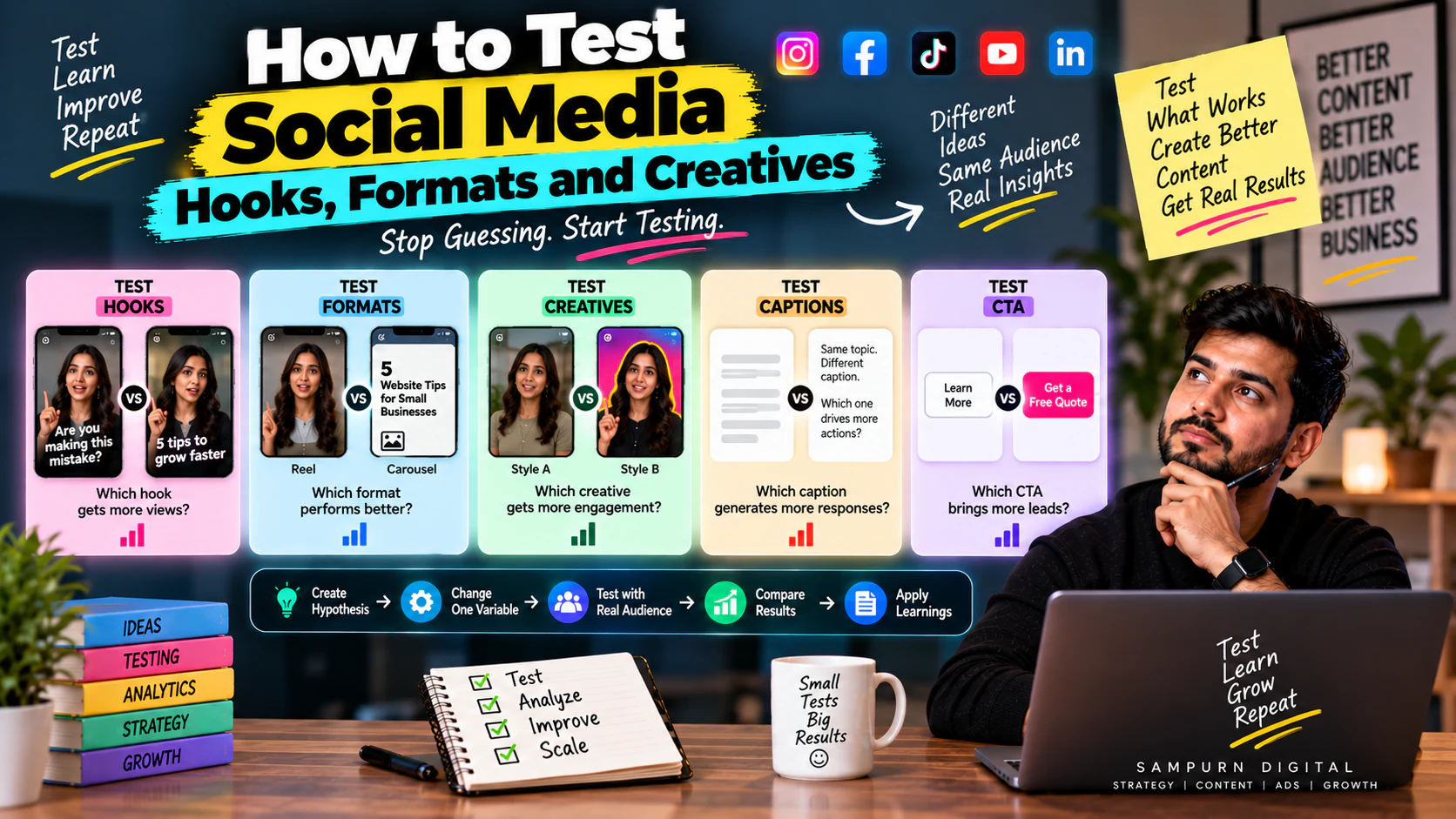
Your social media post underperformed.
What do you change?
The hook?
The format?
The topic?
The thumbnail?
The caption?
The CTA?
The creative?
Most businesses change everything at once.
Then they publish another post.
If it performs better, they have no idea why.
If it performs worse, they have even less information.
That is not testing.
That is guessing.
A better social media strategy treats content like an experiment.
You identify what you want to improve, change one meaningful variable, compare the result, and use the learning to decide what to create next.
This is how you build a social media creative testing framework that produces useful insights instead of random winners and losers.
What Is Social Media Creative Testing?
Social media creative testing is the process of systematically comparing different versions of content to determine what improves performance.
You can test:
- Hooks
- Topics
- Formats
- Visual styles
- Opening frames
- Video lengths
- Headlines
- CTAs
- Story structures
- Captions
- Offers
- Creators
- Presentation styles
The objective is not simply:
“Find the post with the most views.”
The objective is:
Understand which content variables consistently produce better outcomes for your audience and business.
That distinction matters.
A Reel with 100,000 views may teach you something about reach.
A Reel with 8,000 views and 20 qualified enquiries may teach you something about conversion.
You need to know which outcome you're optimizing.
Why Businesses Struggle to Test Social Content
The biggest problem is usually an uncontrolled experiment.
Imagine you publish:
Reel A
- Educational topic
- Talking-head format
- 20-second video
- Problem-based hook
- Direct CTA
Then publish:
Reel B
- Completely different topic
- Carousel-style edit
- 45-second video
- Curiosity hook
- No CTA
If B performs better, what did you learn?
Almost nothing.
You changed too many variables.
A useful test should answer a specific question.
For example:
“Does a problem-focused hook generate more qualified engagement than a curiosity hook when the topic and format remain the same?”
Now you can learn something.
The Social Media Testing Formula
Use this structure:
For example:
Hypothesis
Problem-specific hooks will generate stronger retention.
Variable
Hook.
Control
Same topic, format and core script.
Test
Version A vs Version B.
Measure
Watch time + profile visits.
Learn
Determine which hook creates stronger attention and intent.
Apply
Use the winning hook pattern on future topics.
This creates a repeatable testing system.
What Should You Test First?
Do not test everything simultaneously.
Prioritize variables based on how strongly they can affect performance.
A practical testing order is:
- Hook
- Topic
- Format
- Creative presentation
- CTA
- Caption
- Length
- Visual details
Why start with the hook?
Because if people do not stop watching, the quality of the rest of the content may not matter.
But if your content consistently attracts attention and still generates no meaningful action, the problem may be further down the funnel.
Test One Variable at a Time
Suppose your Reel is about:
“Why your website gets traffic but no leads.”
Create two versions.
Version A
“Getting traffic but no enquiries? Your website may have a conversion problem.”
Version B
“Your website can rank well and still lose potential customers.”
Keep the rest approximately the same.
Now you are testing the hook.
If you also change:
- Video length
- Background
- Speaker
- Topic
- CTA
- Editing
you won't know which change mattered.
Testing Hooks
Hooks are one of the most useful variables to test.
A hook determines the initial promise of the content.
Problem Hook
“Your Instagram gets views but no enquiries. Here's why.”
Mistake Hook
“You're probably making this mistake with your Reels.”
Curiosity Hook
“This is why some low-view Reels generate more leads.”
Contrarian Hook
“More Instagram views can actually be useless for your business.”
Specific-number Hook
“3 reasons your Reels aren't generating leads.”
Audience-specific Hook
“If you run a service business, stop creating Reels like this.”
The topic can remain constant.
Only the entry point changes.
Build a Hook Testing Matrix
| Hook Type | Example | Best For |
|---|---|---|
| Problem | Why your Reels get views but no leads | Problem awareness |
| Mistake | Stop making this Reel mistake | Education |
| Curiosity | Here's what most businesses miss | Discovery |
| Contrarian | More views aren't always better | Authority |
| Number | 5 reasons your content fails | Scannability |
| Audience-specific | If you're a B2B founder... | Relevance |
| Outcome | How to turn views into enquiries | Conversion |
Over time, you may discover that your audience responds particularly well to certain hook categories.
That becomes a reusable insight.
Testing Topics
Sometimes the hook is not the problem.
The topic itself may be weak.
Suppose you publish:
“5 social media design tips”
and it gets weak engagement.
You could test a more commercially relevant topic:
“5 reasons your social media content isn't generating enquiries.”
The second topic connects more directly to a business problem.
Track which topics consistently generate:
- Saves
- Shares
- Profile visits
- Website clicks
- DMs
- Leads
This helps you identify content-market fit.
Create a Topic Scorecard
Score potential topics from 1–5.
| Factor | Score |
|---|---|
| Customer relevance | /5 |
| Business relevance | /5 |
| Audience pain | /5 |
| Expertise | /5 |
| Differentiation | /5 |
| Conversion potential | /5 |
Total possible:
A topic scoring 26/30 should generally receive more attention than one scoring 14/30.
This is especially useful when your team has dozens of ideas but limited production capacity.
Testing Formats
The same idea can be presented as:
- Reel
- Carousel
- Static graphic
- Story
- Text post
- Live session
- Short tutorial
- Case-study video
For example:
Topic
“Why your landing page doesn't convert.”
Test:
Version A: 30-second Reel
Version B: 7-slide carousel
Version C: LinkedIn text post
You may discover that:
- Reels generate reach
- Carousels generate saves
- LinkedIn posts generate conversations
- Stories generate DMs
That does not mean one format is universally better.
It means each format may have a different job.
Test Formats Against the Correct KPI
This is critical.
Do not compare every format using views.
Instead:
| Format | Primary KPI |
|---|---|
| Reel | Watch time / retention |
| Carousel | Saves / shares |
| Story | Replies / clicks |
| LinkedIn post | Comments / profile visits |
| Conversion post | Leads |
| Case study | Website clicks / enquiries |
A carousel getting 4,000 impressions and 200 saves may be performing extremely well even if a Reel gets 20,000 views.
Different formats create different types of value.
Testing Creative Presentation
Creative presentation includes:
- On-camera vs voice-over
- Talking head vs screen recording
- Text-heavy vs visual
- Founder-led vs team-led
- Product demonstration
- Customer testimonial
- Before/after
- Screen capture
- Animation
For example:
Test A
Founder speaking directly to camera.
Test B
Screen recording showing the actual dashboard/process with voice-over.
Same topic.
Same CTA.
Now you can learn whether your audience responds better to personality or demonstration.
Testing the Opening Frame
The first frame can also influence whether someone stops.
Test:
Version A
Person speaking.
Version B
Large problem statement.
Version C
Screenshot/example.
Version D
Before/after result.
For example:
may create a different response from:
The stronger version is determined by your audience and objective—not by personal preference.
Testing Video Length
Do not assume shorter always wins.
A 12-second Reel may create strong reach.
A 45-second Reel may produce stronger qualified engagement because it has enough time to explain a complicated problem.
Test:
- 15 seconds
- 30 seconds
- 45 seconds
- 60 seconds
But keep the topic and core message reasonably consistent.
Measure:
- Retention
- Average watch time
- Completion rate
- Profile visits
- Clicks
- Leads
The goal is not maximum watch time.
The goal is appropriate attention for the business objective.
Testing CTAs
Your CTA can change the action a viewer takes.
Test:
CTA A
“Save this checklist.”
CTA B
“Follow for more practical marketing strategies.”
CTA C
“Read the full guide.”
CTA D
“Send us a message.”
CTA E
“Request an audit.”
These represent different levels of intent.
A low-intent educational Reel may perform better with:
A high-intent service Reel may perform better with:
Do not evaluate CTAs only by raw engagement.
Evaluate whether the action contributes to the desired business outcome.
Testing Captions
Captions can support the content, but they should not be expected to rescue a weak Reel.
Test different structures:
Short caption
One insight + CTA.
Educational caption
Additional explanation.
Story-driven caption
Problem → experience → lesson.
Question caption
Ask the audience for their experience.
Resource caption
Provide a reason to visit the website.
Keep the core content consistent where possible.
Build a Proper Test Matrix
A simple testing sheet could look like:
| Test | Variable | Version A | Version B | KPI | Winner |
|---|---|---|---|---|---|
| 01 | Hook | Problem | Curiosity | Retention | A |
| 02 | Format | Reel | Carousel | Saves | B |
| 03 | CTA | Save | Read guide | Clicks | B |
| 04 | Creative | Talking head | Screen recording | Watch time | A |
| 05 | Length | 20 sec | 40 sec | Completion | A |
Now your team builds a library of insights.
That is much more valuable than simply storing post-performance screenshots.
Create a Testing Hypothesis
Before publishing a test, complete this sentence:
“We believe [change] will improve [metric] because [reason].”
Example:
We believe a problem-specific opening will improve retention because it immediately identifies the viewer's pain point.
Another:
We believe case-study Reels will generate more qualified profile visits because they demonstrate actual outcomes rather than general advice.
This forces the team to think strategically.
What Counts as a Good Test?
A good test has:
One clear variable
You know what you're changing.
One clear objective
You know what you're trying to improve.
A meaningful comparison
The versions are sufficiently similar to isolate the variable.
Enough observations
You avoid declaring a winner from tiny differences.
A documented result
You record what happened.
An action
You use the learning in future content.
Without the last step, testing has little value.
Don't Declare a Winner Too Quickly
Suppose:
Reel A
10,000 views
Reel B
11,000 views
That does not automatically mean B is better.
The difference may be normal variation.
Look at multiple signals.
For example:
| Metric | A | B |
|---|---|---|
| Views | 10,000 | 11,000 |
| Saves | 300 | 420 |
| Shares | 80 | 130 |
| Profile visits | 150 | 240 |
| Website clicks | 20 | 35 |
| Leads | 2 | 5 |
Now B is much more interesting.
The important insight may not be:
“B got 10% more views.”
It may be:
“B produced substantially stronger intent.”
That is a useful business insight.
Use a Minimum Evidence Rule
Avoid changing strategy based on one post.
Instead, look for repeated patterns.
For example:
Test 1: Problem hooks win.
Test 2: Problem hooks win.
Test 3: Problem hooks win.
Now you have stronger evidence.
You can begin treating that hook structure as a working hypothesis for future content.
Not an eternal rule.
Keep testing.
Don't Optimize for Vanity Metrics
A social media test should be connected to the actual objective.
If the objective is awareness:
If the objective is engagement:
If the objective is traffic:
If the objective is lead generation:
If the objective is sales:
The metric should match the job.
Build a Testing Hierarchy
Use three levels.
Level 1 — Attention
- Reach
- Views
- Retention
- Watch time
Question:
Level 2 — Intent
- Profile visits
- Saves
- Shares
- Website clicks
- DMs
Question:
Level 3 — Business
- Leads
- Qualified leads
- Sales opportunities
- Customers
- Revenue
Question:
This prevents your team from celebrating attention that never becomes intent.
Test Content According to Funnel Stage
Different funnel stages need different experiments.
Problem-aware
Test:
- Hooks
- Topics
- Relevance
- Reach
Solution-aware
Test:
- Educational formats
- Frameworks
- Depth
- CTAs
Product-aware
Test:
- Proof
- Case studies
- Objection handling
- Service messaging
High-intent
Test:
- Offers
- CTAs
- Landing-page destinations
- Lead-generation mechanisms
Testing should follow the audience's intent.
Example: Testing a Lead-Generation Reel
Suppose the topic is:
Create two hooks.
Version A
“Getting thousands of Reel views but zero enquiries?”
Version B
“Your Reels may be attracting the wrong audience.”
Keep:
- Same video
- Same explanation
- Same CTA
Measure:
- 3-second retention
- Average watch time
- Profile visits
- Website clicks
- Leads
Now you can identify which framing creates stronger commercial interest.
Test Organic Content Before Scaling It
One useful strategy is to use organic social as a testing environment.
If a piece of content performs strongly organically, ask:
- Is the audience relevant?
- Does it create meaningful engagement?
- Does it generate profile visits?
- Does it generate clicks?
- Does it produce leads?
- Is the creative adaptable to paid advertising?
Strong candidates can then potentially be developed into paid creatives.
This creates a bridge between organic content testing and paid ad creative testing.
Turn Winners Into Repeatable Patterns
Do not simply copy the winning post.
Extract the underlying pattern.
Suppose this Reel performs well:
“3 reasons your landing page is losing leads.”
The lesson may be:
Create new variations:
- “4 reasons your Meta Ads are wasting budget”
- “5 reasons your SEO traffic isn't converting”
- “3 reasons your social content gets views but no leads”
You are not copying the content.
You are scaling the content pattern.
Build a Creative Learning Library
Create categories such as:
Winning hooks
- Problem-specific
- Contrarian
- Outcome-driven
Winning formats
- Talking head
- Screen recording
- Carousel
Winning topics
- Conversion problems
- Paid advertising mistakes
- SEO diagnostics
Winning CTAs
- Save
- Read guide
- Request audit
Winning proof formats
- Before/after
- Case study
- Demonstration
This becomes a strategic asset for your content team.
A Monthly Creative Testing Workflow
Week 1 — Identify
Review the previous month's content.
Find:
- Top performers
- Underperformers
- Repeated patterns
- Potential variables
Week 2 — Hypothesize
Choose 2–3 variables to test.
For example:
- Hook
- Format
- CTA
Write the hypothesis for each.
Week 3 — Publish
Run the tests.
Keep other major variables controlled where practical.
Week 4 — Analyze
Compare:
- Attention
- Engagement
- Intent
- Leads
Then document:
That creates a continuous improvement cycle.
A Practical Social Creative Testing Spreadsheet
Use these columns:
| Column | What to Record |
|---|---|
| Test ID | Unique number |
| Date | Publishing date |
| Topic | Content subject |
| Funnel stage | Awareness / consideration / conversion |
| Variable | Hook / format / CTA etc. |
| Hypothesis | What you expect |
| Version A | Control |
| Version B | Test |
| Reach | Result |
| Views | Result |
| Retention | Result |
| Saves | Result |
| Shares | Result |
| Profile visits | Result |
| Clicks | Result |
| Leads | Result |
| Qualified leads | Result |
| Winner | Best version |
| Learning | What changed |
| Next test | Follow-up experiment |
The Learning and Next Test columns are especially important.
Otherwise your spreadsheet becomes a reporting archive instead of a learning system.
Common Social Media Testing Mistakes
Mistake 1: Testing everything at once
Problem: You cannot identify the cause.
Fix: Isolate one major variable.
Mistake 2: Testing without a hypothesis
Problem: You collect numbers without learning.
Fix: Write down what you expect before publishing.
Mistake 3: Declaring winners from one post
Problem: Random variation can look like a strategy.
Fix: Look for repeated patterns.
Mistake 4: Measuring only views
Problem: Attention may not equal business value.
Fix: Track intent and business metrics.
Mistake 5: Testing completely different topics
Problem: Too many variables change.
Fix: Keep the core subject consistent when testing creative variables.
Mistake 6: Never applying the learning
Problem: Every month starts from zero.
Fix: Turn successful experiments into reusable creative patterns.
The Social Media Testing Decision Tree
When a post performs poorly, ask:
Did people see it?
If no:
Did people watch it?
If no:
Did they engage?
If no:
Did they visit the profile?
If no:
Did they click?
If no:
Did they become leads?
If no:
This keeps the team from automatically blaming the creative.
When Should You Test More Aggressively?
Increase testing when:
- Content performance is inconsistent
- Your audience is growing
- You are launching a new service
- A new platform is being explored
- Lead generation is a priority
- You have enough content production capacity
- Existing content patterns have plateaued
Reduce testing complexity when:
- Your sample size is very small
- Your production team is overloaded
- The business goal is already being met
- You have not yet established basic content consistency
Testing should improve the system—not make content production unnecessarily complicated.
The 5 Rules of Better Social Media Testing
Remember these:
Rule 1
Rule 2
Rule 3
Rule 4
Rule 5
That is how testing compounds.
SEO Publishing Information
Blog ID: SMM-16 Category: Social Media Marketing Stage: Improve Primary Keyword: social media creative testing framework Supporting Keywords: Instagram hook testing; social creative experiments; test social media content Search Intent: Informational Funnel Stage: Solution Aware Pillar Page: Social Media Marketing Services Suggested URL: `/blog/social-media-marketing/how-to-test-social-media-hooks-formats-and-creatives` Content Role: Optimization / measurement resource Publishing Sprint: Sprint 4 CTA: Get a social media growth strategy / Explore Social Media Marketing
Meta Title: How to Test Social Media Hooks, Formats and Creatives
Meta Description: Learn how to test social media hooks, formats and creatives with a practical framework for improving reach, engagement, clicks, leads and content performance.
H1: How to Test Social Media Hooks, Formats and Creatives
