
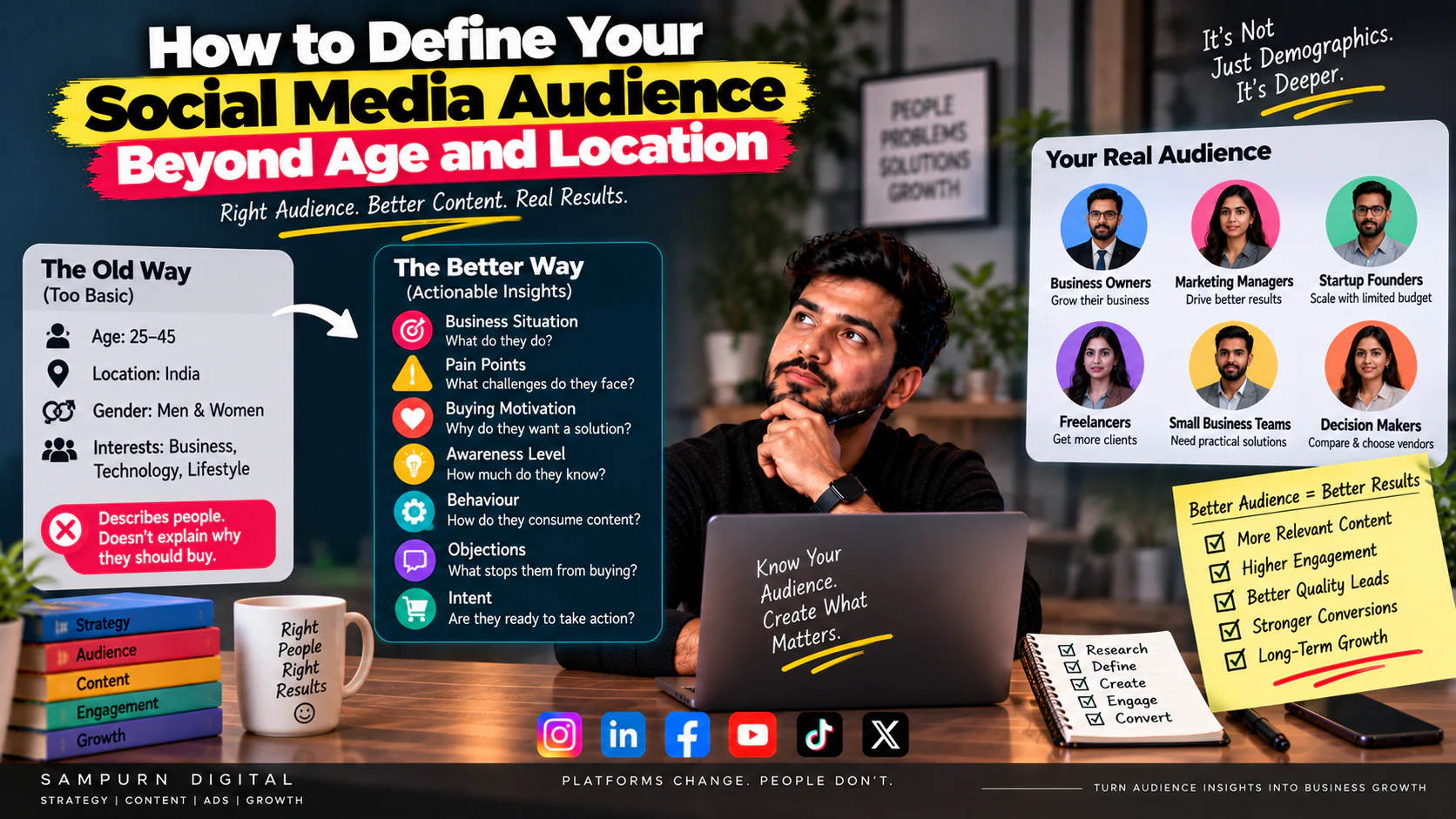
Most businesses define their social media audience like this:
Age: 25–45 Location: India Gender: Men and women Interests: Business, technology, lifestyle
Then they start creating content.
And a few months later, they wonder:
- Why are people viewing but not enquiring?
- Why do competitors attract better customers?
- Why do some posts get engagement while others get ignored?
- Why do paid campaigns generate leads that sales teams don't want?
- Why does the content feel relevant to everyone but persuasive to no one?
The problem is simple:
A useful social media audience definition needs to go deeper into business situation, pain points, buying motivation, awareness level, behaviour, objections and intent.
This guide shows you how to define a social media target audience that your content team, paid media team and sales team can actually use.
What Is a Social Media Target Audience?
Your social media target audience is the specific group of people most likely to:
- Have the problem your business solves
- Care enough about that problem to look for a solution
- Have the ability or authority to buy
- Respond to the type of content you publish
- Eventually become valuable customers
That means your audience isn't simply:
"People aged 25–40 interested in digital marketing."
A more useful definition might be:
"Owners and marketing managers of Indian service businesses generating consistent enquiries but struggling to turn website and social traffic into qualified leads."
The second definition immediately gives your content team more information.
You know:
- Who they are
- What business they operate
- What problem they have
- What they have probably already tried
- What they care about
- What type of content could help them
- What service they may eventually need
That's the difference between demographic targeting and commercial audience definition.
Why Age and Location Are Not Enough
Demographics are useful, but they rarely explain buying intent.
Consider two people:
Person A
- 32 years old
- Lives in Mumbai
- Marketing manager
- Interested in social media
- Follows digital marketing accounts
Person B
- 32 years old
- Lives in Mumbai
- Marketing manager
- Has a monthly lead target
- Cost per lead has increased
- Sales team says lead quality is poor
- Management wants results within 60 days
Both may fit the same demographic audience.
But Person B gives you a much stronger content opportunity.
A post titled:
is likely to be far more relevant to Person B.
This is why good audience research asks:
What is happening in the customer's business or life right now?
The 8 Layers of a Strong Social Media Audience
Instead of defining an audience using only age and location, build it across eight layers.
| Layer | Question |
|---|---|
| 1. Identity | Who is the person? |
| 2. Business/Context | What situation are they in? |
| 3. Problem | What is going wrong? |
| 4. Desired outcome | What do they want instead? |
| 5. Trigger | Why are they looking for a solution now? |
| 6. Behaviour | What are they already doing? |
| 7. Objections | Why haven't they solved it yet? |
| 8. Buying intent | How close are they to taking action? |
Let's break these down.
Start With Who They Actually Are
Demographics still matter.
But use them as the starting point, not the final audience definition.
You might document:
- Age range
- Location
- Job role
- Industry
- Company size
- Business model
- Seniority
- Income or purchasing power
- Decision-making authority
For B2B businesses, job role and decision authority can be more useful than age.
For example:
Weak audience definition
Business owners aged 25–50 in India.
Better
Owners and marketing managers of small and mid-sized service businesses in India.
Stronger
Owners and marketing managers at service businesses with an existing website and regular enquiry flow who want to increase qualified enquiries through digital channels.
The third version gives your content strategy considerably more direction.
Identify Their Business Situation
People don't buy because they belong to an age group.
They buy because something is happening.
For example, a business may be:
- Launching a new service
- Expanding into a new city
- Losing organic reach
- Increasing advertising spend
- Getting poor-quality leads
- Entering a competitive market
- Hiring a marketing team
- Rebuilding its website
- Trying to improve conversion rates
- Preparing for a product launch
These situations create context.
And context creates better content.
Example
Suppose you sell website development.
Your audience isn't simply:
"Companies that need websites."
Your stronger audience segments might include:
Needs:
- Website
- Branding
- Basic lead generation
Has:
- Website
- Traffic
- Poor conversion rate
Needs:
- Conversion optimisation
- Better landing pages
- Stronger calls to action
Has:
- Multiple services
- Multiple marketing channels
- Increasing traffic
Needs:
- Scalable website architecture
- Analytics
- CRM integration
- Lead routing
The same service can therefore require completely different social content.
Define the Problem They Are Experiencing
This is where audience research becomes much more useful.
Don't write:
"Our audience wants better marketing."
Write down the actual problem.
For example:
Surface problem
"My Instagram isn't growing."
Operational problem
"Our content gets inconsistent reach."
Business problem
"Social media isn't generating enough qualified enquiries."
Financial problem
"We are spending time and money on content without seeing measurable revenue."
These are four different levels of the same problem.
Your best content often starts with the business consequence, not the surface symptom.
Instead of:
"5 Instagram tips"
Try:
"Why Your Instagram Gets Views but Your Sales Pipeline Doesn't Move"
The second topic speaks directly to the business problem.
Identify the Desired Outcome
Understanding what people dislike is only half the job.
You also need to know what they want.
Ask:
"If this problem disappeared, what would success look like?"
For different audiences, that could mean:
- More qualified leads
- Lower customer acquisition cost
- More sales
- Higher average order value
- Better brand recognition
- More website enquiries
- Higher repeat purchases
- More appointments
- Better engagement
- Stronger community
- Faster sales cycles
But don't stop at generic outcomes like "more followers."
Ask what the follower or engagement is supposed to accomplish.
For example:
Now social media has a business role.
Find the Trigger That Makes Them Take Action
A person can have a problem for six months without doing anything.
Then something changes.
That change is often the trigger.
Examples:
- Competitor launches a successful campaign
- Website traffic increases but leads don't
- Ad costs rise
- Sales targets increase
- New product launches
- Marketing budget gets approved
- Founder becomes unhappy with results
- Existing agency contract ends
- Internal team can't keep up with content
- Management demands measurable ROI
These triggers are incredibly useful for content planning.
Example
If your audience starts looking for help after advertising costs increase, create content such as:
If they look for help after poor lead quality:
This is also where audience research connects naturally with broader marketing diagnosis. A useful next step is the full-funnel approach covered in DM-07.
Study What They Already Do
Your audience is probably not starting from zero.
They may already be:
- Watching competitor content
- Searching Google
- Following industry creators
- Saving Instagram posts
- Watching YouTube tutorials
- Reading blogs
- Comparing agencies
- Asking questions in communities
- Running ads
- Using freelancers
- Working with an agency
- Trying content themselves
This behaviour tells you what kind of content they consume.
For example
If your audience regularly watches:
"How to run Meta Ads"
they may be solution-aware.
If they watch:
"Why are my Meta Ads not generating leads?"
they may be problem-aware.
If they search:
"Meta Ads agency for B2B"
they are much closer to commercial intent.
Your content should reflect these differences.
Document Their Objections
Audience research becomes much stronger when you understand why people hesitate.
Typical objections include:
- "It is too expensive."
- "We can do this ourselves."
- "We've already tried social media."
- "Our industry doesn't work on Instagram."
- "We don't have enough content."
- "We don't have enough budget."
- "How do we know this will generate leads?"
- "We've worked with agencies before and didn't get results."
- "We don't have time to manage another channel."
These objections should become content topics.
Objection
"Social media doesn't work for our industry."
Content idea
"Does Social Media Actually Work for B2B and Traditional Businesses?"
Objection
"We don't have enough content."
Content idea
"How to Turn One Business Topic Into 30 Social Media Posts"
Objection
"Paid social is expensive."
Content idea
"Organic Social vs Paid Social: What Should Your Business Invest In?"
Your audience's objections can therefore become your content calendar.
Separate Audiences by Buying Intent
Not everyone following your business is equally valuable.
A useful audience model is:
| Audience | Awareness | Typical behaviour |
|---|---|---|
| Unaware | Very low | Consumes general content |
| Problem-aware | Low | Recognises a problem |
| Solution-aware | Medium | Researches possible solutions |
| Product/service-aware | High | Compares providers |
| Ready-to-buy | Very high | Requests pricing, demo or consultation |
Your social strategy should speak to all relevant stages.
Example
For a digital marketing agency:
"5 Signs Your Marketing Is Becoming Hard to Scale"
"Why Your Website Gets Traffic but Few Customers"
"SEO vs Paid Ads: Which Should You Invest In First?"
"What Should a Performance Marketing Agency Actually Manage?"
"How to Prepare for a Digital Marketing Audit"
This creates a content system rather than a collection of random posts.
The Audience Research Framework
Here's a practical framework you can use for each target segment.
Audience Profile
Job:
- Founder
- Marketing manager
- E-commerce manager
- Sales head
Business:
- Industry
- Revenue range
- Company size
- Business model
Location:
- City
- Region
- Country
- Serviceable market
Business Situation
Examples:
- Sales have slowed
- Marketing budget increased
- Website redesigned
- New service launched
- Competitor gaining visibility
Core Problem
Examples:
- Low-quality leads
- Low engagement
- Poor conversion
- Weak organic reach
- High ad costs
Desired Outcome
Examples:
- More qualified leads
- Lower acquisition cost
- More sales
- Better brand visibility
- Higher conversion rate
Trigger
Examples:
- Sales target increased
- Campaign failed
- Competitor gained market share
- Budget approved
- Existing agency contract ending
Behaviour
Examples:
- Running Meta Ads
- Posting on Instagram
- Searching Google
- Hiring freelancers
- Watching tutorials
Objections
Examples:
- Budget
- Trust
- Previous bad experience
- Lack of internal resources
- Uncertainty about ROI
Buying Criteria
Potential factors:
- Proven process
- Relevant experience
- Reporting
- Communication
- Pricing
- Speed
- Strategic expertise
- Case studies
- Technical capability
Now you have an audience definition that a marketing team can actually use.
Create Audience Segments Instead of One Giant Persona
One of the biggest mistakes is trying to create one "ideal customer."
Real businesses often have several valuable audiences.
For example, a marketing agency could have:
Segment 1 — Founder
Problem: Marketing feels unpredictable.
Wants: Growth and visibility.
Concern: Wasting money.
Content angle: Business outcomes.
Segment 2 — Marketing Manager
Problem: Multiple channels aren't working together.
Wants: Better performance and reporting.
Concern: Internal pressure to prove ROI.
Content angle: Strategy, measurement and optimisation.
Segment 3 — E-commerce Manager
Problem: Traffic is coming but revenue isn't growing fast enough.
Wants: Better ROAS and conversion rate.
Concern: Rising acquisition costs.
Content angle: Ads, product pages, CRO and retention.
Segment 4 — Small Business Owner
Problem: Doesn't know where to start.
Wants: A practical marketing plan.
Concern: Limited budget.
Content angle: Prioritisation and simple systems.
Each segment can consume different content even though they buy related services.
How to Build Audience Personas That Are Actually Useful
A persona shouldn't become a fictional character with unnecessary details.
You don't need to know:
"Rajesh drinks two cups of coffee every morning and likes cricket."
Unless that information changes marketing decisions, it isn't particularly useful.
Instead document decision-relevant information.
Use this template:
| Persona Field | Example |
|---|---|
| Role | Founder |
| Business | Service company |
| Company size | 10–50 employees |
| Main objective | Increase qualified enquiries |
| Current channel | Meta + Google |
| Main problem | Poor lead quality |
| Trigger | Rising acquisition costs |
| Biggest objection | ROI uncertainty |
| Buying factor | Strategy + reporting |
| Content preference | Practical guides |
| Awareness level | Solution aware |
| Desired action | Request consultation |
That is a useful persona.
How to Find This Information
You don't need expensive research software to start.
Your existing business data can tell you a lot.
Source 1: Sales Calls
Ask your sales team:
- What problems do prospects mention most?
- What questions appear repeatedly?
- What objections stop deals?
- Why do prospects choose competitors?
- What makes leads qualified?
- What makes them unqualified?
Sales conversations are often a goldmine for content ideas.
Source 2: Existing Customers
Interview your best customers.
Ask:
What problem made you start looking for a solution?
What had you tried before?
What made you choose us?
What were you worried about?
What result mattered most?
The answers can directly influence your messaging.
Source 3: Social Comments
Don't only look at likes.
Look at questions.
A comment such as:
"Does this work for small businesses?"
reveals a concern.
A comment such as:
"How much budget do I need?"
reveals buying consideration.
A comment such as:
"We tried this and it didn't work."
reveals an objection.
Comments can therefore reveal language, pain points and barriers.
Source 4: Search Behaviour
Look at the questions people ask around your service.
For example:
- How much does it cost?
- Which platform is best?
- Why isn't it working?
- How long does it take?
- Can I do it myself?
- Which agency should I choose?
- What should I measure?
These questions can become your content pillars.
Source 5: Competitor Audiences
Don't simply copy competitor content.
Study:
- Which posts attract comments?
- What questions do people ask?
- Which topics repeatedly appear?
- Which objections appear?
- What content generates discussion?
You're trying to understand audience demand, not reproduce someone else's strategy.
Build an Audience Language Bank
This is one of the most useful exercises you can do.
Create four columns:
| What the business says | What the customer says | What it really means | Content opportunity |
|---|---|---|---|
| Low engagement | "Nobody cares about our posts" | Content isn't resonating | Content relevance |
| Poor leads | "Sales says leads are useless" | Targeting or funnel problem | Lead quality |
| High CPL | "Ads are becoming expensive" | Acquisition economics weakening | Paid optimisation |
| Low sales | "We get traffic but no customers" | Conversion problem | Funnel/CRO |
The customer's own words are especially valuable.
Use them in:
- Hooks
- Headlines
- Reels
- Carousels
- Landing pages
- Ads
- FAQs
This makes the content sound like it understands the audience rather than simply broadcasting marketing advice.
Don't Confuse Audience With Platform
Your audience should be defined before choosing the platform.
For example:
"Our audience is on Instagram."
is incomplete.
Ask:
A founder might use:
- Instagram for discovery
- LinkedIn for professional research
- Google for high-intent searches
- YouTube for deeper education
The same person can behave differently across platforms.
This is why audience definition should come before platform selection. Once the audience is clear, you can make a much stronger decision about which social platforms deserve investment.
Audience × Problem × Intent
One of the easiest frameworks for planning social content is:
For example:
Audience
Marketing managers at growing service businesses.
Problem
Lead quality is falling.
Intent
Looking for a way to diagnose the problem.
Content
Another:
Audience
Small business owners.
Problem
They don't know which social platform to prioritise.
Intent
Researching where to invest.
Content
Another:
Audience
E-commerce managers.
Problem
Advertising produces sales but margins are weak.
Intent
Looking for optimisation.
Content
This approach gives every piece of content a reason to exist.
The 5-Question Audience Test
Before publishing a social post, ask:
Who exactly is this for?
If the answer is:
"Everyone"
the topic is probably too broad.
What problem does it address?
If you can't identify one, the post may be entertainment rather than strategic content.
Why would they care now?
Identify the trigger.
What should they do next?
Examples:
- Save
- Comment
- Read
- Visit website
- Request consultation
- Compare solutions
Does this connect to a business outcome?
If not, understand whether the post has a deliberate awareness or community purpose.
Not every post needs to sell.
But your overall system should lead somewhere.
A Practical Social Media Audience Matrix
Create a matrix like this for your business:
| Segment | Problem | Trigger | Content | CTA |
|---|---|---|---|---|
| Founder | Unpredictable marketing | Growth target | Strategy content | Consultation |
| Marketing Manager | Poor lead quality | CPL increasing | Diagnostic content | Audit |
| E-commerce Manager | Weak profitability | Revenue pressure | Ads/CRO content | Growth discussion |
| New Business | Doesn't know where to start | Launch | Educational content | Strategy guide |
Now your content calendar can be built around real business situations rather than random topics.
How Audience Research Improves Paid Social Targeting
The same research becomes useful when you move from organic content to paid advertising.
Suppose your audience research identifies:
Founders of service businesses who already generate leads but want more qualified enquiries.
You can use that understanding to build different creative angles:
Pain-focused ad
Outcome-focused ad
Diagnostic ad
The audience isn't simply a demographic filter.
It's the strategic foundation for your message.
For paid acquisition, this becomes especially important when separating cold, warm and retargeting audiences.
Audience Research Also Improves Lead Quality
There is another major benefit.
Better audience definition can improve the quality of leads reaching sales.
Imagine two campaigns.
Campaign A
Broad.
Almost anyone can respond.
Campaign B
Much more specific.
Some people will ignore it.
That's good.
The goal isn't necessarily to maximise the number of people responding.
The goal is to attract more of the right people.
If your lead quality is poor, audience definition should be examined alongside targeting, messaging, offer, landing page and qualification. This connects directly to the broader full-funnel diagnosis in DM-07.
A Simple Audience Scoring Framework
If you have several possible audience segments, score each one.
Use a 1–5 scale.
| Factor | Score |
|---|---|
| Problem severity | /5 |
| Ability to pay | /5 |
| Urgency | /5 |
| Audience size | /5 |
| Reachability | /5 |
| Fit with your service | /5 |
| Potential customer value | /5 |
Then calculate:
Example:
| Segment | Score |
|---|---|
| Early-stage businesses | 22/35 |
| Growing service businesses | 31/35 |
| Large enterprises | 27/35 |
The highest score isn't automatically the answer.
But the exercise forces you to think beyond:
"Everyone who might buy."
What a Strong Social Media Audience Definition Looks Like
Compare these three statements.
Level 1 — Too broad
"People interested in business."
Level 2 — Better
"Indian business owners interested in digital marketing."
Level 3 — Actionable
"Owners and marketing managers of growing Indian service businesses that already generate enquiries but struggle with lead quality, conversion and predictable customer acquisition."
Level 3 can guide:
- Content
- Messaging
- Paid targeting
- Offers
- Landing pages
- Lead qualification
- Sales conversations
That's what you want from audience research.
Your Social Media Audience Definition Template
Copy this into your marketing strategy:
Primary Audience
Who are they? [Role / customer type]
Where are they? [Location / market]
What business or life situation are they in? [Context]
What problem are they experiencing? [Core problem]
What is the business consequence? [Revenue / growth / efficiency consequence]
What outcome do they want? [Desired result]
What triggered them to look for a solution? [Trigger]
What are they currently doing? [Current behaviour]
What have they already tried? [Existing solutions]
What objections do they have? [Barriers]
What makes them trust a provider? [Buying criteria]
What action do we want them to take? [CTA]
Final Audience Research Checklist
Before finalising your social media audience, make sure you can answer:
- Who exactly are we targeting?
- What role does this person have?
- What business situation are they in?
- What problem are they experiencing?
- How serious is that problem?
- What does the problem cost them?
- What outcome do they want?
- What triggered them to act?
- What are they already doing?
- What content do they consume?
- What questions do they ask?
- What objections do they have?
- What makes them trust a solution?
- What would make them buy?
- What action should our content drive?
- How does this audience connect to our actual business offer?
If you cannot answer these questions, your audience definition is probably still too shallow.
SEO Publishing Information
| Field | Details |
|---|---|
| Blog ID | SMM-05 |
| Category | Social Media Marketing |
| Stage | Understand |
| Primary Keyword | how to define social media target audience |
| Supporting Keywords | social media audience research; audience personas; social media targeting strategy |
| Search Intent | Informational |
| Funnel Stage | Solution Aware |
| Pillar Page | Social Media Marketing Services |
| Suggested URL | `/blog/social-media-marketing/how-to-define-your-social-media-audience-beyond-age-and-location` |
| Content Role | Education + problem awareness |
| Publishing Sprint | Sprint 4 |
| Primary CTA | Get a social media growth strategy |
| Secondary CTA | Explore Social Media Marketing |
| Meta Title | How to Define Your Social Media Audience Beyond Age & Location |
| Meta Description | Learn how to define a social media target audience using problems, intent, behaviour, triggers, objections and buying motivation—not just age and location. |
| H1 | How to Define Your Social Media Audience Beyond Age and Location |
