
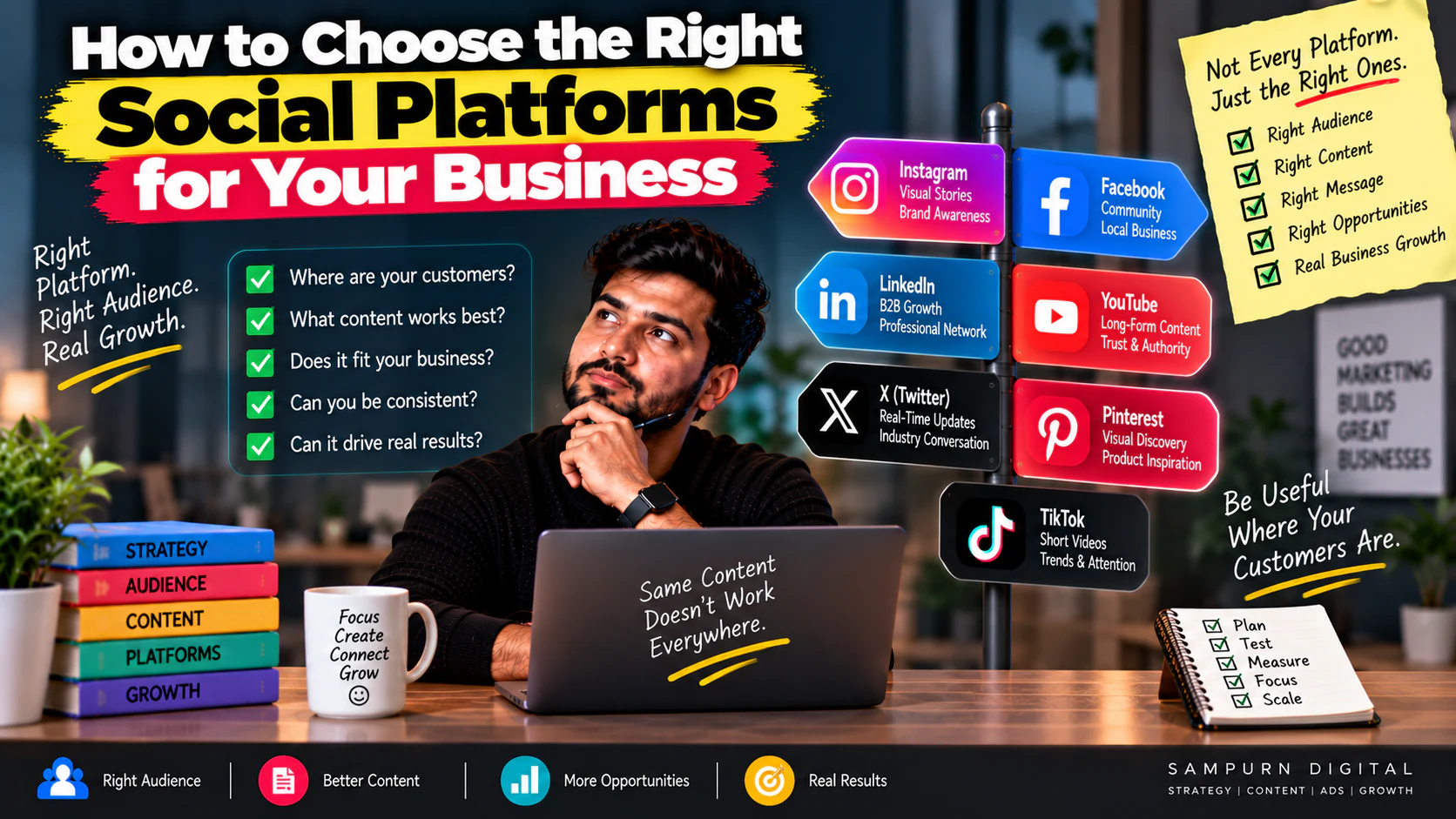
Your business does not need to be active on every social media platform.
In fact, trying to maintain Instagram, Facebook, LinkedIn, YouTube, X, Pinterest and every new platform that appears can create a bigger problem:
The right social media platform is not the one with the most users.
It is the platform where your:
- Target customers spend attention
- Content format makes sense
- Business message fits naturally
- Sales journey can continue
- Team can publish consistently
- Marketing economics work
For one business, Instagram may be the strongest channel.
For another, LinkedIn may produce better opportunities.
For an e-commerce brand, Instagram + Facebook may make sense.
For a B2B technology company, LinkedIn + YouTube may be much more valuable.
The goal is not to be everywhere.
The goal is to be useful where your customers actually are.
The Short Answer: How Do You Choose a Social Media Platform?
Use this formula:
If one factor is close to zero, the platform becomes difficult to justify.
For example:
You discover that your customers use TikTok.
Great.
But if your business sells complex B2B consulting and your team cannot consistently create video content, audience presence alone doesn't make TikTok your best channel.
Likewise, LinkedIn may have your ideal B2B audience, but if your company only posts generic promotional graphics, the platform won't automatically generate leads.
Stop Choosing Platforms Based on Popularity
One of the most common mistakes is:
“Everyone is on Instagram, so we need Instagram.”
That is not a marketing strategy.
Your customers may technically have Instagram accounts but rarely use the platform for researching your type of purchase.
Imagine three businesses:
Business A — Fashion brand
Instagram is highly relevant because visual discovery is central to the purchase.
Business B — Industrial machinery manufacturer
LinkedIn, YouTube and search-driven content may be more useful because buyers need technical information, credibility and demonstrations.
Business C — Local restaurant
Instagram, Facebook and Google-related discovery may matter more because customers care about:
- Location
- Visual appeal
- Reviews
- Menu
- Offers
- Social proof
Same internet.
Different customer journey.
Different platform strategy.
Start With Your Customer, Not the Platform
Before asking:
“Should we use Instagram or LinkedIn?”
Ask:
“How does our customer discover, evaluate and buy from businesses like ours?”
Map the journey.
Discovery
Where does the customer first notice the problem?
Research
Where do they learn about solutions?
Evaluation
Where do they compare providers?
Trust
What convinces them that you're credible?
Conversion
Where do they finally enquire or purchase?
This changes platform selection dramatically.
A customer buying a ₹500 product and a customer considering a ₹5 lakh business service may behave very differently.
Define Your Audience More Precisely
“Men aged 25–45” is not enough.
“Business owners” is not enough.
Your audience definition should include behavior and business context.
For example:
Business owners aged 25–50.
Indian service-business owners generating ₹50 lakh–₹5 crore annually who rely on inbound leads, have a sales team of 2–10 people and are trying to reduce dependence on referrals.
Now platform decisions become easier.
Ask:
- What does this person do during the day?
- What content do they consume?
- What problems do they actively research?
- Who influences their decisions?
- Do they discover vendors through creators, search, communities or professional networks?
- Is the purchase emotional, visual, technical or financial?
- How long is the sales cycle?
This is why audience research should happen before platform expansion.
A useful next step is to [define your social media audience beyond age and location](https://chatgpt.com/blog/social-media-marketing/how-to-define-your-social-media-audience-beyond-age-and-location).
Instagram: Best When Visual Discovery Matters
Instagram is particularly useful when your business can communicate value visually.
Strong use cases include:
- Fashion
- Beauty
- Food
- Travel
- Fitness
- Interior design
- Real estate
- Lifestyle
- Personal brands
- Consumer products
- Creators
But that doesn't mean every business should use Instagram in the same way.
A B2B company can still succeed on Instagram if it has interesting visual stories.
For example:
“We provide digital marketing services.”
Try:
“We audited 100 landing pages. These are the 5 conversion problems we found most often.”
Now the platform has something useful to distribute.
Instagram works well for:
- Reels
- Carousels
- Stories
- Visual demonstrations
- Before/after content
- Educational snippets
- Founder content
- Customer stories
- UGC
The question is not:
“Can we post on Instagram?”
It is:
“Can we consistently create content that earns attention on Instagram?”
Facebook: Still Useful for Specific Audiences and Journeys
Facebook should not automatically be dismissed as an outdated platform.
Its usefulness depends on your audience and business model.
It can be valuable for:
- Local businesses
- Community-driven businesses
- Certain consumer segments
- Groups and communities
- Events
- Offers
- Retargeting
- Paid campaigns
For some businesses, Facebook may be more valuable as a paid distribution and community channel than as the primary organic content channel.
For example:
A local coaching business could use:
while also using paid campaigns for local lead generation.
The platform should be evaluated based on outcomes, not reputation.
LinkedIn: Strong for B2B and Professional Authority
If you sell to businesses, LinkedIn deserves serious consideration.
Especially when your buyer includes:
- Founders
- CEOs
- CMOs
- HR leaders
- Sales leaders
- Technology decision-makers
- Procurement professionals
- Consultants
- Professionals
LinkedIn works particularly well for content based on:
- Expertise
- Industry insights
- Case studies
- Lessons learned
- Opinions
- Research
- Business problems
- Professional education
For example:
Instead of:
“We build websites for businesses.”
A stronger LinkedIn post might say:
“We reviewed 30 service-business websites. The biggest conversion problem wasn't design. It was that visitors couldn't understand what the company actually did within the first few seconds.”
That creates a conversation.
LinkedIn is especially useful when:
is the natural buying journey.
YouTube: Powerful When Demonstration and Education Matter
YouTube is often underestimated because creating videos requires more effort.
But that effort can be valuable.
YouTube is useful when customers need to:
- Learn
- Compare
- See demonstrations
- Understand complex concepts
- Evaluate expertise
- Research products
- Watch tutorials
Consider a software company.
A short social post can say:
“5 mistakes businesses make with CRM implementation.”
A YouTube video can explain:
- What each mistake looks like
- Why it happens
- How to diagnose it
- How to fix it
- What tools to use
That longer interaction can build significant trust.
YouTube can also create content that continues to attract viewers over time.
X: Better for Conversation Than Universal Reach
X can be useful for businesses where:
- Industry conversations happen publicly
- Founder visibility matters
- News moves quickly
- Opinions are valuable
- Community interaction is important
It can work particularly well for:
- Technology
- Startups
- Finance-related commentary
- Media
- Personal brands
- Developers
- Industry experts
But it may not be the best use of resources for every local or consumer business.
Again:
Pinterest: Strong When Discovery Is Visual and Intent-Driven
Pinterest can be valuable for businesses connected to visual planning and inspiration.
Examples:
- Home decor
- Interior design
- Fashion
- Weddings
- Recipes
- DIY
- Crafts
- Travel
- Lifestyle products
Someone searching for:
“modern kitchen design ideas”
has a very different intent from someone scrolling through random social content.
If your business naturally fits visual discovery, Pinterest may deserve testing.
Don't Confuse Audience Presence With Buying Intent
This is a critical distinction.
Your customers may be on a platform for entertainment but not for purchasing.
For example:
Someone may spend 90 minutes a day on Instagram.
That doesn't mean they want to buy your enterprise software there.
Another person may spend only 20 minutes a day on LinkedIn.
But during those 20 minutes they may actively consume content related to:
- Hiring
- Marketing
- Software
- Business strategy
- Vendors
- Industry problems
The second platform could produce significantly more commercial value.
Match Platform to Purchase Type
A useful framework is to classify your purchase.
Visual + emotional purchase
Examples:
- Fashion
- Beauty
- Food
- Travel
Potential priority:
Professional + trust-driven purchase
Examples:
- Consulting
- B2B services
- Recruitment
- Technology services
Potential priority:
Demonstration-heavy purchase
Examples:
- Software
- Machinery
- Electronics
- Tools
Potential priority:
Local purchase
Examples:
- Restaurants
- Clinics
- Salons
- Gyms
- Local services
Potential priority:
The important word is potential.
You still need to validate actual customer behavior.
Match Platform to Content Capability
Your team matters.
Suppose LinkedIn is ideal for your B2B audience.
But your team can only produce polished graphics.
That doesn't mean LinkedIn cannot work.
It means your content capability may be underdeveloped.
Different platforms reward different strengths.
| Content capability | Platforms to consider |
|---|---|
| Strong photography | Instagram, Pinterest |
| Short-form video | Instagram, Facebook |
| Professional writing | |
| Long-form video | YouTube |
| Founder commentary | LinkedIn, X |
| Community management | Facebook, LinkedIn |
| Tutorials | YouTube |
| Product demonstrations | Instagram, YouTube |
Your strategy should fit what your business can produce well and consistently.
One Platform Done Well Beats Six Done Poorly
Imagine your team has:
- 1 strategist
- 1 designer
- 1 video editor
- 1 copywriter
Trying to publish on seven platforms may produce:
- Repetitive content
- Missed deadlines
- Weak engagement
- Poor community management
- Inconsistent brand voice
- Burnout
Instead, choose:
Primary platform
Where you invest most effort.
Secondary platform
Where you repurpose the strongest ideas.
Experimental platform
Where you test selectively.
For example:
Primary: LinkedIn Secondary: Instagram Experimental: YouTube
This creates focus.
Use a 70/20/10 Platform Allocation
A simple model:
70% — Primary platform
Your strongest customer and content fit.
20% — Secondary platform
Repurpose and adapt proven content.
10% — Experiments
Test a new platform or format.
This prevents the team from continuously jumping to the latest platform trend.
Platform Selection Should Consider Your Sales Cycle
This is especially important for B2B.
Imagine:
A platform that creates quick clicks but weak trust may not be the best choice.
Now imagine:
A visual, fast-discovery platform may work much better.
Therefore:
and
should influence platform selection.
Consider Your Average Customer Value
Suppose your average customer is worth ₹2,000.
You may need a high volume of customers.
Now consider a consulting company where one customer is worth ₹5 lakh.
It may only need a handful of qualified opportunities.
That changes what “good performance” means.
For the consulting company:
could be more valuable than:
The platform should be judged against business economics.
Organic and Paid Platform Selection Can Be Different
This is something businesses often overlook.
You may not want to invest heavily in organic content on a platform but still use it for paid advertising.
For example:
Organic priority: LinkedIn
Paid priority: Meta
Organic priority: YouTube
Paid priority: Instagram
The content and advertising strategies don't have to be identical.
If paid social is part of your strategy, your [Meta Ads funnel structure](https://chatgpt.com/blog/performance-marketing/meta-ads-funnel-structure-cold-warm-and-retargeting-audiences) should connect audience targeting with the correct stage of the customer journey.
Your Website Changes the Value of Social Platforms
Social media is rarely the complete conversion system.
A prospect may:
If the website is weak, your social media investment can leak.
For service businesses, check:
- Is the offer clear?
- Is there a strong CTA?
- Are services easy to understand?
- Is there proof?
- Is the enquiry process simple?
- Does the page work well on mobile?
- Does the visitor know what happens next?
Your social platform can generate attention.
Your website often has to convert that attention.
That is why [lead-generation website architecture for service businesses](https://chatgpt.com/blog/web-development/lead-generation-website-architecture-for-service-businesses) should be considered part of the overall journey.
A Platform Selection Scorecard
Give every potential platform a score from 1–5.
| Factor | Score |
|---|---|
| Target audience presence | /5 |
| Buying intent | /5 |
| Content fit | /5 |
| Business relevance | /5 |
| Team capability | /5 |
| Organic opportunity | /5 |
| Paid opportunity | /5 |
| Conversion path | /5 |
| Measurement capability | /5 |
| Long-term value | /5 |
Maximum:
Example:
Audience: 5 Buying intent: 4 Content fit: 5 Business relevance: 4 Team capability: 5 Organic opportunity: 5 Paid opportunity: 5 Conversion path: 4 Measurement: 4 Long-term value: 5
Now compare it with LinkedIn, YouTube and Facebook.
The goal isn't mathematical perfection.
The scorecard forces your team to explain why a platform deserves resources.
A Better Platform Testing Framework
Don't commit to a platform for a year without testing it.
Run a structured 60–90 day test.
Weeks 1–2: Research
Identify:
- Audience
- Competitors
- Content patterns
- Questions
- Topics
- Formats
- Existing demand
Weeks 3–6: Publish
Test several content types.
For example:
- Educational
- Opinion
- Case study
- Problem/solution
- Founder story
- Product/service content
Weeks 7–10: Measure
Look at:
- Reach
- Engagement
- Saves
- Shares
- Profile visits
- Website visits
- Leads
- Lead quality
Weeks 11–12: Decide
Choose:
This is far better than:
“Let's try TikTok because everyone is talking about it.”
What Metrics Should You Use to Judge a Platform?
Avoid judging platforms only by followers.
Instead, create a funnel.
Attention
- Reach
- Impressions
- Video views
Engagement
- Comments
- Shares
- Saves
- Engagement rate
Intent
- Profile visits
- Website clicks
- Content downloads
- DMs
- Enquiries
Conversion
- Leads
- Qualified leads
- Purchases
- Bookings
Revenue
- Customers
- Revenue
- CAC
- Customer value
A platform with 10,000 followers can be weaker than one with 2,000 followers if the smaller audience produces better customers.
Diagnose a Weak Platform Before Abandoning It
If a platform isn't producing results, don't immediately conclude:
“This platform doesn't work.”
Check four areas.
Problem 1: Wrong audience
You may be reaching people who aren't buyers.
Problem 2: Weak content
The audience may be correct, but your content doesn't earn attention.
Problem 3: Weak offer
People engage but don't have a reason to enquire.
Problem 4: Weak conversion path
People click but the website or sales process loses them.
If you're seeing views without business outcomes, first understand [why social media can get views but not business results](https://chatgpt.com/blog/social-media-marketing/why-your-social-media-gets-views-but-not-business-results).
Signs You Chose the Wrong Platform
Watch for these patterns:
- Your target audience rarely interacts
- Content requires unnatural formats
- Team struggles to create consistently
- Engagement comes mostly from irrelevant users
- Traffic rarely reaches your website
- Leads are poor quality
- Content performs only when heavily promoted
- The platform requires disproportionate effort
- Your competitors get attention but your customers don't
- There is no clear path from content to business outcome
One bad post proves nothing.
A consistent pattern over several months is more meaningful.
Signs You Chose the Right Platform
You are probably onto something when:
- The right people engage
- Customers mention your content
- Prospects arrive already familiar with your company
- Website traffic is relevant
- Content questions reveal buyer problems
- Leads become more qualified
- Your team can produce consistently
- Some content repeatedly performs well
- Paid amplification improves results
- Sales conversations become easier
The best platform often becomes obvious after repeated testing.
Platform Strategy by Business Type
E-commerce
Start with:
Consider:
Focus on:
- Product demonstrations
- UGC
- Reviews
- Offers
- Product education
- Creator content
B2B Services
Start with:
Consider:
Focus on:
- Expertise
- Case studies
- Business problems
- Founder content
- Educational content
- Industry opinions
Local Services
Start with:
Support with:
Focus on:
- Reviews
- Results
- Location
- Services
- FAQs
- Offers
- Customer stories
Personal Brand
Potential priorities:
Focus on:
- Expertise
- Opinions
- Stories
- Education
- Experiences
- Proof
Technology/SaaS
Potential priorities:
Support with:
Focus on:
- Product demonstrations
- Tutorials
- Use cases
- Industry problems
- Customer outcomes
- Comparisons
Don't Copy Competitors Blindly
Suppose your competitor has:
- 200,000 Instagram followers
- 50,000 LinkedIn followers
- 1 million YouTube views
That doesn't mean you need to copy all three.
Ask:
Which part of their strategy actually creates business value?
Maybe their Instagram generates awareness while their LinkedIn generates enterprise leads.
Or maybe their large audience produces very little revenue.
Competitor visibility is not the same as competitor profitability.
Use competitor research to identify opportunities — not to blindly copy channel choices.
Your Platform Strategy Should Evolve
You don't need the same platforms forever.
A company may start with:
Then add:
Once B2B sales increase, it may prioritize:
Later, paid campaigns may become more important.
The strategy evolves because:
- Audience changes
- Products change
- Sales cycles change
- Team capabilities change
- Content improves
- Budgets change
- Business goals change
Platform selection is therefore not a one-time decision.
It is a recurring strategic decision.
The 5-Question Platform Test
Before adding any social platform, answer:
Are our ideal customers actually there?
If not, stop.
Can we create content that naturally fits the platform?
If not, reconsider.
Does the platform support our customer journey?
If not, don't force it.
Can we execute consistently?
If not, reduce the number of platforms.
Can we measure business value?
If not, improve tracking before scaling.
If a platform passes all five tests, it deserves a structured experiment.
Build a Primary, Secondary and Experimental Stack
For most businesses, this is easier to manage than trying to dominate everything.
Primary
Your highest-value platform.
Allocate:
Secondary
A complementary platform.
Allocate:
Experimental
A platform you're testing.
Allocate:
After 90 days, evaluate the experiment.
If it works:
If it doesn't:
The Goal Is Not More Platforms
This is the most important takeaway.
A business doesn't win social media because it has seven active profiles.
It wins because it can repeatedly move the right people through:
If Instagram generates attention but LinkedIn generates qualified conversations, LinkedIn may deserve more resources.
If YouTube generates fewer views but produces high-value leads, don't dismiss it because the numbers look smaller.
If Facebook produces cheap leads but poor-quality customers, don't celebrate the CPL.
