
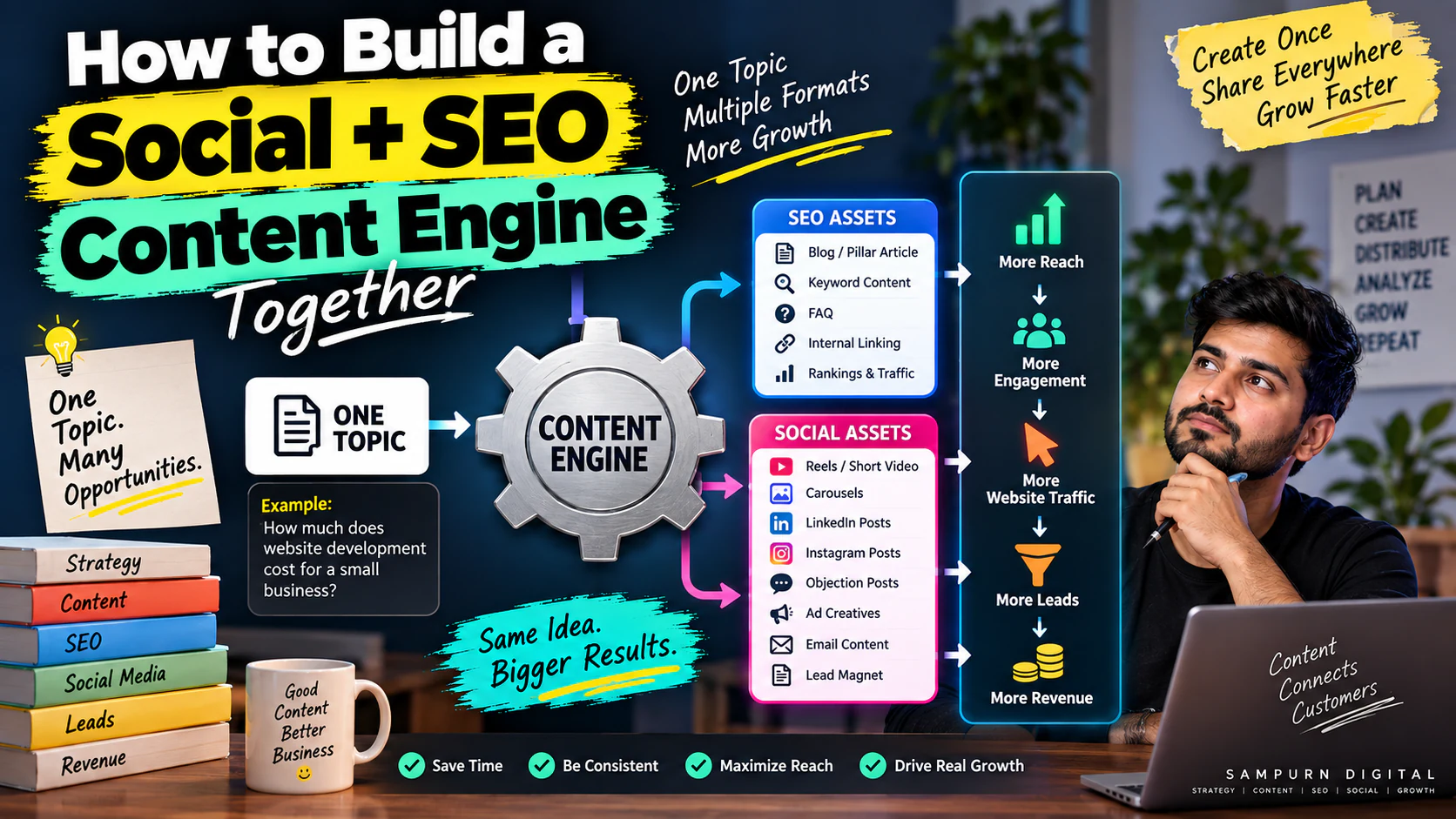
Most businesses treat SEO and social media as two completely different content machines.
The SEO team writes blogs.
The social media team creates Reels.
The SEO team looks at keywords.
The social team looks at trends.
The SEO team wants rankings.
The social team wants reach.
And every month, everyone starts creating content again from zero.
That's an expensive way to operate.
A better system is to build one content engine that feeds both search and social.
Instead of creating:
as separate projects, you create one strong business topic and deliberately turn it into multiple content assets.
For example:
Core topic
From that one topic, you can create:
- SEO pillar article
- Cost breakdown blog
- Instagram Reel
- LinkedIn post
- Instagram carousel
- FAQ content
- Short video
- Customer objection post
- Case-study angle
- Email content
- Lead magnet
- Paid-ad creative
Now your teams aren't creating disconnected content.
They're distributing different versions of the same strategic idea.
That's the foundation of a social + SEO content engine.
What Is a Social + SEO Content Engine?
A social + SEO content engine is a system where:
Instead of thinking:
“What should we post today?”
you start asking:
“What customer problem should our business own across search, social and the website?”
That is a much stronger question.
SEO and Social Have Different Jobs
SEO and social media should work together.
But they shouldn't be forced to behave identically.
SEO is strong at:
- Capturing existing search demand
- Building topical authority
- Answering detailed questions
- Supporting long-term organic traffic
- Capturing high-intent searches
- Creating evergreen resources
Social is strong at:
- Creating attention
- Building familiarity
- Starting conversations
- Demonstrating expertise
- Testing messaging
- Generating engagement
- Distributing ideas quickly
Think of them as two different distribution systems powered by the same strategic content foundation.
Don't Start With Platforms
A common mistake is starting with:
“We need 20 Instagram posts this month.”
Instead start with:
“What are our customers struggling with this month?”
For example, a digital marketing agency may identify:
- Why aren't my ads generating leads?
- Why does my website get traffic but no enquiries?
- Should I invest in SEO or Google Ads?
- How much should I spend on digital marketing?
- Why are my social media views not becoming customers?
These are business problems.
Each problem can become a content cluster.
Build Around Customer Questions
Create a question bank.
Awareness questions
- What is SEO?
- What is performance marketing?
- Why does social media matter?
Problem questions
- Why isn't my website generating leads?
- Why are my ads becoming expensive?
- Why is Instagram reach declining?
Comparison questions
- SEO vs Google Ads?
- Organic vs paid social?
- Agency vs freelancer?
Solution questions
- How do I improve conversion rate?
- How do I structure campaigns?
- How do I build a content calendar?
Purchase questions
- How much does SEO cost?
- What does a digital marketing agency do?
- How long does SEO take?
These questions give your content engine raw material.
Turn One Core Service Into a Content Universe
Suppose your core service is:
Start with the service.
Then identify:
Problems
- Traffic is declining
- Rankings aren't improving
- Pages aren't indexing
- Competitors outrank you
Questions
- How does SEO work?
- How long does SEO take?
- What should an SEO audit include?
Comparisons
- SEO vs PPC
- Agency vs freelancer
- Local SEO vs traditional SEO
Implementation
- Keyword research
- Topic clusters
- Internal linking
- Technical SEO
Commercial
- SEO pricing
- SEO ROI
- Choosing an SEO agency
Now you have dozens of content opportunities from one business service.
Create a Core Content Asset
Your engine needs a central source.
This might be:
- A comprehensive guide
- A pillar page
- A detailed blog
- A research report
- A case study
- A webinar
- An expert interview
Let's say your core asset is:
That becomes the content source.
From it you can extract:
SEO
- Supporting articles
- FAQs
- Comparison pages
- Glossary content
Social
- Reels
- Carousels
- LinkedIn posts
- Stories
- Short-form videos
Lead generation
- Checklist
- Audit offer
- Consultation CTA
- Downloadable framework
One strategic asset becomes multiple distribution assets.
Use the 1 → 10 Content Repurposing Model
A simple model:
You don't have to create exactly this number every time.
The point is:
Example: One Topic → 20 Content Assets
Core topic:
SEO
- Main article
- Website conversion checklist
- Landing page article
- CTA optimization article
- Form optimization article
- Reel: 3 reasons traffic doesn't convert
- Carousel: 7 website conversion mistakes
- Reel: Before vs after homepage
- Story poll: “Does your website generate enquiries?”
- Carousel: Traffic vs leads
- Founder post
- Data-driven post
- Case study
- Opinion post
Video
- 60-second explanation
- 3-minute breakdown
Conversion
- Website audit CTA
- Lead magnet
- Consultation page
Paid
- Retargeting creative
One topic.
Twenty assets.
That's a content engine.
Build Topic Clusters Instead of Random Posts
SEO becomes stronger when related content connects.
For example:
Pillar
Supporting articles
- Keyword research
- Topic clusters
- Technical SEO
- Internal linking
- Local SEO
- Content strategy
- SEO reporting
Social media can then distribute insights from the same cluster.
This is where your SEO strategy and social distribution begin reinforcing each other.
A structured SEO topic cluster from one core service gives your content engine a much stronger foundation than publishing random topics every week.
Use Social Media to Test SEO Ideas
This is one of the most powerful connections.
Suppose you have 20 potential SEO topics.
You don't necessarily know which message will resonate most strongly.
Turn several into social content.
Track:
- Saves
- Shares
- Comments
- Profile visits
- Clicks
- DMs
- Questions
Suppose:
Topic A
1,000 views 20 saves
Topic B
1,200 views 85 saves
Topic C
900 views 140 saves
Topic C deserves investigation.
Why?
Because strong social response can reveal that the underlying problem or message resonates with your audience.
That doesn't automatically mean it will rank in search.
But it gives you another signal for prioritization.
Use SEO Research to Improve Social Content
The reverse works too.
Search research tells you what people actively ask.
Suppose customers repeatedly search:
Instead of creating another generic:
“5 Google Ads Tips”
you can create:
Reel: “How much should a small business actually budget for Google Ads?”
Carousel: “₹20K vs ₹50K vs ₹1L Google Ads budget”
LinkedIn post: “What changes when your monthly ad budget increases?”
Blog: “How to Plan a Google Ads Budget for a Small Business”
SEO research can therefore provide social media with commercially relevant topics.
Create a Content Bridge
Your content shouldn't end at social.
A useful journey is:
For example:
Reel:
“Your website isn't necessarily failing because you don't have enough traffic.”
CTA:
“Read the full 7-point website conversion checklist.”
Blog:
CTA:
Now social becomes a traffic and discovery layer for your website.
Build Content Around Funnel Stages
Don't make every piece of content promotional.
Use different jobs.
Awareness
Goal:
Formats:
- Reels
- Short videos
- Opinions
- Educational posts
Problem awareness
Goal:
Formats:
- Mistakes
- Diagnostics
- Checklists
- Myth-busting
Solution awareness
Goal:
Formats:
- Frameworks
- How-to content
- Comparisons
- Case studies
Commercial
Goal:
Formats:
- Pricing
- Process
- Case studies
- Service explainers
Conversion
Goal:
Formats:
- Audit
- Consultation
- Demo
- Enquiry
This makes the engine commercially useful.
Create a Content Matrix
Use this structure:
| Topic | Funnel Stage | SEO Asset | Social Asset | CTA |
|---|---|---|---|---|
| Website traffic but no leads | Problem | Blog | Reel | Website audit |
| SEO vs PPC | Solution | Comparison | Carousel | Marketing strategy |
| SEO pricing | Commercial | Guide | Reel | Consultation |
| Keyword research | Build | Tutorial | Carousel | SEO service |
| SEO reporting | Improve | Guide | LinkedIn post | SEO audit |
Now content has a job.
Don't Copy-Paste Blogs Into Social Posts
Repurposing does not mean:
Each platform needs a different presentation.
A blog might say:
“Conversion rate optimization involves systematically improving website elements…”
A Reel might say:
“Getting traffic but no enquiries? Check these three things before spending more on ads.”
Same strategic idea.
Different packaging.
That's real repurposing.
Turn SEO Headlines Into Social Hooks
SEO headline:
Social hooks:
“Lower CPL isn't always a win.”
“Your cheapest leads may be your worst leads.”
“Before you cut your Google Ads budget, check this.”
“Why your CPL is rising—and what to fix first.”
One search topic can produce multiple social hooks.
Turn Social Winners Into SEO Topics
Suppose a Reel about:
performs exceptionally well.
Don't just celebrate the views.
Ask:
Maybe the strongest reaction was:
“My website gets 500 visitors but barely any enquiries.”
That could become:
Now social becomes a topic discovery system.
Build a Content Learning Loop
Your engine should work like this:
For SEO, measure:
- Impressions
- Rankings
- Organic clicks
- CTR
- Organic conversions
For social, measure:
- Reach
- Saves
- Shares
- Watch time
- Profile visits
- Clicks
- Leads
For business:
- Qualified leads
- Sales
- Revenue
- CAC
- Conversion rate
The important part is not collecting every metric.
It's turning metrics into decisions.
Build a Content Performance Score
You can create a simple internal score.
For example:
25% business relevance
- 25% engagement
- 25% traffic
- 25% conversion
The weights can change according to your objective.
For a lead-generation campaign, increase the conversion weighting.
For brand awareness, increase reach and engagement.
This helps prevent your team from automatically calling the most-viewed post the “winner.”
Use Social Analytics to Prioritize Content
Suppose you have 50 content ideas.
You can't produce everything.
Rank them based on:
- Business relevance
- Search opportunity
- Audience demand
- Social potential
- Commercial intent
- Production effort
A practical scoring model:
Business Value + Audience Demand + Search Opportunity + Social Potential − Production Complexity
Now your editorial calendar becomes strategic.
Connect Search Intent With Social Intent
A keyword can tell you what someone searches.
Social behavior tells you what captures attention.
They're different signals.
Example:
Search:
Social hook:
SEO captures the explicit question.
Social captures attention around the same underlying problem.
The content engine connects them.
Create Content Once, Distribute Many Times
Suppose your expert spends one hour explaining:
Record the conversation.
Then create:
- Long-form blog
- FAQ section
- LinkedIn post
- Instagram Reel
- YouTube Short
- Carousel
- Founder post
- Sales-team FAQ
- Retargeting creative
The expert contributed once.
The content team multiplies the output.
This is where a repeatable social media production workflow becomes important.
Without a workflow, repurposing quickly becomes chaos.
Create a Central Content Database
Your content database should track:
| Field | Example |
|---|---|
| Topic ID | SEO-042 |
| Core topic | Google Ads CPL |
| Search intent | Problem |
| Primary keyword | reduce Google Ads CPL |
| SEO asset | Blog |
| Social assets | Reel + Carousel |
| CTA | Audit |
| Status | Published |
| Performance | High |
| Repurpose | Yes |
| Owner | Content Team |
Now everyone sees the same information.
Give Every Topic a Content ID
For example:
Then:
SEO-042-BLOG SEO-042-REEL-01 SEO-042-CAROUSEL-01 SEO-042-LINKEDIN-01 SEO-042-EMAIL-01
This makes content management much easier.
You know exactly which assets came from the same strategic topic.
Create a Monthly Engine
A practical monthly process:
Week 1
Research:
- Search demand
- Customer questions
- Sales objections
- Social performance
Week 2
Create:
- Core SEO content
- Supporting assets
- Social scripts
Week 3
Publish:
- Blog
- Reels
- Carousels
Week 4
Analyze:
- Search performance
- Social performance
- Website behavior
- Leads
Next month
Double down on winners.
Use Sales Teams as a Content Source
Your sales team knows:
- What customers ask
- What objections stop deals
- What competitors are mentioned
- Why prospects hesitate
- What language customers actually use
These questions are content gold.
Suppose sales hears:
“Why should I spend ₹50,000 on SEO when I can run Google Ads?”
That can become:
Blog
SEO vs Google Ads
Reel
“Should you invest in SEO or Google Ads?”
Carousel
“SEO vs PPC: Which should you choose first?”
Sales asset
SEO vs PPC decision framework
One customer objection becomes four useful assets.
Use Customer Conversations as Keyword Discovery
Your customers may not use the same language as SEO tools.
A customer might say:
“My website looks good but nobody contacts me.”
The keyword tool may show:
Both describe the same problem.
Use real customer language to improve:
- Blog titles
- Social hooks
- FAQs
- Landing pages
- CTAs
The closer your content is to the language customers actually use, the more useful it becomes.
Build Cross-Channel Internal Linking
Your content engine shouldn't create isolated pages.
A blog should link to:
- Related blogs
- Service pages
- Pillar pages
- Conversion resources
Social content should send users to:
- Relevant articles
- Landing pages
- Lead magnets
- Service pages
This creates a connected content ecosystem.
For example:
The user gets a natural path to the next level of information.
Social Can Accelerate Content Discovery
Even when organic search takes time, social distribution can immediately put your idea in front of an audience.
That gives you early feedback.
You can learn:
- Which hook works
- Which problem resonates
- Which example gets comments
- Which objection appears repeatedly
- Which CTA gets clicks
Then improve the larger content asset.
This makes content development less dependent on guesswork.
SEO Can Create Evergreen Social Content
Social content often has a short lifespan.
SEO content can continue attracting search traffic.
So build a recycling system.
Suppose an SEO article performs strongly for six months.
Every few weeks, extract:
- A statistic
- A mistake
- A framework
- A checklist
- A quote
- A customer question
- A case example
Turn each into a fresh social asset.
Your SEO library becomes a long-term social content library.
Build a Content Recycling Queue
Create four categories:
Evergreen winners
Republish periodically.
Seasonal
Reuse around relevant dates.
Updated
Refresh with new examples/data.
Failed
Rewrite the angle before trying again.
Don't automatically delete underperforming content.
Sometimes the topic is good but the packaging is weak.
Know When to Rewrite vs Repurpose
Repurpose when:
The core idea is strong.
But the format can change.
Rewrite when:
The idea is correct but:
- headline is weak
- angle is unclear
- search intent is mismatched
- social hook is poor
Retire when:
The topic is no longer commercially relevant.
This prevents endless content production without improvement.
Build a Social + SEO Editorial Calendar
A strong calendar should include:
| Date | Core Topic | SEO Asset | Social Asset | Funnel Stage | CTA |
|---|---|---|---|---|---|
| 5 Sep | Website conversion | Blog | Reel | Problem | Audit |
| 8 Sep | Website conversion | — | Carousel | Problem | Blog |
| 12 Sep | SEO vs PPC | Blog | Reel | Solution | Strategy |
| 16 Sep | SEO vs PPC | — | Commercial | Consultation | |
| 20 Sep | SEO pricing | Guide | Reel | Commercial | Enquiry |
Notice the calendar is organized around topics, not just dates.
Use a Topic-Based Calendar
Instead of:
Monday \= Reel Tuesday \= Carousel Wednesday \= Post
build:
Week theme
Monday:
Problem Reel
Tuesday:
Blog
Wednesday:
Checklist carousel
Thursday:
Case study
Friday:
CTA post
Now the audience receives multiple perspectives around one problem.
Build Content Clusters Around Commercial Services
For every major service, create:
1 pillar page
The main service/resource.
5–10 supporting topics
Customer problems and questions.
10–20 social derivatives
Reels, carousels, posts.
2–5 conversion assets
Case study, checklist, audit, consultation.
This creates a content ecosystem around revenue-generating services rather than content for content's sake.
Connect the Content Engine to Lead Generation
A content engine should eventually answer:
For example:
Awareness content
CTA:
Problem-solving content
CTA:
Solution content
CTA:
Commercial content
CTA:
Service page
CTA:
This is how content becomes part of the acquisition system.
Don't Make Every Social Post Point to a Sales Page
If every Reel says:
“Contact us today\!”
the audience learns to ignore you.
Use multiple CTA types.
Engagement CTA
“What would you choose?”
Education CTA
“Save this checklist.”
Traffic CTA
“Read the complete guide.”
Lead CTA
“Request an audit.”
Commercial CTA
“Talk to our team.”
Match the CTA to the audience's stage.
Build a Content-to-Revenue Map
For every major content topic, track:
Example:
Blog:
300 CTA clicks
45 leads
15 qualified leads
5 customers
₹3,00,000 revenue
Now you can evaluate content as a business asset.
Measure Assisted Conversions Too
Not every customer converts immediately after reading a blog or seeing a Reel.
A user might:
Day 1:
See Reel
Day 5:
Read blog
Day 12:
Visit service page
Day 18:
Request consultation
If you only credit the final touchpoint, you may underestimate the role of earlier content.
Use your analytics and attribution setup to understand the complete journey where possible.
Create a Content Experiment System
Every month, test:
SEO
- New topic
- New content angle
- New title
- New internal-link structure
Social
- New hook
- New format
- New opening
- New CTA
Conversion
- New CTA
- New landing page
- New offer
Now content becomes an experimentation system.
Build a Winner Library
Every month, identify:
Top SEO winners
- Highest traffic growth
- Best ranking gains
- Highest conversions
Top social winners
- Highest saves
- Highest shares
- Highest watch time
- Highest clicks
Top commercial winners
- Most qualified leads
- Highest revenue
- Best conversion rate
Then ask:
Maybe:
- Specific numbers
- Strong problem framing
- Local examples
- Before/after
- Contrarian opinions
- Practical checklists
Turn those patterns into your next content brief.
Use Social Winners to Improve Landing Pages
Suppose a Reel hook:
“Your website doesn't need more traffic. It needs this.”
gets exceptional response.
That message could become a landing-page headline.
For example:
Now your social testing informs conversion copy.
This is one of the biggest advantages of an integrated content system.
Use SEO Winners to Improve Social Hooks
Suppose a blog starts ranking strongly for:
Look at the search intent.
Then create social hooks around the same demand:
“What should a Google Ads lead actually cost?”
“Why your Google Ads CPL suddenly increased.”
“Don't benchmark CPL without checking lead quality.”
The SEO data becomes a source of social ideas.
SEO and social teams should share:
Business priorities
What are we trying to sell?
Audience priorities
Who are we trying to reach?
Customer problems
What are they struggling with?
Messaging
What should customers understand?
Proof
What evidence can we show?
CTA
What action should they take?
Without shared strategy, every channel creates its own interpretation of the brand.
Build a Simple Team Structure
A small team might use:
Strategist
Owns:
- Topics
- Priorities
- Funnel
- Business goals
SEO/content writer
Owns:
- Search intent
- Articles
- Internal links
- On-page optimization
Social strategist
Owns:
- Hooks
- Formats
- Distribution
- Community response
Designer/video editor
Owns:
- Visual assets
- Reels
- Carousels
Performance/analytics owner
Owns:
- Tracking
- Attribution
- Reporting
- Optimization
One person can handle multiple roles in a small business.
The important thing is that ownership is clear.
Avoid the Biggest Content Engine Mistakes
Mistake 1
Creating content based only on trends.
Mistake 2
Creating blogs without social distribution.
Mistake 3
Creating social posts with no website destination.
Mistake 4
Repurposing by copy-paste.
Mistake 5
Measuring only followers and traffic.
Mistake 6
Ignoring sales-team questions.
Mistake 7
Publishing without tracking.
Mistake 8
Creating too many topics without depth.
Mistake 9
No content performance review.
Mistake 10
No connection to services or revenue.
The 30-Day Social + SEO Content Engine
Here's a practical starting system.
Days 1–5
Identify:
- 5 customer problems
- 5 search opportunities
- 5 sales objections
Select:
Days 6–10
Create:
- 3 SEO assets
- 9–12 social derivatives
- 3 conversion CTAs
Days 11–20
Publish:
- Blogs
- Reels
- Carousels
- LinkedIn posts
Track:
- Search impressions
- Reach
- Saves
- Clicks
- Website behavior
Days 21–25
Identify winners.
Days 26–30
Repurpose winners into:
- New social hooks
- Supporting blogs
- Case studies
- Paid creatives
- Conversion assets
Then begin the next cycle.
A Practical Content Engine for a Small Business
If you have limited resources, don't try to publish everywhere.
Use:
One core topic
One strong SEO article
Three Reels
One carousel
Two LinkedIn posts
One email
One CTA
That's already:
Do this four times per month.
You now have:
without inventing 32 unrelated ideas.
The Complete Content Engine Framework
Use this as your operating model:
STEP 1 — Research
Find:
- Customer questions
- Search demand
- Sales objections
- Social signals
STEP 2 — Prioritize
Score:
- Business value
- Search potential
- Social potential
- Audience demand
STEP 3 — Create
Build:
STEP 4 — Repurpose
Create:
- Reels
- Posts
- Carousels
- Emails
- FAQs
- Lead magnets
STEP 5 — Distribute
Publish across:
- Search
- Social
- Website
STEP 6 — Connect
Link:
STEP 7 — Measure
Track:
- Reach
- Rankings
- Traffic
- Engagement
- Leads
- Revenue
STEP 8 — Learn
Identify:
STEP 9 — Multiply
Create more around the winning:
- Topic
- Hook
- Format
- Intent
- Offer
That's the engine.
Final Checklist
Before publishing a new content topic, ask:
Strategy
- Does this connect to a business goal?
- Does it solve a real customer problem?
- Is there search potential?
- Is there social potential?
SEO
- Search intent is clear
- Primary keyword is defined
- Supporting topics are identified
- Internal links are planned
- CTA is relevant
Social
- Strong hook exists
- Format matches the platform
- Content is native, not copied
- CTA matches funnel stage
Conversion
- Website destination exists
- Landing experience is relevant
- Tracking is configured
- Lead action is measurable
Optimization
- Performance will be reviewed
- Winners will be repurposed
- Weak assets will be improved
- Insights will feed the next content cycle
