
Posting on social media becomes difficult when every post starts with the same question:
Monday becomes a motivational quote.
Tuesday becomes a product photo.
Wednesday becomes a random Reel.
Thursday becomes a festival creative.
Friday becomes:
“5 tips to grow your business.”
Then the next week starts again.
The problem isn't that you don't have enough content ideas.
The problem is that you don't have a content system.
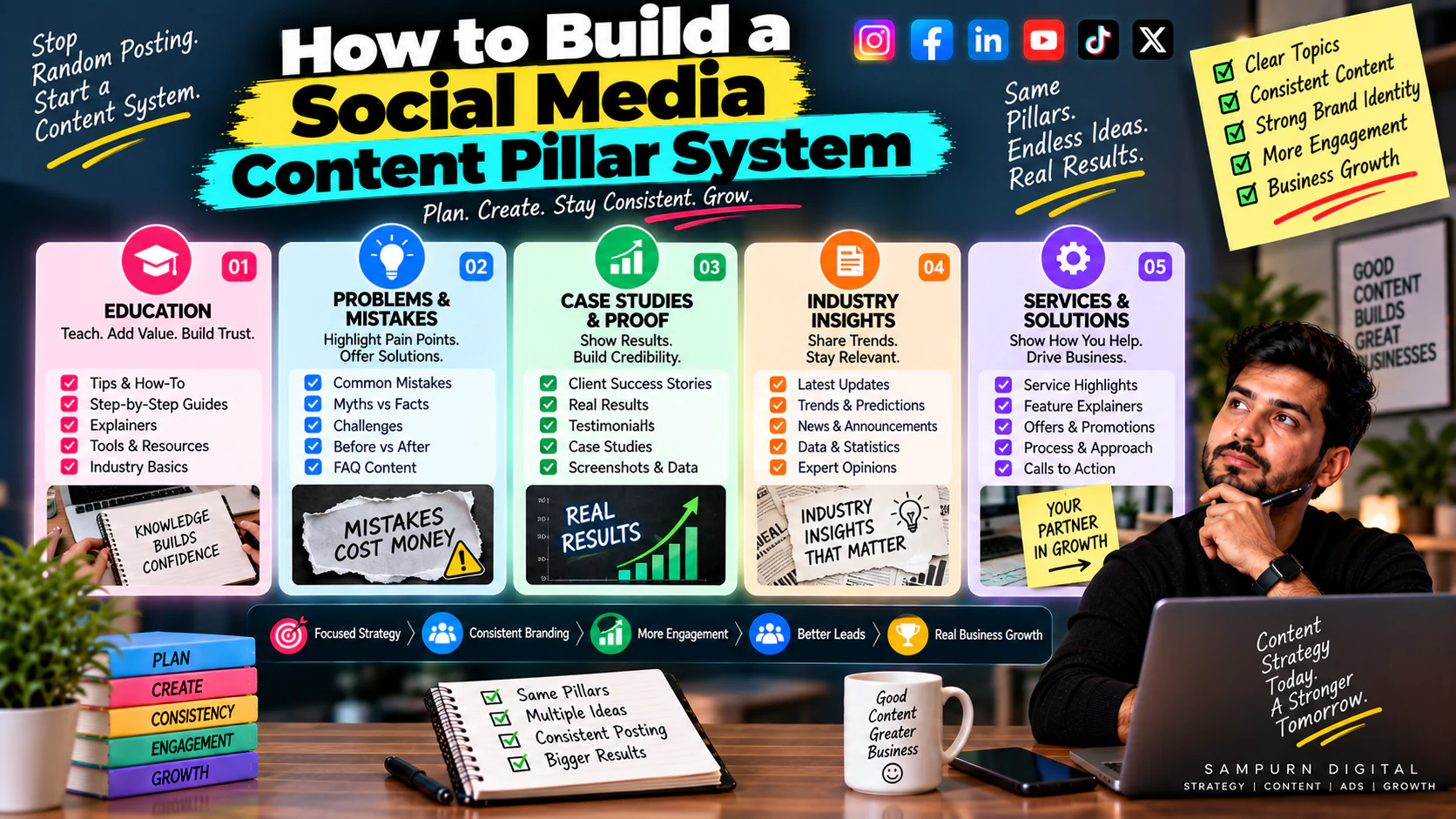
A social media content pillar system gives your brand a small number of strategic topics that you can repeatedly create content around.
Instead of inventing 30 unrelated posts, you build content around a few core business themes.
For example, a digital marketing company might have pillars such as:
- Education
- Problems & mistakes
- Case studies & proof
- Industry insights
- Services & solutions
Those five pillars can generate hundreds of useful content ideas.
More importantly, they keep your social media connected to your business.
What Is a Social Media Content Pillar?
A social media content pillar is a broad, repeatable topic category that your brand consistently talks about.
Think of it as a content bucket.
For example, a fitness business might use:
- Nutrition
- Training
- Recovery
- Transformation
- Products
A real estate company might use:
- Property education
- Market insights
- Buyer mistakes
- Property tours
- Financing
A digital agency might use:
- SEO
- Paid advertising
- Social media
- Websites
- Conversion optimization
The pillar is not the individual post.
It is the strategic topic underneath many posts.
Pillar
Individual posts
- Why Google Ads clicks don't become leads
- 5 negative keyword mistakes
- How to calculate profitable CPA
- Search terms you should review weekly
- When to increase your ad budget
- Why branded campaigns can distort reporting
One pillar can therefore produce dozens of specific pieces of content.
Why Businesses Need Content Pillars
Without pillars, social content often becomes reactive.
Someone sees a trend.
Someone suggests a Reel.
A festival arrives.
A competitor posts something interesting.
A manager says:
“We haven't posted in three days.”
So the team creates something quickly.
This creates content activity without strategic consistency.
A pillar system solves that.
It gives you:
- Topic consistency
- Audience relevance
- Better planning
- Easier brainstorming
- Stronger brand positioning
- Easier repurposing
- Better internal linking
- Better funnel coverage
- More predictable production
Most importantly, it answers:
Content Pillars Are Not the Same as Content Formats
This distinction is important.
A pillar is what you talk about.
A format is how you communicate it.
For example:
Pillar
Landing page optimization
Formats
- Reel
- Carousel
- Static post
- Story
- Tutorial
- Case study
- Founder video
You can therefore take one pillar and distribute it across multiple formats.
That's how you avoid repetitive content.
The 5-Part Content Pillar Framework
A strong business content system usually needs coverage across five areas:
Educate
Teach the audience something useful.
Diagnose
Help them identify problems.
Demonstrate
Show expertise, process or proof.
Differentiate
Explain how your approach differs.
Convert
Connect the audience with an appropriate next step.
This creates a much stronger content journey than simply posting educational tips.
Start With Your Business Goals
Don't begin with:
“What content do we enjoy making?”
Begin with:
“What does the business need social media to accomplish?”
Possible goals include:
- Brand awareness
- Qualified reach
- Lead generation
- Website traffic
- Product discovery
- Community building
- Authority
- Recruitment
- Customer education
- Retention
Suppose a B2B company needs more qualified leads.
Its pillars should support:
If the same company chooses pillars only because they are easy to post about, the strategy will probably produce activity rather than results.
Define Your Audience
Your pillars should reflect what your audience actually cares about.
Ask:
- Who are our ideal customers?
- What problems do they have?
- What are they trying to achieve?
- What questions do they ask?
- What mistakes do they make?
- What objections stop them from buying?
- What information do they need before choosing us?
For example, an SEO agency serving established businesses might discover that customers care about:
- Declining rankings
- Poor-quality traffic
- Slow SEO results
- Competitor rankings
- Content strategy
- Technical issues
- ROI
Those topics should influence the content pillars.
Identify Your Core Expertise
Now list what your business can credibly talk about.
For Sampurn Digital, that might include:
- SEO
- Digital marketing
- Performance marketing
- Social media
- Web development
- Conversion optimization
But don't automatically turn every service into a pillar.
A pillar needs enough depth to generate consistent content.
For example:
is a broad enough pillar.
But:
may be too narrow to function as a primary pillar.
It could instead become a subtopic inside:
Combine Audience Problems With Your Expertise
This is where strategic pillars emerge.
Use:
Example:
Audience problem
Businesses struggle to generate leads.
Expertise
Landing pages and CRO.
Pillar
Possible content:
- Why traffic isn't becoming leads
- Landing page mistakes
- CTA problems
- Lead form optimization
- Offer positioning
- Conversion rate diagnosis
Now you have a pillar connected to both:
Choose 4–7 Primary Pillars
You don't need 15 pillars.
Too many pillars create the same problem you're trying to solve:
A practical starting point is around 4–7 primary pillars.
For example, a digital marketing agency could build:
| Pillar | Purpose |
|---|---|
| Marketing Education | Teach useful concepts |
| Problems & Mistakes | Diagnose customer problems |
| Case Studies & Proof | Build trust |
| Industry Insights | Demonstrate expertise |
| Strategy | Show how solutions work |
| Services | Create commercial awareness |
Now every new idea has somewhere to belong.
Example: Content Pillars for a Digital Marketing Agency
Let's build a complete system.
Pillar 1: Marketing Education
Topics:
- SEO basics
- Google Ads concepts
- Social media strategy
- Website fundamentals
- Conversion principles
Goal:
Pillar 2: Marketing Problems
Topics:
- Why traffic doesn't convert
- Why ads generate poor leads
- Why social media gets views but no sales
- Why rankings decline
- Why websites lose enquiries
Goal:
Pillar 3: Proof & Case Studies
Topics:
- Campaign breakdowns
- Before/after results
- Website improvements
- SEO growth examples
- Lead-generation examples
Goal:
Pillar 4: Strategy
Topics:
- Marketing channel selection
- Funnel strategy
- Budget allocation
- Content strategy
- SEO strategy
- Paid acquisition strategy
Goal:
Pillar 5: Industry Insights
Topics:
- Market changes
- Platform developments
- Search trends
- Consumer behaviour
- Advertising trends
Goal:
Pillar 6: Services & Solutions
Topics:
- What SEO services include
- When businesses need paid ads
- Website redesign situations
- Social media management
- Conversion optimization
Goal:
Create Subtopics Under Every Pillar
Your pillars should not remain broad.
Turn each one into subtopics.
For example:
Pillar: Social Media Strategy
Subtopics:
- Audience research
- Platform selection
- Content pillars
- Reels
- Analytics
- Engagement
- Content calendars
- Influencers
- Organic vs paid
- Social conversion
Now one pillar can support months of content.
Use the 3-Layer Content Structure
A particularly useful way to organize each pillar is:
Layer 1 — Core Topic
The broad pillar.
Layer 2 — Subtopic
A specific area.
Layer 3 — Content Angle
A specific problem or question.
This gives you a repeatable content-generation system.
One Pillar Can Produce 20+ Posts
Take:
You could create:
- What makes a landing page convert?
- 5 landing page mistakes
- Homepage vs landing page
- Why visitors don't submit forms
- CTA placement mistakes
- How to write a stronger headline
- Form length and conversion
- Social proof on landing pages
- Mobile landing page mistakes
- Landing page speed
- Offer clarity
- Trust signals
- Above-the-fold optimization
- Before/after redesign
- Landing page audit checklist
- Common CRO myths
- Case study
- FAQ
- Expert opinion
- Conversion testing ideas
That's the power of pillars.
You're no longer asking:
“What should we post tomorrow?”
You're asking:
“Which part of our content system should we develop next?”
Create Pillars Around Customer Questions
One of the easiest ways to generate useful pillars is to collect customer questions.
For example, a web development company might hear:
“How much does a website cost?”
“How long does development take?”
“Do I need a landing page?”
“Why is my website slow?”
“Why am I not getting enquiries?”
These questions can become pillar themes such as:
- Website strategy
- Website performance
- Conversion
- Pricing and planning
- Lead generation
Your customers are effectively giving you your content strategy.
Build Pillars Around the Buying Journey
Your content should not stop at awareness.
Map pillars against funnel stages.
| Funnel Stage | Content Type |
|---|---|
| Unaware | Industry insights |
| Problem Aware | Problems and mistakes |
| Solution Aware | Educational strategy |
| Product/Service Aware | Case studies and comparisons |
| Most Aware | Services, offers and conversion |
This prevents the common mistake of having hundreds of educational posts but almost nothing that supports a buying decision.
Add a Proof Pillar
Many brands talk.
Few demonstrate.
A dedicated proof pillar can include:
- Client stories
- Results
- Screenshots
- Process demonstrations
- Audits
- Before/after
- Lessons from projects
- Experiments
- Data
For example:
Instead of:
“Landing pages are important.”
Create:
“We found three conversion issues on this landing page. Here's what we changed and why.”
The second creates much stronger evidence of expertise.
Add a Human/Brand Pillar Carefully
Some brands benefit from content around:
- Team
- Culture
- Founder
- Behind the scenes
- Work process
- Company values
This can be useful.
But it shouldn't consume the majority of your content unless recruitment or brand-building is a major business objective.
A business account should not become:
unless that's actually aligned with the brand's goals.
How Many Posts Should Each Pillar Get?
There isn't one universal percentage.
Your distribution should reflect:
- Business goals
- Audience stage
- Platform
- Sales cycle
- Content maturity
But a practical starting framework might be:
30%
Education
25%
Problems / diagnosis
20%
Proof / trust
15%
Strategy / authority
10%
Commercial content
The percentages are a starting hypothesis.
Your analytics should eventually tell you what deserves more or less attention.
Create a Pillar Scorecard
Before finalizing a pillar, score it from 1–5.
| Question | Score |
|---|---|
| Does our audience care about it? | /5 |
| Does it connect to our business? | /5 |
| Do we have expertise here? | /5 |
| Can we create 20+ ideas? | /5 |
| Can it support different formats? | /5 |
| Can it contribute to business goals? | /5 |
A pillar scoring:
is probably strong.
A pillar scoring:
may not deserve a major role.
The “30 Ideas Test”
Before approving a content pillar, try this:
If yes, the pillar has depth.
If you struggle to produce even ten useful ideas, it may be:
- Too narrow
- Too disconnected from the audience
- Too repetitive
- Better as a subtopic
This simple test prevents weak pillars from entering your content strategy.
The “Business Connection” Test
Now ask:
If this pillar performs extremely well, can it help our business?
Suppose a marketing agency creates viral memes.
The memes may generate 500,000 views.
But if they attract people who will never purchase the agency's services, the pillar may have limited commercial value.
Compare that with:
It might generate fewer views.
But it attracts a much more commercially relevant audience.
A good pillar should therefore balance:
Build a Pillar-to-Format Matrix
Now decide how each pillar can be expressed.
| Pillar | Reel | Carousel | Static | Story | Case Study |
|---|---|---|---|---|---|
| Education | ✓ | ✓ | ✓ | ✓ | |
| Problems | ✓ | ✓ | ✓ | ✓ | |
| Proof | ✓ | ✓ | ✓ | ✓ | |
| Strategy | ✓ | ✓ | ✓ | ✓ | |
| Services | ✓ | ✓ | ✓ | ✓ | ✓ |
This gives your production team flexibility.
The same pillar doesn't need to look identical every time.
Build a Pillar-to-Funnel Matrix
You can also map pillars to funnel stages.
| Pillar | Awareness | Consideration | Trust | Conversion |
|---|---|---|---|---|
| Education | ✓ | ✓ | ||
| Problems | ✓ | ✓ | ||
| Proof | ✓ | ✓ | ✓ | |
| Strategy | ✓ | ✓ | ||
| Services | ✓ | ✓ |
This creates a more complete content ecosystem.
Use Content Pillars to Prevent Repetition
Suppose you've published:
“5 SEO mistakes.”
Instead of creating another nearly identical post next week, move across your pillar.
Education
“What is search intent?”
Problem
“Why your service pages aren't ranking.”
Strategy
“How to build an SEO topic cluster.”
Proof
“How restructuring content improved organic visibility.”
Commercial
“When should a business invest in SEO services?”
Same broad subject.
Different purpose.
That's strategic variety.
Turn Your Pillars Into a Weekly System
Imagine your brand publishes five times a week.
You could structure it like:
Monday
Education
Tuesday
Problem
Wednesday
Proof
Thursday
Strategy
Friday
Commercial / community
Now the team doesn't start each Monday from zero.
They already know the role of each publishing slot.
Example Weekly Calendar
For a performance marketing agency:
Monday: “Why your Google Ads spend is increasing.”
Tuesday: “3 search-term mistakes wasting budget.”
Wednesday: “Campaign optimization case study.”
Thursday: “How to decide when to increase your ad budget.”
Friday: “Should your business invest in Google Ads?”
Every post has a different job.
Together they build:
Don't Make Every Pillar a Service
This is a common mistake.
A business has six services.
So it creates six pillars.
That can make the account feel like a brochure.
Instead of:
- SEO services
- Google Ads services
- Social media services
- Website services
- Design services
- Branding services
consider broader customer-focused themes such as:
- Growth problems
- Marketing education
- Customer acquisition
- Conversion
- Proof
- Industry insights
Your services can appear naturally within those themes.
Use Content Pillars to Strengthen Brand Positioning
A content pillar system also tells the market:
For example, if a company consistently publishes about:
- Lead generation
- Conversion
- Paid acquisition
- Analytics
- Customer acquisition economics
people begin associating the brand with performance and growth, rather than simply “digital marketing.”
That is positioning through repetition.
Connect Social Content With Your Website
Your social media pillars shouldn't exist separately from your website.
Suppose your pillar is:
Your website may contain:
- SEO service page
- SEO guides
- Case studies
- Topic clusters
- Conversion pages
A social post can introduce the topic.
The website can provide deeper information.
The service page can provide the commercial next step.
That creates:
For a deeper framework, see Social Media Content → Website → Lead: How to Build the Journey.
Connect Pillars With SEO
There is also an opportunity to connect social content planning with search content.
Suppose your core service is:
You can build:
For example:
Core service
SEO
Topic cluster
Technical SEO
Social pillar
SEO problems
Social posts
- Why pages aren't indexed
- Common technical SEO mistakes
- Crawl budget explained
- Canonical errors
- Website migration problems
This creates consistency across your marketing channels.
For a deeper approach to structuring search content around a core service, see How to Build an SEO Topic Cluster From One Core Service.
Turn One Pillar Into 30 Posts
Once your pillars are ready, the next challenge is content volume.
Don't solve it by brainstorming 30 random ideas.
Use a structured system.
Take one pillar:
Then create content around:
Problems
5 ideas
Questions
5 ideas
Mistakes
5 ideas
Strategies
5 ideas
Proof/examples
5 ideas
Commercial topics
5 ideas
You now have:
The dedicated guide How to Turn One Business Topic Into 30 Social Media Posts can take this process further.
Build a Content Pillar Worksheet
Use this structure for every pillar:
Pillar Name
What is the broad topic?
Audience
Who cares about it?
Core Problem
What problem does it address?
Business Connection
Which service, product or expertise does it support?
Subtopics
List 5–10.
Content Angles
- Mistakes
- Questions
- Myths
- How-to
- Comparisons
- Examples
- Case studies
- Opinions
- Checklists
Formats
- Reels
- Carousels
- Stories
- Static
- Video
- Case studies
Funnel Stage
Awareness / Consideration / Trust / Conversion
CTA
What should the audience do next?
A Complete Example
Let's build one pillar for a hypothetical web development company.
Pillar
Audience
Service businesses receiving website traffic.
Problem
Visitors aren't becoming enquiries.
Subtopics
- Headlines
- CTAs
- Forms
- Trust signals
- Mobile UX
- Page speed
- Offers
- Landing pages
- Navigation
- Social proof
Content ideas
Education: “What makes a website trustworthy?”
Problem: “Why people visit your website but don't contact you.”
Mistake: “3 CTA mistakes costing you enquiries.”
Proof: “Before/after landing page conversion breakdown.”
Strategy: “How to structure a service page for lead generation.”
Commercial: “When should a business redesign its website?”
That's a complete pillar.
Review Your Pillars Every Quarter
Your content pillars shouldn't be permanent forever.
Review them every 3–6 months.
Look at:
- Top-performing topics
- Qualified engagement
- Website traffic
- Leads
- DMs
- Sales influence
- Audience questions
- Competitor activity
- New services
- Business priorities
You may discover:
Don't blindly keep the same distribution.
Improve the system based on evidence.
Signs Your Content Pillars Are Weak
Your pillar system may need work if:
There's no recognizable theme.
Your team still asks “What should we post?”
The pillars aren't operational enough.
Posts constantly repeat themselves
The pillar may be too narrow.
Content gets engagement but no business value
The pillar may attract the wrong audience.
Everything is promotional
You have product/service categories, not a content strategy.
Everything is educational
You may lack trust and conversion content.
Your audience can't describe what you are known for
Your pillars aren't creating strong positioning.
The 7-Step Content Pillar Process
Use this whenever you're building a new social strategy.
Step 1
Define business goals.
Step 2
Research your audience.
Step 3
List customer problems and questions.
Step 4
Map your expertise to those problems.
Step 5
Choose 4–7 primary pillars.
Step 6
Create subtopics and content angles.
Step 7
Map each pillar to formats, funnel stages and CTAs.
Then turn the system into a monthly content calendar.
Final Content Pillar Template
Use this as your starting framework:
| Pillar | Audience Problem | Purpose | Example Topics | Funnel |
|---|---|---|---|---|
| Education | Doesn't understand the problem | Teach | Guides, concepts | Awareness |
| Problems | Experiencing a challenge | Diagnose | Mistakes, symptoms | Problem Awareness |
| Strategy | Wants to know what to do | Demonstrate expertise | Frameworks, processes | Consideration |
| Proof | Needs confidence | Build trust | Case studies, results | Trust |
| Industry | Wants perspective | Build authority | Trends, insights | Awareness |
| Services | Evaluating providers | Create demand | Solutions, FAQs | Conversion |
You can adapt the number of pillars to your business.
The framework matters more than the exact number.
SEO Publishing Information
| Field | Details |
|---|---|
| Blog ID | SMM-11 |
| Category | Social Media Marketing |
| Stage | Build |
| Primary Keyword | Social media content pillars strategy |
| Supporting Keywords | Content pillars for business; social media content framework; content pillar examples |
| Search Intent | Informational |
| Funnel Stage | Solution Aware |
| Pillar Page | Social Media Marketing Services |
| Suggested URL | `/blog/social-media-marketing/how-to-build-a-social-media-content-pillar-system` |
| Content Role | Implementation / how-to resource |
| Publishing Sprint | Sprint 4 |
| CTA | Get a social media growth strategy / Explore Social Media Marketing |
| H1 | How to Build a Social Media Content Pillar System |
| Meta Title | How to Build a Social Media Content Pillar System |
| Meta Description | Learn how to build a social media content pillar system with practical frameworks, examples, content ideas and a repeatable strategy for business growth. |
