
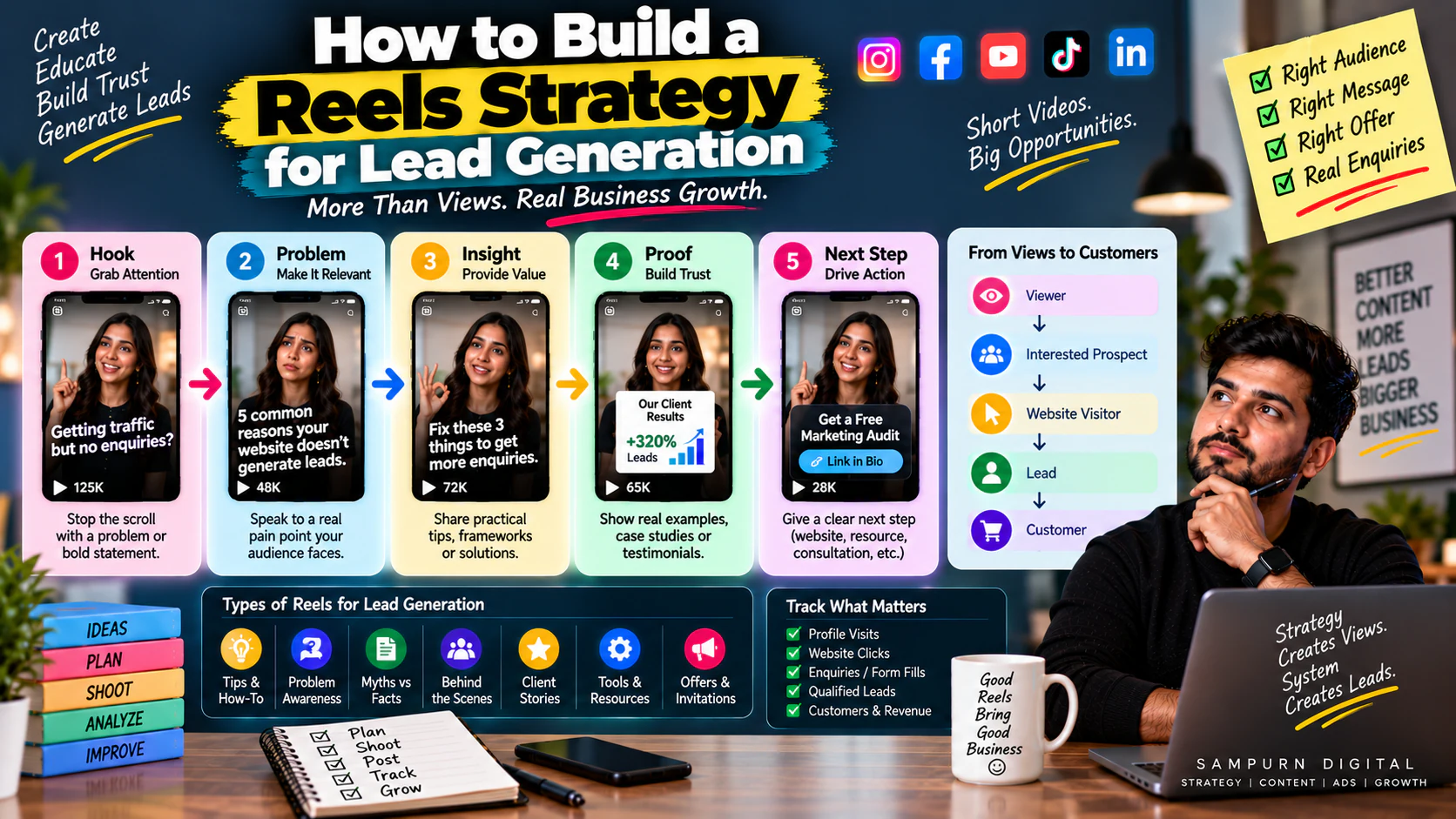
Getting 100,000 Reel views feels great.
Getting 10 qualified enquiries from a Reel is better.
That difference explains why many businesses misunderstand Instagram Reels.
They optimize for:
- Views
- Likes
- Followers
- Trending audio
- Viral hooks
But they fail to build a path from:
A Reel does not need to go viral to generate business.
It needs to reach the right people, communicate something they care about, build enough trust to create interest, and give them a logical next step.
That is what a Reels lead generation strategy is designed to do.
This guide explains how to build a Reels system for a business that wants more than views.
What Is a Reels Strategy for Lead Generation?
A Reels strategy for lead generation is a repeatable system for using short-form video to:
- Attract relevant prospects
- Identify their problems
- Educate them
- Build trust
- Create intent
- Move interested viewers toward a conversion point
The basic system looks like this:
For example:
“Getting traffic but no enquiries?”
Then explain three common conversion problems.
Then show an example.
Then direct interested viewers toward a relevant resource or service.
The Reel is not trying to close the entire sale.
Its job is to move the viewer one step further.
Why Most Business Reels Don't Generate Leads
The biggest problem is usually not video quality.
It is strategy.
A business may create excellent-looking videos but still get poor commercial results because the content has no connection to the buyer journey.
Common examples:
Problem 1: The content is too broad
“5 marketing tips you need to know.”
Who is that for?
Almost everyone.
And therefore, almost nobody feels specifically addressed.
Problem 2: The content attracts the wrong audience
A funny marketing Reel may get thousands of views from people who will never buy your service.
High reach does not compensate for poor audience quality.
Problem 3: There is no commercial bridge
The Reel ends.
The viewer scrolls.
There is no reason to visit the website, explore the service, download something, send a message, or take another meaningful action.
Problem 4: Every Reel asks for a sale
The opposite problem is also common.
If every Reel says:
“Contact us today.”
the audience has little reason to keep watching.
People usually need value and confidence before they are ready to enquire.
Problem 5: The profile cannot convert the attention
A Reel may generate profile visits, but if the profile is unclear, the opportunity disappears.
The viewer should quickly understand:
- Who you help
- What you do
- What problem you solve
- Why they should trust you
- What they can do next
The Reels Lead Generation Funnel
Think about Reels as the top and middle layers of a funnel.
A practical journey looks like:
Different Reels can support different parts of this journey.
Stage 1: Cold Audience Reels
These are designed for people who do not know your business.
Content examples:
- Common mistakes
- Problems
- Myths
- Quick insights
- Contrarian opinions
- Industry misconceptions
Example:
“Your website may not have a traffic problem. It may have a conversion problem.”
The goal is not immediate sales.
The goal is:
Stage 2: Warm Audience Reels
These target people who already recognize the problem.
Content examples:
- How-to videos
- Frameworks
- Comparisons
- Diagnostic tips
- FAQs
- Process explanations
Example:
“Here are five things we check when Google Ads are generating leads but the lead quality is poor.”
Now the audience starts seeing your expertise.
Stage 3: High-Intent Reels
These target people who are closer to action.
Content examples:
- Case studies
- Before/after results
- Service explanations
- Client questions
- Process walkthroughs
- Objection handling
Example:
“What actually happens during a paid advertising account audit?”
The CTA can now become more direct.
Define the Customer Before Creating Reels
Do not start with:
“What Reel should we make?”
Start with:
“Which customer are we trying to attract?”
Build a simple audience profile.
Example
Business type: Service business
Problem: Paid advertising generates enquiries but poor-quality leads
Awareness: Solution aware
Concern: Wasted budget
Desired outcome: More qualified leads
Buying trigger: Rising advertising costs + poor sales conversion
Likely objection: “Will another agency actually improve this?”
Now your content can speak directly to that person.
Build Reels Around Customer Problems
Create a list of real customer problems.
For example, for a digital marketing agency:
SEO problems
- Traffic has stopped growing
- Rankings dropped
- Competitors outrank the business
- Traffic does not generate leads
- Important pages are not ranking
Paid advertising problems
- CPC is increasing
- Leads are expensive
- Lead quality is poor
- ROAS looks good but revenue does not
- Campaigns spend without converting
Social media problems
- Reels get views but no leads
- Engagement is falling
- Content ideas run out
- Followers do not become customers
- Social traffic does not convert
Each problem can generate multiple Reels.
That gives you a much stronger content pipeline than searching for random “Reel ideas.”
Create a Strong Reel Hook
The first few seconds determine whether someone continues watching.
Your hook should quickly communicate:
Good hook structures include:
Problem hook
“Your Instagram may be getting views for the wrong reason.”
Mistake hook
“This Google Ads mistake can waste thousands of rupees.”
Curiosity hook
“Your best-performing Reel may not be your most valuable Reel.”
Contrarian hook
“More followers won't necessarily give your business more customers.”
Diagnostic hook
“If your Reels get views but no enquiries, check these three things.”
Outcome hook
“Here is how we would turn one customer problem into ten Reels.”
Specific beats generic.
Compare:
“Let's talk about social media marketing.”
“If your Reels get 20,000 views but zero enquiries, this is what I would check first.”
The second immediately identifies the audience and problem.
Use the Problem → Insight → Action Structure
A simple Reel structure for business content is:
Problem
Identify something the audience recognizes.
Insight
Explain why it happens.
Solution
Give a useful framework or recommendation.
Proof
Use an example, result, process, demonstration, or evidence where available.
Action
Tell the viewer what to do next.
Example:
“Your website gets visitors but no enquiries?”
“The problem may not be your traffic.”
“If your landing page doesn't communicate the offer quickly, paid and organic traffic can both struggle to convert.”
“Check your headline, proof, CTA and form friction.”
“Save this checklist and audit your landing page.”
That is useful even without a sales pitch.
Create Different Types of Reels
Do not make every Reel look and feel identical.
Build a portfolio.
Type 1: Educational Reels
Teach something specific.
Examples:
- “How to audit your Google Ads search terms”
- “3 SEO issues to check before publishing another blog”
- “How to structure a landing page”
Purpose:
Type 2: Diagnostic Reels
Help people identify a problem.
Examples:
- “5 signs your website is leaking leads”
- “Why your Meta Ads CPL suddenly increased”
- “Why your Instagram reach dropped”
Purpose:
Type 3: Opinion Reels
Take a clear position.
Examples:
- “Stop measuring your marketing strategy by followers.”
- “Not every business needs to be on every social platform.”
- “A high ROAS does not automatically mean your marketing is profitable.”
Purpose:
Type 4: Proof Reels
Show evidence.
Examples:
- Case study
- Before/after
- Client feedback
- Process improvement
- Campaign result
Purpose:
Never manufacture results.
Use actual business evidence or explain the example as hypothetical.
Type 5: FAQ Reels
Answer questions prospects repeatedly ask.
Examples:
- “How long does SEO take?”
- “How much should a business spend on Google Ads?”
- “Should I run Meta Ads before fixing my website?”
Purpose:
Type 6: Behind-the-Scenes Reels
Show how the work happens.
Examples:
- Campaign audit
- Keyword research
- Content planning
- Website wireframe review
- Analytics analysis
Purpose:
Build Content Around Content Pillars
Your Reels should fit into the broader social media content system.
For example:
Pillar 1 — Education
Teach the audience.
Pillar 2 — Diagnosis
Help them identify problems.
Pillar 3 — Authority
Show how you think.
Pillar 4 — Proof
Demonstrate credibility.
Pillar 5 — Conversion
Give interested people a next step.
Now your Reels aren't random videos.
They are part of a larger content architecture.
Create a Weekly Reels Mix
A service business could start with something like:
| Day | Reel Type | Objective |
|---|---|---|
| Monday | Problem | Awareness |
| Tuesday | Educational | Authority |
| Thursday | Diagnostic | Consideration |
| Saturday | Proof/FAQ | Trust |
That gives you four strategic Reels per week.
If you have the resources to publish more, expand the system rather than simply repeating the same format.
For example:
- 2 educational
- 1 diagnostic
- 1 proof
- 1 conversion/FAQ
The correct frequency depends on your production capacity and audience response.
Make Your Reels More Specific
Specificity is one of the easiest ways to improve business content.
Instead of:
“Tips to improve your ads.”
Say:
“If your Google Ads campaign spends ₹50,000 a month but produces poor-quality leads, check these four areas first.”
Instead of:
“Improve your website.”
Say:
“If your service page gets traffic but visitors leave without enquiring, check these five conversion elements.”
Instead of:
“Create better content.”
Say:
“Before publishing another Reel, check whether your hook answers a problem your target customer actually has.”
Specific content attracts specific people.
And specific people are more commercially valuable than random reach.
Build a CTA Ladder
Not every Reel should ask for a sales call.
Create different CTA levels.
Low-intent CTA
- Follow
- Save
- Share
- Comment
Mid-intent CTA
- Read the article
- Visit the profile
- Watch another Reel
- Download the guide
- Send a question
High-intent CTA
- Request an audit
- Book a consultation
- Get a proposal
- Contact the team
Match the CTA to the Reel.
For example:
“Save this checklist.”
“See how the complete process works.”
“Request a strategy consultation.”
This creates a natural progression.
Optimize Your Instagram Profile for Conversion
Your Reel can create demand.
Your profile must capture it.
Review:
Profile name
Does it communicate what the business does?
Bio
Does it explain:
- Who you help
- What you provide
- What outcome you create?
Profile image
Is the brand recognizable?
Pinned posts
Do they explain the business effectively?
A strong pinned-post structure could be:
- Start here — what we do
- How we solve the problem
- Proof / case study
Link
Does the profile link send people somewhere useful?
A Reel can generate 500 profile visits.
If the profile provides no clear next step, much of that demand disappears.
Create a Reel-to-Website Journey
For lead generation, do not stop at:
Build the next step.
Example:
Now the Reel is part of an actual acquisition system.
The same principle can be used for:
- SEO guides
- Case studies
- Service pages
- Lead magnets
- Webinars
- Consultation pages
For more detail on building this complete journey, see Social Media Content → Website → Lead.
Use Reels to Feed Your Other Marketing Channels
One strong Reel should not necessarily be used once.
Suppose you create a Reel:
“7 reasons your website isn't generating leads.”
That idea can become:
- Instagram Reel
- LinkedIn video
- LinkedIn text post
- Carousel
- Blog article
- Story series
- Lead magnet
- Sales conversation topic
This is content multiplication.
The objective is not:
It is:
Test Hooks Before Completely Changing the Topic
Sometimes the topic is good but the packaging is weak.
Suppose the topic is:
Test different hooks.
Hook A
“Your Google Ads may be generating the wrong leads.”
Hook B
“Getting leads but sales hates them?”
Hook C
“Before increasing your Google Ads budget, check this.”
Hook D
“₹1 lakh in ad spend can still produce terrible leads.”
The underlying subject remains the same.
You are testing the entry point.
This is much more useful than changing your entire content strategy after one poor-performing Reel.
Track More Than Views
A lead-generation Reel should be measured across multiple levels.
Attention
Track:
- Reach
- Plays/views
- Average watch time
- Completion rate
Engagement
Track:
- Likes
- Comments
- Shares
- Saves
Intent
Track:
- Profile visits
- Link clicks
- DMs
- Website visits
Business
Track:
- Leads
- Qualified leads
- Sales opportunities
- Customers
- Revenue
A Reel with 5,000 views and 12 qualified enquiries may be more valuable than a Reel with 200,000 views and no business impact.
Calculate Lead Rate From Reels
If you can track the journey, calculate:
Example:
A Reel generates:
5,000 views
Then:
The Reel generated awareness.
The profile created the transition.
The website converted the intent.
This means you should not automatically blame the Reel if conversions are weak.
The problem could exist anywhere in the journey.
Diagnose Your Reels Funnel
Use this simple framework.
High views + low profile visits
Potential problem:
Low views + high profile-visit rate
Potential problem:
High profile visits + low website clicks
Potential problem:
High website traffic + low leads
Potential problem:
High leads + low qualified leads
Potential problem:
High qualified leads + low sales
Potential problem:
This prevents you from saying:
“Reels don't work.”
The actual problem may be several steps downstream.
Create a 30-Day Reels Plan
Here is a practical example for a digital marketing agency.
| Reel | Topic | Type | Funnel Stage | CTA |
|---|---|---|---|---|
| 1 | Why your website gets traffic but no leads | Diagnostic | Problem | Save |
| 2 | 3 SEO mistakes businesses make | Educational | Problem | Follow |
| 3 | How we audit a landing page | Behind the scenes | Solution | Save |
| 4 | SEO vs Google Ads | Comparison | Consideration | Comment |
| 5 | Why ad leads can be poor quality | Diagnostic | Problem | Share |
| 6 | Client result breakdown | Proof | Trust | Learn more |
| 7 | What a marketing audit includes | Educational | Solution | Save |
| 8 | 5 website conversion mistakes | Diagnostic | Problem | Save |
| 9 | How to choose a social platform | Educational | Solution | Follow |
| 10 | Why views don't equal customers | Opinion | Problem | Share |
| 11 | Google Ads search-term mistake | Educational | Solution | Save |
| 12 | Before/after campaign example | Proof | Trust | Learn more |
| 13 | How we build a content strategy | Behind the scenes | Authority | Follow |
| 14 | SEO traffic vs qualified traffic | Opinion | Consideration | Comment |
| 15 | Why your CPL is increasing | Diagnostic | Problem | Save |
| 16 | Landing page FAQ | FAQ | Consideration | DM |
| 17 | Social media myth | Opinion | Awareness | Share |
| 18 | Case-study lesson | Proof | Trust | Learn more |
| 19 | 3 signs you need an SEO audit | Diagnostic | Consideration | Save |
| 20 | How to structure a paid campaign | Educational | Solution | Save |
| 21 | Common website CTA mistake | Diagnostic | Problem | Share |
| 22 | Marketing reporting explained | Educational | Authority | Follow |
| 23 | Client question answered | FAQ | Consideration | Comment |
| 24 | How a campaign audit works | Behind the scenes | Solution | Learn more |
| 25 | Why high ROAS can be misleading | Opinion | Consideration | Save |
| 26 | Marketing funnel explained | Educational | Solution | Share |
| 27 | Client proof/testimonial | Proof | Trust | Learn more |
| 28 | Biggest marketing mistake | Opinion | Problem | Follow |
| 29 | Who should request an audit? | Conversion | High intent | Enquire |
| 30 | What happens after you contact us? | Conversion | High intent | Book a consultation |
The exact topics can change.
The strategic structure is what should remain.
A Simple Reel Script Template
Use this for future videos:
Hook
“If [specific audience] is struggling with [specific problem], watch this.”
Problem
“The reason this happens is usually…”
Insight
“Most businesses focus on X, but the real issue is Y.”
Solution
“Instead, check these three things…”
Proof
“We commonly see this when…”
CTA
“Save this checklist” or “Read the complete guide” or “Request an audit.”
This gives your team a repeatable script structure.
What Makes a Reel Commercially Strong?
A strong lead-generation Reel usually has five characteristics:
Audience specificity
The right person recognizes themselves.
Problem relevance
The topic relates to a genuine business problem.
Useful insight
The viewer learns something.
Credibility
The business demonstrates knowledge, proof, or experience.
Clear next step
The viewer knows what to do if they want more.
If one of these is missing, the Reel can become weaker commercially.
Don't Confuse Viral Content With Lead-Generation Content
Viral content is optimized for distribution.
Lead-generation content is optimized for relevance + intent + conversion.
Sometimes they overlap.
Sometimes they don't.
A Reel with:
may be less valuable than:
The second Reel reached fewer people.
But it reached more commercially relevant people.
For a business, that distinction matters.
The Best Reels Strategy Is Not "Post More"
It is:
That creates a feedback loop.
Month 1
Test topics, hooks, formats and CTAs.
Month 2
Identify patterns.
Month 3
Scale winning themes.
Month 4+
Build repeatable content systems around what consistently works.
Your strategy should become smarter over time.
Reels Lead Generation Checklist
Before publishing a business Reel, ask:
Audience
- Who is this for?
- Is the problem commercially relevant?
- Would a potential customer recognize themselves?
Content
- Is the hook specific?
- Is there one clear idea?
- Does the Reel teach, diagnose, prove or help?
- Is the message easy to understand?
Conversion
- Is there a logical CTA?
- Does the profile support the CTA?
- Is the destination page relevant?
- Is the offer clear?
Measurement
- Are views tracked?
- Are profile visits tracked?
- Are clicks tracked?
- Are leads tracked?
- Can qualified leads be identified?
If you can answer these questions, you are building Reels as a marketing channel—not simply producing videos.
SEO Publishing Information
Blog ID: SMM-14 Category: Social Media Marketing Stage: Build Primary Keyword: Reels strategy for lead generation Supporting Keywords: Instagram Reels lead generation; short video marketing funnel; Reels content strategy Search Intent: Commercial Investigation Funnel Stage: Solution Aware Pillar Page: Social Media Marketing Services Suggested URL: `/blog/social-media-marketing/how-to-build-a-reels-strategy-for-lead-generation` Content Role: Implementation / how-to resource Publishing Sprint: Sprint 4 CTA: Get a social media growth strategy / Explore Social Media Marketing
Meta Title: How to Build a Reels Strategy for Lead Generation
Meta Description: Learn how to build an Instagram Reels strategy for lead generation using customer problems, strong hooks, content pillars, CTAs, funnels and business-focused KPIs.
H1: How to Build a Reels Strategy for Lead Generation
