
Starting SEO for a new business can feel overwhelming.
There are keywords to research, pages to create, technical issues to check, content to publish, competitors to analyze, and dozens of SEO recommendations competing for attention.
The problem is that a new business usually does not need to do everything at once.
It needs to do the right things in the right order.
A practical SEO strategy for a new business should focus on building a strong foundation first, creating pages around real customer demand, making those pages understandable to search engines, and gradually building authority.
The first 90 days should therefore not be treated as a race to publish as many blogs as possible.
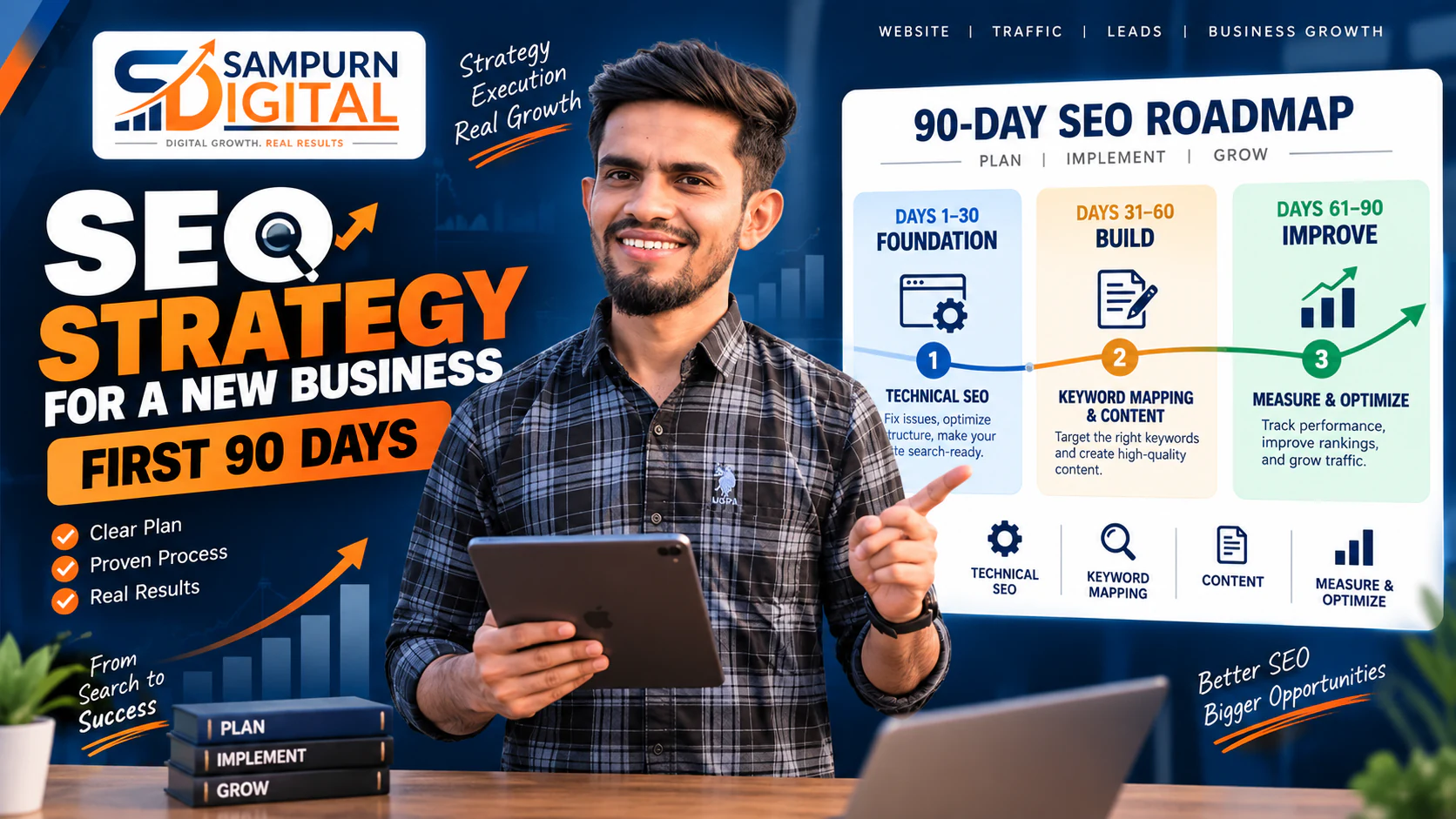
Instead, think of the first three months as three stages:
In this guide, we will break down what a new business should prioritize during the first 90 days, what to avoid, how to structure the website, how to approach keywords and content, and how to measure whether SEO is moving in the right direction.
First: Don't Expect SEO to Work Like Paid Advertising
One of the biggest mistakes new businesses make is expecting SEO to produce immediate traffic.
Paid advertising can generate visibility as soon as campaigns are launched.
SEO generally works differently.
A new website needs time to:
- Be discovered and crawled
- Have important pages indexed
- Build topical relevance
- Develop useful content
- Earn links and mentions
- Establish authority
- Improve rankings
- Generate consistent organic traffic
That does not mean you should wait three months before measuring anything.
It means the first 90 days should focus on building measurable SEO foundations rather than expecting instant traffic.
The right question is not:
"How much traffic should I get in 90 days?"
A better question is:
"Have I built the right foundation for sustainable organic growth?"
What Should an SEO Strategy for a New Business Actually Achieve?
A good first-90-day SEO plan should create five things:
- A technically accessible website
- Clear keyword and search-intent mapping
- Important commercial pages optimized for search
- A focused content system
- A measurement and improvement process
These foundations work together.
You cannot compensate for a badly structured website simply by publishing more articles.
You cannot compensate for weak page targeting by building hundreds of backlinks.
And you cannot evaluate SEO properly without measurement.
The objective is to build a system rather than a collection of isolated SEO tasks.
Days 1–30: Understand and Build the Foundation
The first month should focus primarily on understanding the business, website, customers, competitors, and technical environment.
Do not begin by publishing 20 random blogs.
Start with the foundation.
Understand the Business Before Choosing Keywords
SEO should begin with the business.
Before opening a keyword research tool, identify:
- What does the business sell?
- Who are the ideal customers?
- Which products or services generate the most revenue?
- Which offerings have the strongest margins?
- Which locations matter?
- Which customers are most valuable?
- What problems cause customers to search?
- What makes the business different?
- Which services are priorities for growth?
This matters because search volume is not the same as business value.
A keyword with thousands of monthly searches may attract people who will never become customers.
A smaller, highly specific keyword may bring fewer visitors but much stronger commercial opportunities.
That is why keyword selection should eventually connect search demand with revenue potential.
Define Your SEO Goals
A new business should decide what SEO is expected to accomplish.
Possible goals include:
- Increase qualified organic traffic
- Generate leads
- Increase product discovery
- Improve local visibility
- Build category authority
- Support sales
- Reduce dependence on paid acquisition
- Increase visibility for important commercial searches
Avoid setting the entire SEO strategy around one metric such as "increase traffic."
Traffic without relevance can create misleading growth.
A better measurement chain is:
The exact measurement depends on the business and available tracking.
Perform a Baseline SEO Audit
Before changing anything, establish the current condition of the website.
A useful audit should examine:
Technical SEO
- Indexability
- Crawlability
- Robots.txt
- XML sitemap
- Canonical URLs
- Redirects
- HTTP status codes
- HTTPS
- Duplicate URLs
- JavaScript rendering
- Mobile usability
On-page SEO
- Page titles
- Meta descriptions
- H1 structure
- Headings
- Content relevance
- Image optimization
- Internal links
- URL structure
Content
- Existing pages
- Thin pages
- Duplicate content
- Missing commercial content
- Search-intent mismatches
- Outdated information
Performance
- Page speed
- Core Web Vitals
- Mobile performance
- Large assets
- Unnecessary scripts
If you want to systematically work through the major areas, use [the 50-point SEO audit checklist for a business website](https://www.sampurndigital.com/blog/seo/the-50-point-seo-audit-checklist-for-a-business-website).
The objective is not to fix every minor issue immediately.
Prioritize problems that can materially affect crawling, indexing, user experience, rankings, or conversions.
Make Sure Google Can Discover Your Important Pages
A new website can have excellent content and still receive little organic traffic if important pages are not properly discoverable or indexable.
Check:
- Is the website accessible?
- Are important pages returning a successful status code?
- Are important pages blocked from crawling?
- Is the XML sitemap available?
- Are canonical tags appropriate?
- Are internal links pointing to important pages?
- Are important URLs indexed?
- Are there accidental noindex directives?
Google Search Console is particularly useful for checking indexing and search performance.
Do not make "get every URL indexed" the goal.
The priority should be getting valuable pages discovered and indexed.
Build a Clear Website Architecture
A new business has an advantage that older websites often do not:
You can build the architecture correctly from the beginning.
Your structure should make it obvious:
- What the business offers
- Which services are most important
- Which pages target which topics
- How informational content supports commercial pages
For example:
This creates logical relationships between pages.
Your website architecture should also make navigation easy for users.
Do not create dozens of pages simply because you found dozens of keywords.
Each page should have a clear purpose.
Map Search Intent Before Creating Content
One of the most important steps in a new-business SEO strategy is determining which page should target which search.
Consider these searches:
- `what is SEO`
- `how does SEO work`
- `SEO strategy for small business`
- `SEO audit`
- `SEO services`
- `SEO agency`
They are related.
But they do not represent the same intent.
A user searching "what is SEO" needs education.
A user searching "SEO services" may be evaluating a provider.
This is why [search intent mapping](https://www.sampurndigital.com/blog/seo/search-intent-mapping-how-to-match-pages-with-what-people-actually-want) should happen before content production.
Create a keyword-to-URL map that defines:
- Primary keyword
- Secondary keywords
- Search intent
- Target page
- Funnel stage
- Business value
- Supporting content
This prevents random content creation and reduces the risk of multiple pages competing for the same search.
Days 31–60: Build the Right Pages and Content
Once the foundation is in place, the second month should focus on building the pages that matter.
This is where many businesses make another mistake:
They publish blog after blog while their important commercial pages remain weak.
Start with the pages closest to business value.
Optimize Your Core Service Pages
If your business sells services, service pages should be a major SEO priority.
A service page should clearly communicate:
- What the service is
- Who it is for
- What problems it solves
- What the process looks like
- What is included
- Why the business is qualified
- Frequently asked questions
- Relevant proof where available
- The next step
For example, a business offering SEO should have a dedicated [SEO Services](https://www.sampurndigital.com/seo-services) page rather than expecting its homepage to rank for every SEO-related search.
The same principle applies to:
- Web development
- Performance marketing
- Social media marketing
- PPC
- CRO
- Other core services
Each important commercial offering should have a logical destination.
Build a Keyword Strategy Around Business Value
Keyword research should not be a list of high-volume phrases.
A stronger approach evaluates:
Search demand
How many people are searching?
Business relevance
Does the search relate directly to what you sell?
Search intent
What does the person actually want?
Competition
How difficult may the query be to compete for?
Conversion potential
Could this search reasonably lead to a customer?
Customer value
How valuable would that customer be?
For a deeper approach, see [keyword research based on business revenue, not just search volume](https://www.sampurndigital.com/blog/seo/keyword-research-based-on-business-revenue-not-just-search-volume).
This approach helps a new business avoid chasing keywords simply because they look impressive in a keyword tool.
Prioritize Commercial Keywords
A new business should usually establish its commercial search foundation before attempting to dominate extremely broad informational topics.
For example, a web development company may prioritize:
- website development company
- business website development
- ecommerce website development
- custom web development
- website redesign services
before spending months trying to rank for something extremely broad such as:
"website"
The goal is not to avoid broad keywords forever.
It is to build relevance and authority progressively.
Create Supporting Content Around Core Services
Once important commercial pages are established, create supporting content around them.
Suppose your core service is SEO.
Your supporting content might cover:
- Why websites don't get organic traffic
- How Google decides which page ranks
- Search intent
- Keyword research
- Keyword mapping
- SEO audits
- Technical SEO
- Internal linking
- Content optimization
This creates a topic ecosystem.
The articles educate users and provide contextual paths back toward the commercial service.
That is much stronger than publishing unrelated articles just because they have search volume.
Build Topic Clusters Instead of Random Blogs
A topic cluster connects multiple useful resources around one core subject.
For example:
SEO Strategy
Keyword Research
Search Intent
Keyword Mapping
Technical SEO
SEO Audit
Content Optimization
The individual articles can target different searches while supporting the broader topic.
This also creates opportunities for contextual internal linking.
A new business should think:
"What collection of pages would make this website genuinely useful for someone researching this subject?"
rather than:
"How many blogs can we publish this month?"
Create Internal Links as You Publish
Do not wait until 50 articles are published before thinking about internal linking.
Add links as the content system develops.
A useful internal link should:
- Help the reader continue learning
- Provide additional context
- Connect closely related topics
- Clarify the website's content relationships
- Support important pages
For example, after explaining keyword selection, you can naturally point readers toward [how to build a keyword map for every important website page](https://www.sampurndigital.com/blog/seo/how-to-build-a-keyword-map-for-every-important-website-page).
The anchor text should explain what the reader will find.
Avoid generic anchors such as:
- Click here
- Read more
- Learn more
Instead, use descriptive phrases that fit the sentence naturally.
Improve the Content Before Increasing Content Volume
More pages do not automatically mean more organic traffic.
If an existing page has:
- Impressions but few clicks
- Rankings around page two
- Declining traffic
- Weak intent alignment
- Poor internal links
- Outdated information
it may be a better opportunity than creating another article.
A good SEO strategy constantly asks:
"Should we create something new, or improve what already exists?"
That question becomes increasingly important as the website grows.
Days 61–90: Improve, Measure and Build Momentum
The third month should focus on understanding what is working and improving the highest-impact opportunities.
At this stage, SEO becomes less about setup and more about iteration.
Review Google Search Console Data
Look for:
- Queries generating impressions
- Queries generating clicks
- Pages gaining visibility
- Pages losing visibility
- Unexpected keywords
- High-impression, low-click pages
- Pages ranking for related searches
- Indexing issues
You may discover that a page is already appearing for searches you did not intentionally target.
That can reveal opportunities for:
- Content expansion
- Better headings
- Additional sections
- Internal links
- New supporting articles
- Title improvements
Search data should inform the next round of work.
Analyze Pages That Are Starting to Rank
Do not wait until a page reaches position one before optimizing it.
A page ranking around positions 8–20 may already have relevance.
Ask:
- Does it fully satisfy the search intent?
- Does it answer the main question quickly?
- Is the content more useful than competing results?
- Does the title accurately communicate the value?
- Are relevant supporting pages linking to it?
- Is the page internally connected to the correct commercial destination?
The goal is not to manipulate rankings.
The goal is to make an already-relevant page more useful and better connected to the website.
Strengthen Internal Linking
As more content is published, review your internal link structure.
Look for:
- Important pages with few internal links
- Orphan pages
- Overlinked pages
- Repeated anchor text
- Missing contextual relationships
- Articles that should connect to service pages
- Supporting articles that should link to one another
The purpose is not to maximize the number of links.
It is to create a logical information architecture.
Review Competitors
Competitor analysis should not mean copying their content.
Instead, investigate:
- Which topics they cover
- Which commercial pages they have
- What content formats rank
- Which search intents they target
- How their website architecture is organized
- Which topics appear to be missing from your website
- Where your content provides a better opportunity
Competitor research should identify gaps and opportunities.
It should not become a race to reproduce the same articles.
Build Authority Gradually
A new business website often starts with limited authority.
That means ranking for highly competitive queries may take time.
Focus on earning legitimate signals through:
- Useful content
- Relevant industry mentions
- Digital PR
- Partnerships
- Original research
- Genuine business listings where appropriate
- Relevant links from credible websites
Avoid treating link building as a numbers game.
A large number of irrelevant links is not a substitute for relevance, useful content, and a technically sound website.
Connect SEO With Conversion Optimization
Traffic is not the final objective.
A page can rank well and still generate very few leads.
Look at:
- Calls to action
- Contact forms
- Service-page clarity
- Page structure
- Trust signals
- Navigation
- Mobile usability
- Lead forms
- Landing-page experience
Your SEO strategy should eventually connect organic visibility with conversion performance.
This is where SEO and website strategy start working together rather than operating as separate disciplines.
For businesses evaluating the wider website experience, [lead-generation website architecture for service businesses](https://www.sampurndigital.com/blog/web-development/lead-generation-website-architecture-for-service-businesses) provides a useful next step.
Create a 90-Day SEO Reporting Baseline
At the end of the first 90 days, compare the website against the starting baseline.
Track metrics such as:
Visibility
- Search impressions
- Number of ranking keywords
- Average position
Traffic
- Organic sessions
- Organic users
- Landing-page traffic
Engagement
- Relevant engagement metrics
- Key landing-page behavior
Business outcomes
- Leads
- Enquiries
- Sales
- Revenue where tracking allows
Technical health
- Indexed important pages
- Critical technical issues
- Core performance indicators
Do not evaluate SEO based on one number.
A new website may have modest traffic but strong improvements in indexing, visibility, relevant rankings, and qualified enquiries.
Those can be meaningful signs of progress.
A Simple 90-Day SEO Roadmap
Here is a practical way to organize the first three months.
| Period | Primary Focus | Key Activities |
|---|---|---|
| Days 1–30 | Foundation | Business research, technical audit, indexing, architecture, keyword research |
| Days 31–60 | Build | Service pages, keyword mapping, content clusters, internal linking |
| Days 61–90 | Improve | Search Console analysis, content optimization, internal links, competitor gaps, conversion improvements |
The exact workload will depend on the size and condition of the website.
A small local business will require a different approach from a large ecommerce website.
The principle remains the same:
What a New Business Should NOT Do in the First 90 Days
Don't Publish Hundreds of AI-Generated Articles
Content volume is not the same as content value.
Publishing large amounts of repetitive, generic content can create more pages to manage without creating meaningful organic visibility.
Don't Target Every High-Volume Keyword
High volume does not automatically mean high business value.
Start with searches that have a strong connection to your products, services, customers, and business goals.
Don't Ignore Commercial Pages
Blog content can attract users, but important commercial pages are usually where business value becomes much clearer.
Build those pages early.
Don't Buy Random Backlinks
Link acquisition should focus on relevance, credibility, and legitimate value.
Do not build an SEO strategy around link quantity alone.
Don't Change Everything Every Week
SEO needs enough time for you to evaluate changes.
Constantly changing titles, pages, URLs, content, and strategies makes it difficult to determine what actually worked.
Prioritize changes, document them, and measure the results.
The First 90 Days Should Create a Repeatable SEO System
The most valuable outcome after 90 days is not necessarily a specific traffic number.
It is a repeatable process.
You should know:
- How to identify valuable keywords
- How to map keywords to URLs
- How to determine search intent
- How to create useful content
- How to build internal links
- How to identify technical problems
- How to improve existing pages
- How to measure organic performance
- How to connect SEO with leads and revenue
Once that system exists, scaling becomes much easier.
A Practical SEO Priority Framework
When deciding what to work on next, score each opportunity using four questions:
Business Impact
Could this help generate meaningful customers or revenue?
Search Opportunity
Is there relevant search demand?
Current Performance
Does the website already have some visibility or relevance?
Effort
How much time and development work will the change require?
A simple priority model can be:
This does not need to be mathematically complicated.
The purpose is to stop SEO teams from spending weeks fixing low-impact issues while important commercial opportunities remain untouched.
