
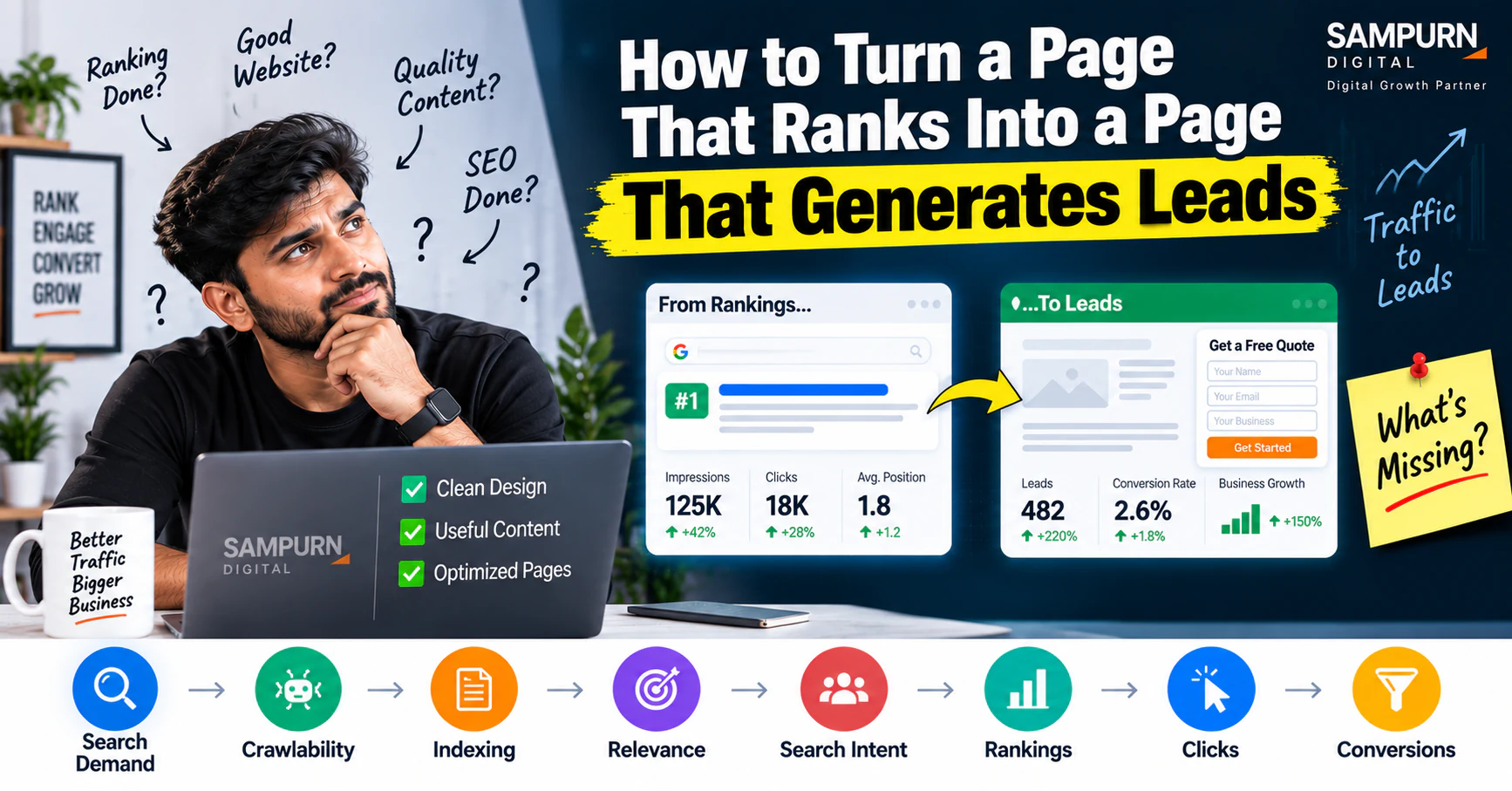
Ranking on Google is valuable.
But ranking alone does not automatically create business.
A page can attract hundreds or thousands of organic visitors every month and still generate very few enquiries, calls, demos or purchases.
That creates an important SEO question:
How do you turn organic traffic into an actual business outcome?
The answer is not simply adding a bigger CTA at the bottom of the article.
You need to understand why the visitor arrived, what they want next, where the page fits into the buying journey and whether your website makes that next step easy.
This is where SEO conversion optimization becomes important.
The goal is not to turn every informational article into a sales page.
The goal is to create a logical journey:
First: Don't Assume More Traffic Means More Leads
Suppose an article receives:
- 10,000 organic visits
- 8,000 engaged visitors
- 500 visitors reaching the CTA
- 20 enquiries
The problem isn't necessarily traffic.
The page may have a conversion journey problem.
Now compare that with another page:
- 2,000 organic visits
- 1,200 engaged visitors
- 300 CTA interactions
- 35 enquiries
The second page generates more leads despite receiving much less traffic.
This is why SEO should not be evaluated only through rankings and sessions.
A useful SEO strategy connects:
Search Visibility ↓ Relevant Traffic ↓ Useful Content ↓ Intent Match ↓ Next-Step Engagement ↓ Lead / Sale
What Does It Mean to Turn Organic Traffic Into Leads?
Turning organic traffic into leads means designing the page and surrounding website experience so that relevant visitors have a clear opportunity to take a valuable next action.
That action could be:
- Contacting your business
- Requesting a quote
- Booking a consultation
- Starting a trial
- Downloading a useful resource
- Requesting a demo
- Calling your business
- Purchasing a product
The important word is relevant.
A visitor searching for:
"What is SEO?"
may not be ready to hire an SEO agency.
A visitor searching for:
"SEO agency for eCommerce business"
has a much stronger commercial signal.
The conversion strategy should reflect that difference.
Understand the Search Intent Behind the Page
Before adding a CTA, identify why people are visiting the page.
Search intent generally falls into different categories.
Informational
The visitor wants to learn.
Examples:
- What is technical SEO?
- How does keyword research work?
- What is content decay?
Commercial Investigation
The visitor is evaluating solutions.
Examples:
- Best SEO agency for startups
- SEO services pricing
- SEO audit agency
- SEO company for eCommerce
Transactional
The visitor is closer to taking action.
Examples:
- Buy SEO software
- Hire SEO consultant
- Book SEO consultation
Your CTA should match the intent.
An informational visitor may respond better to:
"Download the SEO Audit Checklist"
while a commercial visitor may respond better to:
"Request a Free SEO Audit"
Identify the Page's Business Purpose
Every important organic landing page should have a purpose.
Ask:
What should a qualified visitor do after consuming this page?
Possible answers:
- Read another related guide
- Visit a service page
- Contact sales
- Request an audit
- Download a resource
- Compare solutions
- Start a purchase journey
If you cannot answer this question, the page may be attracting traffic without contributing clearly to the customer journey.
Match the CTA to the Visitor's Readiness
One of the biggest mistakes is using the same CTA everywhere.
For example:
Contact Us Now
on every informational blog post.
That may be too aggressive for someone who is still researching.
Instead, create different CTA levels.
Low Commitment
For early-stage visitors:
- Read the next guide
- Download a checklist
- View examples
- Explore the topic
Medium Commitment
For visitors evaluating solutions:
- Get an audit
- View services
- Request a strategy
- See how the process works
High Commitment
For high-intent visitors:
- Book a consultation
- Request a quote
- Start a project
- Contact the team
This creates a more natural progression.
Build a Content-to-Service Journey
A blog shouldn't necessarily send every visitor directly to the homepage.
Instead, connect content to the most relevant next step.
For example:
SEO Audit Article ↓ Technical SEO Guide ↓ SEO Strategy Resource ↓ SEO Services ↓ Audit / Consultation
Another example:
Keyword Research Guide ↓ Keyword Mapping Guide ↓ Topic Cluster Guide ↓ SEO Services
The visitor moves deeper into the subject before reaching the commercial decision.
This is particularly useful for informational searches.
Add Contextual Internal Links
Internal links aren't only an SEO mechanism.
They can also guide visitors.
Suppose an article discusses outdated content.
Instead of ending the section with no next step, you could naturally link to [how to improve existing content instead of publishing more blogs](https://www.sampurndigital.com/blog/seo/how-to-improve-existing-content-instead-of-publishing-more-blogs).
The visitor gets a logical next resource.
That creates:
Current Question ↓ Relevant Explanation ↓ Related Resource ↓ Deeper Problem ↓ Potential Solution
The link should make sense in context.
Don't insert internal links just to increase the number of links.
Use Existing Ranking Pages as Conversion Assets
Your highest-value conversion opportunities may already exist.
Look for pages that:
- Rank on page one
- Receive consistent organic traffic
- Attract your target audience
- Cover a problem your business solves
- Have strong engagement
- Currently generate few leads
Create a list:
| Page | Traffic | Intent | Leads | Opportunity |
|---|---|---|---|---|
| Page A | High | Informational | Low | Medium |
| Page B | High | Commercial | Low | High |
| Page C | Medium | Commercial | Medium | High |
| Page D | Low | Informational | Low | Low |
Prioritize pages where traffic quality and business relevance are both strong.
Look Beyond the Primary Keyword
A page may rank for hundreds of related queries.
Those queries can reveal different levels of intent.
Imagine an article ranking for:
- SEO meaning
- SEO benefits
- SEO strategy
- SEO services
- SEO agency
- SEO consultant
These queries don't represent exactly the same visitor.
Analyze the queries bringing traffic and ask:
What does this visitor probably want next?
If the page attracts increasingly commercial queries, its conversion opportunities may need to become more visible.
Make the Value Proposition Clear
A visitor should understand what your business offers without having to search around the website.
For example, an SEO article can naturally explain:
If you are looking to improve organic visibility but don't have the internal resources to manage technical SEO, content strategy and ongoing optimization, an SEO service can provide the expertise and execution needed to build the system.
The commercial connection should be relevant to the topic.
Avoid turning educational content into an advertisement.
Place CTAs Where They Make Sense
Don't rely on one CTA at the very bottom.
Consider several logical positions.
After the Problem
When the visitor understands the challenge.
After the Solution
When they understand what needs to be done.
Near the End
When they're ready to take the next step.
For example:
Problem ↓ Explanation ↓ Practical Solution ↓ Relevant CTA ↓ Additional Resources
The CTA should appear because the reader has reached a logical decision point.
Make the CTA Specific
Weak CTA:
Learn More
Better:
Get a Free SEO Audit
Weak:
Contact Us
Better:
Talk to an SEO Strategist About Your Website
Weak:
Our Services
Better:
Explore SEO Services for Your Business
Specific CTAs communicate what happens next.
Reduce the Conversion Friction
Getting the visitor to click is only the beginning.
After clicking, ask:
- Is the landing page relevant?
- Does it continue the same message?
- Is the form too long?
- Is the CTA clear?
- Does the visitor understand what happens next?
- Is the page mobile-friendly?
- Is there unnecessary information?
- Are trust signals available?
A good article can lose a lead if the next page creates friction.
For businesses where website architecture is important, [lead generation website architecture for service businesses](https://www.sampurndigital.com/blog/web-development/lead-generation-website-architecture-for-service-businesses) provides a useful framework for connecting website structure with lead generation.
Create a Strong Landing Experience
Imagine someone clicks:
Get a Free SEO Audit
The next page should immediately confirm:
It should explain:
- What the offer is
- Who it is for
- What the visitor receives
- What information is required
- What happens after submission
Don't make visitors reconstruct the context themselves.
Connect Content With the Right Service
Not every article should link to the same service.
For example:
| Content Topic | Relevant Commercial Next Step |
|---|---|
| Technical SEO | SEO Services |
| Website speed | Web Development |
| Landing page optimization | CRO / Performance |
| Social content | Social Media Marketing |
| Paid search | Performance Marketing |
This makes the journey more relevant.
A visitor reading about technical SEO shouldn't necessarily be pushed toward an unrelated service.
Improve the Page Before Adding More Traffic
If a page already ranks and receives qualified visitors, improving conversion can be more practical than immediately trying to double traffic.
Consider improving:
- Content clarity
- CTA relevance
- Internal links
- Page structure
- Service connections
- Trust signals
- Forms
- Landing-page continuity
- Mobile experience
The objective is:
Don't Destroy the Informational Value
There is a dangerous balance here.
If you optimize too aggressively for leads, the article can become unpleasant to read.
For example:
Paragraph CTA CTA CTA Sales Pitch CTA Form CTA
That's not a useful content experience.
Instead:
Useful Information ↓ Example ↓ Practical Advice ↓ Relevant Resource ↓ Useful Information ↓ Commercial Next Step
The reader should receive value before being asked to convert.
Use Content Upgrades
A content upgrade is a resource directly related to the article.
For example:
Article: SEO Audit Guide
Possible upgrade:
SEO Audit Checklist
Article: Keyword Research Guide
Possible upgrade:
Keyword Research Template
Article: Content Strategy Guide
Possible upgrade:
Content Planning Template
The upgrade should solve a natural next problem.
Connect Ranking Pages With Conversion Pages
Think about your website as a network.
A ranking article is one node.
A service page is another.
A landing page is another.
A conversion action is another.
The architecture might look like:
            Blog Article
                  ↓
         Related Resource
            ↙         ↘
    Service Page    Case/Proof
            ↓         ↓
             Conversion
The stronger the relationships, the easier it becomes for users to move through the site.
Use Data to Find the Real Problem
Suppose a page gets 5,000 organic visits but only 5 leads.
Don't immediately rewrite the article.
Investigate:
Question 1
Are the visitors relevant?
Question 2
What queries bring them?
Question 3
What section do they engage with?
Question 4
Do they click internal links?
Question 5
Do they reach the CTA?
Question 6
Do they start the form?
Question 7
Do they complete the form?
This creates a funnel:
5,000 Visitors ↓ 3,000 Engaged ↓ 600 CTA Views ↓ 120 CTA Clicks ↓ 40 Form Starts ↓ 15 Leads
Now you can identify where the biggest loss occurs.
Separate Traffic Quality From Conversion Quality
A low conversion rate doesn't always mean the page is poorly optimized.
The audience may simply have low commercial intent.
For example:
may attract many beginners.
may attract fewer people but much stronger commercial intent.
Therefore evaluate:
not conversion rate alone.
Test One Major Change at a Time
If you change:
- Headline
- CTA
- Form
- Page structure
- Offer
- Internal links
- Landing page
all at once, it becomes difficult to understand what caused the improvement.
Where possible, create a controlled optimization process.
For paid campaigns and landing pages, testing methodology also matters; [A/B testing ads vs landing pages](https://www.sampurndigital.com/blog/performance-marketing/ab-testing-ads-vs-landing-pages-what-should-you-test-first) can help frame the question of what should be tested first.
For organic pages, changes may take time to produce measurable search effects, so separate SEO performance analysis from conversion analysis where possible.
Measure More Than Clicks
For a ranking page, monitor:
- Organic impressions
- Organic clicks
- Ranking visibility
- Engagement
- CTA clicks
- Form starts
- Form submissions
- Calls
- Qualified leads
- Revenue where measurable
A simple dashboard could look like:
| Metric | Before | After |
|---|---|---|
| Organic Visits | 4,000 | 4,100 |
| CTA Clicks | 80 | 150 |
| Form Starts | 30 | 55 |
| Leads | 12 | 25 |
| Qualified Leads | 7 | 16 |
Traffic barely changed.
But the business outcome improved significantly.
That's the point of SEO conversion optimization.
Connect SEO With the Complete Marketing System
Organic search doesn't operate independently.
A visitor might:
Google Search ↓ Blog Article ↓ Website ↓ Retargeting ↓ Social Content ↓ Return Visit ↓ Lead
Google ↓ Educational Article ↓ Service Page ↓ Paid Retargeting ↓ Conversion
This is why SEO should connect with broader acquisition and conversion systems.
For a broader view, see [the digital growth operating system covering SEO, paid, social, website and analytics](https://www.sampurndigital.com/blog/digital-marketing/the-digital-growth-operating-system-how-seo-paid-social-website-and-analytics-work-to).
Use Paid Traffic to Support High-Value Pages Carefully
A page that already converts organically can sometimes become a valuable landing asset for other channels.
But don't assume every SEO article should become a paid landing page.
Evaluate:
- Intent
- Conversion rate
- Offer relevance
- Page experience
- Audience quality
- Economics
Paid acquisition introduces its own variables, including campaign targeting, landing-page performance and tracking. A complete paid growth system can help when organic and paid acquisition need to work together.
Build a Page-Level Conversion Optimization Framework
For every important ranking page, ask these eight questions:
Who is visiting?
Define the audience.
Why are they visiting?
Understand intent.
What problem are they solving?
Identify the immediate need.
What should they do next?
Choose the next logical action.
What resource helps them?
Add contextual internal links.
What commercial solution fits?
Connect the relevant service.
What friction exists?
Improve the conversion experience.
What should we measure?
Track meaningful outcomes.
This creates a repeatable system rather than random CTA placement.
Example: Turning an SEO Article Into a Lead Generator
Imagine a company has an article:
The article gets 3,500 organic visits per month.
But it generates only 4 leads.
The team could approach the problem like this.
Current Journey
Google ↓ SEO Audit Article ↓ End of Article ↓ Exit
Improved Journey
Google ↓ SEO Audit Article ↓ Interactive / Downloadable Checklist ↓ SEO Audit Explanation ↓ Common Technical Problems ↓ Free SEO Audit CTA ↓ Lead Form
The content remains educational.
But the journey now gives qualified readers a logical way to continue.
What If Traffic Is High but Leads Are Still Low?
This deserves its own investigation.
Possible causes include:
- Wrong search intent
- Low commercial intent
- Weak CTA
- Poor offer
- Unclear value proposition
- Poor landing page
- Long form
- Weak trust signals
- Technical conversion problems
- Slow website
- Mobile UX problems
If your traffic has increased but business results have not, review [why traffic increased but leads didn't](https://www.sampurndigital.com/blog/seo/why-traffic-increased-but-leads-didnt-an-seo-conversion-investigation).
The problem may not be SEO visibility at all.
It may be what happens after the visitor arrives.
Common Mistakes When Optimizing SEO Traffic for Leads
Mistake 1: Putting a Sales CTA Everywhere
More CTAs don't automatically mean more conversions.
Mistake 2: Ignoring Search Intent
A beginner researching a topic isn't necessarily ready to buy.
Mistake 3: Sending Everyone to the Homepage
The homepage often isn't the most relevant next step.
Mistake 4: Using Generic Anchor Text
"Click here" tells the visitor almost nothing.
Use descriptive contextual links instead.
Mistake 5: Making the Article Too Promotional
People came for an answer.
Give them a genuinely useful answer.
Mistake 6: Optimizing Only for Form Submissions
Calls, purchases, demos, downloads and qualified enquiries may also matter.
Mistake 7: Ignoring Mobile Users
A CTA that works on desktop can still create friction on mobile.
Mistake 8: Measuring Only Organic Traffic
More visitors don't necessarily mean more business.
SEO Traffic-to-Lead Checklist
Search Intent
- Primary intent identified
- Audience defined
- Commercial relevance evaluated
- Queries bringing traffic reviewed
Content
- Page answers the searcher's main question
- Content is genuinely useful
- Structure is easy to navigate
- Relevant examples are included
- Important gaps are addressed
Internal Links
- Relevant resources linked contextually
- Anchor text is descriptive
- Service page is relevant
- Visitor has a logical next step
Conversion
- CTA matches visitor intent
- CTA communicates a clear benefit
- Conversion path is simple
- Landing page continues the same message
- Form friction is minimized
- Mobile experience is checked
Measurement
- Organic traffic tracked
- Ranking queries tracked
- CTA clicks tracked
- Form starts tracked
- Leads tracked
- Qualified leads tracked
- Revenue tracked where possible
