
Getting a page to rank on Google is a major SEO achievement.
But ranking is not the finish line.
A page can attract thousands of organic visitors every month and still generate very few enquiries.
That creates an important business question:
How do you turn existing organic traffic into actual leads?
The answer is not simply adding a bigger "Contact Us" button.
You need to understand the searcher's intent, improve the page around that intent, create a logical next step, strengthen internal links, improve the offer and remove conversion friction.
In other words:
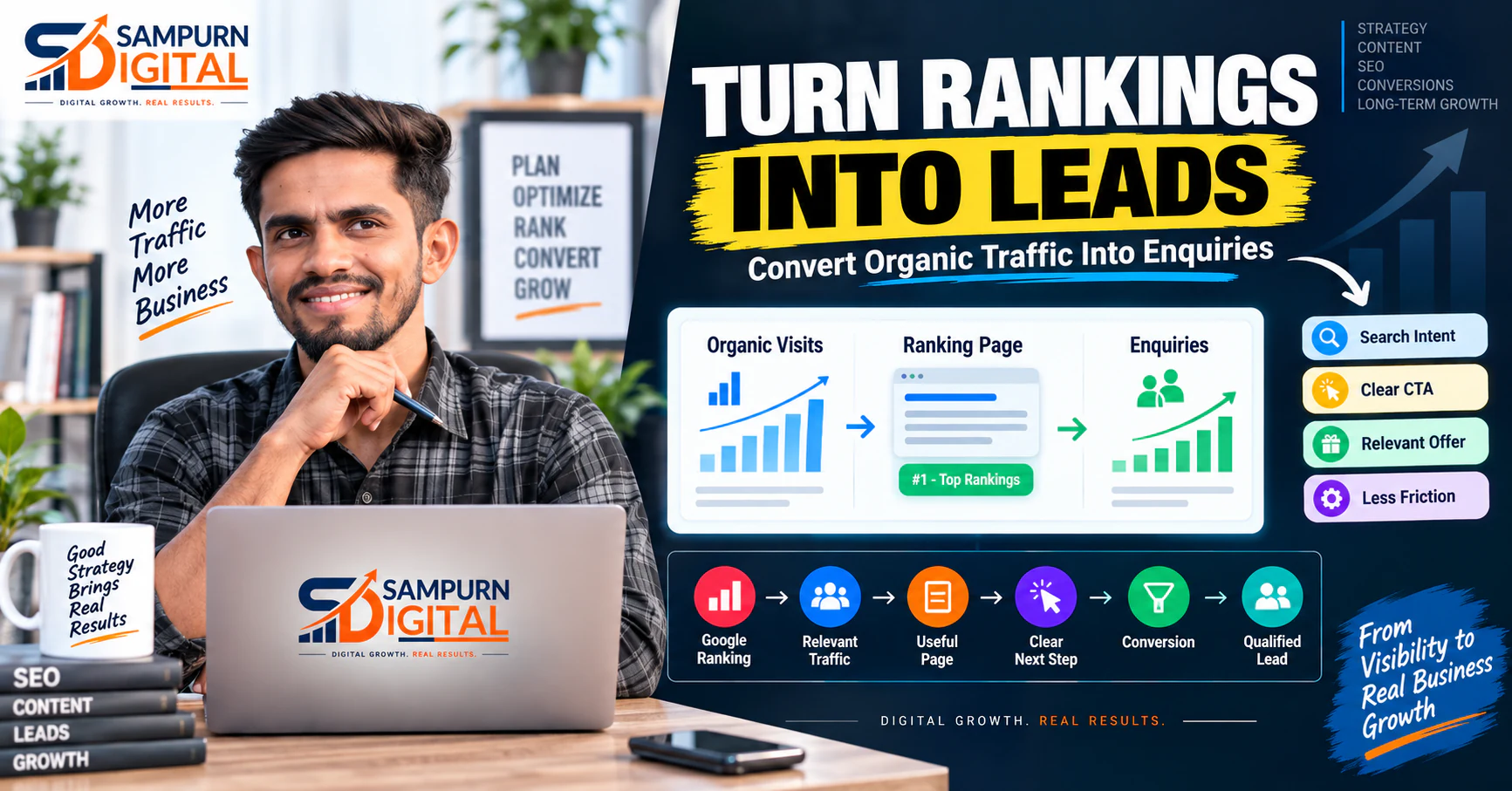
Google Ranking ↓ Relevant Organic Traffic ↓ Useful Page Experience ↓ Clear Next Step ↓ Conversion ↓ Qualified Lead
This guide explains how to turn organic traffic into leads without sacrificing the SEO value that helped the page rank in the first place.
First: Don't Assume a Ranking Page Is a Conversion Page
A page can succeed at SEO while failing at conversion.
For example:
- 15,000 organic visits
- Ranking for 80 keywords
- 25 enquiries
- 3,000 organic visits
- Ranking for 20 keywords
- 40 enquiries
Page A has more visibility.
Page B creates more leads.
That doesn't mean Page A is bad.
It means the two pages are serving different purposes.
Before optimizing a ranking page, understand what the page is supposed to accomplish.
What Makes a Page "Conversion Ready"?
A conversion-ready organic page usually has five things working together:
- Relevant search intent
- Useful content
- Strong page structure
- Relevant conversion offer
- Low-friction next step
Think of the page as a bridge.
Google brings the visitor to one side.
Your business goal is on the other side.
The page needs to help the visitor cross that bridge naturally.
Identify Why the Page Ranks
Before changing the page, understand why Google is sending traffic to it.
Look at:
- Search queries
- Impressions
- Clicks
- Ranking positions
- Search intent
- Related queries
- Landing-page behavior
Suppose your article ranks for:
"SEO audit checklist"
But your business offers SEO audits.
That's a strong opportunity.
The page already attracts people who may have a problem your business solves.
Your job is to create a useful path from information to action.
Identify the Searcher's Intent
Search intent determines how aggressively you should ask for a conversion.
Consider three visitors.
Visitor A
Searches:
"What is technical SEO?"
Likely intent:
Visitor B
Searches:
"How to fix technical SEO problems"
Likely intent:
Visitor C
Searches:
"Technical SEO agency"
Likely intent:
These visitors should not receive exactly the same conversion experience.
For the first visitor, an educational next step may be appropriate.
For the third, a service CTA may be much more relevant.
Find the Page's Highest-Value Queries
Don't optimize around traffic volume alone.
Look for queries that indicate commercial relevance.
For example:
| Query | Intent | Opportunity |
|---|---|---|
| What is SEO? | Informational | Low |
| How does SEO work? | Informational | Medium |
| SEO audit checklist | Problem / Solution | Medium |
| SEO audit service | Commercial | High |
| SEO agency for business | Commercial | Very High |
A page ranking for several high-intent queries may have significant lead-generation potential.
Match the Page to the Visitor's Problem
A visitor shouldn't have to figure out why your content is relevant.
Make the connection obvious.
If the page discusses:
the content can naturally explain:
- Technical problems
- Indexing
- Search intent
- Content quality
- Internal linking
- SEO strategy
Then the next step can be an SEO audit.
The conversion doesn't feel random because it directly relates to the problem being discussed.
Improve the Opening Section
The first few paragraphs are important.
The visitor should quickly understand:
- What the page covers
- Whether it addresses their problem
- What they will learn
- Why they should continue
Avoid starting with several paragraphs of generic background.
Instead:
For example:
If your website ranks for relevant searches but generates few enquiries, the problem may not be your rankings. The issue could be the page experience, CTA, offer or conversion path. This guide shows how to identify the gap and improve it.
The visitor immediately knows the article is relevant.
Create a Clear Content Hierarchy
A ranking page should be easy to scan.
Use:
- Clear H2 headings
- Short paragraphs
- Bullet points
- Tables
- Examples
- Step-by-step processes
- Relevant callouts
Don't make the visitor search through a wall of text to find the answer.
Good structure improves usability without requiring you to reduce useful information.
Add Conversion Opportunities at Natural Points
Don't place a CTA after every paragraph.
Instead, identify moments when the visitor is likely to think:
"I need help with this."
For example, after explaining an SEO audit problem:
If you're unsure which technical or content issues are limiting your organic performance, a professional SEO audit can identify the highest-priority problems.
That is a natural conversion opportunity.
Use Contextual Internal Links
Internal links aren't only for rankings.
They can move visitors deeper into the buying journey.
For example, a page about improving existing content can naturally lead to [how to turn a page that ranks into a page that generates leads](https://www.sampurndigital.com/blog/seo/how-to-turn-a-page-that-ranks-into-a-page-that-generates-leads).
Similarly, when discussing content optimization, link to [how to improve existing content instead of publishing more blogs](https://www.sampurndigital.com/blog/seo/how-to-improve-existing-content-instead-of-publishing-more-blogs).
The anchor text should explain what the visitor will get.
Avoid:
Click here.
Prefer:
Learn how to improve existing content instead of publishing more blogs.
Build a Logical Internal-Link Journey
A useful SEO content journey might look like:
Informational Article ↓ Problem-Solving Article ↓ Commercial Resource ↓ Service Page ↓ Enquiry
For example:
"Why Is My Traffic Declining?" ↓ "How to Recover Declining Organic Traffic" ↓ "How to Turn a Ranking Page Into Leads" ↓ "SEO Services"
This creates a natural progression.
Use the Right CTA for the Page
A CTA should match intent.
Informational Page
Possible CTA:
Problem-Aware Page
Possible CTA:
Solution-Aware Page
Possible CTA:
Commercial Page
Possible CTA:
Don't force a sales CTA where it doesn't belong.
Make the Offer Specific
A vague CTA:
Contact us
doesn't tell the visitor what happens next.
A more specific CTA:
Get a Free SEO Audit
communicates:
- What they receive
- Why they should act
- What the next step is
The offer should be genuine.
Don't promise an audit if you don't actually provide one.
Connect the CTA to the Problem
The strongest CTAs often complete the sentence:
"I have this problem, so my next step is..."
For example:
"My website isn't getting organic traffic."
"Get an SEO audit."
"My page gets traffic but doesn't generate enquiries."
"Review the page's conversion journey."
The CTA becomes part of the solution rather than an interruption.
Improve the Landing Page After the Click
The page that ranks isn't always the page where the lead is submitted.
The journey might be:
Google ↓ Blog Article ↓ CTA ↓ Service Page ↓ Contact Form
If the service page is weak, the article's SEO performance won't translate into leads.
The destination page should reinforce:
- The visitor's problem
- Your solution
- Your value proposition
- Proof
- Process
- CTA
A strong [lead generation website architecture for service businesses](https://www.sampurndigital.com/blog/web-development/lead-generation-website-architecture-for-service-businesses) helps connect these elements across the site.
Reduce Conversion Friction
A visitor may be interested but still abandon the process.
Check:
- Number of form fields
- Mobile usability
- Page speed
- CTA visibility
- Form errors
- Required information
- Trust concerns
- Unclear instructions
Ask:
What is stopping a motivated visitor from completing this action?
Then remove unnecessary obstacles.
Don't Put the Conversion Before the Value
People don't visit an article because they want to see your sales pitch.
They visit because they have a question or problem.
Give them useful information first.
Then present the next logical action.
A good balance is:
Useful Information ↓ Problem Understanding ↓ Solution ↓ Relevant Offer
This is more sustainable than making every article aggressively promotional.
Turn High-Traffic Sections Into Conversion Paths
Not every section of an article needs a CTA.
Find the sections that indicate stronger intent.
For example, an article might contain:
What Is SEO?
Low commercial intent.
Why SEO Traffic Declines
Medium intent.
How to Diagnose SEO Problems
Higher intent.
When Should You Hire an SEO Agency?
Very high intent.
The final sections may be much more appropriate for a service CTA.
Use Content Upgrades Where Appropriate
A useful content upgrade can turn an informational visitor into a known prospect.
Examples:
- SEO audit checklist
- Keyword mapping template
- Content audit worksheet
- Website conversion checklist
- SEO planning template
The resource should genuinely add value.
Don't hide the main answer behind a form simply to collect an email address.
Connect Ranking Pages to Commercial Pages
A website may have hundreds of articles but weak connections to its service pages.
Look for ranking pages that discuss topics directly related to your services.
Then ask:
Which service solves the problem discussed on this page?
Add a relevant contextual link.
For example, when discussing SEO reporting, a natural next step may be [SEO reporting for business owners and the numbers that actually matter](https://www.sampurndigital.com/blog/seo/seo-reporting-for-business-owners-what-numbers-actually-matter).
The goal is not to maximize the number of links.
The goal is to create useful paths.
Use Content Decay as a Conversion Opportunity
Sometimes an old ranking page loses traffic.
Before replacing it, determine whether the page can be recovered.
Review:
- Rankings
- Search queries
- Content freshness
- Competitor pages
- Internal links
- Search intent
- Conversion paths
A practical [content decay recovery process](https://www.sampurndigital.com/blog/seo/content-decay-how-to-find-pages-losing-traffic-and-recover-them) can help identify which declining pages are worth improving.
Once a page regains visibility, its conversion journey should also be reviewed.
Improve Existing Content Before Creating Another Page
If you already have a page ranking for a valuable topic, creating another page targeting the same audience may create unnecessary competition.
Instead, ask:
- Can the existing page answer the query better?
- Can the CTA be improved?
- Can internal links be strengthened?
- Can the offer be made more relevant?
- Can outdated sections be refreshed?
A structured [existing-content optimization workflow](https://www.sampurndigital.com/blog/seo/how-to-improve-existing-content-instead-of-publishing-more-blogs) can help you decide whether the page needs improvement rather than replacement.
Use Data to Find Conversion Opportunities
Create a page-level table.
| Page | Organic Visits | CTA Clicks | Leads | Conversion Rate |
|---|---|---|---|---|
| Page A | 10,000 | 180 | 20 | 0.20% |
| Page B | 5,000 | 250 | 45 | 0.90% |
| Page C | 2,500 | 160 | 32 | 1.28% |
| Page D | 15,000 | 100 | 8 | 0.05% |
Page D deserves investigation.
It has enormous traffic but very weak conversion.
That could be a high-value optimization opportunity.
Look for High-Traffic, Low-Conversion Pages
These pages are often your best starting point.
Prioritize pages that have:
- Significant organic traffic
- Relevant audience
- Clear business connection
- Low conversion rate
For example:
may offer more upside than:
because improving a large existing traffic asset can produce meaningful incremental leads.
Also Find Low-Traffic, High-Conversion Pages
Don't ignore these.
Suppose a service-related page receives only 500 visits but converts at 4%.
That page may already have strong commercial alignment.
The opportunity could be to increase its qualified organic visibility.
This creates two different optimization strategies:
High Traffic + Low Conversion
Improve conversion.
Low Traffic + High Conversion
Increase qualified traffic.
Test One Major Change at a Time
If you change:
- Headline
- CTA
- Form
- Offer
- Page structure
- Internal links
all at once, it becomes difficult to understand what caused the improvement.
Where practical, test significant changes in a controlled way.
Potential experiments include:
- CTA wording
- CTA placement
- Offer positioning
- Form length
- Section order
- Landing-page messaging
For broader experimentation principles, [A/B testing for ads versus landing pages](https://www.sampurndigital.com/blog/performance-marketing/ab-testing-ads-vs-landing-pages-what-should-you-test-first) provides a useful way to think about where testing effort should go first.
Measure the Entire Funnel
Don't stop at CTA clicks.
Track:
Organic Visits ↓ Engaged Visitors ↓ CTA Interaction ↓ Form Start ↓ Form Completion ↓ Lead ↓ Qualified Lead ↓ Customer
This shows where the real problem exists.
For example:
The CTA may be working.
The form may be the problem.
Investigate Traffic That Doesn't Convert
If traffic is high but conversions are low, ask:
Is the traffic relevant?
If not, investigate keyword targeting.
Is the intent correct?
If not, the page may rank for queries it wasn't designed to serve.
Is the content useful?
If not, improve the content.
Is the CTA relevant?
If not, improve the offer.
Is the landing page strong?
If not, improve the destination.
Is tracking working?
If not, fix measurement before making strategic decisions.
This prevents random changes.
Connect SEO With Your Full Growth System
Organic search rarely operates in isolation.
A visitor might:
Google ↓ Blog ↓ Social Media ↓ Website ↓ Retargeting ↓ Lead
Google ↓ Service Page ↓ Exit ↓ Paid Ad ↓ Return ↓ Lead
This is why SEO should be connected with the broader marketing system.
A useful [digital growth operating system](https://www.sampurndigital.com/blog/digital-marketing/the-digital-growth-operating-system-how-seo-paid-social-website-and-analytics-work-to) can connect SEO, paid media, social, website and analytics rather than treating them as isolated channels.
Paid acquisition can also benefit from the same landing-page and conversion principles. A broader [paid growth system covering ads, landing pages, tracking and CRO](https://www.sampurndigital.com/blog/performance-marketing/the-complete-paid-growth-system-ads-landing-pages-tracking-cro) provides another useful perspective.
Don't Destroy SEO While Optimizing for Conversion
Conversion optimization should not mean removing the content that makes the page useful.
Avoid:
- Removing important sections just to shorten the page
- Replacing useful explanations with sales copy
- Hiding answers behind forms
- Adding excessive pop-ups
- Stuffing CTAs into every section
- Changing the topic completely
The objective is:
not:
Build a Simple Page Optimization Framework
For every ranking page, review these seven areas:
Query
What searches bring visitors?
Intent
What are visitors trying to accomplish?
Content
Does the page solve the problem well?
Journey
What should the visitor do next?
Offer
Is the next step relevant?
Experience
Is the conversion process easy?
Measurement
Can you accurately measure the result?
This framework makes optimization repeatable.
A Practical Before-and-After Example
Imagine a page receives:
Current performance:
That produces:
Now improve:
- CTA relevance
- Internal links
- Service-page journey
- Offer clarity
- Form friction
Suppose conversion increases to:
At the same traffic level:
Traffic didn't increase.
The page generated twice as many leads.
That's why SEO conversion optimization is often an important part of organic growth.
The Ranking-to-Lead Optimization Checklist
Search Intent
- Search queries reviewed
- Primary intent identified
- Commercial opportunities identified
- Page matches the query
Content
- Opening addresses the problem
- Content is useful and specific
- Headings are easy to scan
- Examples support the explanation
- Outdated information is refreshed
Internal Links
- Relevant supporting articles linked
- Commercial pages linked naturally
- Anchor text is descriptive
- Links support the user's next question
- No forced or generic links
Conversion
- CTA matches intent
- Offer is relevant
- CTA is visible
- Landing page matches the promise
- Form is easy to complete
- Mobile experience is checked
- Trust elements are available
Measurement
- Organic traffic tracked
- CTA clicks tracked
- Form submissions tracked
- Qualified leads tracked
- Sales tracked where possible
- Conversion rate monitored
