
Publishing individual blog posts around random keywords can create traffic opportunities.
But it does not automatically create a strong SEO strategy.
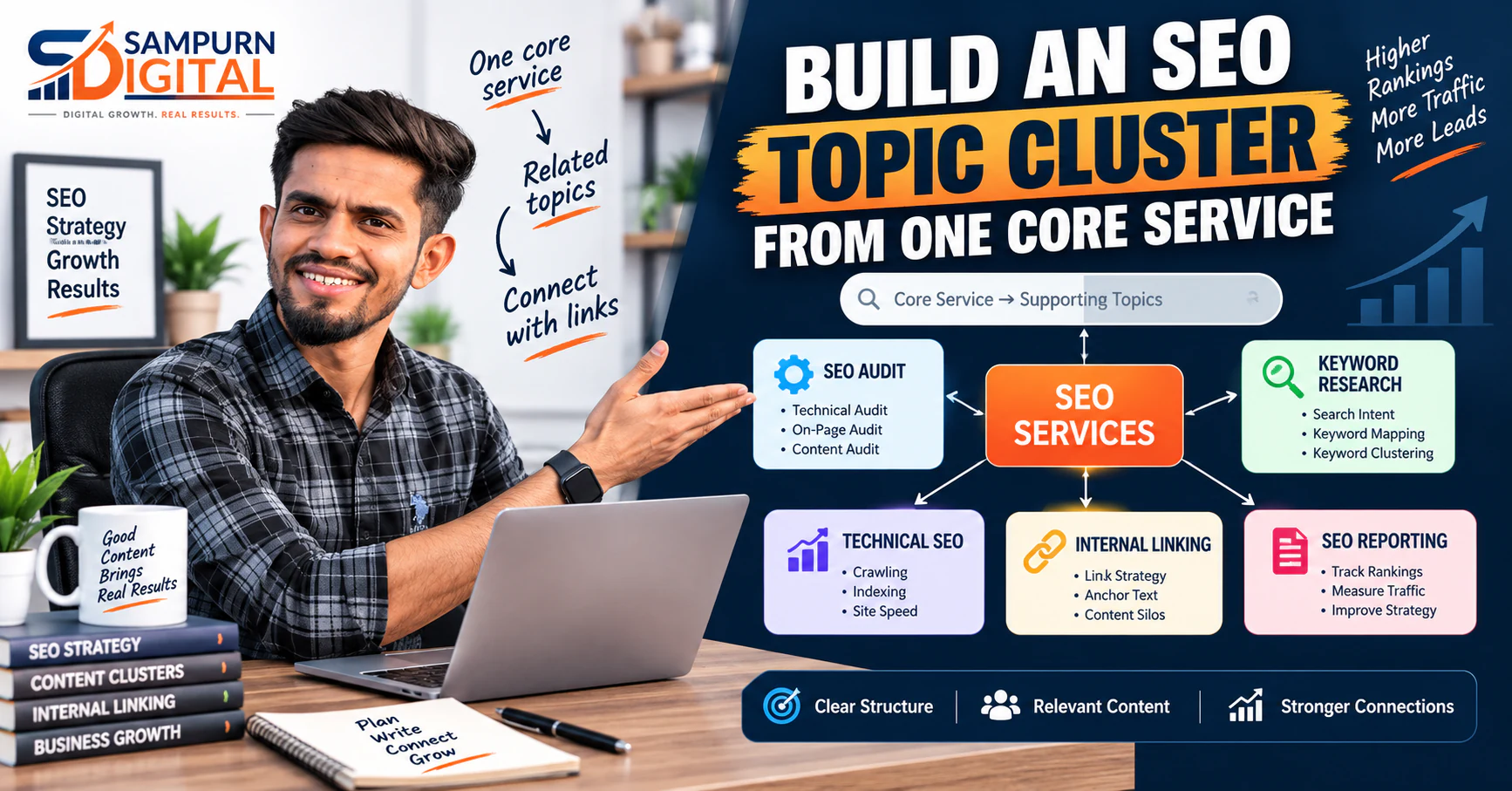
A better approach is to organize related content around a core service or business topic and connect those pages into a logical content system.
This is commonly called an SEO topic cluster.
For example, if your business provides SEO services, you could build supporting content around:
- SEO audits
- Technical SEO
- Keyword research
- Search intent
- Keyword mapping
- Internal linking
- Content audits
- SEO reporting
- Local SEO
- E-commerce SEO
Instead of treating these as unrelated articles, you connect them around the main commercial topic:
The basic structure becomes:
This guide explains how to build an SEO topic cluster from one core service and turn separate articles into a connected search-focused content system.
What Is an SEO Topic Cluster?
An SEO topic cluster is a group of closely related pages organized around a central topic.
A typical structure contains:
Core or Pillar Page
The main commercial or comprehensive page.
Example:
Supporting Pages
Articles that answer specific questions related to the service.
Examples:
- SEO audit checklist
- Technical SEO problems
- Google indexing problems
- Keyword research
- Search intent mapping
- Keyword mapping
- Internal linking
Internal Links
Links connect the supporting pages to each other and to the core service.
The result is not simply a collection of articles.
It becomes a connected information architecture.
Why Build a Topic Cluster Around a Service?
A service-based topic cluster has a major advantage:
Consider the customer journey.
Someone may first search:
"Why is my website not getting Google traffic?"
Later they may search:
"SEO audit checklist"
Then:
"technical SEO problems"
Then:
"SEO services"
These searches are different.
But they can belong to the same customer journey.
A well-built topic cluster gives each stage an appropriate page.
The Basic Topic Cluster Model
A simple service cluster can look like this:
                    SEO Services
                          |
    \------------------------------------------------
    |              |              |               |
 SEO Audit    Keyword Research  Technical SEO  Content SEO
    |              |              |               |
 Indexing       Keyword Map    Site Speed     Content Audit
 Problems       Search Intent  Crawl Issues   Content Decay
    |              |              |               |
    \---------------- Internal Linking \-----------
The exact structure will depend on the business.
The principle remains the same:
Create useful pages around distinct search intents and connect them logically.
Choose One Core Service
Start with one service.
Don't try to build a massive cluster covering everything your company offers.
For example, if your business provides:
- SEO
- Performance Marketing
- Social Media Marketing
- Web Development
start with one.
Suppose you choose:
Now ask:
What questions does a potential SEO customer have before, during and after considering this service?
That question becomes the foundation of your cluster.
Understand the Business Behind the Service
Before researching keywords, understand what the service actually includes.
For SEO, that might include:
- Technical SEO
- Keyword research
- Content strategy
- On-page optimization
- Internal linking
- SEO audits
- Local SEO
- E-commerce SEO
- Reporting
- Conversion optimization
This prevents the topic cluster from becoming a list of generic SEO definitions.
The content should reflect what the business can genuinely help customers with.
Identify Customer Problems
Now list the problems customers experience.
For SEO, examples include:
- Website isn't getting organic traffic
- Important pages aren't indexed
- Competitors rank higher
- Website has technical SEO problems
- Multiple pages compete for the same keyword
- Existing content has stopped growing
- Traffic isn't generating leads
- Local pages aren't performing
- E-commerce categories aren't ranking
These problems often provide better content ideas than starting with broad keywords alone.
Turn Problems Into Topics
Now convert those problems into specific content topics.
For example:
Problem
Website isn't getting Google traffic.
Topic
Problem
Important pages aren't appearing in Google.
Topic
Problem
Multiple pages target similar searches.
Topic
Problem
Competitors consistently rank above you.
Topic
Each topic has a distinct purpose.
That makes the cluster more useful than publishing five generic articles about "SEO."
Research Keywords for Each Topic
Once the topics are identified, perform keyword research.
Look for:
- Primary keyword
- Secondary keywords
- Long-tail variations
- Question-based searches
- Commercial modifiers
- Problem-based searches
- Related entities and concepts
For example:
Topic
Keyword Mapping
Primary keyword
Keyword mapping for website pages
Supporting keywords
- SEO keyword mapping template
- map keywords to pages
- keyword map for service pages
- prevent keyword overlap
The goal is not to insert every phrase into the article.
The goal is to understand the search landscape around the topic.
For a revenue-focused approach, [use keyword research based on business revenue rather than search volume alone](https://www.sampurndigital.com/blog/seo/keyword-research-based-on-business-revenue-not-just-search-volume).
Group Keywords by Search Intent
This is one of the most important steps.
Don't group keywords simply because they contain the same words.
Group them according to what the searcher wants.
For example:
Informational
"how does keyword mapping work"
Implementation
"how to create a keyword map"
Commercial
"SEO keyword mapping services"
These may require different pages.
The keyword group should represent a meaningful search intent.
This prevents the cluster from becoming a collection of overlapping articles.
Create a Cluster Map
Now organize the topics.
For an SEO service, a simplified cluster might look like:
Core Service
Understand
- Why Is My Website Not Getting Google Traffic?
- How Google Decides Which Page Should Rank
- Search Intent Mapping
- SEO Strategy for a New Business
Diagnose
- SEO Audit Checklist
- Technical SEO Problems
- Google Indexing Problems
- Keyword Cannibalization
- SEO Content Audit
- Competitor Ranking Analysis
Build
- Revenue-Driven Keyword Research
- Keyword Mapping
- SEO Topic Clusters
- Pillar Page Architecture
- Internal Linking
- SEO Content Calendar
Improve
- Existing Content Optimization
- Content Decay
- Turning Rankings Into Leads
- SEO Conversion Investigation
- SEO Reporting
Scale
- Local SEO
- E-commerce SEO
- Integrated SEO + Paid + Content + CRO
Now you have a content system rather than a random editorial calendar.
Give Every Page a Distinct Job
A topic cluster becomes weak when every article tries to answer the same question.
Each page should have a clear role.
For example:
SEO Audit Checklist
Purpose:
Help a business systematically identify SEO problems.
Technical SEO Problems
Purpose:
Explain technical issues that can restrict organic visibility.
Keyword Mapping
Purpose:
Explain how to assign target searches to the correct website URLs.
Topic Clusters
Purpose:
Explain how to organize related content around a core service.
These pages are related.
But they aren't interchangeable.
Build the Pillar-to-Cluster Relationship
Your core service page should connect naturally to supporting resources.
For example:
The service page provides the commercial destination.
The supporting articles provide educational depth.
This lets users move from learning toward evaluating the service without forcing a sales message into every paragraph.
Use Internal Links to Connect the Cluster
Internal linking is what turns separate pages into a cluster.
Don't add links simply because the spreadsheet says "add eight links."
Add them where they help the reader continue their research.
For example:
Before creating a new page, determine whether another URL is already targeting the same search intent. You can [learn how to find cannibalization between your website pages](https://www.sampurndigital.com/blog/seo/how-to-find-cannibalization-between-your-website-pages).
That link is useful because the reader is already thinking about overlapping pages.
Likewise:
Once your topics are selected, the next step is to [build a keyword map for every important website page](https://www.sampurndigital.com/blog/seo/how-to-build-a-keyword-map-for-every-important-website-page).
The link follows the user's next logical question.
Use Descriptive Anchor Text
Avoid anchors such as:
- Click here
- Read more
- Learn more
- This article
- Here
Instead, describe the destination.
Examples:
- [build a keyword map for every important website page](https://www.sampurndigital.com/blog/seo/how-to-build-a-keyword-map-for-every-important-website-page)
- [pillar page architecture best practices](https://www.sampurndigital.com/blog/seo/pillar-page-architecture-how-to-connect-2030-articles-around-one-topic)
- [build internal links that actually help users and rankings](https://www.sampurndigital.com/blog/seo/how-to-build-internal-links-that-actually-help-users-and-rankings)
Good anchor text improves clarity for the reader and makes the relationship between pages easier to understand.
Create Content in the Right Order
You don't necessarily need to publish every article immediately.
A practical sequence is:
Phase 1: Commercial Foundation
Build the main service page.
Phase 2: Problem Awareness
Create content answering major customer problems.
Phase 3: Diagnosis
Create audit and troubleshooting resources.
Phase 4: Implementation
Create detailed how-to content.
Phase 5: Improvement
Create optimization and measurement resources.
Phase 6: Scale
Create advanced industry, local and e-commerce resources.
This creates a natural progression:
Businesses rarely have only one service.
Eventually, your SEO cluster can connect with other marketing topics.
For example:
Suppose you're writing about keyword research.
A natural cross-cluster connection could be customer acquisition cost because keyword prioritization should ultimately relate to business economics.
You can [learn how to calculate customer acquisition cost across marketing channels](https://www.sampurndigital.com/blog/digital-marketing/how-to-calculate-customer-acquisition-cost-across-marketing-channels) when evaluating how SEO fits into a broader acquisition strategy.
Cross-cluster links should be relevant.
Don't link to unrelated articles simply to increase the number of internal links.
Build a Content Dependency Map
Some articles naturally depend on earlier concepts.
For example:
That sequence matters.
If someone doesn't understand search intent, keyword mapping becomes less precise.
If keyword mapping is unclear, the topic cluster can become fragmented.
If the cluster isn't structured properly, internal linking becomes much harder to plan.
This is why a content cluster should be designed as a system.
Avoid Creating Thin Supporting Articles
A topic cluster does not become stronger simply because it contains more URLs.
You could publish:
- 10 articles
- 20 articles
- 50 articles
and still have a weak cluster.
Why?
Because quantity doesn't replace usefulness.
Each article should answer a distinct question thoroughly enough to justify its existence.
Before publishing, ask:
Would this topic be better handled by improving an existing page?
If yes, update the existing page instead.
Watch for Cannibalization
Topic clusters naturally contain closely related topics.
That makes cannibalization an important risk.
For example:
- How to Do Keyword Research
- SEO Keyword Research Guide
- Keyword Research Strategy
- Keyword Research Process
If all four pages target the same intent, the cluster may be unnecessarily fragmented.
Your solution isn't simply "add more internal links."
Instead:
- Compare the intent.
- Compare the content.
- Identify overlap.
- Decide whether the pages need distinct purposes.
- Merge or retarget where necessary.
A strong cluster is organized, not merely large.
Design Each Article to Support the Service
Supporting articles should educate first.
But they can still provide a natural path toward the service.
For example, an SEO audit article might explain:
- What to check
- How to identify problems
- How to prioritize fixes
- What businesses can handle internally
- When specialist help becomes useful
Then the commercial bridge can be simple:
If the audit reveals technical, content or structural issues that are difficult to prioritize internally, a professional SEO audit can help turn the findings into an actionable roadmap.
This is much more useful than inserting a sales pitch every few paragraphs.
Measure the Cluster, Not Just Individual Articles
Individual article rankings are useful.
But the bigger question is:
Is the entire topic cluster contributing to business growth?
Track:
- Organic impressions
- Organic clicks
- Rankings
- Non-branded traffic
- Commercial keyword visibility
- Organic leads
- Conversion rate
- Assisted conversions
- Revenue where measurable
- Internal link coverage
You may discover that one article generates significant traffic while another generates fewer visits but more qualified leads.
Both can be valuable.
A Practical SEO Topic Cluster Example
Suppose the core service is:
A practical cluster could be:
SEO SERVICES │ ├── Understand │ ├── Why Website Is Not Getting Google Traffic │ ├── How Google Decides Which Page Ranks │ ├── Search Intent Mapping │ └── SEO Strategy for a New Business │ ├── Diagnose │ ├── SEO Audit Checklist │ ├── Technical SEO Problems │ ├── Google Indexing Problems │ ├── Keyword Cannibalization │ ├── SEO Content Audit │ └── Competitor Ranking Analysis │ ├── Build │ ├── Revenue-Driven Keyword Research │ ├── Keyword Mapping │ ├── SEO Topic Clusters │ ├── Pillar Page Architecture │ └── Internal Linking │ ├── Improve │ ├── Existing Content Optimization │ ├── Content Decay │ ├── Rankings → Leads │ ├── Traffic → Lead Investigation │ └── SEO Reporting │ └── Scale ├── Local SEO ├── E-commerce SEO └── Integrated Growth System
This structure gives every article a place.
More importantly, it gives the reader a logical path through the subject.
Common SEO Topic Cluster Mistakes
Mistake 1: Creating Content Around Keywords Only
Keywords are important.
But a cluster should be based on topics, intent and customer problems—not just keyword variations.
Mistake 2: Making Every Article Too Similar
If five articles answer essentially the same question, you may have created fragmentation rather than a cluster.
Mistake 3: Linking Everything to Everything
Internal links should be useful.
A page does not need links to every other article.
Connect pages where the relationship makes sense.
Mistake 4: Ignoring Commercial Pages
A cluster made entirely of blog posts can generate traffic without creating a strong path toward the business.
Connect informational content with the relevant service page.
Mistake 5: Publishing Before Planning
Publishing 30 articles and deciding how they relate afterward is harder than designing the architecture first.
Create the map before creating the volume.
Mistake 6: Measuring Only Traffic
A cluster can generate large traffic numbers but little business value.
Track qualified leads and commercial outcomes where possible.
SEO Topic Cluster Checklist
Before building a cluster, check:
Core Service
- Is the service clearly defined?
- Does the business genuinely offer it?
- Is there a strong commercial destination?
Topics
- What problems do customers experience?
- What questions do they ask?
- What solutions do they research?
- Which topics deserve dedicated pages?
Keywords
- Does each page have a clear primary keyword?
- Are supporting keywords relevant?
- Are keywords grouped by intent?
Architecture
- Does every page have a distinct purpose?
- Are overlapping pages identified?
- Is the cluster logically organized?
Internal Linking
- Do supporting articles connect naturally?
- Do relevant articles link toward the service?
- Are anchor texts descriptive?
Business Value
- Can the cluster support commercial searches?
- Does it address real customer needs?
- Are conversions measurable?
Maintenance
- Will existing pages be updated?
- Will overlapping content be consolidated?
- Will the cluster expand based on actual search data?
