
Publishing content consistently is not the same as having a strong SEO content strategy.
A business can publish 20, 50 or even 100 articles and still struggle to generate meaningful organic traffic, qualified leads or conversions.
Why?
Because the content may not be connected to the customer's actual journey.
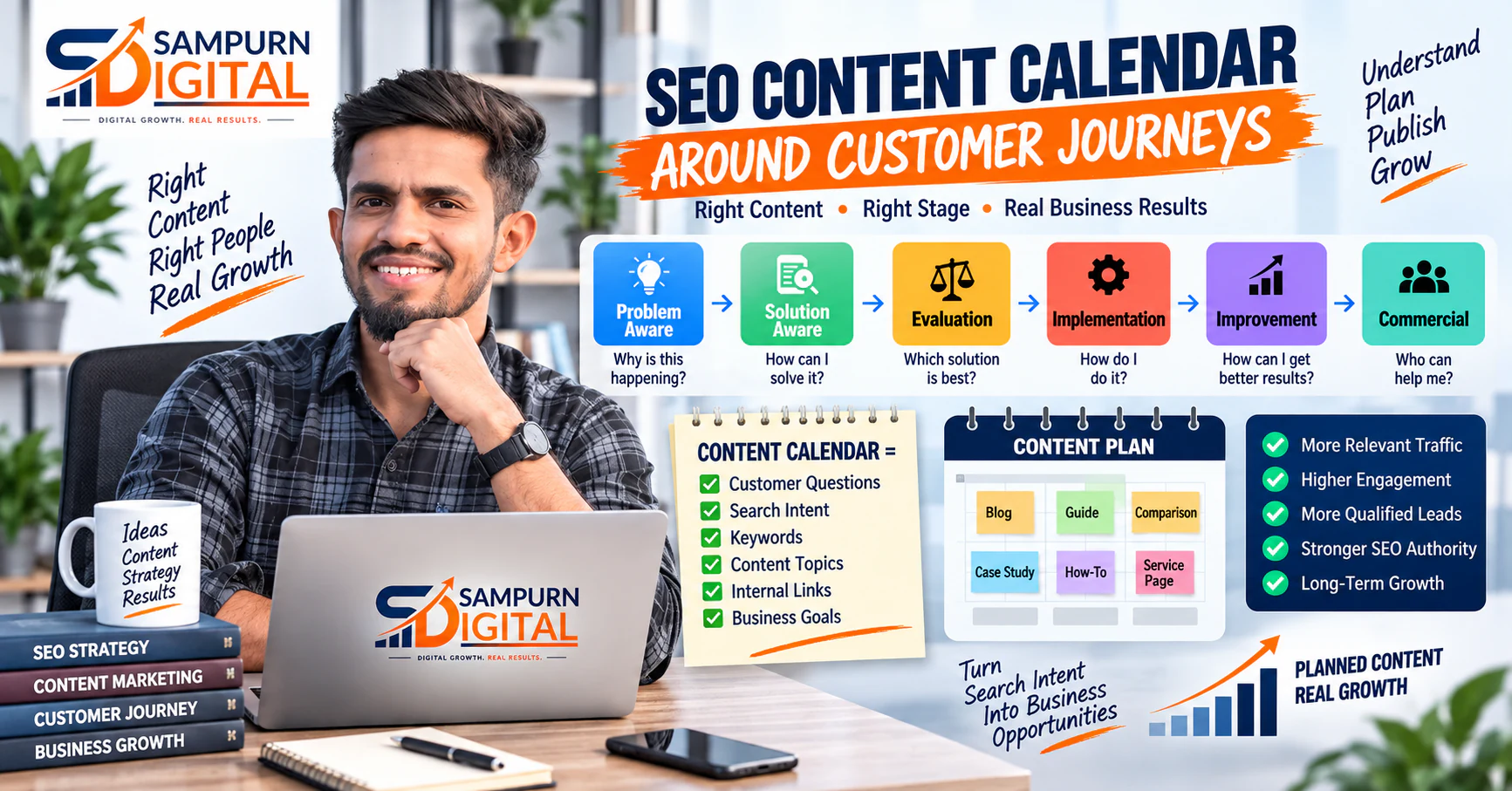
People don't search for information in one straight line. They move from identifying a problem to understanding it, exploring solutions, comparing options, implementing a solution and eventually deciding whether they need professional help.
Your content calendar should reflect that journey.
An effective SEO content calendar based on customer journey connects:
Instead of asking:
"What should we publish this week?"
Ask:
"What information does our customer need next?"
That is how a publishing schedule becomes an SEO growth system.
What Is an SEO Content Calendar Based on Customer Journey?
An SEO content calendar is a structured plan for deciding what content should be created, optimized and published over a specific period.
A customer-journey-based SEO calendar adds another layer.
It asks:
For example:
| Customer Stage | Typical Question | Content Type |
|---|---|---|
| Problem Aware | Why is this happening? | Diagnostic article |
| Solution Aware | How can I solve it? | Educational guide |
| Evaluation | Which solution should I choose? | Comparison / decision content |
| Implementation | How do I do it? | How-to guide |
| Improvement | How can I get better results? | Optimization guide |
| Commercial | Who can help me? | Service / landing page |
This gives every piece of content a specific role.
Why Random Content Publishing Creates Weak SEO
Imagine a business publishes these five articles:
- What Is SEO?
- Best SEO Tools
- SEO Audit Checklist
- Keyword Research Guide
- How to Improve Website Speed
All five topics may be useful.
But there is no obvious journey.
A stronger structure might look like:
Website Traffic Problem ↓ SEO Diagnosis ↓ Keyword Research ↓ Keyword Mapping ↓ Content Planning ↓ Topic Clusters ↓ Internal Linking ↓ SEO Improvement ↓ SEO Services
Now every article has a relationship with another article.
The content library becomes a connected system instead of a collection of posts.
First: Start With the Customer, Not the Keyword
One of the biggest content-planning mistakes is starting with keyword research and immediately creating a publishing list.
For example, you may find:
- SEO audit
- keyword research
- technical SEO
- content strategy
- internal linking
- SEO agency
Instead of immediately creating six articles, ask:
What problem is the searcher trying to solve?
Then identify where that person is in the customer journey.
This is where [search intent mapping](https://www.sampurndigital.com/blog/seo/search-intent-mapping-how-to-match-pages-with-what-people-actually-want) becomes important.
The keyword tells you what people search.
The intent helps you understand why they are searching.
The customer journey tells you what they may need next.
Define Your Customer Journey
Start by mapping the major stages your customers go through.
For many businesses, a useful framework is:
Stage 1: Problem Aware
The person knows something isn't working.
Examples:
- Why is my website not getting traffic?
- Why are my leads decreasing?
- Why aren't my pages ranking?
- Why are my ads getting clicks but no customers?
At this stage, don't immediately sell.
Help the person understand the problem.
Stage 2: Solution Aware
The person understands the problem and begins researching solutions.
Examples:
- How does SEO work?
- How can I improve organic traffic?
- What is technical SEO?
- How should I plan SEO content?
The content should explain possible approaches.
Stage 3: Evaluation
The person is comparing solutions.
Examples:
- SEO agency vs in-house team
- SEO vs paid advertising
- WordPress vs custom development
- Google Ads vs Meta Ads
This content helps people make decisions.
Stage 4: Implementation
The person has decided on an approach and wants to execute it.
Examples:
- How to build a keyword map
- How to build an SEO topic cluster
- How to create internal links
- How to build a content calendar
This is where detailed how-to content becomes valuable.
Stage 5: Improvement
The person already has a system but wants better results.
Examples:
- Why traffic declined
- How to improve existing content
- Why rankings dropped
- Why traffic increased but leads didn't
This content addresses optimization.
Stage 6: Commercial Decision
The person wants professional support.
At this point, relevant service pages become the natural next step.
The content journey can eventually lead toward [SEO Services](https://www.sampurndigital.com/seo-services).
List the Questions Customers Ask at Each Stage
Create a question bank.
For example:
Problem Questions
- Why isn't my website getting traffic?
- Why did my rankings drop?
- Why aren't my pages indexed?
Solution Questions
- How does SEO work?
- What should I fix first?
- How do I perform an SEO audit?
Implementation Questions
- How do I research keywords?
- How do I map keywords to pages?
- How do I create topic clusters?
- How do I build internal links?
Improvement Questions
- How do I improve old content?
- How do I recover declining traffic?
- How do I convert organic traffic into leads?
Commercial Questions
- Should I hire an SEO agency?
- What does professional SEO support include?
- How should an SEO strategy be managed?
This question bank becomes the foundation of your content calendar.
Group Questions Into Topic Clusters
Once you have the questions, group them into related topics.
For example:
SEO │ ├── SEO Strategy │ ├── SEO planning │ ├── Customer journey │ └── Content strategy │ ├── SEO Diagnosis │ ├── SEO audit │ ├── Technical SEO │ └── Indexing │ ├── Keyword Strategy │ ├── Keyword research │ ├── Keyword mapping │ └── Search intent │ ├── Content Architecture │ ├── Topic clusters │ ├── Pillar pages │ └── Internal linking │ └── SEO Improvement ├── Content updates ├── Content decay └── Conversion optimization
This makes it much easier to build a structured editorial calendar.
Map Keywords to Customer Intent
Now assign keywords to the appropriate stage.
For example:
| Keyword / Topic | Intent | Journey Stage |
|---|---|---|
| why website isn't getting traffic | Informational | Problem |
| SEO audit checklist | Informational | Diagnose |
| keyword research | Informational | Solution |
| keyword mapping | Informational | Implementation |
| SEO content calendar | Informational | Implementation |
| internal linking strategy | Informational | Implementation |
| content decay | Informational | Improvement |
| SEO services | Commercial | Decision |
The goal isn't to force every keyword into a funnel.
The goal is to understand the underlying need behind each search.
Identify the Next Question
This is one of the most useful techniques for building a customer-journey content strategy.
After every topic, ask:
What will the reader probably want to know next?
For example:
Question 1
The next question might be:
How do I diagnose the problem?
That leads to:
Then:
What if the problem is technical?
That leads to:
Then:
Which keywords should I target?
That leads to:
Then:
Which page should target each keyword?
That leads to:
Then:
How do I organize related content?
That leads to:
Then:
How should the pages connect?
That leads to:
This is how a customer journey naturally generates an SEO content sequence.
Build Content Sequences Instead of Isolated Articles
A content sequence is a group of related articles designed to answer connected questions.
For example:
SEO Diagnosis Sequence
- Website traffic problems
- SEO audit
- Technical SEO problems
- Google indexing
- Keyword cannibalization
- Competitor analysis
Then:
SEO Build Sequence
- Keyword research
- Keyword mapping
- Topic clusters
- Pillar pages
- Internal linking
- Content calendar
This creates depth around the subject.
Connect the Content With Internal Links
A customer-journey content calendar should include internal linking from the beginning.
For example:
A content-calendar article can naturally point readers toward:
- [a practical SEO strategy for a new business](https://www.sampurndigital.com/blog/seo/seo-strategy-for-a-new-business-what-should-you-do-in-the-first-90-days)
- [the 50-point SEO audit checklist for a business website](https://www.sampurndigital.com/blog/seo/the-50-point-seo-audit-checklist-for-a-business-website)
- [technical SEO problems that quietly kill organic traffic](https://www.sampurndigital.com/blog/seo/technical-seo-problems-that-quietly-kill-organic-traffic)
These aren't random related articles.
Each one answers a relevant question in the broader SEO journey.
Plan Internal Links Before Publishing
Don't wait until the article is finished.
Add internal-link opportunities to your content calendar.
Your planning sheet could contain:
| Article | Destination | Purpose |
|---|---|---|
| Content Calendar | Search Intent | Understand intent |
| Content Calendar | SEO Strategy | Define strategy |
| Content Calendar | SEO Audit | Diagnose |
| Content Calendar | Technical SEO | Solve technical problems |
| Content Calendar | Digital Roadmap | Broader marketing planning |
| Content Calendar | Customer Journey | Map customer stages |
| Content Calendar | Social Audit | Cross-channel planning |
This makes internal linking part of production rather than an afterthought.
Connect SEO Content With Broader Marketing
Customers rarely interact with only one marketing channel.
A person might:
Google Search ↓ Blog ↓ Website ↓ Social Media ↓ Retargeting ↓ Landing Page ↓ Lead
Your SEO content strategy should therefore fit into the broader marketing journey.
A [90-day digital marketing roadmap](https://www.sampurndigital.com/blog/digital-marketing/how-to-build-a-90-day-digital-marketing-roadmap) can help connect SEO publishing with wider campaign planning.
Similarly, a [customer journey map for digital marketing](https://www.sampurndigital.com/blog/digital-marketing/how-to-build-a-customer-journey-map-for-digital-marketing) can help you understand how search fits alongside other customer touchpoints.
Use Cross-Channel Content Opportunities
One strong topic can often become multiple pieces of content.
For example:
Blog: Why Your Website Is Not Getting Google Traffic
Can become:
- LinkedIn post
- Instagram carousel
- Reel
- YouTube video
- Sales presentation
- FAQ
- Short-form educational post
This makes the content calendar more efficient.
You can also use SEO insights to inform social planning.
For example, a [social media audit](https://www.sampurndigital.com/blog/social-media-marketing/social-media-audit-50-things-to-check-before-posting-more-content) can help identify which social topics and content formats need improvement.
Create a Content Calendar Matrix
Now bring everything together.
A practical planning sheet can look like this:
| Topic | Keyword | Intent | Journey Stage | Cluster | Format | CTA |
|---|---|---|---|---|---|---|
| Website traffic | traffic diagnosis | Informational | Problem | SEO | Guide | SEO Audit |
| SEO Audit | SEO audit checklist | Informational | Diagnose | SEO | Checklist | SEO Audit |
| Keyword Research | business-value keywords | Informational | Solution | SEO | Guide | SEO Services |
| Keyword Mapping | keyword mapping | Informational | Build | SEO | How-to | SEO Services |
| Content Calendar | customer journey | Informational | Build | SEO | Guide | SEO Services |
| Content Decay | declining traffic | Informational | Improve | SEO | Guide | SEO Audit |
This is much more useful than a spreadsheet containing only:
Prioritize Topics by Business Value
Not every topic should receive equal priority.
Evaluate each idea using four questions.
Is the topic relevant to the business?
A topic can generate traffic but still be commercially irrelevant.
Does the audience need it?
Content should solve a real customer problem.
Does it support an important service?
The strongest topics often have a natural relationship with your commercial offering.
Is there a meaningful content gap?
If competitors already cover the topic thoroughly, you need a reason to create another page.
Balance Your Funnel
A healthy content calendar shouldn't contain only beginner topics.
For example:
Problem Aware ↓ Solution Aware ↓ Implementation ↓ Improvement ↓ Commercial
If you publish only beginner articles, you may attract people who aren't ready for your service.
If you publish only commercial content, you may miss people earlier in their research.
Your calendar should support the entire journey.
Avoid Keyword Cannibalization
When building a large calendar, review planned topics against existing URLs.
Suppose you already have:
and then plan:
If both pages answer essentially the same question, you may be creating unnecessary overlap.
Before adding a new article, ask:
Does this topic require a separate page?
If not, consider improving the existing page.
Review Existing Content Before Adding More
Content planning should include optimization, not just publication.
Before adding another article, check:
- Is the topic already covered?
- Is the existing article outdated?
- Is it ranking for related searches?
- Does it have enough internal links?
- Could it be expanded?
- Could two pages be consolidated?
Sometimes the best content-calendar decision is:
This keeps the website focused.
Create a Monthly Content Sequence
Instead of randomly selecting topics each month, organize publishing into logical phases.
Month 1: Understand and Diagnose
Focus on:
- Customer problems
- Search intent
- SEO fundamentals
- Website diagnosis
- Technical issues
The objective is to understand what is happening.
Month 2: Build
Focus on:
- Keyword research
- Keyword mapping
- Content planning
- Topic clusters
- Pillar pages
- Internal linking
The objective is to create the SEO system.
Month 3: Improve
Focus on:
- Existing content
- Content decay
- Internal-link improvements
- Conversion optimization
- Reporting
- Business outcomes
The objective is to improve the system rather than simply publish more.
Give Every Article a Clear Job
Before approving an article, complete this sentence:
"This article exists to help \_\_\_\_\_\_ understand/do/solve \_\_\_\_\_\_."
For example:
This article exists to help businesses build an SEO content calendar around the questions customers ask at different stages of the buying journey.
If you can't clearly explain why the article exists, the topic may not be ready.
Give Every Article a Next Step
A useful article should answer the immediate question.
But it should also make the next step obvious.
For example:
Customer Problem ↓ Educational Article ↓ Detailed Guide ↓ Implementation Resource ↓ Service / Solution
The next step could be another article.
It could also be a service page when professional help becomes relevant.
This creates a natural journey without turning every article into a sales pitch.
Measure the Journey, Not Just Traffic
Traffic is useful, but it isn't the complete picture.
Track:
- Organic impressions
- Organic clicks
- Rankings
- Engagement
- Internal-link clicks
- Leads
- Conversion rate
- Assisted conversions
- Commercial-page visits
For example:
An article may generate 1,000 visits but no meaningful leads.
Another article may generate 200 visits and consistently send qualified visitors to a service page.
The second article may be more valuable to the business.
Review and Update the Calendar
An SEO content calendar shouldn't remain unchanged for a year.
Review it when:
- New customer questions appear
- Search behavior changes
- A service changes
- New competitors emerge
- Existing content begins declining
- A new product launches
- Content gaps are discovered
- Analytics show a weak funnel stage
The calendar should evolve with the business.
A Complete Customer-Journey Content Planning Framework
Use this workflow:
- Understand the Customer ↓
- Map the Customer Journey ↓
- Collect Customer Questions ↓
- Research Keywords ↓
- Identify Search Intent ↓
- Group Topics Into Clusters ↓
- Identify Content Gaps ↓
- Map Existing URLs ↓
- Plan New Content ↓
- Assign Internal Links ↓
- Add CTAs ↓
- Schedule Publishing ↓
- Measure Performance ↓
- Improve the Calendar
This turns content planning into a repeatable process.
SEO Content Calendar Template
For every article, record:
Article: Primary Keyword: Secondary Keywords:
Customer Problem: Customer Question: Journey Stage: Search Intent:
Topic Cluster: Parent Resource: Supporting Resources:
Business Objective: Target Audience: Content Format:
Primary CTA: Internal Links:
Planned Publish Date: Performance Review Date: Update Date:
This structure helps SEO, content and marketing teams work from the same plan.
Common SEO Content Calendar Mistakes
Mistake 1: Publishing Only What Has High Search Volume
Search volume doesn't automatically equal business value.
Mistake 2: Creating Articles Without a Customer Journey
Every article becomes an isolated resource.
Mistake 3: Ignoring Search Intent
The same keyword theme can represent different customer needs.
Mistake 4: Publishing Similar Articles
This can create unnecessary overlap between URLs.
Mistake 5: Forgetting Internal Links
A new article should have a place within the existing website architecture.
Mistake 6: Publishing More Instead of Improving
Sometimes existing content has a bigger opportunity than a new article.
Mistake 7: Creating Only Informational Content
Your content system should eventually support evaluation and commercial decisions too.
Mistake 8: Measuring Only Traffic
Traffic is only one part of the customer journey.
SEO Content Calendar Checklist
Customer Journey
- Customer problems are documented
- Customer questions are identified
- Journey stages are mapped
- Important decision points are understood
Keyword Strategy
- Primary keyword is assigned
- Secondary keywords are identified
- Search intent is clear
- Keyword overlap is reviewed
Content Planning
- Every article has a clear purpose
- Articles belong to relevant topic clusters
- Content gaps are identified
- Existing content is reviewed first
Internal Linking
- Parent pages are identified
- Supporting pages are identified
- Contextual internal links are planned
- Commercial pathways are relevant
Publishing
- Publishing schedule is realistic
- Content production is assigned
- Each article has a clear CTA
- Content is reviewed before publication
Measurement
- Rankings are monitored
- Organic traffic is monitored
- Internal-link engagement is reviewed
- Leads are measured
- Conversion performance is reviewed
- Underperforming content is updated
