
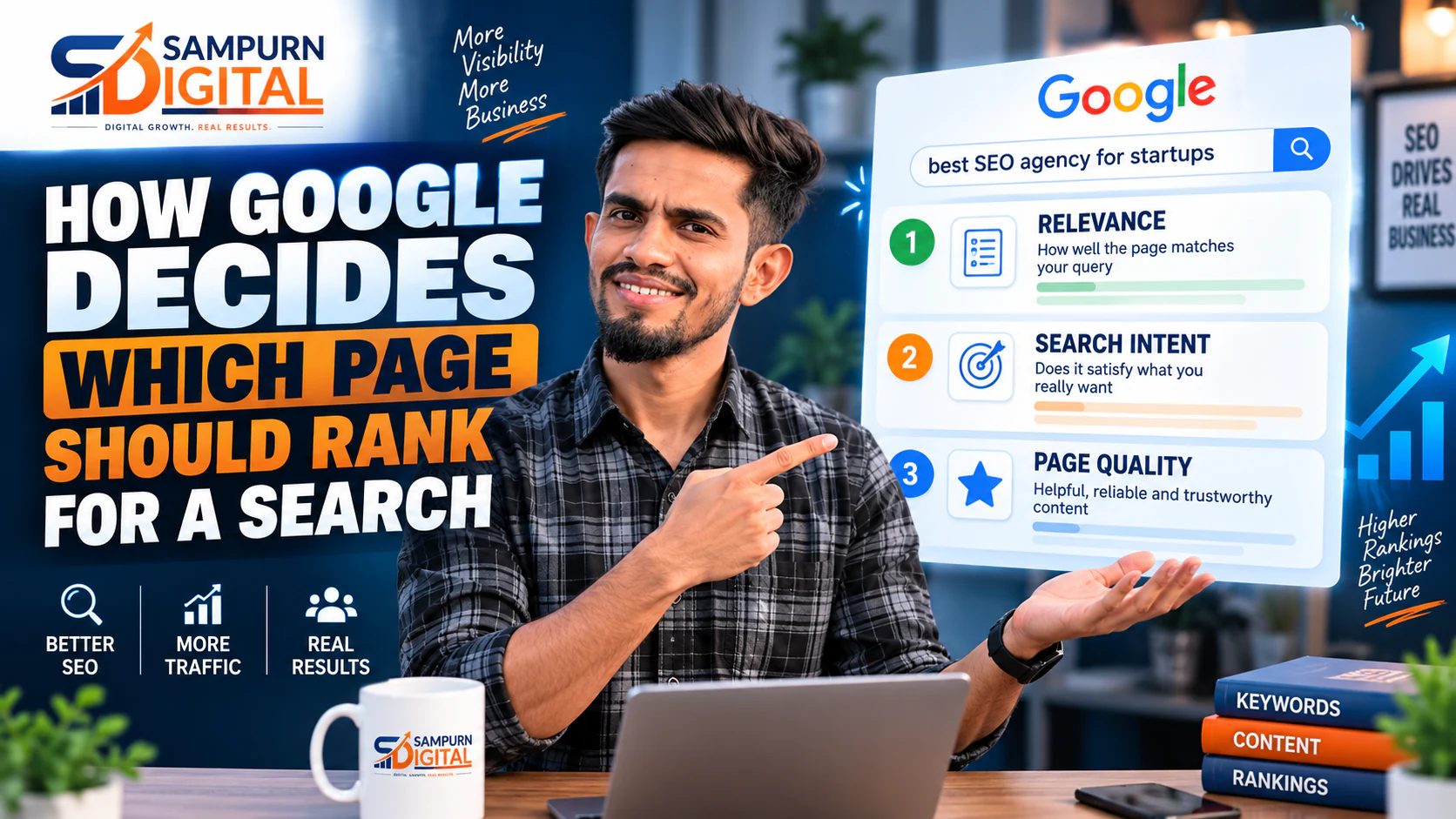
You search for something on Google.
You type a query.
Google shows you a list of pages.
But have you ever wondered:
How does Google decide which page should rank for that search?
This question is more important than simply asking how to rank higher.
Because before Google can rank your page, it needs to understand:
- What your page is about
- What the searcher is looking for
- Whether your page satisfies that need
- How useful and trustworthy the page appears to be
- How your page compares with other relevant pages
- Whether your website provides enough context around the topic
This is why SEO isn't simply about putting a keyword into a title, writing 2,000 words, and waiting for rankings.
Google has to determine which page is the best match for a particular search.
And that means the same website can have:
- One page ranking extremely well
- Another page barely appearing
- Another page ranking for unexpected queries
- Multiple pages competing with each other
- Some pages receiving impressions but almost no clicks
So, how Google chooses search results is really a question of relevance, intent, quality, competition, and page-level signals working together.
Understanding this process makes SEO much easier to diagnose and plan.
First: Google Doesn't Simply Rank the Page With the Most Keywords
One of the biggest SEO misconceptions is:
"If I use the keyword more times, Google will rank my page higher."
That's not how modern search works.
Imagine someone searches:
"best SEO agency for startups"
Now compare two pages.
Title: What Is SEO?
The article explains:
- What SEO means
- Basic SEO concepts
- How search engines work
- General SEO terminology
Title: How to Choose an SEO Agency for a Startup
The article explains:
- What startups should look for
- Different SEO service models
- Technical SEO requirements
- Content strategy
- Reporting
- Pricing considerations
- Questions to ask an agency
- Common mistakes
Page B is much closer to the underlying need behind the search.
It doesn't necessarily win because it repeats the phrase "SEO agency" more often.
It has a stronger relationship between the query, intent, topic, page type, and useful information.
That's the foundation of search relevance.
What Does Google Actually Need to Understand?
When someone performs a search, Google has to solve a matching problem.
On one side:
On the other:
Google needs to determine which pages are appropriate results for that particular query.
At a simplified level, the process can be thought of as:
The important word is relevant.
Google isn't trying to find the page that mentions the search phrase the most.
It is trying to return results that are useful for the searcher's need.
That means your SEO strategy should begin with a different question:
"What does this searcher actually need?"
rather than:
"Where can I insert my keyword?"
Google Tries to Understand the Meaning Behind the Search
People don't always search using perfect language.
A person might type:
"seo agency small business"
Another might type:
"best seo company for small businesses"
Another might search:
"how to get more Google traffic for my business"
The wording is different.
But the underlying need may overlap.
Search engines need to interpret the meaning behind these queries rather than simply matching exact words.
This is one reason why modern SEO should focus on topics, entities, relationships, context, and intent, not just exact keyword repetition.
For example, a page about SEO for small businesses might naturally discuss:
- Organic traffic
- Keyword research
- Technical SEO
- Search intent
- Content
- Internal linking
- Local SEO
- Rankings
- Search Console
- Conversions
Those concepts help establish what the page is actually about.
You don't need to force every possible variation of a keyword into the article.
Instead, build a page that comprehensively addresses the subject.
Search Intent Helps Determine Which Page Should Rank
Understanding query meaning is only the beginning.
Google also needs to determine:
What is the searcher trying to accomplish?
This is called search intent.
Consider these searches:
"what is SEO"
The user probably wants an explanation.
"how to do SEO"
The user probably wants instructions.
"SEO audit checklist"
The user probably wants a checklist or practical resource.
"SEO services"
The user is much closer to evaluating or purchasing a service.
These searches may all contain the word "SEO".
But they require different types of pages.
That's why search relevance cannot be reduced to keyword matching.
A detailed explanation may be appropriate for:
"what is SEO"
But a service page may be more appropriate for:
"SEO services"
And a checklist may be more appropriate for:
"SEO audit checklist"
For a deeper understanding of this relationship, see our guide to [search intent mapping](https://www.sampurndigital.com/blog/seo/search-intent-mapping-how-to-match-pages-with-what-people-actually-want).
Google Looks at How Well the Page Matches the Query
Once Google understands the query and potential intent, it needs to determine which pages are relevant.
This is where search relevance becomes important.
Suppose someone searches:
"how to improve website conversion rate"
A page about:
"What Is Digital Marketing?"
might mention conversion rates.
But that doesn't make it the best answer.
Another page might specifically explain:
- Conversion problems
- Landing-page structure
- Calls to action
- Forms
- User experience
- Testing
- Analytics
- Conversion optimization
That page has stronger topical alignment.
The key question is:
Does this page directly address what the searcher is trying to solve?
This is why a page can contain a keyword and still fail to rank well for it.
The Page Type Matters More Than Many Businesses Realize
Search results often reveal what type of content Google believes is appropriate for a query.
Consider:
"best laptops for graphic designers"
You might see:
- Comparison pages
- Product roundups
- Reviews
- Buying guides
Now imagine you publish:
"What Is a Laptop?"
Even if the article is excellent, it doesn't match the expected purpose of the search.
The same thing happens with business websites.
A search for:
"SEO services"
has a different intent from:
"how does SEO work?"
A service page may be appropriate for the first.
An educational article may be appropriate for the second.
This is why page type and search intent should be mapped before content is created.
Google Doesn't Evaluate Your Page in Isolation
Your page exists within a competitive search environment.
If ten pages are targeting the same query, Google has to compare them.
It can consider many aspects of the available results, including:
- Relevance
- Content quality
- Usefulness
- Page experience
- Website context
- Authority and credibility
- Links and references
- Freshness where appropriate
- Search intent satisfaction
- Overall competitive strength
This doesn't mean there is one universal ranking formula that you can calculate.
There isn't.
Instead, think of SEO as a relative evaluation.
Your page doesn't need to be perfect in every possible way.
It needs to be a strong result for the search it is targeting.
Your Page Needs a Clear Topic
One common problem is creating pages that try to rank for everything.
Imagine a page titled:
"Complete Digital Marketing Guide"
It discusses:
- SEO
- PPC
- Social media
- Email marketing
- Web development
- Branding
- Video marketing
- Influencer marketing
- Analytics
It may be comprehensive.
But what is the primary search need?
Now compare it with a focused page about:
"How Google Decides Which Page Should Rank for a Search"
The second page has a much clearer topical purpose.
That clarity helps with:
- Content planning
- Search intent
- Internal linking
- Keyword targeting
- User experience
- Content architecture
A page should have a clear reason for existing.
Google Uses Context From Your Website
Your individual page is important.
But your website structure also provides context.
Imagine you have a website about SEO.
You publish articles about:
- Search intent
- Keyword research
- Technical SEO
- Internal linking
- Content audits
- SEO reporting
- Topic clusters
These pages can reinforce the broader subject expertise of the website when they are properly organized and connected.
This is one reason internal linking matters.
For example:
This creates a meaningful relationship between pages.
If you're trying to understand why a particular page receives impressions but doesn't rank strongly, it also helps to start with a broader [diagnostic framework for why a website may not be getting Google traffic](https://www.sampurndigital.com/blog/seo/why-is-my-website-not-getting-google-traffic-a-diagnostic-framework).
Internal Links Help Google Understand Relationships Between Pages
Internal linking isn't only about passing authority from one page to another.
It also creates context.
Suppose you have one article explaining:
"How Google Decides Which Page Should Rank"
And another explaining:
"Search Intent Mapping"
A contextual link between them tells the reader:
These topics are related.
It also helps create a logical information structure.
For example:
This is much stronger than publishing 100 unrelated blog posts.
For a practical next step, you can learn about [how to improve pillar page architecture](https://www.sampurndigital.com/blog/seo/pillar-page-architecture-how-to-connect-2030-articles-around-one-topic) and connect supporting content around a central topic.
Keyword Relevance Still Matters — But Not in the Way People Think
Keywords still matter.
Google needs to understand what a page is about.
But keyword usage should be natural.
Suppose your primary keyword is:
You might naturally use variations such as:
- how Google chooses search results
- how Google ranks pages
- search relevance
- page ranking factors
- which page should rank
- how search engines determine relevance
- how Google matches queries with pages
You don't need to repeat one exact phrase 30 times.
Instead, create a page where the topic is unmistakable.
Think in terms of a topic relationship
That is much more natural than keyword stuffing.
Search Volume Does Not Tell Google Which Page Should Rank
Search volume is useful for planning.
But search volume doesn't determine which page deserves to rank.
Imagine two businesses.
Business A targets:
"digital marketing"
Business B targets:
"digital marketing strategy for local businesses"
Business A may have chosen a keyword with much larger search demand.
But Business B may have a page that is much more closely aligned with a specific audience and intent.
This is why effective keyword strategy should connect search demand with business value.
Before selecting keywords, consider:
- Who is searching?
- Why are they searching?
- What page should answer them?
- What problem are they solving?
- What happens after they visit?
- Does the search have commercial relevance?
A useful next step is understanding [keyword research based on business revenue rather than search volume alone](https://www.sampurndigital.com/blog/seo/keyword-research-based-on-business-revenue-not-just-search-volume).
Freshness Matters — But Only When Freshness Is Relevant
Not every query requires today's information.
If someone searches:
"what is HTML"
The basic concept doesn't change every day.
But if someone searches:
"Google Ads trends 2026"
fresh information matters much more.
The important distinction is:
Updating a page just to change the publication date doesn't automatically make it better.
A meaningful update should improve the usefulness of the content.
That might mean:
- Correcting outdated information
- Adding new developments
- Replacing outdated examples
- Improving instructions
- Expanding missing sections
- Removing obsolete recommendations
Authority and Trust Can Influence Competitive Searches
Relevance isn't the only challenge.
For competitive topics, Google has many potentially relevant pages to choose from.
This makes broader credibility important.
Authority can be supported by things such as:
- High-quality external references
- Relevant backlinks
- Strong topical coverage
- Clear business information
- Demonstrated expertise
- Helpful content
- Good site architecture
- Positive reputation
- Consistent information across the website
But authority should not be treated as:
"Get 1,000 backlinks and Google will rank everything."
It doesn't work that simply.
A page still needs to satisfy the search.
Authority cannot compensate indefinitely for an irrelevant or poor-quality result.
Your Website Architecture Can Influence How Google Understands Content
Imagine a website with this structure:
This creates a logical hierarchy.
Now imagine the same content is scattered across hundreds of unrelated URLs with no meaningful navigation or internal links.
The content may still be discoverable.
But the structure provides less useful context.
Good architecture helps establish relationships between:
- Services
- Categories
- Topics
- Supporting articles
- Products
- Locations
- Conversion pages
This becomes especially important as a website grows.
For service businesses, the same principle applies to the relationship between informational content and conversion-focused pages.
For example, [lead-generation website architecture for service businesses](https://www.sampurndigital.com/blog/web-development/lead-generation-website-architecture-for-service-businesses) can help connect SEO traffic with the pages designed to turn visitors into enquiries.
Multiple Pages Can Compete for the Same Search
Now we reach an important SEO problem.
Suppose you have:
- "SEO agency"
- "SEO company"
- "SEO services"
- "SEO experts"
- "best SEO agency"
If all of these pages target essentially the same intent, you may create unnecessary overlap.
The issue isn't simply having multiple pages.
The issue is having multiple pages that don't have clearly differentiated purposes.
Google needs to determine:
Which page is the best candidate for this query?
If your own website sends mixed signals, you may create unnecessary competition between your pages.
This is why keyword mapping matters.
For every important query, ask:
Which page should rank?
If you cannot answer that confidently, your content architecture may need work.
A Keyword Should Have a Clear Destination Page
A strong SEO strategy doesn't start with:
"Here are 500 keywords."
It starts with:
"Here are the searches our customers care about, and here is the page that should answer each one."
For example:
| Search | Intent | Target Page |
|---|---|---|
| what is SEO | Informational | SEO guide |
| how Google ranks pages | Informational | This article |
| search intent mapping | Informational | Search intent article |
| SEO audit checklist | Informational | SEO audit article |
| SEO services | Transactional | SEO service page |
This prevents a common SEO mistake:
Instead, define the purpose before writing.
Google Doesn't Need Every Page to Rank
This is another important point.
A website doesn't need every blog post to rank.
Some pages may exist to:
- Support another page
- Answer a narrow question
- Explain a concept
- Strengthen topical coverage
- Help users move through the site
- Support a commercial page
- Capture a long-tail search
The goal is not:
"Every page must generate thousands of visitors."
The goal is to create a useful website where important pages have clear purposes.
Some articles may generate direct traffic.
Others may primarily support the broader topic cluster.
That is perfectly normal.
A Practical Framework: How to Decide Which Page Should Rank
If you're unsure which page should target a keyword, use this framework.
Identify the Exact Search
Write down the query.
For example:
"how Google ranks pages"
Don't immediately start writing.
First understand the search.
Identify the Searcher's Intent
Ask:
Are they trying to:
- Learn?
- Compare?
- Evaluate?
- Buy?
- Find a specific website?
- Solve a problem?
Identify the Expected Page Type
Determine what kind of result makes sense.
Could the answer be:
- Blog article?
- Guide?
- Service page?
- Product page?
- Category page?
- Comparison?
- Tutorial?
- Location page?
Choose One Primary Page
Ask:
Which page on my website should be the strongest answer?
Choose one.
Don't create three pages targeting the same intent simply because the keyword can be phrased three different ways.
Build Supporting Content
Once you have the primary page, identify related questions.
For example:
How Google decides which page should rank
Supporting topics might include:
- Search intent
- Keyword research
- Internal linking
- Topic clusters
- Content audits
- Technical SEO
- Indexing
These supporting pages can then link back to the main topic where appropriate.
Connect the Pages With Internal Links
Internal links should create a logical path.
For example:
This creates an interconnected content system.
What You Should NOT Do
Understanding how Google chooses results also tells you what to avoid.
Don't create multiple pages for every keyword variation
One page can often target multiple closely related searches when they share the same intent.
Don't stuff exact-match keywords everywhere
Natural language and useful coverage are more important than repetition.
Don't copy the top-ranking pages
Study them to understand search intent and expectations.
Then create something genuinely useful and differentiated.
Don't change your target keyword every few weeks
Give the page a clear purpose and evaluate performance before making major changes.
Don't build pages with no business or user purpose
A keyword with search volume isn't automatically a good content opportunity.
Don't treat backlinks as the only ranking solution
Links can matter, but they don't replace relevance, useful content, technical accessibility, or search-intent alignment.
How to Diagnose a Page That Isn't Ranking
If a page isn't ranking for its target query, ask these questions in order.
Is the page indexed?
If not, solve the indexing problem first.
Is the page accessible to search engines?
Check technical accessibility, status codes, robots directives, canonicals and other technical issues.
Is this the correct page for the query?
Could another page on your website be a better candidate?
Does the page match search intent?
Compare what the searcher wants with what your page actually provides.
Is the topic sufficiently covered?
Does the page answer the important aspects of the query?
Is the page genuinely useful?
Would you choose this page if you were the searcher?
Is the page internally connected?
Are relevant pages linking to it?
Is the competition significantly stronger?
Look at the quality, relevance, authority and depth of competing results.
This turns ranking analysis into a diagnosis rather than random experimentation.
A Simple Page-Ranking Model for SEO Teams
You can use this simplified model internally:
This is a much stronger workflow than:
The Role of SEO Services in This Process
When businesses struggle with rankings, the problem is often bigger than one keyword.
You may need to understand:
- Which pages should rank
- Which pages are competing
- Which pages need better search-intent alignment
- Which pages need internal links
- Which pages need more authority
- Which pages need consolidation
- Which topics deserve new content
- Which pages should support commercial goals
This is where a structured SEO process becomes valuable.
A strong [SEO strategy and optimization service](https://www.sampurndigital.com/seo-services) should not simply focus on producing more content.
It should help identify the right pages, the right topics, the right priorities and the right path from search visibility to business results.
What This Means for Your Content Strategy
If you understand how Google decides which page should rank, your content strategy changes.
Instead of asking:
"What blog should we publish this week?"
Ask:
"Which customer search or business problem do we need to answer next?"
Then determine:
That creates a much more organized SEO system.
For example:
This is how individual articles become part of a larger SEO system instead of isolated posts.
