
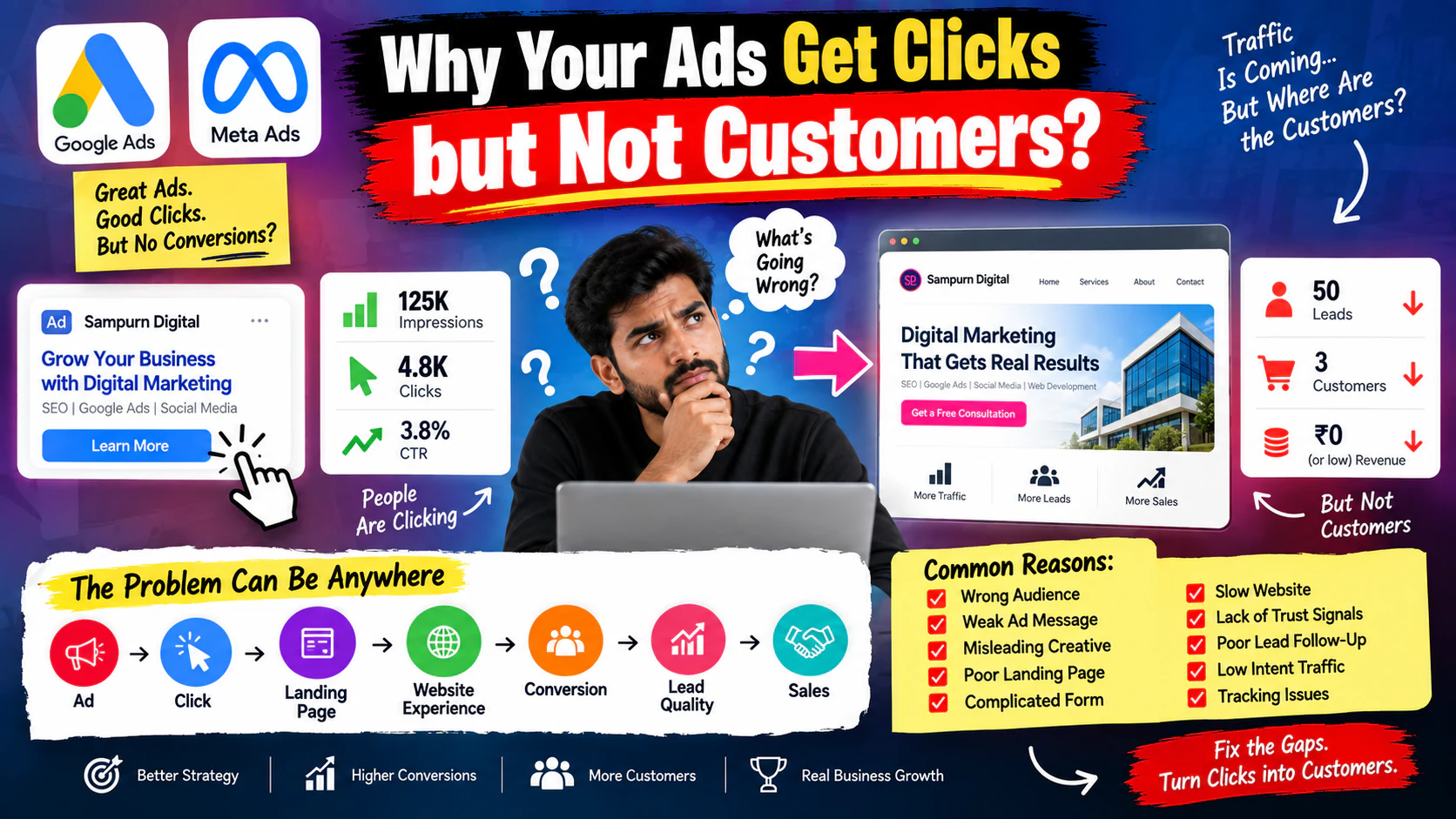
You launched a Google Ads or Meta Ads campaign.
People are clicking.
Traffic is coming to your website.
The numbers in your advertising dashboard may even look good.
But something is wrong.
This is one of the most frustrating problems in performance marketing because it can make a campaign look successful on the surface while producing very little business value.
You may see:
- High impressions
- Growing clicks
- Good click-through rates
- Increasing website traffic
- Engagement from your audience
But then:
So, why do ads get clicks but no customers?
The answer usually isn't simply “bad ads.”
The problem can exist anywhere between:
If one part of that journey is weak, your advertising can generate plenty of activity without generating enough customers.
The goal of this guide is to help you diagnose where the problem actually exists before you increase your ad budget or completely rebuild your campaigns.
First: Don't Assume More Clicks Will Fix the Problem
When an advertising campaign isn't producing enough customers, businesses often respond by trying to generate more traffic.
They might:
- Increase the budget
- Add more keywords
- Broaden targeting
- Increase bids
- Launch more campaigns
- Create more ads
But imagine your current campaign produces:
Increasing traffic to:
doesn't solve the underlying efficiency problem.
You simply doubled the activity and doubled the outcome.
If the goal is growth, you need to understand why the existing clicks aren't converting efficiently.
A better framework is:
Find the stage where performance drops.
Then fix that stage.
The 8 Reasons Your Ads May Get Clicks but Not Customers
Let's work through the most common causes.
Your Ad Is Promising Something the Landing Page Doesn't Deliver
This is one of the most common problems.
Imagine your ad says:
“Get a Free SEO Audit for Your Business.”
Someone clicks.
But the landing page says:
“Welcome to our digital marketing agency.”
The visitor now has to figure out:
- Where is the free audit?
- What exactly am I getting?
- How do I request it?
- Why should I trust this business?
The ad created a specific expectation.
The landing page didn't immediately satisfy it.
That creates friction.
Your ad and landing page should tell the same story
Think about:
The transition should feel natural.
For example:
The visitor immediately understands that they arrived at the right place.
You're Getting the Wrong Clicks
Not every click is valuable.
A campaign can generate thousands of clicks while attracting people who have little chance of becoming customers.
This can happen because of:
- Broad targeting
- Irrelevant keywords
- Poor search-term control
- Weak audience definitions
- Misleading ad copy
- Low-intent searches
- Poor geographic targeting
- Poor placement selection
For example, imagine you sell professional accounting services.
A keyword such as:
“free accounting software”
could attract people looking for software.
But your business may provide accounting services.
The person can click the advertisement without ever becoming a customer.
The click is real.
The traffic is real.
But the intent is wrong.
This is why paid acquisition needs to be connected to business intent rather than click volume.
Our guide on [search term analysis and finding wasted Google Ads spend](https://www.sampurndigital.com/blog/performance-marketing/search-term-analysis-how-to-find-wasted-google-ads-spend) can help you understand where irrelevant traffic may be entering your campaigns.
Your Landing Page Has Too Much Friction
A visitor may be interested in your offer but still abandon the page because taking action feels difficult.
Common friction points include:
- Too many form fields
- Confusing navigation
- Weak headline
- No clear CTA
- Poor mobile experience
- Slow loading
- Too much text before the offer
- Lack of trust signals
- Unclear pricing
- Too many competing actions
Imagine someone clicks an ad for a consultation.
They land on a page with:
- 12 navigation links
- Multiple unrelated services
- Several CTAs
- A long company history
- No clear offer
- A complicated form
The visitor has to work too hard.
A paid traffic landing page should make the next step obvious.
For a deeper framework, see [landing page structure for paid traffic that is ready to convert](https://www.sampurndigital.com/blog/performance-marketing/landing-page-structure-for-paid-traffic-that-is-ready-to-convert).
Your Offer Isn't Strong Enough
Sometimes the advertising and landing page are technically fine.
The offer is the problem.
A visitor may ask:
“Why should I take action now?”
If the answer isn't obvious, clicks may not become conversions.
Compare:
Weak
“Contact our digital marketing team.”
with:
Stronger
“Get a 30-Minute Digital Growth Consultation.”
The second offer tells the visitor:
- What they receive
- What action to take
- What the interaction is about
Your offer doesn't necessarily need to be a discount.
It could be:
- Audit
- Consultation
- Demo
- Free assessment
- Trial
- Strategy session
- Product comparison
- Quote
- Downloadable resource
The important thing is that the value of the next step is clear.
Your Ads Are Attracting Curiosity Instead of Buying Intent
High click-through rate can sometimes be misleading.
An ad can be extremely interesting and still generate poor customers.
For example:
“5 Secrets Every Business Owner Needs to Know About Google Ads”
might generate strong curiosity.
But someone searching:
“Google Ads agency for e-commerce”
may have much stronger commercial intent.
This creates an important distinction:
Your campaign should attract the right people, not simply the largest possible audience.
This is especially important when deciding between search and social advertising.
Our guide on [search ads vs social ads and demand capture vs demand creation](https://www.sampurndigital.com/blog/performance-marketing/search-ads-vs-social-ads-demand-capture-vs-demand-creation) explains why these channels behave differently.
Your Conversion Tracking May Be Wrong
Before changing the campaign, verify that you're actually measuring conversions correctly.
This is often overlooked.
Imagine your campaign generates:
but your analytics reports:
You might conclude:
“The campaign isn't working.”
But the problem could be measurement.
Check whether:
- Forms are tracked
- Phone calls are tracked
- Purchases are tracked
- Thank-you pages fire correctly
- Conversion events are configured correctly
- Duplicate conversions are excluded
- Important actions are marked correctly
- CRM data is connected where possible
The opposite problem can also occur.
A campaign might report many “conversions” that aren't meaningful business outcomes.
For example:
- Page views
- Button clicks
- Time on page
- Low-quality form submissions
These aren't necessarily customers.
The most useful measurement system connects:
Your Website Is Losing the Traffic
Sometimes the advertising campaign is doing its job.
The website isn't.
This can happen when visitors arrive on:
- Slow pages
- Poorly designed pages
- Generic service pages
- Broken forms
- Confusing navigation
- Weak mobile experiences
- Pages with unclear messaging
Imagine a visitor clicks an ad for:
They land on:
That's a mismatch.
The visitor has to search through the website to find the service they were promised.
A better journey would be:
Your website architecture therefore plays a major role in paid advertising performance.
For service businesses, [lead-generation website architecture](https://www.sampurndigital.com/blog/web-development/lead-generation-website-architecture-for-service-businesses) explains how pages can be structured around conversion journeys.
Your Leads Are Coming In — But They Aren't Becoming Customers
This is where the problem moves beyond advertising.
Suppose your campaign generates:
But only:
You shouldn't automatically conclude that the advertising is failing.
Investigate the entire funnel.
Ask:
- Are the leads qualified?
- Are sales responding quickly?
- Are leads being followed up consistently?
- Are prospects receiving the right information?
- Is the offer attracting the right customers?
- Are sales objections being addressed?
- Is pricing competitive?
- Is the sales process too complicated?
You could have an acquisition problem.
Or you could have a sales problem.
Or both.
This is why performance marketing should ultimately be measured against business outcomes, not simply ad-platform metrics.
How to Diagnose the Problem Step by Step
Instead of randomly changing campaigns, use a structured diagnosis.
Check Impressions
If impressions are low, ask:
- Is the audience too narrow?
- Are search volumes limited?
- Are bids competitive?
- Is targeting too restrictive?
- Is the campaign eligible to serve?
Low impressions mean you may have an reach or demand problem.
Check Click-Through Rate
If impressions are healthy but clicks are low, investigate:
- Ad relevance
- Creative
- Headlines
- Offers
- Audience targeting
- Search terms
You may have a message or targeting problem.
Check Landing Page Engagement
If clicks are healthy but visitors leave quickly, investigate:
- Message match
- Page speed
- Mobile UX
- Headline
- Offer
- Trust
- Page structure
You may have a landing-page problem.
Check Conversion Rate
If visitors engage but don't convert, investigate:
- CTA
- Form
- Offer
- Trust signals
- Pricing
- Friction
- Page clarity
You may have a conversion problem.
Check Lead Quality
If conversions are high but customers are low, investigate:
- Audience quality
- Keyword intent
- Lead qualification
- Offer positioning
- Geographic targeting
- Sales follow-up
You may have a lead-quality or sales problem.
The Paid Traffic Diagnosis Funnel
Use this simple model:
At each stage, ask:
“Is performance dropping here?”
That question is much more useful than simply asking:
“Are my ads working?”
Don't Optimize for the Wrong Metric
A campaign can have:
but:
but:
but:
This is why performance marketing needs multiple measurement layers.
Ad-level metrics
- Impressions
- Clicks
- CTR
- CPC
Conversion metrics
- Conversion rate
- Cost per conversion
- Cost per lead
Business metrics
- Qualified leads
- Customers
- Customer acquisition cost
- Revenue
- Return on investment
The further you move down the funnel, the more valuable the measurement becomes.
What Should You Fix First?
When a campaign isn't generating customers, don't change everything simultaneously.
Use a priority framework.
Problem: Low-quality traffic
Fix:
Problem: Good traffic but poor engagement
Fix:
Problem: Good engagement but few conversions
Fix:
Problem: Good conversions but poor customer quality
Fix:
Problem: Good leads but poor sales
Fix:
This helps you fix the actual bottleneck.
When Should You Change the Ads?
Don't automatically rewrite your ads because conversions are low.
First identify where the problem is.
If your targeting is wrong, new creative won't fix the traffic quality.
If your landing page is weak, changing headlines may produce only a temporary improvement.
If your offer is weak, increasing the budget can make the problem worse.
Ads should be changed when the evidence suggests the message or creative itself is contributing to the problem.
Useful tests include:
- Different value propositions
- Different headlines
- Different calls to action
- Different pain points
- Different proof points
- Different creative formats
But test deliberately.
Don't change everything at once.
When Should You Change the Landing Page?
Consider testing the landing page when:
- Ads receive clicks but conversion rate is low
- Bounce or abandonment is high
- The ad and page message don't match
- Visitors don't understand the offer
- The CTA is unclear
- The page is slow
- The mobile experience is weak
- There is too much friction
A useful rule is:
If people are willing to click but unwilling to act, investigate what happens after the click.
When Should You Change the Targeting?
Targeting deserves attention when:
- Search terms are irrelevant
- Lead quality is poor
- Audience is too broad
- Geographic targeting is incorrect
- Campaigns attract low-intent users
- Spend is concentrated in weak segments
For Google Ads, search-term analysis is particularly important because the actual queries can reveal where money is being spent on irrelevant demand.
For Meta Ads, audience and creative signals can help determine whether the campaign is attracting people who are likely to take meaningful action.
Don't Increase Your Ad Budget Yet
This is one of the biggest mistakes businesses make.
Imagine:
Increasing the budget to:
doesn't automatically create:
You may simply create more inefficient traffic.
Before increasing spend, establish that:
- Targeting is relevant
- Ads attract qualified users
- Landing pages convert
- Tracking works
- Leads are qualified
- Sales follow-up works
- Acquisition economics are sustainable
Only then should scaling become a serious consideration.
For a structured approach to deciding whether an account is ready for more investment, see [when should you increase your ad budget using a data-based scaling framework](https://www.sampurndigital.com/blog/performance-marketing/when-should-you-increase-your-ad-budget-a-data-based-scaling-framework).
Build a Better Paid Acquisition System
A successful paid campaign is not just:
It is a connected system:
Every step matters.
If one step is significantly weaker than the others, the whole system suffers.
This is why paid advertising should be managed as a growth system rather than a traffic-generation tactic.
A Practical Ads-to-Customer Audit
Use this checklist before changing your campaign.
Targeting
- Is the audience relevant?
- Are geographic settings correct?
- Are keywords aligned with customer intent?
- Are irrelevant search terms being controlled?
- Are low-quality placements being identified?
Ads
- Does the ad clearly communicate the offer?
- Does the message match customer intent?
- Is the CTA clear?
- Are multiple creative variations being tested?
- Are ads aligned with the landing page?
Landing Page
- Does the headline match the ad?
- Is the offer immediately clear?
- Is the CTA easy to find?
- Is the page mobile-friendly?
- Does the page load quickly?
- Are trust signals visible?
- Is unnecessary friction removed?
Conversion
- Is conversion tracking working?
- Are meaningful conversions being measured?
- Are duplicate conversions excluded?
- Are forms working?
- Are phone calls or other important actions tracked?
Lead Quality
- Are leads relevant?
- Are leads qualified?
- Are sales teams following up?
- Are poor-quality leads being identified?
- Are customer outcomes being connected to campaigns?
Business Results
- What is the customer acquisition cost?
- What is the revenue generated?
- Which campaigns produce customers?
- Which audiences produce valuable customers?
- Which campaigns should receive more or less budget?
Final Diagnosis: The Click Isn't the Goal
A click is only the beginning of the paid acquisition journey.
Your real goal is:
If your ads are generating clicks but not customers, don't immediately assume the ads are broken.
Find the exact point where the journey is breaking.
It could be:
- Targeting
- Search intent
- Ad messaging
- Offer
- Landing page
- Website experience
- Conversion tracking
- Lead qualification
- Sales follow-up
Once you identify the bottleneck, the solution becomes much clearer.
And that's the fundamental principle of performance marketing:
Don't optimize for more activity. Optimize the system that turns paid attention into profitable customers.
If you want to understand how paid acquisition fits into the broader business growth system, [see how SEO, paid, social, website and analytics work together](https://www.sampurndigital.com/blog/digital-marketing/the-digital-growth-operating-system-how-seo-paid-social-website-and-analytics-work-together).
For businesses that need help diagnosing campaign performance, reducing wasted spend and improving the path from ad click to customer, request a performance marketing audit from Sampurn Digital.
