
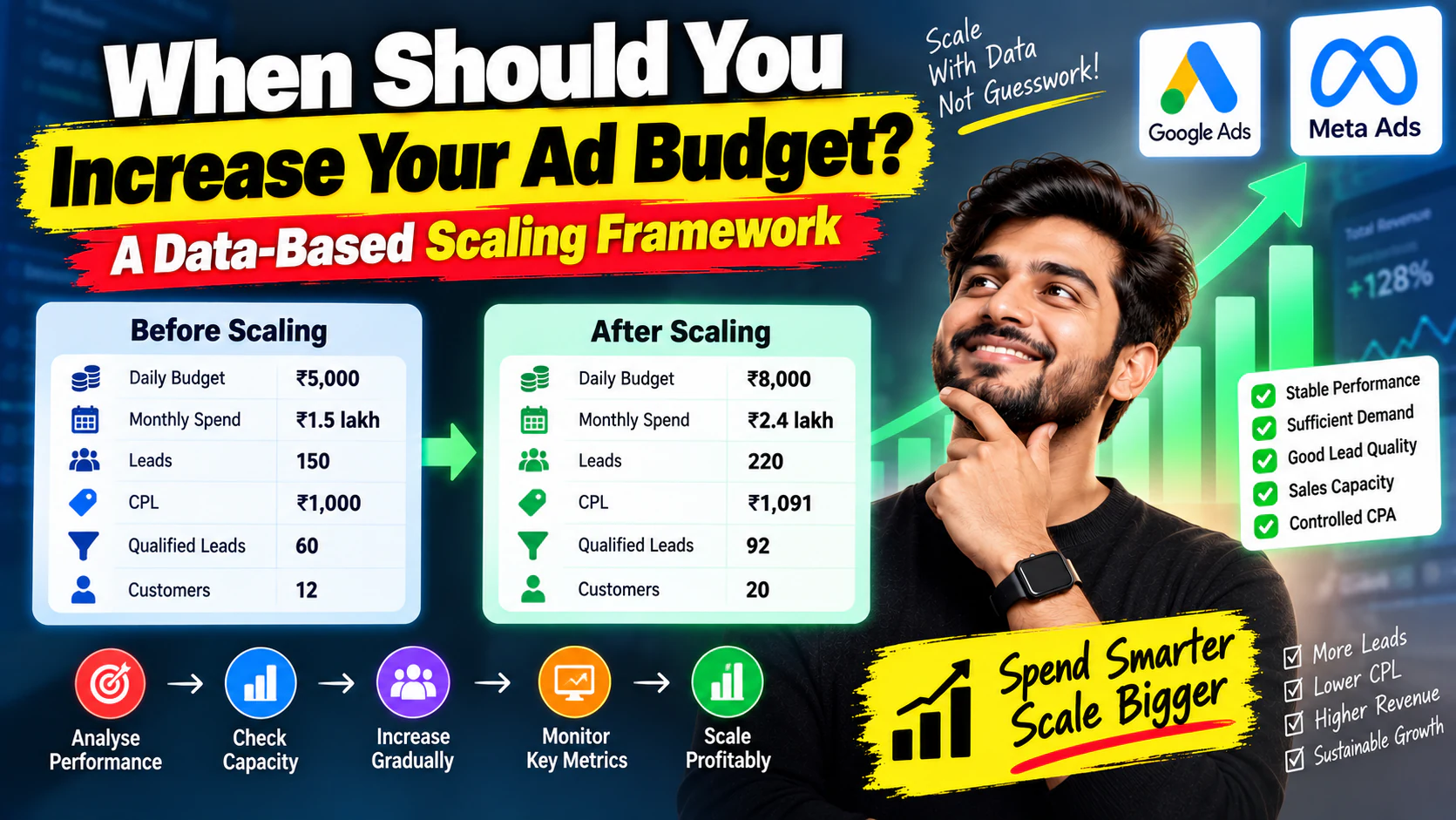
Increasing your advertising budget sounds simple.
If a campaign is generating leads at ₹800 each with a ₹5,000 daily budget, why not increase it to ₹10,000?
Because more budget does not automatically mean more profitable growth.
A campaign can perform well at ₹5,000 per day and struggle at ₹10,000.
The audience may be limited. Search demand may be exhausted. Costs may rise. Lead quality may decline. Your sales team may not be able to handle additional enquiries.
So the real question isn't:
"Can we spend more?"
It is:
"Has the campaign demonstrated enough stability, efficiency and capacity to justify spending more?"
This guide explains when to increase your Google Ads budget, how to determine whether a paid campaign is ready to scale, how much to increase, and what numbers you should monitor after the increase.
What Does Scaling an Ad Budget Actually Mean?
Budget scaling means increasing advertising investment while attempting to maintain acceptable economics.
For example:
Before scaling
- Daily budget: ₹5,000
- Monthly spend: approximately ₹1.5 lakh
- Leads: 150
- CPL: ₹1,000
- Qualified leads: 60
- Customers: 12
After scaling
- Daily budget: ₹8,000
- Monthly spend: approximately ₹2.4 lakh
- Leads: 220
- CPL: ₹1,091
- Qualified leads: 92
- Customers: 20
The campaign didn't maintain exactly the same CPL.
But it generated substantially more qualified opportunities and customers.
That can still be successful scaling.
It's about increasing business output while keeping acquisition economics within an acceptable range.
The Biggest Mistake: Scaling Because the Campaign "Looks Good"
One or two strong weeks aren't enough.
Imagine a campaign generated:
- ₹50,000 spend
- 100 leads
- ₹500 CPL
It looks excellent.
You increase the budget by 100%.
The following week:
- ₹1,00,000 spend
- 120 leads
- ₹833 CPL
Lead volume increased.
But efficiency collapsed.
This happens because the first ₹50,000 may have captured the easiest available demand.
The additional ₹50,000 had to find less efficient opportunities.
That's why scaling requires evidence of capacity, not simply evidence of performance.
The 7 Signals That Tell You a Campaign May Be Ready to Scale
Before increasing budget, check these seven areas:
- Conversion performance
- Cost efficiency
- Lead quality
- Conversion volume
- Demand capacity
- Tracking reliability
- Business capacity
If several of these are weak, increasing spend is usually premature.
Your Campaign Is Consistently Converting
Start with the simplest question:
Don't scale a campaign because:
- CTR is high
- impressions are increasing
- CPC is low
- the ads look good
Scale based on meaningful conversions.
For lead generation, that might mean:
For e-commerce:
The more valuable the conversion, the stronger the scaling signal.
Your Acquisition Cost Is Acceptable
Know your target economics before increasing spend.
Suppose your business can sustainably acquire a customer for up to ₹4,000.
Your current CAC is:
That's potentially healthy.
If CAC is already:
scaling isn't automatically the answer.
You should first understand why acquisition is expensive.
A useful framework is:
If the gap is healthy, you have room to experiment.
If current CAC is already close to your maximum, aggressive scaling can quickly become dangerous.
Lead Quality Is Stable
This is especially important for service businesses.
Suppose:
Before scaling
100 leads 40 qualified 10 customers
Now you increase the budget.
After scaling
180 leads 45 qualified 8 customers
The campaign generated 80 additional leads.
But qualified-lead rate fell from:
And customers actually declined.
This is not successful scaling.
It's simply buying more low-quality demand.
Before increasing budget, review:
- qualified lead rate
- sales acceptance rate
- opportunity rate
- customer rate
- average deal value
Cheap leads are not the objective.
You Have Enough Conversion Volume to Judge Performance
Scaling decisions become difficult when there is very little data.
Imagine you spent ₹20,000 and received:
- 3 leads
- 1 qualified lead
- 0 customers
You cannot confidently conclude that the campaign is ready to scale.
You need enough conversion activity to identify a pattern.
The exact amount depends on:
- business model
- average order value
- sales cycle
- conversion rate
- campaign type
- market size
But the principle is simple:
Look for repeatable performance.
There Is More Demand to Capture
This is one of the most overlooked scaling questions.
A campaign may be profitable but have limited available demand.
For example, suppose you're advertising a highly specific service in one city.
You may have excellent:
- CTR
- conversion rate
- CPL
- customer rate
But there may simply not be enough relevant searches or qualified prospects to double the budget.
In that situation, increasing budget may cause:
- broader targeting
- weaker search terms
- higher CPC
- lower-quality leads
Before scaling, ask:
Tracking Is Reliable
Never scale aggressively when you don't trust your data.
Before increasing budget, verify:
- conversion tracking
- form tracking
- call tracking
- purchase tracking
- CRM lead matching
- revenue attribution
- duplicate conversion prevention
- landing-page analytics
If your platform reports 100 conversions but your CRM shows only 62 actual enquiries, don't solve the discrepancy by increasing spend.
Solve the measurement problem first.
Your Business Can Handle More Demand
This is the difference between marketing capacity and business capacity.
Imagine your ads currently generate:
50 qualified leads per month.
Your sales team can comfortably handle:
You increase the budget and generate:
120 qualified leads.
Now:
- response time increases
- follow-ups are missed
- sales quality drops
- prospects receive delayed responses
Your advertising may look successful while your business loses opportunities.
Before scaling, ask:
The Scaling Readiness Scorecard
Use a simple scorecard before increasing your budget.
| Question | Status |
|---|---|
| Is conversion volume consistent? | ✅ / ⚠️ / ❌ |
| Is CAC within target? | ✅ / ⚠️ / ❌ |
| Is lead quality stable? | ✅ / ⚠️ / ❌ |
| Is conversion tracking reliable? | ✅ / ⚠️ / ❌ |
| Is there additional market demand? | ✅ / ⚠️ / ❌ |
| Can sales handle additional leads? | ✅ / ⚠️ / ❌ |
| Can operations fulfil additional customers? | ✅ / ⚠️ / ❌ |
Decision rule
Mostly ✅: Consider scaling.
Several ⚠️: Scale cautiously or investigate first.
Any major ❌: Fix the constraint before adding budget.
How Much Should You Increase the Budget?
This is where many advertisers make their biggest mistake.
They go from:
₹5,000/day
to:
₹15,000/day
overnight.
That's a 200% increase.
Instead, consider controlled increases.
For example:
Then observe.
If performance remains acceptable:
Then evaluate again.
The exact increase depends on:
- platform
- campaign structure
- available demand
- conversion volume
- bidding strategy
- account maturity
- budget size
There is no universal percentage that guarantees safe scaling.
The important principle is:
Increase spending in a way that allows you to identify whether performance remains sustainable.
Use a Scaling Ladder
A practical approach is:
Current Budget ↓ Small Increase ↓ Observe Performance ↓ Check CPL / CAC ↓ Check Lead Quality ↓ Check Revenue ↓ Scale Again or Stop
Don't make the second increase until the first increase has been evaluated.
Example: Scaling a ₹5,000/Day Campaign
Suppose your campaign currently generates:
- Spend: ₹5,000/day
- Leads: 5/day
- CPL: ₹1,000
- Qualified leads: 2/day
- Customers: 0.4/day
You increase the budget to:
After enough data:
- Leads: 6/day
- CPL: ₹1,000
- Qualified leads: 2.4/day
- Customers: 0.5/day
The economics remain stable.
You may have evidence to consider another increase.
Now imagine the result was:
- Leads: 5/day
- CPL: ₹1,200
- Qualified leads: 1.5/day
- Customers: 0.2/day
The additional spend isn't producing proportional business value.
Stop scaling.
Diagnose the constraint.
Revenue Scaling Is More Important Than Lead Scaling
A common mistake is to measure scaling by lead volume.
But:
Suppose:
Campaign A
100 leads 20 customers ₹10 lakh revenue
Campaign B
200 leads 15 customers ₹7 lakh revenue
Campaign B generated twice the leads.
Campaign A generated more revenue.
This is why the scaling dashboard should connect advertising to business outcomes.
Your weekly reporting system should already track these relationships. If it doesn't, start with a proper [weekly paid ads performance dashboard](https://chatgpt.com/blog/performance-marketing/weekly-paid-ads-performance-dashboard-what-should-you-track).
Know Your Scaling Constraint
Every campaign eventually hits a constraint.
Your job is to identify it before increasing spend.
Common constraints include:
Constraint 1: Search demand
There aren't enough relevant searches.
Constraint 2: Audience size
Your target audience is too small.
Constraint 3: Creative fatigue
People are seeing the same ads repeatedly.
Constraint 4: Landing-page capacity
More traffic doesn't produce proportionally more conversions.
Constraint 5: Lead quality
Additional reach produces weaker prospects.
Constraint 6: Sales capacity
The business cannot process additional leads.
Constraint 7: Economics
CAC rises beyond the acceptable level.
Scaling becomes easier when you know which constraint you're dealing with.
Scaling Google Ads: What to Check First
For Google Ads, look at:
- search volume
- impression share
- lost impression share
- CPC trends
- conversion rate
- search-term quality
- campaign-level CPA/CPL
- qualified lead rate
- conversion value
If the campaign is already capturing most available high-intent demand, simply adding budget may not generate proportionally more results.
You may need to expand:
- keyword coverage
- locations
- services
- audiences
- campaign types
But expansion should be controlled.
Scaling Meta Ads: What to Check First
Meta works differently because audience discovery and demand creation are major parts of the system.
Before scaling, monitor:
- audience size
- CPM
- frequency
- CTR
- CPC
- conversion rate
- CPL
- lead quality
- creative performance
If frequency rises while response deteriorates, simply increasing budget may accelerate creative fatigue.
Instead, you may need more:
- creative concepts
- hooks
- formats
- offers
- audience variations
Don't Scale a Broken Funnel
Imagine:
₹1,00,000 ad spend
You decide to double the budget.
But the landing page is converting at only 5%.
If you double traffic, you haven't fixed the conversion bottleneck.
You have simply paid to send more people into the same bottleneck.
Before scaling traffic, ask:
Review:
This is where paid advertising connects with website architecture. A strong [lead generation website architecture for service businesses](https://chatgpt.com/blog/web-development/lead-generation-website-architecture-for-service-businesses) can become a scaling advantage rather than a constraint.
Scaling vs Optimizing: Know the Difference
Sometimes you don't need more budget.
You need better efficiency.
Optimize when:
- CPL is too high
- CTR is weak
- conversion rate is weak
- lead quality is poor
- search terms are irrelevant
- landing page underperforms
- creative fatigue is visible
Scale when:
- economics are healthy
- conversion volume is consistent
- quality is stable
- demand exists
- tracking is reliable
- business capacity exists
This distinction can save a significant amount of wasted spend.
A Simple Scaling Decision Tree
Use this:
Is the campaign profitable? │ NO ↓ Fix economics │ YES ↓ Is performance consistent? │ NO ↓ Collect more data │ YES ↓ Is lead/customer quality stable? │ NO ↓ Fix targeting/funnel │ YES ↓ Is additional demand available? │ NO ↓ Expand the opportunity │ YES ↓ Can the business handle more volume? │ NO ↓ Fix operational capacity │ YES ↓ Increase budget gradually ↓ Monitor economics ↓ Scale again or stop
This is much safer than:
What Should You Monitor After Increasing the Budget?
The scaling decision doesn't end when you increase the budget.
The next step is monitoring.
Watch:
Spend
Did delivery actually increase?
CPC/CPM
Did media costs rise?
CTR
Did engagement deteriorate?
Conversion Rate
Is additional traffic converting?
CPL/CPA
Did acquisition efficiency remain acceptable?
Lead Quality
Are additional conversions commercially useful?
CAC
Are additional customers still affordable?
Revenue
Did additional spend create additional revenue?
Profitability
Did incremental revenue create acceptable contribution after costs?
The Incremental ROAS Question
Don't look only at total ROAS.
Ask:
Suppose:
Before scaling
Spend \= ₹1 lakh Revenue \= ₹5 lakh
ROAS \= 5x
After scaling
Total spend \= ₹2 lakh Total revenue \= ₹8 lakh
ROAS \= 4x
Total ROAS declined.
But the additional ₹1 lakh generated ₹3 lakh incremental revenue.
Incremental ROAS:
Whether that is good depends on your margins and business economics.
This is a better way to think about scaling than demanding that total ROAS never move.
Don't Confuse High ROAS With Unlimited Scaling Capacity
A campaign can have excellent ROAS at a small budget.
For example:
₹20,000 spend ₹1,20,000 revenue
ROAS \= 6x
That doesn't mean you can immediately spend ₹2 lakh and expect ₹12 lakh revenue.
The first ₹20,000 may have captured highly efficient demand.
Additional spend may produce:
- lower-intent traffic
- higher CPC
- lower conversion rates
- lower average order values
Scaling should therefore be based on marginal performance, not just historical averages.
How to Build a Safe Scaling Test
Before scaling, write down:
Current state
- budget
- spend
- conversions
- CPL/CPA
- qualified leads
- customers
- revenue
- ROAS
- CAC
Scaling change
- new budget
- percentage increase
- campaigns affected
- expected additional volume
Evaluation window
Define when you'll review the change.
Success criteria
For example:
- CPL remains below ₹1,200
- CPQL remains below ₹3,500
- qualified lead rate stays above 25%
- CAC stays below ₹5,000
Stop criteria
For example:
- CPL exceeds ₹1,500
- lead quality falls materially
- tracking becomes unreliable
- incremental revenue doesn't justify spend
This turns scaling into an experiment instead of a guess.
A ₹50,000 Budget Scaling Example
Suppose your monthly paid media budget is ₹50,000.
Before increasing it, review:
| Metric | Current Result |
|---|---|
| Spend | ₹50,000 |
| Leads | 80 |
| CPL | ₹625 |
| Qualified Leads | 28 |
| CPQL | ₹1,786 |
| Customers | 7 |
| CAC | ₹7,143 |
| Revenue | ₹2,80,000 |
| ROAS | 5.6x |
Now ask:
Is CPL acceptable?
Yes.
Is lead quality acceptable?
Potentially.
Is CAC profitable?
Depends on customer economics.
Is revenue reliable?
Needs verification against CRM/accounting data.
Can the sales team handle more leads?
Must be confirmed.
Is additional demand available?
Must be checked.
Only after answering these questions should the budget be increased.
If you're starting with a defined advertising budget, the planning framework in [How a ₹50,000 Ad Budget Should Be Planned Before Launch](https://chatgpt.com/blog/performance-marketing/how-a-50000-ad-budget-should-be-planned-before-launch) provides the foundation.
Signs You Should NOT Increase Your Ad Budget
Don't scale simply because management wants more leads.
Pause the scaling decision if:
CPL is rising rapidly
Your existing acquisition economics are already deteriorating.
Lead quality is falling
You're buying volume instead of value.
Conversion rate is declining
Your additional traffic may be less relevant.
Tracking is unreliable
You don't know what you're actually buying.
Sales follow-up is weak
More leads won't solve a broken sales process.
Landing page performance is poor
More traffic will amplify the bottleneck.
The market is too small
There may not be enough additional demand.
Campaign performance is unstable
You need more evidence before increasing exposure.
What If the Campaign Is Profitable but Can't Spend More?
This is a common situation.
Your campaign has:
- strong conversion rate
- strong ROAS
- good lead quality
But the budget isn't fully spending.
Don't immediately assume the platform needs a higher budget.
The constraint may be:
- insufficient search demand
- narrow targeting
- limited audience
- bidding limitations
- overly restrictive settings
The correct response may be to expand the opportunity, not simply increase the budget.
Budget Scaling Should Follow Business Scaling
Your advertising budget should ultimately connect to business targets.
For example:
Business target:
Required customers:
Average revenue per customer:
Maximum acceptable CAC:
Now your advertising strategy has a business constraint.
If the campaign produces customers at ₹2,000 CAC, there may be room to scale.
If CAC is ₹4,500, adding budget may move you farther away from the goal.
This is why paid media shouldn't operate independently from the broader marketing strategy.
If you're evaluating whether the overall business is ready for more aggressive marketing investment, [How to Decide When Your Business Is Ready to Scale Marketing](https://chatgpt.com/blog/digital-marketing/how-to-decide-when-your-business-is-ready-to-scale-marketing) is the next logical step.
Google Ads Budget Scaling vs Meta Ads Scaling
The decision framework is similar, but the signals can differ.
| Area | Google Ads | Meta Ads |
|---|---|---|
| Core demand | Existing search demand | Audience + demand creation |
| Key constraint | Search volume | Audience/creative capacity |
| Watch | Impression share, CPC | CPM, frequency, creative fatigue |
| Main risk | Expanding into weaker queries | Audience saturation |
| Scaling path | More relevant demand | More audience/creative combinations |
| Core business metric | CPA/CAC/revenue | CPA/CAC/revenue |
The platform changes.
The business objective doesn't.
For a deeper channel decision, compare [Google Ads vs Meta Ads](https://chatgpt.com/blog/performance-marketing/google-ads-vs-meta-ads-which-is-better-for-your-business) rather than assuming the same scaling strategy works everywhere.
Search Ads and Social Ads Require Different Scaling Logic
Search advertising often captures existing demand.
Social advertising can create demand among people who weren't actively searching.
That means the available scaling opportunity can look very different.
A search campaign may hit a demand ceiling quickly.
A social campaign may have a much larger audience but require continuous creative development.
Understanding this distinction through [Search Ads vs Social Ads: Demand Capture vs Demand Creation](https://chatgpt.com/blog/performance-marketing/search-ads-vs-social-ads-demand-capture-vs-demand-creation) can help you choose the right scaling path.
A Practical 10-Point Scaling Checklist
Before increasing your ad budget, ask:
Performance
- Are conversions consistent?
- Is CPL/CPA within target?
- Is CAC within acceptable limits?
Quality
- Is lead quality stable?
- Are customers increasing with spend?
- Is revenue tracking reliable?
Capacity
- Is there additional market demand?
- Can the landing page handle more traffic?
- Can sales handle more leads?
- Can operations fulfil more customers?
If you cannot confidently answer these questions, the campaign may not be ready to scale.
The 5 Numbers You Should Watch Most Closely
If you want a simplified scaling dashboard, start with these:
Spend
How much additional money are you putting into the system?
Qualified conversions
What valuable action did that money produce?
CAC
How much does it cost to acquire a customer?
Revenue
How much business value did the campaign generate?
Incremental ROAS or profitability
Did the additional spend actually make economic sense?
Everything else helps explain these numbers.
The Golden Rule of Paid Campaign Scaling
Don't ask:
Ask:
Those are completely different questions.
A company may have ₹10 lakh available for advertising.
That doesn't mean it should spend ₹10 lakh.
The correct budget is the amount that can be deployed into a system with enough demand, conversion capacity, operational capacity and acceptable economics.
