
You can have a great ad.
You can target the right audience.
You can have a ₹50,000 or ₹1 lakh advertising budget.
And still get poor results.
Why?
Because paid advertising amplifies what already exists.
If your website is confusing, ads will send more people to a confusing website.
If your offer is weak, ads will put that weak offer in front of more people.
If your tracking is broken, you may spend money without knowing what actually worked.
And if your sales process is slow, even good leads can disappear.
That is why the right question before launching ads isn't:
"Which campaign should we create?"
It is:
"What needs to be fixed before we put money behind this?"
This paid ads pre-launch checklist walks through the most important things to fix before starting Google Ads, Meta Ads or another paid campaign.
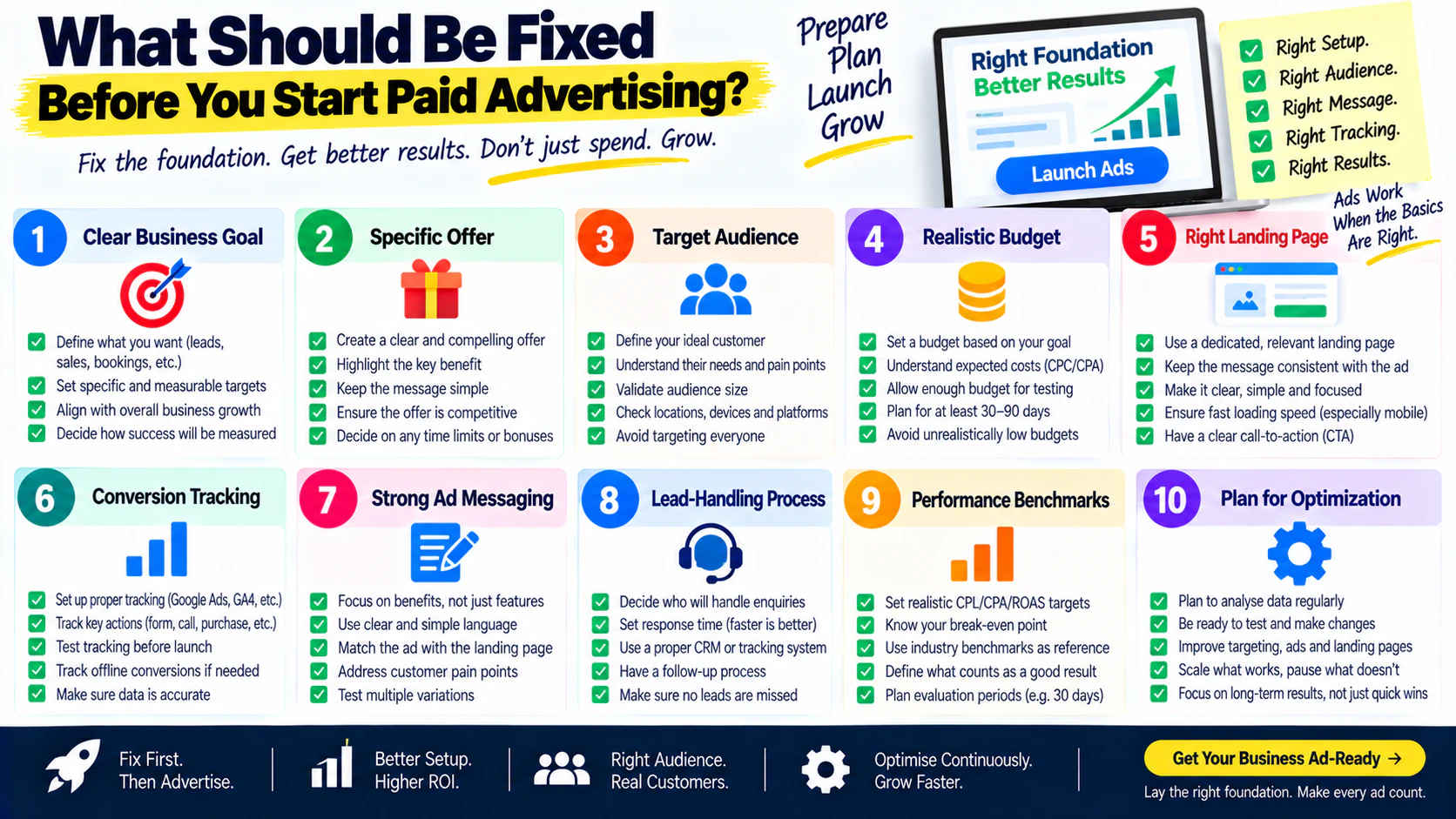
The Short Answer: Fix These 10 Things First
Before spending serious money on advertising, make sure you have:
- A clear business goal
- A specific offer
- A defined target audience
- A realistic budget
- The right landing page
- Proper conversion tracking
- Strong ad messaging
- A lead-handling process
- Clear performance benchmarks
- A plan for optimization
If several of these are missing, launching ads immediately is usually premature.
Let's break them down.
Fix the Business Goal Before the Campaign
"Get more customers" is a business goal.
It is not yet a campaign objective.
You need to define exactly what you want the advertising to generate.
For example:
- 50 qualified leads
- 20 product purchases
- 100 demo requests
- 30 consultation bookings
- 500 online orders
- ₹5 lakh in attributed revenue
The objective changes how the campaign should be designed.
Example
A real estate company may want:
An ecommerce company may want:
A B2B software company may want:
A local service business may want:
These are different conversion events.
If the goal isn't clear, campaign optimization becomes difficult because there is no clear definition of success.
Fix the Offer
This is one of the most overlooked parts of paid advertising.
Businesses often spend hours discussing:
- Keywords
- Audiences
- Campaign names
- Ad formats
- Headlines
But spend very little time asking:
Why should someone choose this offer?
Your advertisement needs something worth responding to.
That could be:
- A free consultation
- A product discount
- A limited-time package
- A demo
- A free audit
- A trial
- A bundled service
- A strong guarantee
- A specific business outcome
But the offer must make sense for your audience and business model.
Weak offer
"We provide digital marketing services."
Stronger offer
"Get a 30-minute performance marketing audit to identify where your paid campaigns are wasting budget."
The second gives the visitor a reason to take action.
Fix Your Target Audience
"Everyone who needs our service" is not an audience.
Before launching, define:
Who?
- Industry
- Company size
- Job role
- Demographics
- Location
- Customer type
What problem?
- What are they struggling with?
- What are they trying to achieve?
- What triggers them to look for a solution?
When?
- Are they actively searching?
- Are they researching?
- Are they comparing providers?
- Are they ready to buy?
Why you?
- What makes your solution different?
- Why should they trust you?
- Why should they choose you instead of another option?
The more clearly you understand the customer, the easier it becomes to write relevant ads and build relevant landing pages.
Fix Your Budget Before You Launch
Don't decide the daily budget by simply asking:
"How much can we spend?"
Instead ask:
"What economics need to work for this campaign to be profitable?"
Start with:
For example:
Suppose:
- Average customer value \= ₹30,000
- Acceptable customer acquisition cost \= ₹6,000
- Lead-to-customer rate \= 20%
Then your approximate target CPL is:
Now you have a benchmark.
You can compare actual performance against a business-based target instead of deciding whether a ₹500 or ₹1,500 lead is "good" based on instinct.
If you are working with a fixed advertising budget, plan it before launch rather than deciding where to spend after the campaigns are live.
Fix the Landing Page
This is where many advertising campaigns quietly fail.
The ad gets the click.
The landing page loses the customer.
Imagine an ad says:
"Get a Free SEO Audit"
The user clicks.
But the page says:
"Welcome to XYZ Digital Solutions."
There is no mention of the audit.
The visitor now has to figure out:
- What is being offered?
- Where do I get it?
- Why should I trust this company?
- What should I do next?
You have created unnecessary friction.
Your Landing Page Should Answer 5 Questions Quickly
What is this?
The visitor should understand the offer immediately.
Is it relevant to me?
The messaging should match the audience and problem.
Why should I trust you?
Use:
- Reviews
- Case studies
- Client logos
- Results
- Certifications
- Testimonials
- Experience
What do I need to do?
Give the visitor one obvious next step.
What happens after I submit?
Explain what happens next.
For example:
"Submit the form and our consultant will contact you within one business day."
That reduces uncertainty.
Fix the Message Match Between Ad and Landing Page
Your ad and landing page should feel like parts of the same conversation.
Suppose your ad says:
Google Ads Audit for B2B Companies
Your landing page should immediately reinforce:
Find out where your B2B Google Ads budget is being wasted.
Not:
"Welcome to our full-service digital marketing agency."
The second message forces the visitor to restart the decision-making process.
Good message flow
Each step should logically lead to the next.
Fix Conversion Tracking Before Spending Money
Never launch a campaign first and think about tracking later.
Before spending, know exactly what counts as a conversion.
Depending on the business, that might include:
- Form submission
- Phone call
- WhatsApp enquiry
- Demo booking
- Purchase
- Add to cart
- Lead form
- Quote request
- Appointment
But there is another important question:
Are you tracking the conversion that actually matters?
For example, 100 form submissions sound good.
But what if only 5 are qualified?
Your real performance isn't:
It may be closer to:
That is why conversion tracking should eventually connect advertising with actual business outcomes.
Fix Your Lead Qualification Process
Getting leads is not the finish line.
For many businesses, it is the beginning of the sales process.
Before launching paid advertising, decide:
- Who receives the lead?
- How quickly will they respond?
- How will leads be qualified?
- Where will leads be recorded?
- How many follow-ups will happen?
- When is a lead considered lost?
- How will sales outcomes be reported back?
Example
Imagine your campaign generates 30 leads.
If your sales team responds to 25 of them within an hour, you have one situation.
If the team contacts them after two days, you have another.
The advertising platform cannot fix slow sales follow-up.
Your acquisition system needs both:
Fix Your Website Experience
Before sending paid traffic to your website, check the basics.
Technical
- Does the website load correctly?
- Does it work on mobile?
- Are important pages accessible?
- Are forms working?
- Are buttons clickable?
- Are there broken links?
- Does the checkout work?
Conversion
- Is the value proposition clear?
- Is the CTA visible?
- Is there enough trust?
- Is the navigation distracting?
- Are important answers easy to find?
User experience
- Is the page easy to scan?
- Does the visitor understand what to do?
- Are there unnecessary steps?
- Is the content relevant to the ad?
You don't necessarily need to redesign the entire website before advertising.
But you do need to make sure the pages receiving paid traffic aren't creating avoidable conversion problems.
Fix Your Mobile Experience
This deserves its own check.
A large percentage of advertising traffic may come from mobile users, depending on your audience and platform.
Open your landing page on an actual phone.
Don't just check it on desktop.
Look at:
- Headline size
- Page loading
- Button placement
- Form length
- Navigation
- Images
- Pop-ups
- Text readability
- WhatsApp/call buttons
- Checkout experience
Ask someone unfamiliar with the business to open the page and complete the intended action.
Watch where they hesitate.
That can reveal problems your team has become blind to.
Fix Your Ad Copy Before Launch
Your ads should not simply describe your company.
They should connect:
Weak
"We are a leading digital marketing agency offering SEO, social media, PPC and web development."
Better
"Google Ads generating clicks but not enough leads? Find the campaigns, keywords and landing-page issues wasting your budget."
The second is built around a problem the customer recognizes.
Fix Your Keyword Strategy for Search Ads
If you're launching Google Search Ads, don't start by adding every keyword related to your business.
Separate keywords based on intent.
For example:
High intent
- digital marketing agency
- hire SEO agency
- Google Ads agency
- PPC agency for ecommerce
Research intent
- how does Google Ads work
- PPC strategy
- SEO vs Google Ads
Low commercial relevance
- digital marketing jobs
- free marketing course
- digital marketing salary
The last group may generate traffic but not necessarily customers.
Your keyword strategy should reflect the business outcome you want.
Fix Your Negative Keyword Strategy
Search advertising can waste budget when ads appear for searches you don't actually want.
Before launch, think about irrelevant themes such as:
- Jobs
- Careers
- Courses
- Free resources
- DIY searches
- Definitions
- Unrelated industries
- Low-value products
Negative keyword planning isn't a one-time task.
You should continue reviewing actual search terms after launch.
But establishing an initial negative keyword list can prevent obvious waste.
Fix Your Audience Strategy for Social Ads
Meta and other social platforms work differently from search.
The user may not be actively looking for your service.
So you need to think more carefully about:
- Audience
- Creative
- Hook
- Problem
- Offer
- Stage of awareness
Instead of targeting everyone interested in "business," for example, build a hypothesis around the actual customer.
Ask:
What does this person care about?
What problem are they experiencing?
What content would make them stop scrolling?
What would make them take the next step?
Fix Your Creative Before Launch
One creative is rarely enough to learn what works.
Prepare multiple variations.
Test differences in:
- Hook
- Headline
- Visual
- Offer
- CTA
- Proof
- Problem statement
- Format
For example:
Creative A
Focus on the problem:
"Your Google Ads are getting clicks. But where are the customers?"
Creative B
Focus on the outcome:
"Turn high-intent searches into qualified enquiries."
Creative C
Focus on proof:
"See how we identify wasted paid search spend."
The goal isn't to create random variations.
Each variation should test a specific hypothesis.
Fix Your Proof
People are cautious when clicking an advertisement.
Especially when the product or service is expensive.
Before launch, collect the proof that supports your claim.
Useful proof can include:
- Case studies
- Customer reviews
- Testimonials
- Before/after results
- Screenshots
- Client logos
- Certifications
- Industry experience
- Specific numbers where they can be substantiated
Don't simply say:
"We deliver exceptional results."
Show evidence that helps the visitor believe it.
Fix Your CTA
Your CTA should tell people exactly what happens next.
Weak:
Learn More
Stronger:
Get Your Free Audit
Book a Strategy Call
Request a Quote
The right CTA depends on the buying stage.
Someone discovering your brand may not be ready to "Buy Now."
Someone searching for a specific product may be.
Match the CTA to intent.
Fix the Form
A form can destroy an otherwise good campaign.
If you only need:
- Name
- Phone
don't ask for 15 fields without a strong reason.
Every additional field creates friction.
But don't make the form so short that your sales team receives unusable leads.
The right question is:
What information do we actually need to qualify or follow up with this person?
Ask only for what has a business purpose.
Fix Your Follow-Up Process
Before launching ads, test the entire journey yourself.
Submit the form.
Then ask:
- Did the submission work?
- Did the confirmation appear?
- Did the notification reach the team?
- Did the lead enter the CRM?
- Did someone receive the lead?
- How quickly did they respond?
- Was the lead assigned correctly?
This simple test can uncover expensive problems before your campaign starts.
Fix Your Measurement Dashboard
Don't wait until the end of the month to figure out whether your campaign worked.
Create a basic dashboard before launch.
At minimum, monitor:
| Metric | Why It Matters |
|---|---|
| Spend | How much budget is being used |
| Impressions | How much exposure you're getting |
| Clicks | Traffic generated |
| CTR | Ad relevance/engagement |
| CPC | Traffic cost |
| Conversions | Desired actions |
| CPL | Lead acquisition efficiency |
| Qualified leads | Lead quality |
| Customers | Actual business outcome |
| CAC | Customer acquisition cost |
| Revenue | Commercial impact |
The exact metrics will depend on your campaign.
But the principle is simple:
Fix Your Benchmarks
You need a definition of:
- Good
- Acceptable
- Poor
before the campaign starts.
For example:
| Metric | Target | Warning |
|---|---|---|
| CTR | 4%+ | \<2% |
| Landing-page CVR | 5%+ | \<2% |
| CPL | ₹1,000 | ₹1,500+ |
| Qualified lead rate | 50%+ | \<30% |
| Lead-to-customer | 20%+ | \<10% |
These numbers are illustrative, not universal industry benchmarks.
Your actual targets should come from your historical performance and business economics.
Having benchmarks simply gives you a framework for making decisions.
Fix Your Testing Plan
Don't launch with the mindset:
"Let's see what happens."
Launch with questions you want the campaign to answer.
For example:
Hypothesis 1
High-intent keywords will generate better-quality leads than broad keywords.
Hypothesis 2
A problem-focused landing page will convert better than a generic service page.
Hypothesis 3
Case-study creative will generate more qualified enquiries than promotional creative.
Now your campaign becomes an experiment.
You aren't just spending money.
You're learning which combination of:
produces the best business outcome.
Fix Your Optimization Rules
Before launching, decide what you will do when performance changes.
For example:
If clicks are low
Review:
- Targeting
- Keywords
- Creative
- Ad copy
If clicks are high but conversions are low
Review:
- Landing page
- Offer
- Message match
- CTA
- Traffic quality
If conversions are high but leads are poor
Review:
- Targeting
- Search terms
- Qualification
- Offer
- Audience
If leads are good but customers are low
Review:
- Sales follow-up
- Pricing
- Sales process
- Lead qualification
- Offer
This prevents you from making random campaign changes.
Fix Your Expectations
Paid advertising is not a magic switch.
You shouldn't expect:
Launch today → profitable tomorrow.
Some campaigns need testing before you understand:
- Which audience works
- Which keywords work
- Which creative works
- Which offer works
- Which landing page works
The goal of early campaigns should be to establish a reliable acquisition model.
Once you know what works, you can increase investment with more confidence.
The Complete Paid Advertising Pre-Launch Checklist
Before pressing Launch, run through this list.
Strategy
- Business goal is clearly defined
- Target customer is defined
- Offer is clear
- Customer problem is understood
- Competitive positioning is understood
Budget
- Total budget is approved
- Daily/weekly spending limit is defined
- Target CPL is calculated
- Target CAC is calculated
- Testing budget is planned
Website
- Landing page is relevant
- Ad-to-page message matches
- CTA is clear
- Forms work
- Mobile experience works
- Page loads properly
- Trust signals are visible
Tracking
- Conversion tracking is installed
- Important conversion events are defined
- Forms are tracked
- Calls are tracked where relevant
- Analytics is connected
- Lead source can be identified
Search campaigns
- Keyword strategy is ready
- Search intent is reviewed
- Negative keywords are prepared
- Ad groups/campaign structure make sense
- Ad copy matches keywords and landing pages
Social campaigns
- Audience strategy is defined
- Multiple creative concepts are ready
- Hooks are tested
- Offer is clear
- Retargeting audiences are considered
Sales
- Leads have an owner
- Follow-up process exists
- CRM/lead management works
- Response time is defined
- Lead qualification process exists
Reporting
- Dashboard is ready
- KPIs are defined
- Benchmarks are defined
- Optimization rules are agreed
- Reporting frequency is established
A Simple "Should We Launch?" Test
Ask these five questions:
Do we know who we're targeting?
If not, stop.
Do we have a compelling reason for them to respond?
If not, fix the offer.
Does the landing page support the promise made in the ad?
If not, fix the page.
Can we accurately measure the desired conversion?
If not, fix tracking.
Do we know what happens after someone becomes a lead?
If not, fix the sales process.
If you can't answer these five questions confidently, you're probably not ready to scale paid traffic.
The Biggest Mistake: Trying to Fix Everything After Launch
Businesses often think:
"Let's launch first and optimize later."
Some optimization will always happen after launch.
That's normal.
But there is a difference between optimizing a working system and using paid traffic to discover that the system doesn't work.
You should test campaigns after launch.
You should improve ads.
You should refine targeting.
You should optimize landing pages.
But fundamental problems—unclear offers, broken forms, missing tracking, poor sales follow-up—should be fixed before you start spending seriously.
