
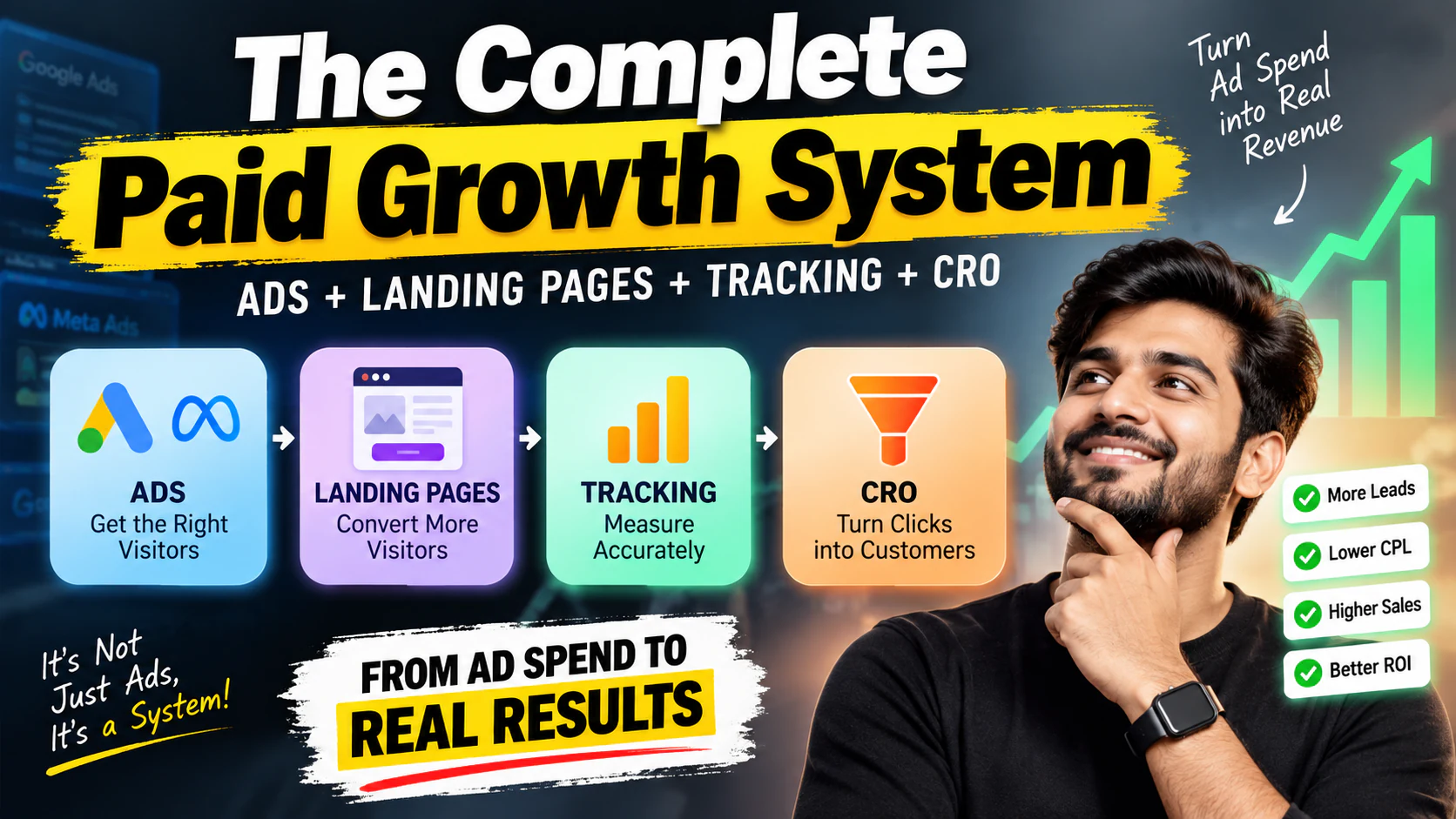
Running Google Ads or Meta Ads is not the same thing as having a paid growth system.
A business can spend ₹1 lakh a month on advertising and still have no idea:
- Which campaigns are actually profitable
- Which landing pages are losing potential customers
- Whether conversion tracking is accurate
- Why leads are becoming more expensive
- Which ad creatives deserve more budget
- Whether the problem is traffic, website, offer, or sales follow-up
That is why simply “optimizing the ads” often stops producing meaningful improvements.
A strong paid acquisition system connects four major components:
Ads → Landing Pages → Tracking → CRO
And those four components need to work together.
If your ads generate 1,000 visitors but the landing page converts only 1%, you have an acquisition problem.
If the landing page converts at 8% but tracking records only half the conversions, you have a measurement problem.
If tracking is accurate and leads are coming in, but sales teams close very few of them, you may have a lead-quality or sales-process problem.
Paid growth works when the entire system improves—not just the advertising platform.
What Is a Paid Growth System?
A paid growth system is the complete process used to turn advertising budget into measurable business outcomes.
It includes:
- Demand generation and capture
- Campaign and audience strategy
- Ad creative and messaging
- Landing-page experience
- Conversion tracking
- Conversion-rate optimization
- Lead or purchase quality
- Revenue measurement
- Continuous testing
- Budget allocation and scaling
Think of it as a chain.
Every step affects the next.
For example:
Suppose a company spends ₹1,00,000 on Google Ads.
It generates:
- 5,000 clicks
- ₹20 average CPC
- 250 leads
- ₹400 CPL
- 40 qualified leads
- 10 customers
- ₹4,000 customer acquisition cost
Now imagine the company increases the conversion rate from 5% to 7%.
Without increasing ad spend, the same traffic can generate substantially more leads.
That is the power of treating paid marketing as a system.
The Paid Growth Equation
A useful way to understand paid growth is:
For e-commerce:
For lead generation:
This matters because an advertising platform only controls part of this equation.
You may improve CPC by 10%, but if your landing-page conversion rate falls by 30%, overall acquisition can become worse.
The 4-Layer Paid Growth System
A practical paid growth system can be divided into four layers.
| Layer | Primary Question |
|---|---|
| Ads | Are we attracting the right people? |
| Landing Page | Are we convincing them to act? |
| Tracking | Can we measure what actually happened? |
| CRO | Can we systematically improve the conversion rate? |
Let's examine each one.
Ads: Bring the Right Traffic
The first job of advertising is not simply generating clicks.
It is generating relevant traffic.
A campaign can have:
- High CTR
- Low CPC
- Large traffic volume
…and still perform badly.
Why?
Because inexpensive traffic is not necessarily valuable traffic.
Example
Imagine two campaigns.
Campaign A
- Spend: ₹25,000
- Clicks: 2,000
- CPC: ₹12.50
- Leads: 20
- CPL: ₹1,250
Campaign B
- Spend: ₹25,000
- Clicks: 1,000
- CPC: ₹25
- Leads: 100
- CPL: ₹250
Campaign A looks better if you only evaluate CPC.
Campaign B is clearly stronger from a lead-generation perspective.
This is why paid growth should move beyond vanity metrics.
What Should You Measure at the Ad Level?
Track at least:
- Impressions
- Reach
- Clicks
- CTR
- CPC
- Spend
- Conversions
- Conversion rate
- CPA/CPL
- Qualified leads
- Revenue
- ROAS
- Customer acquisition cost
But don't stop there.
For lead-generation businesses, add:
- Lead-to-qualified rate
- Qualified-to-opportunity rate
- Opportunity-to-sale rate
- Revenue per lead
- Revenue per qualified lead
- Customer acquisition cost
The platform's “conversion” is not automatically your business's success.
Landing Pages: Convert the Traffic
Once the right visitor clicks your advertisement, the landing page takes over.
This is where many paid campaigns break.
The ad promises one thing.
The landing page communicates something else.
The visitor becomes confused and leaves.
Example
Ad:
“Get a Free Website Performance Audit”
Landing page:
“Welcome to Sampurn Digital — Full-Service Digital Marketing Agency”
Then the visitor has to search for:
- What is the offer?
- What do I get?
- Who is this for?
- Why should I trust you?
- What happens after I submit?
- How long does it take?
That creates friction.
A paid landing page should continue the conversation started by the advertisement.
The Message-Match Rule
A simple rule:
The closer the landing page matches the ad's promise, the easier it is for the visitor to understand what to do next.
If your ad says:
“Google Ads Audit for E-commerce Businesses”
Your landing page should immediately reinforce:
“Google Ads Audit for E-commerce Businesses”
Not:
“Our Digital Marketing Services”
The visitor should not have to reconstruct the offer.
A High-Conversion Landing Page Structure
A practical structure is:
Clear headline
Tell the visitor what they can achieve.
Supporting statement
Explain how you help.
Primary CTA
Give them one obvious next action.
Relevant proof
Use:
- Results
- Case studies
- Client logos
- Testimonials
- Reviews
- Certifications
- Industry experience
Problem explanation
Show that you understand their situation.
Solution
Explain what your service actually does.
Process
Remove uncertainty by showing what happens next.
Objection handling
Answer questions about:
- Pricing
- Time
- Risk
- Commitment
- Results
- Implementation
Final CTA
Make the next step obvious again.
Tracking: Know What Actually Happened
You cannot optimize what you cannot measure.
And poor tracking can make a good campaign look bad—or a bad campaign look good.
Suppose Google Ads reports:
But your CRM contains:
Which number should you trust?
You need to investigate.
Possible causes include:
- Duplicate conversion events
- Form submission firing incorrectly
- Page-load conversions
- Phone-click tracking
- Imported offline conversions
- Multiple tags
- Incorrect event configuration
- Cross-domain tracking problems
- Consent-related measurement gaps
This is why conversion tracking should be treated as infrastructure, not an afterthought.
What Should Your Tracking System Capture?
At minimum, capture:
Traffic
- Source
- Medium
- Campaign
- Ad group
- Keyword/search term where applicable
- Landing page
Conversion
- Form submission
- Phone call
- WhatsApp click
- Demo request
- Purchase
- Booking
- Lead magnet download
Business outcome
- Qualified lead
- Sales opportunity
- Closed customer
- Revenue
The goal is to connect:
Not simply:
GA4 + GTM: The Measurement Layer
For many websites, Google Analytics 4 and Google Tag Manager can form an important part of the tracking infrastructure.
Your tracking setup should answer questions such as:
- Where did the visitor come from?
- Which campaign generated the session?
- Which page did they land on?
- What action did they take?
- Did the form actually submit?
- Did the visitor become a qualified lead?
- Did the lead become revenue?
A technically correct tracking setup makes later optimization dramatically easier.
CRO: Turn More Traffic Into Results
CRO—Conversion Rate Optimization—is the process of systematically improving the percentage of visitors who take a desired action.
The basic formula is:
Suppose:
- 2,000 visitors
- 60 leads
Conversion rate:
If you improve the page to 4.5%:
You generated 30 additional leads without buying additional traffic.
That is why CRO can be one of the highest-leverage components of paid growth.
Don't Guess What to Optimize
A common CRO mistake is changing random elements:
- Button color
- Font size
- Image
- Headline
- Form position
…without understanding why users are not converting.
Instead, start with evidence.
Look at:
- Conversion data
- Device performance
- Landing-page behavior
- Form abandonment
- Scroll depth
- Traffic sources
- Heatmaps/session recordings where appropriate
- User feedback
- Sales-team feedback
Then form a hypothesis.
The CRO Hypothesis Framework
Use:
Because [evidence], we believe [problem] is reducing [metric]. If we change [element], then [expected outcome] should improve.
Example:
Because mobile users convert at 1.2% compared with 4.1% on desktop, we believe the mobile form is creating excessive friction. Reducing the form from 8 fields to 4 fields should increase mobile lead conversion.
Now you have something measurable.
The Complete Funnel
A paid growth system should be viewed as a funnel.
Every stage creates a different diagnostic question.
| Problem | Possible Cause |
|---|---|
| Low CTR | Creative, offer, targeting, message |
| High CPC | Competition, relevance, bidding |
| High clicks but few conversions | Landing page, offer, mismatch |
| Many leads but few qualified leads | Targeting or messaging |
| Many qualified leads but few sales | Sales process, pricing, offer |
| Good sales but poor profit | CAC, margins, AOV, retention |
This prevents the classic mistake of blaming the advertising platform for every problem.
Example: Where Is the Real Problem?
Imagine this funnel:
- 100,000 impressions
- 2,000 clicks
- 2% CTR
- ₹50 CPC
- ₹1,00,000 spend
- 100 leads
- 20 qualified leads
- 5 customers
- ₹20,000 average gross profit per customer
Your advertising generated revenue-producing customers.
But where could the system improve?
Scenario A: Increase CTR
More qualified clicks at the same spend could increase traffic.
Scenario B: Improve landing-page CVR
100 leads could become 140 leads.
Scenario C: Improve lead quality
20 qualified leads could become 30.
Scenario D: Improve sales close rate
5 customers could become 8.
Scenario E: Improve customer value
A ₹20,000 customer could become worth ₹30,000 through better pricing, upsells, or retention.
The best growth opportunity may not be inside Google Ads or Meta Ads at all.
Why Ads + Landing Pages Must Be Managed Together
Consider two businesses.
Business A
- Great ads
- Poor landing page
- Weak offer
- No trust signals
Business B
- Good ads
- Strong landing page
- Clear offer
- Strong proof
- Simple CTA
Even if both businesses generate identical traffic, Business B can produce significantly better economics.
That's why an ad campaign should never be judged completely independently from the destination experience.
Build One Conversion Path Per Intent
Different audiences may need different landing experiences.
For example:
Searcher: “Google Ads agency”
Landing page:
Searcher: “Google Ads audit”
Landing page:
Searcher: “reduce Google Ads CPL”
Landing page:
Sending all three audiences to the same generic services page creates unnecessary friction.
Intent-specific journeys make measurement and optimization easier.
Your Offer Is Part of the Growth System
CRO cannot fix a weak offer indefinitely.
Imagine two offers.
Offer A
“Contact us for digital marketing services.”
Offer B
“Get a 30-point paid advertising audit identifying wasted spend, tracking gaps and the three highest-priority optimization opportunities.”
Offer B gives the visitor a much clearer reason to act.
The landing page, ad, and CTA should all reinforce the same value proposition.
Don't Optimize Only for Cheap Leads
One of the most dangerous paid-growth traps is celebrating a falling CPL.
Suppose:
Month 1
- Spend: ₹1,00,000
- Leads: 200
- CPL: ₹500
- Qualified leads: 50
- Customers: 10
Month 2
- Spend: ₹1,00,000
- Leads: 400
- CPL: ₹250
- Qualified leads: 30
- Customers: 5
CPL improved by 50%.
Business performance got worse.
This is why the real optimization target should often be closer to:
or
or ultimately:
A Better Paid Growth Scorecard
Instead of reporting only:
Spend: ₹1,00,000 Leads: 200 CPL: ₹500
Build a deeper scorecard.
| Metric | Result |
|---|---|
| Spend | ₹1,00,000 |
| Clicks | 2,000 |
| CPC | ₹50 |
| Landing Page CVR | 10% |
| Leads | 200 |
| CPL | ₹500 |
| Qualified Leads | 60 |
| Cost per Qualified Lead | ₹1,667 |
| Customers | 15 |
| CAC | ₹6,667 |
| Revenue | ₹6,00,000 |
| ROAS | 6× |
Now the marketing team and management team can see the complete picture.
The Weekly Paid Growth Review
A strong paid growth system should have a recurring review process.
Check tracking
Before making decisions, verify that the data is trustworthy.
Check business outcomes
Look at:
- Qualified leads
- Customers
- Revenue
- CAC
- ROAS
Find the largest bottleneck
Ask:
Where is the biggest percentage loss occurring?
Identify the cause
Is it:
- Traffic?
- Creative?
- Audience?
- Offer?
- Landing page?
- Tracking?
- Sales?
Choose one or two priorities
Don't create 25 simultaneous tests.
Implement
Make the smallest meaningful change.
Measure
Compare against a defined baseline.
Feed the learning back
The result should influence future ads, landing pages and offers.
The Paid Growth Feedback Loop
A mature system looks like this:
This is much more powerful than treating advertising as a monthly campaign launch.
How to Allocate Your Optimization Effort
A useful approach is to divide optimization into four buckets.
25% — Acquisition
Improve:
- Campaign structure
- Keywords
- Audiences
- Creative
- Placement
- Bidding
- Budget allocation
25% — Conversion
Improve:
- Landing pages
- Forms
- CTAs
- Offer
- Trust signals
- Messaging
25% — Measurement
Improve:
- Tracking
- Attribution
- CRM integration
- Conversion definitions
- Revenue reporting
25% — Experimentation
Test:
- New offers
- New creative
- New audiences
- New landing pages
- New funnel paths
The exact allocation will vary by business.
If tracking is broken, fixing measurement may deserve 80% of the immediate effort.
If traffic is excellent but conversion is poor, CRO becomes the priority.
When Should You Fix Ads vs Landing Pages?
Use this simple decision framework.
If CTR is low
Start with:
If CTR is strong but conversion is low
Investigate:
If conversions are high but lead quality is poor
Investigate:
If qualified leads are strong but sales are weak
Investigate:
If everything looks good but reporting is unreliable
Fix:
This framework prevents random optimization.
A Practical Paid Growth Audit
Before scaling a campaign, review these areas.
Ads
- Is targeting aligned with business intent?
- Are ads matched to the audience?
- Are weak creatives being removed?
- Are winning messages being expanded?
- Are search terms relevant?
Landing Pages
- Does the headline match the ad?
- Is the offer immediately clear?
- Is the CTA obvious?
- Is there enough proof?
- Is mobile UX strong?
- Is the form unnecessarily long?
Tracking
- Are conversions firing correctly?
- Are duplicate events excluded?
- Are important actions tracked?
- Are campaign parameters preserved?
- Can conversions be connected to revenue?
CRO
- What is the current conversion rate?
- What is the biggest bottleneck?
- What evidence supports the hypothesis?
- What should be tested first?
- What is the success metric?
Business Outcomes
- What percentage of leads are qualified?
- What percentage become customers?
- What is CAC?
- What is customer value?
- Is the campaign actually profitable?
The ₹1 Lakh Paid Growth Example
Suppose you have ₹1,00,000 available for paid acquisition.
Don't start with:
“How much should I spend on Google?”
Start with the economics.
Assume:
- Average gross profit per customer: ₹25,000
- Target CAC: ₹8,000
- Required customers: 12
Maximum acquisition spend:
Now work backwards.
If your sales team closes 20% of qualified opportunities:
If 30% of leads become qualified:
If your landing page converts at 5%:
Now you know the traffic requirement.
This is a much more intelligent way to plan paid growth than simply saying:
“Let's spend ₹1 lakh and see what happens.”
Why CRO Can Change Your Ad Economics
Suppose your campaign generates:
At a 5% conversion rate:
Now improve the landing page to 7%.
You get:
That's 80 additional leads from the same traffic.
If the average lead-to-customer rate stays constant, those additional leads can produce additional customers without increasing ad spend.
That effectively improves your acquisition economics.
This is why landing-page optimization should be considered part of paid media performance—not a separate website project.
Why Tracking Must Come Before Aggressive Optimization
Imagine your dashboard says:
You shift most of the budget toward Campaign A.
Later you discover that Campaign A was recording a conversion whenever users opened a form, while Campaign B recorded only successful submissions.
Your optimization decision was based on bad data.
The lesson:
Reliable measurement comes before aggressive optimization.
Build the System Around Business Goals
Different businesses should optimize different outcomes.
Lead Generation
Primary:
E-commerce
Primary:
SaaS
Primary:
Local Business
Primary:
The conversion event should reflect the actual business objective.
Common Paid Growth Mistakes
Mistake 1: Optimizing CTR as the final goal
High CTR does not guarantee revenue.
Mistake 2: Sending every campaign to the homepage
Different intent requires different landing experiences.
Mistake 3: Tracking only platform conversions
Platform data does not always tell you which leads became customers.
Mistake 4: Changing everything simultaneously
You won't know what actually caused the improvement.
Mistake 5: Scaling before fixing the funnel
More traffic can simply produce more wasted traffic.
Mistake 6: Celebrating low CPL
Cheap leads can be expensive customers.
Mistake 7: Ignoring sales feedback
Your sales team often knows exactly which campaigns generate poor-quality leads.
Mistake 8: Treating CRO as button-color testing
Real CRO is about reducing friction and improving the complete conversion experience.
The Paid Growth Operating Model
A strong organization can divide responsibilities like this:
| Area | Core Responsibility |
|---|---|
| Paid Media | Traffic and acquisition |
| Creative | Attention and messaging |
| Landing Page | Conversion experience |
| Analytics | Measurement |
| CRO | Conversion improvement |
| Sales | Lead qualification and revenue |
| Leadership | Economics and strategic allocation |
The most important part is not the organizational chart.
It is the feedback loop between these teams.
Sales feedback should influence advertising.
Advertising data should influence landing pages.
Landing-page behaviour should influence CRO.
CRO results should influence campaign economics.
Revenue data should influence budget allocation.
The 30-Day Paid Growth Improvement Plan
If your paid campaigns are underperforming, don't try to rebuild everything overnight.
Week 1 — Diagnose
Audit:
- Campaigns
- Tracking
- Search terms/audiences
- Landing pages
- Conversion data
- Lead quality
Identify the biggest bottleneck.
Week 2 — Fix
Address the highest-impact technical or structural issues.
Examples:
- Remove wasted traffic
- Fix tracking
- Improve message match
- Simplify forms
- Improve CTA clarity
Week 3 — Test
Run controlled experiments.
Test:
- New messaging
- New creative
- New offer
- Landing-page variations
Week 4 — Scale What Works
Shift budget toward proven winners.
Document:
- What worked
- What failed
- Why
- What should be tested next
This creates an actual optimization system instead of another campaign reset.
The Paid Growth Maturity Model
You can think of businesses as moving through five levels.
Level 1 — Running Ads
“We are advertising.”
Level 2 — Measuring Ads
“We know clicks, conversions and CPA.”
Level 3 — Optimizing the Funnel
“We improve ads and landing pages together.”
Level 4 — Connecting Revenue
“We know which campaigns generate qualified customers and revenue.”
Level 5 — Building a Growth System
“We continuously use advertising, tracking, CRO, sales data and customer economics to decide where the next rupee should go.”
The goal is Level 5.
Your Paid Growth System Checklist
Before calling your paid marketing system mature, ask:
Acquisition
- Are campaigns aligned with business intent?
- Are audiences/keywords relevant?
- Are ads communicating a compelling offer?
- Are wasted placements or search terms controlled?
Landing Pages
- Does the page match the ad?
- Is the value proposition immediately clear?
- Is there one primary CTA?
- Is there sufficient proof?
- Is mobile conversion experience strong?
Tracking
- Are conversion events correctly configured?
- Are duplicate conversions prevented?
- Are important lead actions tracked?
- Can marketing data connect to CRM outcomes?
- Can revenue be traced back to acquisition sources?
CRO
- Do you know your baseline conversion rate?
- Do you know your biggest funnel bottleneck?
- Are tests based on evidence?
- Is there a defined success metric?
- Are learnings documented?
Business
- Do you know qualified-lead cost?
- Do you know CAC?
- Do you know customer value?
- Are you optimizing for profit, not vanity metrics?
- Do sales and marketing share feedback?
If several answers are “no,” increasing ad spend is probably not your first priority.
SEO Publishing Information
Blog ID: PM-25 Category: Performance Marketing Stage: Scale Content Role: Advanced strategy + commercial bridge Publishing Sprint: Sprint 3
Primary Keyword: paid growth system for business
Supporting Keywords: paid acquisition system; ads landing pages tracking CRO; performance marketing framework
Search Intent: Commercial Investigation
Funnel Stage: Solution Aware
Pillar Page: Performance Marketing Services
Suggested URL: `/blog/performance-marketing/the-complete-paid-growth-system-ads-landing-pages-tracking-cro`
Meta Title: The Complete Paid Growth System: Ads + Landing Pages + Tracking + CRO
Meta Description: Learn how to build a complete paid growth system connecting ads, landing pages, tracking and CRO to improve conversions, lead quality, CAC and revenue.
H1: The Complete Paid Growth System: Ads + Landing Pages + Tracking + CRO
Primary CTA: Request a performance marketing audit / Explore Performance Marketing
