
You can have the right keywords in your Google Ads account and still waste a significant part of your budget.
Why?
Because the keywords you add are not always the exact searches people make.
You may target a keyword such as:
but your ads could appear for searches that are only loosely related to what you actually sell.
Some searches can bring customers.
Some can bring curious visitors.
Some can bring students, job seekers, people looking for free information, or users searching for something completely different.
And you pay for the click either way.
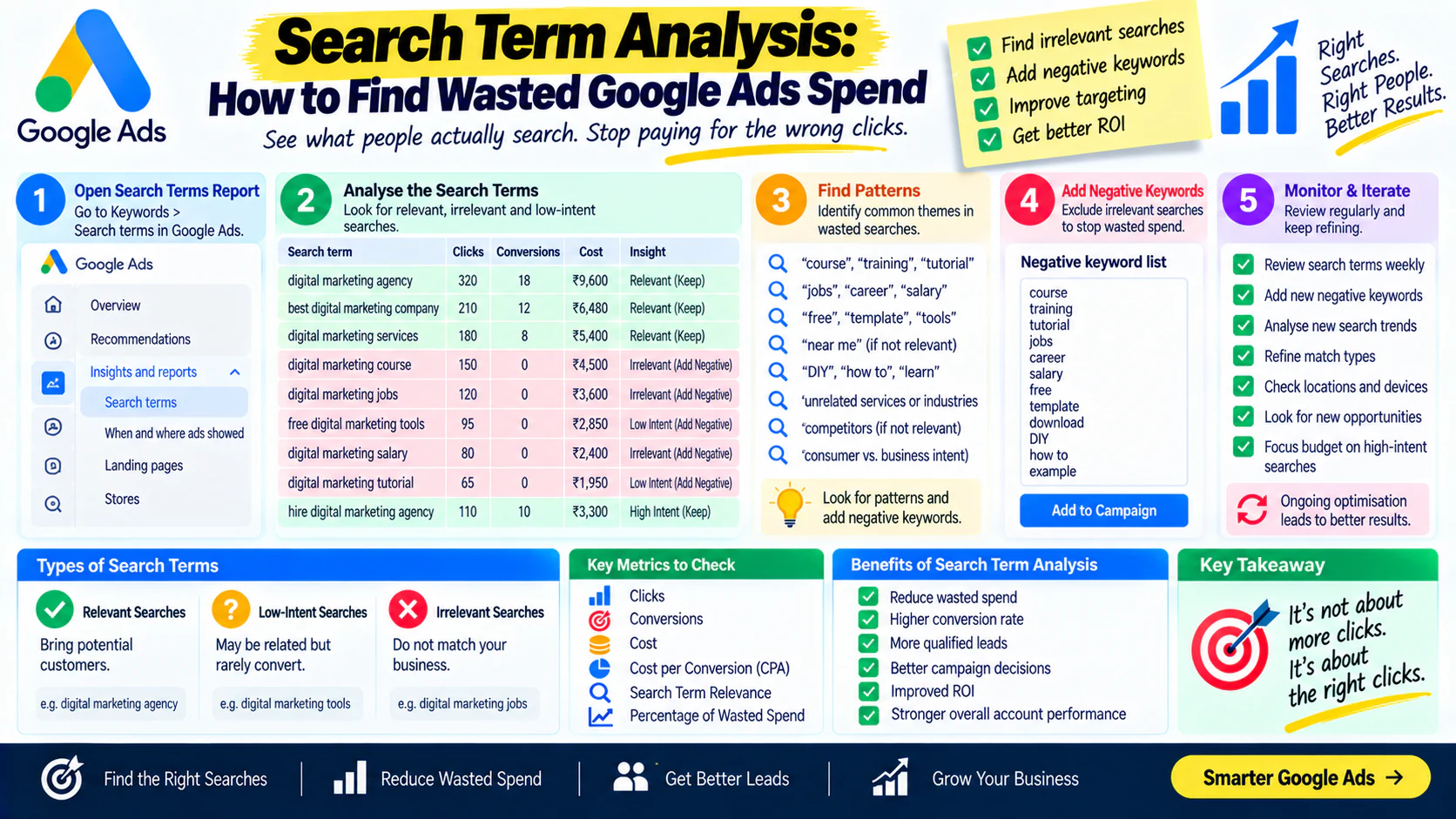
That is why search term analysis is one of the most practical ways to find wasted Google Ads spend.
Instead of guessing which traffic is wasting your budget, you look at what people actually searched before clicking your ad.
This guide explains how to analyse those searches, what patterns to look for, which searches should become negative keywords, and how to turn search-term data into better campaign decisions.
What Is Search Term Analysis in Google Ads?
Search term analysis means reviewing the actual search queries that triggered your ads and evaluating whether those searches are valuable to your business.
There is an important difference between:
and
A keyword is what you use to tell Google what type of searches you want to target.
A search term is what the user actually typed into Google.
For example:
Keyword: office furniture
- office furniture manufacturer
- office furniture near me
- used office furniture
- office furniture jobs
- office furniture ideas
- office furniture wholesale
These searches are not equally valuable.
If you sell premium office furniture to businesses, some could be strong opportunities.
Others may waste your budget.
Search-term analysis helps you separate them.
Why Search Terms Matter More Than Your Keyword List
Your keyword list represents your intention.
Your search-term report represents real user behaviour.
That makes search-term data extremely valuable.
Suppose you add:
You expect searches such as:
- Google Ads agency
- Google Ads management agency
- PPC agency
- Google Ads management services
But you may also receive searches related to:
- Google Ads jobs
- Google Ads course
- Google Ads certification
- Google Ads tutorial
- Google Ads free
- Google Ads login
The keyword itself may look perfectly relevant.
The actual search traffic tells a different story.
This is why an account can appear well structured while still leaking money.
The 5 Types of Search Terms You Should Identify
When reviewing your search terms, classify them into five broad groups.
High-Intent Searches
These are searches that strongly indicate a potential buyer.
Examples:
- PPC agency for ecommerce
- Google Ads management company
- digital marketing agency for real estate
- website development company
- hire SEO agency
These deserve attention.
Depending on performance, you may want to:
- keep them active
- add them as keywords
- create dedicated ad groups
- build dedicated landing pages
Relevant but Research-Oriented Searches
These searches may be related to your service but may not indicate immediate buying intent.
For example:
- how does Google Ads work
- digital marketing strategy
- SEO agency pricing
- how much does website development cost
These aren't automatically bad.
Their value depends on your business model and campaign objective.
But if your campaign is designed specifically to generate high-intent leads, you should monitor them carefully.
Irrelevant Searches
These are the easiest waste signals to identify.
For example, a company selling:
might receive:
- digital marketing jobs
- digital marketing internship
- digital marketing course
- digital marketing salary
Those searches don't represent the intended customer.
They are strong candidates for negative keywords.
Low-Value Searches
Some searches are relevant but economically unattractive.
Examples:
- cheap website design
- free SEO tools
- free Google Ads consultation
- lowest price digital marketing agency
Whether these should be excluded depends on your offer and positioning.
Don't automatically block every price-related search.
First understand whether those users can realistically become profitable customers.
Unexpected Opportunities
Search-term analysis isn't only about finding waste.
It can also uncover valuable searches you weren't intentionally targeting.
For example, you may discover:
is generating strong leads.
That could become:
- a dedicated keyword
- a dedicated ad group
- a dedicated landing page
- eventually, a dedicated campaign
The search-term report can therefore become a keyword discovery tool, not just a waste-control tool.
How to Find Wasted Google Ads Spend Step by Step
Export or Review Your Search Terms
Start with enough data to identify patterns.
Don't judge the account from one or two days unless there is an obvious problem such as completely irrelevant traffic.
Look at:
- search term
- campaign
- ad group
- impressions
- clicks
- cost
- conversions
- conversion value where relevant
The goal is to connect:
Sort by Cost
One of the fastest ways to find waste is to sort search terms by cost.
Look at the searches that have consumed meaningful budget without producing the desired outcome.
For example:
| Search Term | Clicks | Cost | Conversions |
|---|---|---|---|
| digital marketing agency | 18 | ₹4,500 | 3 |
| digital marketing course | 15 | ₹3,200 | 0 |
| digital marketing jobs | 10 | ₹2,100 | 0 |
| digital marketing company | 8 | ₹1,900 | 2 |
| digital marketing salary | 7 | ₹1,400 | 0 |
The second, third and fifth searches deserve immediate investigation.
They may be consuming budget without contributing to the campaign objective.
Look for Repeated Irrelevant Patterns
Don't only add individual negative keywords.
Look for patterns.
Suppose you find:
- SEO jobs
- SEO internship
- SEO career
- SEO salary
- SEO vacancy
The pattern is obvious:
Instead of manually dealing with every search individually, evaluate whether terms such as:
should be excluded from relevant campaigns.
This makes optimisation more scalable.
Identify Educational Intent
Educational searches can consume a lot of paid-search budget.
Examples:
- what is PPC
- what is SEO
- how Google Ads works
- how to run Google Ads
- Google Ads tutorial
- PPC guide
- SEO meaning
If your objective is lead generation, these searches may be poor traffic.
But don't assume every informational search is worthless.
For some businesses, education is part of the customer journey.
The correct question is:
Find “Free” and “Cheap” Intent
Review searches containing terms such as:
- free
- cheap
- cheapest
- discount
- free trial
- free tool
- free download
These can indicate a different expectation from your commercial offer.
For example:
is very different from:
But context matters.
If your business intentionally uses a free consultation as the offer, don't blindly exclude “free.”
Negative keyword decisions should be based on business intent, not isolated words.
Check Job-Seeking Searches
Job searches are a common source of wasted PPC spend for service businesses.
Look for:
- jobs
- careers
- vacancy
- hiring
- salary
- internship
- recruitment
For example:
has almost nothing to do with someone looking to hire a Google Ads agency.
If these searches appear repeatedly, they are strong negative-keyword candidates.
Check “How To” Searches
Searches beginning with:
- how to
- tutorial
- guide
- learn
- training
- course
- certification
may indicate users trying to learn rather than buy.
Again, this is not an automatic exclusion.
A training company should probably want these searches.
An agency trying to generate immediate service enquiries may not.
Check Competitor and Brand Searches
Competitor searches require careful handling.
You may see searches such as:
- competitor name
- competitor + pricing
- competitor + alternatives
- competitor + reviews
These can sometimes produce valuable opportunities.
But competitor campaigns can also have:
- lower conversion rates
- higher CPCs
- weaker relevance
- legal/trademark considerations
- lower lead quality
Don't automatically classify them as wasted spend.
Separate them and evaluate their economics.
Check Location-Based Waste
A search can have excellent commercial intent and still be useless if the person is outside your service area.
For example, your campaign targets:
but you discover clicks from users who cannot realistically be served.
Review:
- city
- state
- country
- service area
- location performance
A good keyword in the wrong geography is still wasted spend.
Compare Cost With Conversions
Not every search without a conversion is automatically bad.
A search that spent ₹150 and has no conversion means something very different from a search that spent ₹8,000 without a conversion.
This is why you should consider:
rather than using a simple rule such as:
“No conversion \= negative keyword.”
When Should a Search Term Become a Negative Keyword?
There is no universal number of clicks that automatically makes a search term a negative.
Instead, consider:
Relevance
Does the search match what you sell?
Intent
Does the user appear to be looking for a solution you provide?
Cost
Has the search consumed meaningful budget?
Conversion history
Has it produced conversions or qualified leads?
Business value
Would this visitor realistically become a customer?
Pattern
Is this a one-off search or part of a repeated irrelevant category?
This produces much better decisions than blindly adding negative keywords.
A Simple Negative Keyword Decision Framework
Use this framework:
Search is irrelevant
Search is relevant but low intent
Search is relevant and converts
Search is relevant but expensive
Search is ambiguous
That last point is important.
Over-aggressive negative keyword management can remove valuable traffic.
Example: Finding ₹15,000 of Wasted Spend
Imagine a campaign spent:
during the selected period.
Search-term analysis reveals:
| Search Category | Spend | Action |
|---|---|---|
| High-intent service searches | ₹38,000 | Keep |
| Strong category searches | ₹12,000 | Keep + expand |
| Job-related searches | ₹7,000 | Exclude |
| Course/training searches | ₹5,000 | Exclude/review |
| Irrelevant product searches | ₹4,000 | Exclude |
| Low-value generic searches | ₹9,000 | Investigate |
You don't need to cut the entire ₹75,000 budget.
You need to reduce the leakage.
The immediate opportunity could be approximately:
while protecting the traffic that is actually producing business.
That's a much more intelligent approach than simply lowering the campaign budget.
Search Term Analysis Can Improve Your Keywords Too
Suppose you discover these searches are producing qualified leads:
- PPC agency for SaaS
- Google Ads agency for SaaS
- SaaS PPC management
- PPC services for SaaS companies
Your original keyword may have been:
Now you have evidence of a specific commercial niche.
You can consider:
- adding relevant high-performing terms
- creating tighter ad groups
- writing more specific ads
- creating a dedicated landing page
- developing a dedicated campaign if volume supports it
In other words:
Don't Turn Every Search Term Into a Keyword
This is another common mistake.
You find one interesting search:
and immediately create a new keyword.
But one search does not necessarily represent a scalable opportunity.
First ask:
- Is the intent strong?
- Is the search relevant?
- Did it convert?
- Is there enough potential volume?
- Does the business actually want these customers?
- Can we create a better experience for this audience?
Only then decide whether it deserves a dedicated keyword or campaign structure.
Search Terms vs Keywords: The Difference in Practice
| Keyword | Search Term |
|---|---|
| What you target | What users actually searched |
| Planned | Observed |
| Based on your strategy | Based on user behaviour |
| Used for campaign setup | Used for optimisation |
| Can be broad | Can reveal unexpected intent |
This is why experienced PPC management does not stop at keyword research.
10 Search-Term Patterns That Often Deserve Investigation
Look for searches containing:
- jobs
- career
- salary
- internship
- course
- training
- tutorial
- free
- download
- unrelated product/service terms
These aren't automatically negative keywords.
They are investigation signals.
Always check the context before excluding them.
How Often Should You Analyse Search Terms?
The right frequency depends on:
- budget
- traffic volume
- campaign type
- account size
- search volume
- amount of irrelevant traffic
High-spend accounts may require much more frequent monitoring than small campaigns.
The key is not performing a search-term review because it is “Monday.”
The key is reviewing it whenever enough new search data exists to make useful decisions.
What to Do After Finding Wasted Spend
Finding wasted searches is only step one.
A useful workflow is:
- irrelevant
- low intent
- high intent
- opportunity
- uncertain
Depending on the situation:
- add negative keywords
- refine targeting
- change match strategy
- restructure campaigns
- create new keywords
- improve ads
- improve landing pages
Check whether:
- wasted spend decreases
- conversion rate improves
- CPL improves
- qualified lead volume improves
- overall revenue improves
Common Search-Term Analysis Mistakes
Mistake 1: Only Looking at Keywords
Your keyword list doesn't show the complete reality of your traffic.
Always investigate actual search behaviour.
Mistake 2: Negating Everything That Doesn't Convert
One non-converting search does not automatically mean bad traffic.
Mistake 3: Ignoring Search Intent
A relevant phrase can still represent the wrong intent.
Mistake 4: Looking Only at CTR
A high CTR doesn't guarantee valuable traffic.
Mistake 5: Ignoring Lead Quality
A search can produce conversions but still be commercially poor.
Mistake 6: Making Too Many Changes at Once
If you change targeting, ads, bidding and landing pages simultaneously, diagnosing the impact becomes difficult.
Mistake 7: Treating Search-Term Analysis as a One-Time Task
Search behaviour changes.
New irrelevant searches can appear as campaigns scale.
A Practical Google Ads Search-Term Audit Checklist
Before finishing your analysis, ask:
Traffic
- Which search terms received the most clicks?
- Which consumed the most spend?
- Which searches are generating repeated traffic?
Intent
- Which searches show buying intent?
- Which are informational?
- Which are job-related?
- Which are educational?
- Which indicate price/free intent?
Relevance
- Does the search match the product or service?
- Does the business actually serve this audience?
- Is the location relevant?
Performance
- Which terms converted?
- Which produced qualified leads?
- Which have high spend with no useful outcome?
Optimisation
- Which terms should become negative keywords?
- Which deserve dedicated keywords?
- Which should receive different ad messaging?
- Which could justify dedicated landing pages?
Business
- Which searches actually produce customers?
- Which searches produce profitable customers?
That final question is the one that matters most.
Search-Term Analysis Should Be Connected to the Rest of the Account
Search terms don't operate independently.
A wasted search can point to a:
- keyword problem
- campaign structure problem
- landing-page problem
- targeting problem
- offer problem
For example:
If search terms are highly relevant but conversion rates are poor, the problem may not be targeting.
It could be the landing page.
If you want to understand whether low conversion is coming from the ads or the landing page, continue with PM-09: Low Conversion Rate in Google Ads: Is the Problem Ads or Landing Page?
If the bigger issue is overall budget leakage, continue with PM-10: How to Find Wasted Spend Across a Paid Campaign.
The Goal Is Not Less Spend
This is perhaps the biggest mindset shift.
The objective isn't:
The objective is:
Reducing spend by ₹20,000 means nothing if you also lose ₹50,000 worth of potential revenue.
Good search-term analysis doesn't simply make campaigns cheaper.
It makes them more selective.
