
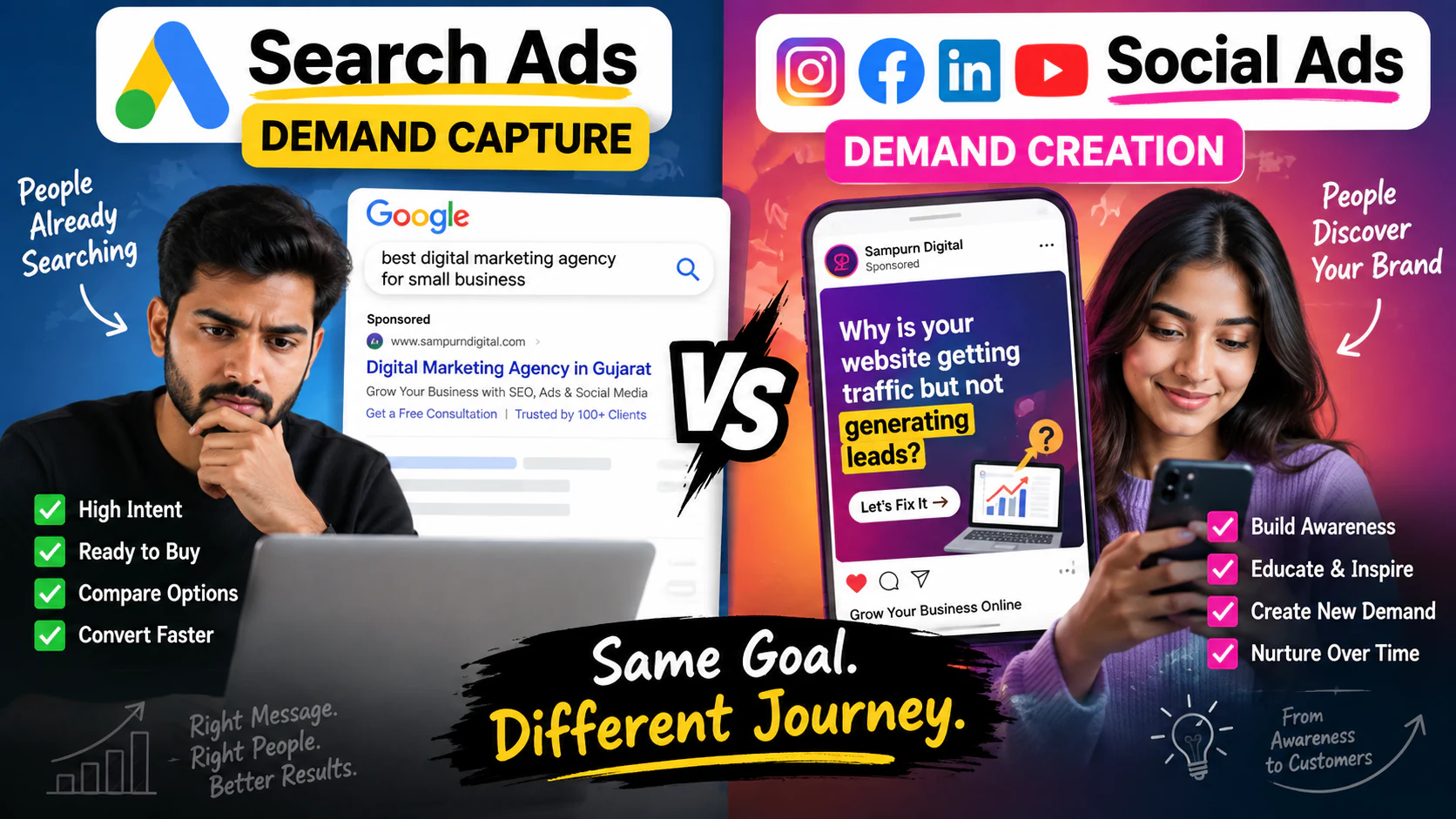
Not every person who sees your advertisement is ready to buy.
Some people are actively looking for a solution.
Others don't even know they have a problem yet.
That difference is what makes search ads vs social ads so important.
A person searching:
"best digital marketing agency for small business"
is behaving very differently from someone scrolling Instagram and seeing:
"Why is your website getting traffic but not generating leads?"
Both people could eventually become customers.
But they are at different stages of the buying journey.
And that means your advertising strategy should be different too.
The biggest mistake businesses make is treating all paid traffic as if it has the same level of intent.
It doesn't.
Understanding this difference can help you decide:
- Which platform to use
- What message to show
- What landing page to send people to
- What conversion to measure
- How to structure your funnel
- How to allocate your advertising budget
Let's break it down.
What Is Demand Capture?
Demand capture means reaching people who are already looking for something you provide.
The demand already exists.
Your job is to capture it.
For example, imagine someone searches:
They may already:
- Know they need SEO
- Be comparing agencies
- Have a budget
- Be researching providers
- Be close to contacting someone
A search ad gives your business an opportunity to appear when that intent exists.
The basic journey is:
That's demand capture.
You aren't necessarily convincing someone that SEO exists.
They are already looking for it.
You're trying to become one of the solutions they consider.
What Is Demand Creation?
Demand creation is different.
Instead of waiting for someone to search, you introduce a problem, solution, product or opportunity to a relevant audience.
For example, someone may be scrolling Instagram without thinking about website conversion rates.
They see an advertisement:
"Getting traffic but not enough enquiries? Your website may be losing customers before they contact you."
Now you've created curiosity.
The person may:
- Watch the video
- Visit your website
- Read your content
- Follow your brand
- Download something
- Visit again later
- Search for your service
- Eventually become a customer
The journey can look like:
That's demand creation.
Search Ads vs Social Ads: The Core Difference
Here's the simplest way to think about it:
| Search Ads | Social Ads |
|---|---|
| Capture existing demand | Create or influence demand |
| User actively searches | User is browsing |
| Intent is often explicit | Intent may be latent |
| Keywords are important | Audience + creative are important |
| Query drives relevance | Creative drives attention |
| Strong for high-intent needs | Strong for discovery and awareness |
| User often knows the problem | User may not know the problem |
| Landing-page relevance is critical | Creative-to-landing-page continuity is critical |
Neither approach is automatically better.
They solve different problems.
Search Ads: The Customer Is Already Looking
Let's take a simple example.
You provide:
Someone searches:
"AC repair near me"
They aren't asking:
"Should I get an AC?"
They already have the problem.
They need a solution.
This is a high-intent search.
Your advertisement might say:
- Same-day service
- Experienced technicians
- Quick diagnosis
- Book a service
The ad is aligned with the existing demand.
The customer searched.
You responded.
That's demand capture.
Social Ads: The Customer May Not Be Looking Yet
Now imagine the same principle with a less urgent product.
Suppose you sell:
Someone scrolling Instagram may not be searching for:
"online fitness coach."
But they might see a video showing:
That creates curiosity.
The person may think:
"That's actually happening to me."
Now the advertisement has created a new level of awareness.
They may visit your profile.
Then your website.
Then your offer.
Then perhaps come back through retargeting.
That's demand creation.
Why Search Intent Matters So Much
Search behaviour gives you a powerful signal.
When someone searches for:
their intent is very different from someone who sees an office chair advertisement while watching a video.
The search query tells you something about the person's current need.
This is why search advertising can work particularly well for:
- Local services
- Professional services
- Emergency services
- B2B services
- High-intent products
- Software
- Home services
- Healthcare searches
- Legal services
When demand already exists, capturing that demand can be highly valuable.
But Search Volume Alone Isn't Enough
A keyword can have thousands of searches and still produce poor business results.
Imagine you sell:
You might find huge search volume around:
But what does the person actually want?
They could be:
- A student learning SEO
- Someone looking for an SEO definition
- A beginner watching tutorials
- Someone looking for an SEO tool
- A business owner looking for an agency
The word is relevant.
The intent isn't necessarily relevant.
That's why search advertising needs intent-based keyword selection, not simply high-volume keyword targeting.
The same principle applies to SEO.
Understanding [search intent mapping](https://www.sampurndigital.com/blog/seo/search-intent-mapping-how-to-match-pages-with-what-people-actually-want) helps you understand what users actually want from a search.
Social Ads Start With the Audience
With social advertising, you often don't begin with a search query.
You begin with:
For example:
- Business owners
- Parents
- Fitness enthusiasts
- Home buyers
- E-commerce shoppers
- Marketing professionals
- Students
- Travellers
Then you combine audience signals with creative.
The goal is to stop the scroll.
That makes the first few seconds of your advertisement extremely important.
Creative Is the Search Query of Social Advertising
This is a useful way to think about it.
In search:
On social:
A search ad gets attention because the user is already looking.
A social ad has to earn attention.
That's why social advertising depends heavily on:
- Hooks
- Visuals
- Videos
- Headlines
- Problem statements
- Demonstrations
- Testimonials
- Social proof
- Offers
A weak creative can make a strong audience perform badly.
Demand Capture Doesn't Mean "Easy"
It is tempting to think:
"If someone is searching, they'll automatically buy."
Not true.
You still have competition.
Imagine someone searches:
They might see:
- Several advertisements
- Organic results
- Review websites
- Agencies
- Directories
- AI-generated search experiences
- Social proof
Your ad still needs to win attention.
And then your landing page needs to convince the visitor to take the next step.
That's why advertising doesn't stop at the click.
Demand Creation Doesn't Mean "Low Intent"
Another common misconception is:
"Social traffic is always low quality."
Not necessarily.
A person may not be searching today but could still be an excellent customer.
For example:
Someone sees an advertisement for a new SaaS product.
They weren't looking for it.
But the product solves a problem they already experience.
They click.
They explore.
They compare.
They sign up.
They become a customer.
The demand wasn't necessarily absent.
It simply wasn't being expressed through a search query.
The Customer Journey Can Move Between Both
This is where things get interesting.
A person may discover your business on social media.
Then later search for your brand.
Then visit your website.
Then search for alternatives.
Then return through retargeting.
Then contact your sales team.
The journey could look like:
So comparing search and social as if they operate independently can be misleading.
They can work together.
Search Ads Capture Intent at the Bottom of the Funnel
Search advertising can be particularly valuable when someone is closer to taking action.
Consider these searches:
Low intent
Medium intent
Higher intent
Very strong commercial intent
The closer the search gets to a commercial decision, the more valuable the traffic may become.
This is why keyword intent matters.
Social Ads Can Influence the Top and Middle of the Funnel
Social advertising can work across multiple stages.
Cold audience
The person doesn't know your brand.
Your job:
Warm audience
The person has interacted with your brand.
Your job:
Retargeting audience
The person has visited your website or engaged with your content.
Your job:
This creates a funnel:
The Paid Media Funnel
A practical paid media funnel can look like this:
Stage 1: Awareness
The customer learns that your solution exists.
Possible channels:
- Social ads
- Video ads
- Display
- Influencer content
Goal:
Stage 2: Consideration
The customer starts researching.
Possible channels:
- Search ads
- Educational content
- Remarketing
- Comparison pages
Goal:
Stage 3: Conversion
The customer is ready to act.
Possible channels:
- High-intent search ads
- Remarketing
- Branded campaigns
- Offer-based campaigns
Goal:
Why Businesses Often Waste Money on Social Ads
One common mistake is sending cold social traffic directly to a hard sales page.
For example:
This may work in some situations.
But often the person isn't ready.
They haven't:
- Understood the problem
- Trusted the brand
- Seen proof
- Compared solutions
- Understood the value
Instead, you may need to introduce the problem first.
For example:
"5 reasons your website traffic isn't turning into leads."
The funnel matches the level of awareness.
Why Search Ads Can Also Waste Money
Search campaigns can waste budget when businesses assume every search is valuable.
Imagine bidding on:
You could attract people looking for:
- Courses
- Jobs
- Definitions
- Agencies
- Tools
- Strategies
- Freelancers
If you don't control intent, you can pay for irrelevant clicks.
That means search campaigns need:
- Keyword research
- Match-type strategy
- Negative keywords
- Search-term analysis
- Ad relevance
- Landing-page relevance
Search Ads vs Social Ads: What Should Your Ad Say?
The message should reflect the user's mindset.
Search Ad
The user is already searching.
So the message can be direct:
SEO Services for Small Businesses
Build organic visibility, improve qualified traffic and generate more enquiries.
The ad answers the query.
Social Ad
The user may not be searching.
So the message may need to create curiosity:
Your website may not have a traffic problem.
It may have a conversion problem.
Here's how to identify where visitors are dropping off.
The ad creates interest.
Same business.
Different mindset.
Different message.
Search Ads vs Social Ads: Landing Pages Should Also Differ
A search visitor may arrive after searching:
They expect a page directly related to Google Ads management.
If you send them to a generic homepage, you introduce unnecessary friction.
A social visitor may arrive after seeing:
They may need an educational landing page before being presented with a service offer.
This is why landing-page strategy should match the traffic source.
A well-structured [lead-generation website architecture](https://www.sampurndigital.com/blog/web-development/lead-generation-website-architecture-for-service-businesses) can help connect paid traffic with the right conversion path.
Search Ads vs Social Ads: Which Has Better Conversion Rates?
There is no universal answer.
Conversion rate depends on:
- Traffic quality
- Intent
- Offer
- Industry
- Landing page
- Price
- Audience
- Creative
- Sales process
- Brand trust
A search campaign may have a higher conversion rate because users have stronger immediate intent.
A social campaign may have a lower initial conversion rate but create valuable demand that converts later.
If you only measure last-click conversions, you may underestimate the contribution of demand-creation channels.
Don't Measure Social Only by Immediate Sales
Suppose someone sees your social advertisement today.
They don't buy.
Three weeks later, they search your brand name on Google.
Then they contact you.
Which channel gets credit?
Depending on your attribution setup, the final search may receive the conversion credit.
But the social advertisement may have started the journey.
This is why paid marketing measurement needs to look beyond a single click.
What Should You Measure?
For search campaigns, monitor:
- Impressions
- Click-through rate
- Cost per click
- Search terms
- Conversion rate
- Cost per conversion
- Qualified leads
- Customer acquisition cost
- Revenue
For social campaigns, monitor:
- Reach
- Video engagement
- Hook rate
- Click-through rate
- Landing-page visits
- Leads
- Qualified leads
- Cost per qualified lead
- Assisted conversions
- Customer acquisition cost
- Revenue
The final goal is not cheap traffic.
It's profitable customer acquisition.
A Cheap Click Can Be an Expensive Click
Suppose:
Social
CPC \= ₹10
Search
CPC \= ₹80
At first glance, social looks much cheaper.
But suppose:
Social
1,000 clicks → 10 customers
Search
1,000 clicks → 40 customers
The more expensive click may actually be producing better economics.
This is why comparing CPC alone is dangerous.
You need to follow the journey to revenue.
When Search Ads Usually Make More Sense
Search advertising can be a strong starting point when:
- Customers actively search for your solution
- Your product category is already understood
- Search intent is commercially meaningful
- Customers have an immediate need
- You serve a local market
- Your service has clear high-intent keywords
- Your sales process can convert inbound demand
Examples:
These searches provide a direct signal of interest.
When Social Ads Usually Make More Sense
Social advertising can be particularly useful when:
- Your product is visually compelling
- Your audience is easy to define
- Your category is discovery-driven
- Your offer needs explanation
- You want to create awareness
- You have strong creative
- You can retarget engaged audiences
Examples:
- Fashion
- Beauty
- Fitness
- Food brands
- Lifestyle products
- Consumer apps
- New products
- Courses
- Events
When You Should Use Both
For many businesses, the strongest approach is not:
It is:
Use social to create awareness.
Use content to educate.
Use search to capture active demand.
Use retargeting to bring interested users back.
Use your website to convert them.
The system becomes:
Example: How Both Channels Could Work Together
Imagine you operate a B2B software company.
Step 1 — Social
You run a video:
"Still managing sales leads in spreadsheets?"
The audience watches the video.
Step 2 — Retargeting
People who watched the video see:
"Here's what a modern lead management workflow looks like."
They visit your website.
Step 3 — Search
Later, they search:
"CRM software for small business"
Your search campaign appears.
Step 4 — Landing Page
They arrive at a dedicated CRM landing page.
Step 5 — Conversion
They request a demo.
Now social helped create awareness.
Search captured active demand.
The website converted the visitor.
How to Decide Between Search and Social
Ask these five questions.
Are people actively searching for your solution?
If yes:
Do people need to discover your product first?
If yes:
Is your product visually compelling?
If yes:
Is your problem urgent?
If yes:
Does the customer need multiple touchpoints?
If yes:
A Simple Decision Framework
Use this before spending your budget.
High search demand + high intent
Low search demand + strong visual product
Strong search demand + strong social creative
Long sales cycle
New category
Established category
This gives you a much more useful starting point than simply asking which platform is "better."
What If Your Business Has Almost No Search Volume?
This happens with:
- New products
- New categories
- Innovative services
- New brands
- Emerging technologies
If customers don't know the category exists, they can't search for it effectively.
In that situation, waiting for search demand can limit growth.
You may need to create the demand first.
The sequence can become:
Social advertising can play an important role here.
What If Search Competition Is Extremely Expensive?
A high-intent keyword can also be highly competitive.
Suppose ten businesses are bidding for the same keyword.
CPC rises.
Instead of simply increasing bids, consider:
- More specific keywords
- Long-tail searches
- Better landing pages
- Better offers
- Geographic segmentation
- Different campaign structures
- Social demand creation
- SEO
- Retargeting
You don't always solve expensive search traffic by spending more.
Sometimes you need to change the acquisition strategy.
The Best Paid Strategy Is Often a Funnel, Not a Platform
Think beyond:
Instead think:
Then choose the channel.
For example:
Customer doesn't know your brand
Customer understands the problem
Customer is researching solutions
Customer visited but didn't convert
Customer is ready to buy
This approach creates a connected paid media funnel.
Common Mistakes to Avoid
Mistake 1: Treating all traffic equally
A click from a high-intent search isn't necessarily equivalent to a social click.
Mistake 2: Optimizing for cheap clicks
Cheap clicks don't automatically produce cheap customers.
Mistake 3: Using one message everywhere
Search and social users have different mindsets.
Mistake 4: Sending every visitor to the homepage
Different campaigns often need different landing pages.
Mistake 5: Ignoring the funnel
A person who just discovered your brand shouldn't always receive the same message as someone who requested a proposal.
Mistake 6: Measuring only last-click conversions
Demand creation can influence conversions that happen later through another channel.
Mistake 7: Scaling before fixing conversion problems
More traffic won't fix a weak offer, poor landing page or broken sales process.
For a broader diagnosis, see [why your ads get clicks but not customers](https://www.sampurndigital.com/blog/performance-marketing/why-your-ads-get-clicks-but-not-customers).
Search Ads vs Social Ads: The Practical Comparison
| Factor | Search Ads | Social Ads |
|---|---|---|
| Primary role | Demand capture | Demand creation + demand capture |
| User mindset | Actively searching | Browsing / discovering |
| Intent | Often explicit | Often latent |
| Main targeting | Keywords | Audiences |
| Creative importance | Important | Extremely important |
| Best signal | Search query | Audience + engagement |
| Strongest stage | Consideration / conversion | Awareness / consideration |
| Good for urgent needs | Yes | Usually less direct |
| Good for discovery | Limited | Strong |
| Retargeting | Yes | Yes |
| Main risk | Irrelevant searches | Low-intent traffic |
| Core optimization | Search intent + conversion | Creative + audience + conversion |
Search Ads and Social Ads Should Have Different Jobs
A strong paid strategy might assign each channel a specific role.
Search Ads
Social Ads
Retargeting
Landing Pages
Analytics
When every channel has a job, your paid media strategy becomes much easier to manage.
