
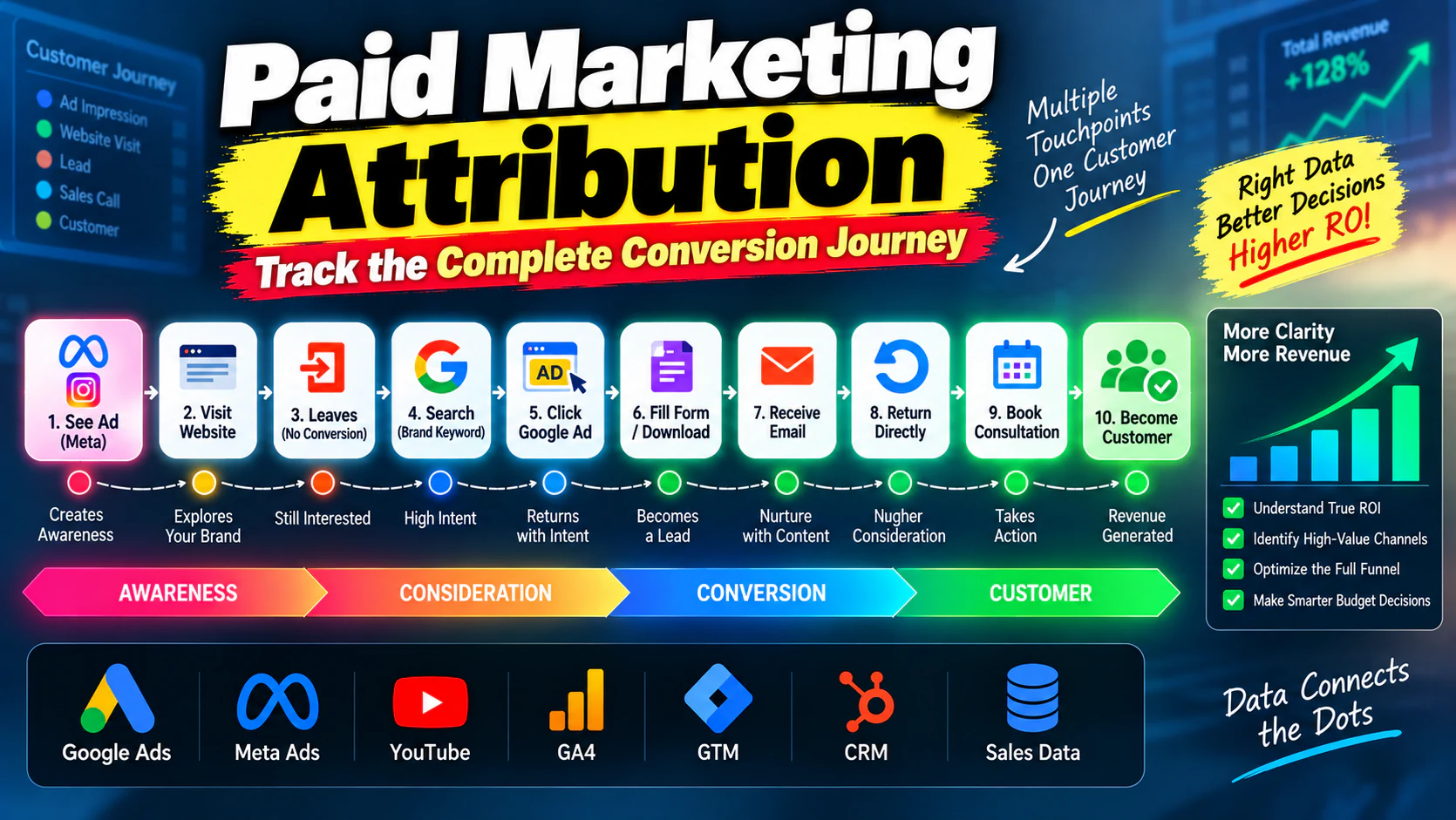
You can have Google Ads, Meta Ads, landing pages, CRM data, GA4, and sales data all working at the same time—and still not know which marketing activity actually generated a customer.
That is the attribution problem.
A prospect may:
- See a Meta ad.
- Visit your website.
- Leave without converting.
- Search your brand on Google three days later.
- Click a Google Search ad.
- Download a guide.
- Receive an email.
- Return directly.
- Book a consultation.
- Become a customer two weeks later.
So which channel gets the credit?
If your reporting simply says "Google generated the lead", you may be missing the role Meta played earlier in the journey.
If it says "Meta generated the customer", you may be ignoring the search campaign that captured the final high-intent interaction.
This is why paid marketing attribution tracking needs to look beyond individual ad-platform conversions.
The goal is not to find one magical attribution model.
The goal is to build enough visibility to answer:
Where did the customer come from, what happened between the first interaction and the sale, and which paid channels are actually contributing profitable revenue?
What Is Paid Marketing Attribution?
Paid marketing attribution is the process of assigning credit to marketing interactions that influenced a conversion.
For paid campaigns, this can include:
- Google Search Ads
- Google Display
- YouTube
- Meta Ads
- Instagram Ads
- remarketing campaigns
- paid social campaigns
- shopping campaigns
- lead-generation campaigns
- branded and non-branded paid search
- other paid acquisition channels
The important word is journey.
A conversion rarely happens because of one isolated click.
A customer might interact with multiple channels before becoming a lead or customer.
Simple example
Imagine a B2B company selling a ₹1,00,000 annual service.
A prospect:
If you only look at the final conversion source, you might conclude:
But the complete journey tells a different story:
That is much more useful for decision-making.
Why Paid Campaign Attribution Becomes Difficult
The basic idea sounds simple.
Track where someone came from and connect it to the conversion.
In practice, several things make attribution messy.
Customers use multiple devices
Someone might:
- see an ad on mobile
- research on desktop
- submit a form from laptop
- speak to sales from another device
The platforms may not always connect every interaction perfectly.
Customers return through different channels
A person can initially discover your brand through paid social and later return through:
- organic search
- branded Google Search
- direct traffic
- referral
- remarketing
The final session does not necessarily explain the entire acquisition journey.
Ad platforms have their own reporting systems
Google Ads and Meta Ads may each report conversions according to their own attribution and measurement systems.
Your analytics platform may report the same customer differently.
Your CRM may show something else again.
This can create apparently contradictory numbers.
Leads are not customers
This is one of the biggest problems.
Suppose:
| Channel | Leads | Customers | Revenue |
|---|---|---|---|
| Google Ads | 100 | 12 | ₹12,00,000 |
| Meta Ads | 180 | 5 | ₹5,00,000 |
Looking only at lead volume makes Meta look stronger.
Looking at customers and revenue changes the decision completely.
The Difference Between Conversion Tracking and Attribution
These terms are often used interchangeably, but they solve different problems.
Conversion tracking asks:
For example:
- form submission
- phone call
- WhatsApp enquiry
- purchase
- demo booking
- consultation request
Attribution asks:
That means attribution sits one level above basic conversion tracking.
You need reliable conversion tracking before attribution can become reliable.
A useful hierarchy is:
The further down this chain you can connect your data, the more useful your paid marketing decisions become.
The Paid Marketing Attribution Data You Actually Need
You do not need to track hundreds of fields.
You need a consistent set of identifiers that allow different systems to connect the journey.
Campaign information
Track:
- platform
- campaign
- ad group/ad set
- ad
- keyword where applicable
- creative
- audience
- placement where useful
Acquisition information
Capture:
- source
- medium
- campaign
- landing page
- first-touch source
- latest-touch source
Conversion information
Record:
- conversion type
- conversion date
- conversion value
- lead ID
- transaction ID where applicable
CRM information
For lead-generation businesses, connect:
- lead status
- qualified/unqualified
- opportunity created
- proposal sent
- won/lost
- customer value
- revenue
This is where attribution becomes commercially valuable.
Build a Single Conversion Journey
Instead of looking at advertising reports independently, create a common journey.
A practical structure looks like this:
AD IMPRESSION ↓ AD CLICK ↓ WEBSITE VISIT ↓ LANDING PAGE ↓ MICRO-CONVERSION ↓ LEAD ↓ QUALIFIED LEAD ↓ SALES OPPORTUNITY ↓ CUSTOMER ↓ REVENUE
Each stage should have a clear definition.
For example:
Lead: submitted a valid enquiry.
Qualified Lead: meets your sales criteria.
Opportunity: sales has confirmed genuine buying potential.
Customer: deal closed.
This prevents the marketing team from optimizing around cheap but useless leads.
UTM Tracking: The Foundation of Paid Attribution
UTM parameters help identify where website traffic originated.
A paid campaign URL might contain:
utm\_source=google utm\_medium=paid\_search utm\_campaign=service\_campaign utm\_content=ad\_variant\_a
For Meta:
utm\_source=meta utm\_medium=paid\_social utm\_campaign=lead\_generation utm\_content=video\_test\_01
The exact naming convention matters less than consistency.
If one campaign uses:
`paid-social`
and another uses:
`paidsocial`
and another uses:
`social_paid`
your reporting becomes unnecessarily difficult.
Create a UTM Naming Convention Before Launch
Do not let every campaign manager invent their own naming system.
Create rules.
For example:
| Parameter | Example |
|---|---|
| utm\_source | |
| utm\_medium | paid\_search |
| utm\_campaign | seo\_service\_leads |
| utm\_content | rsa\_variant\_a |
| utm\_term | technical\_seo |
For Meta:
| Parameter | Example |
|---|---|
| utm\_source | meta |
| utm\_medium | paid\_social |
| utm\_campaign | lead\_gen\_services |
| utm\_content | founder\_video\_01 |
| utm\_term | optional |
The important thing is that your naming remains predictable across campaigns.
First-Touch vs Last-Touch Attribution
Two of the easiest attribution concepts to understand are first touch and last touch.
First-touch attribution
The first meaningful marketing interaction gets the credit.
Example:
First-touch reporting gives the acquisition credit to Meta.
This can help answer:
Which channels are introducing people to our business?
Last-touch attribution
The final meaningful interaction before conversion receives the credit.
Using the same journey:
Last-touch reporting gives the conversion credit to Google.
This can help answer:
Which channel is capturing demand closest to conversion?
Why neither view is enough
If you use only first touch, you may overvalue awareness channels.
If you use only last touch, you may undervalue channels that created demand earlier.
That is why businesses with multiple paid channels should consider the complete journey, not just one attribution position.
Multi-Touch Attribution
Multi-touch attribution attempts to distribute conversion credit across multiple interactions.
Imagine this customer journey:
Instead of giving 100% credit to one interaction, a multi-touch approach can distribute credit across the journey.
Common conceptual models include:
- linear attribution
- position-based attribution
- time-decay attribution
- data-driven attribution
Each model answers the journey differently.
There is no universally perfect model.
The important question is:
Attribution Models Explained Simply
| Model | How Credit Is Assigned | Useful For |
|---|---|---|
| First Touch | First interaction gets credit | Demand creation |
| Last Touch | Final interaction gets credit | Conversion capture |
| Linear | Credit distributed across interactions | Balanced journey view |
| Position-Based | More weight to first/last interactions | Acquisition + conversion |
| Time Decay | Recent interactions receive more weight | Longer buying cycles |
| Data-Driven | Credit based on observed journey patterns | Larger data environments |
Treat attribution models as decision-making lenses, not absolute truth.
Why Google Ads and Meta Ads Numbers May Not Match
This is a common source of confusion.
You may see:
Google Ads: 80 conversions
Meta Ads: 65 conversions
Analytics: 105 conversions
CRM: 91 leads
That does not automatically mean one system is broken.
Different platforms can use different:
- attribution windows
- conversion definitions
- counting methods
- reporting logic
- identity matching
- conversion dates
Therefore, your reporting process should establish a source of truth for each business stage.
For example:
| Business Question | Primary Source |
|---|---|
| Ad spend | Ad platform |
| Clicks | Ad platform |
| Website sessions | Analytics |
| Website conversions | Analytics/CRM |
| Qualified leads | CRM |
| Customers | CRM |
| Revenue | CRM/Finance |
This avoids trying to force one platform to answer every question.
The Most Important Attribution Setup for Lead Generation
For service businesses, the journey should not end at:
You want:
Suppose two campaigns generate this:
Campaign A
- Spend: ₹1,00,000
- Leads: 100
- Qualified leads: 35
- Customers: 10
- Revenue: ₹10,00,000
Campaign B
- Spend: ₹1,00,000
- Leads: 180
- Qualified leads: 12
- Customers: 3
- Revenue: ₹3,00,000
Campaign B has a lower apparent CPL.
But Campaign A produces much more business value.
This is why cheap leads are not necessarily efficient leads.
Connect Paid Campaigns to CRM Data
For lead-generation businesses, this is one of the highest-value attribution improvements you can make.
When someone submits a form, preserve the acquisition information alongside the lead.
Useful fields include:
- Lead ID
- First source
- First campaign
- Latest source
- Latest campaign
- Landing page
- Lead creation date
- Qualification status
- Opportunity value
- Customer status
- Revenue
Then your sales team can update the downstream stages.
This creates a bridge between:
Without that bridge, paid media optimization often stops too early.
Example: Why Lead-Level Attribution Changes Decisions
Suppose you run three campaigns.
| Campaign | Spend | Leads | Qualified Leads | Customers | Revenue |
|---|---|---|---|---|---|
| Search A | ₹75,000 | 60 | 24 | 8 | ₹8,00,000 |
| Meta A | ₹75,000 | 100 | 15 | 4 | ₹4,00,000 |
| Remarketing | ₹50,000 | 40 | 18 | 7 | ₹7,00,000 |
If you optimize for CPL:
If you optimize for qualified leads:
If you optimize for customers:
If you optimize for revenue:
The metric you choose changes the decision.
A Better Paid Marketing Attribution Dashboard
Your dashboard should answer business questions—not simply display every available metric.
A useful structure is:
Acquisition
- Spend
- Impressions
- Clicks
- CTR
- CPC
Conversion
- Leads
- Conversion rate
- CPL
- Qualified leads
- Cost per qualified lead
Sales
- Opportunities
- Customers
- Customer acquisition cost
- Revenue
Profitability
- ROAS
- Revenue/spend
- Gross margin where available
- CAC
- LTV/CAC where meaningful
The most valuable dashboard often connects these layers.
The Attribution Funnel
A practical reporting structure is:
₹ Spend ↓ Clicks ↓ Website Visits ↓ Leads ↓ Qualified Leads ↓ Opportunities ↓ Customers ↓ Revenue
Now calculate the conversion rate between each stage.
For example:
You can immediately investigate where the biggest leakage occurs.
How to Diagnose an Attribution Problem
When reporting looks inconsistent, use this sequence.
Check conversion definitions
Ask:
- What exactly counts as a conversion?
- Is it a form submission?
- Is it a qualified lead?
- Is duplicate conversion counting possible?
Check tracking parameters
Verify:
- UTMs
- campaign names
- source/medium
- landing-page URLs
- redirects
Check analytics events
Make sure the important actions are actually being recorded.
Check CRM capture
Confirm acquisition information survives after the lead enters the CRM.
Check lead quality
Compare:
Compare revenue
Do not stop with CPL.
Look for attribution gaps
Investigate:
- direct traffic
- missing UTMs
- cross-device journeys
- offline conversions
- imported leads
- phone calls
- WhatsApp conversations
- sales-assisted conversions
Common Paid Attribution Mistakes
Mistake 1: Treating platform-reported conversions as absolute truth
Ad platforms are useful for campaign optimization.
They should not automatically be treated as the final business ledger.
Mistake 2: Optimizing for leads instead of revenue
A campaign generating 200 leads may be worse than one generating 50 highly qualified leads.
Mistake 3: Ignoring offline conversions
A lead may become a customer through a sales call weeks later.
If that information never returns to your marketing reporting, your optimization remains incomplete.
Mistake 4: Inconsistent UTMs
Inconsistent campaign naming can fragment your reporting.
Mistake 5: Measuring only last-click
This can make demand-creation channels look weaker than they really are.
Mistake 6: Giving every channel credit
If several platforms report the same conversion, adding all platform conversions together can dramatically overstate total results.
For example:
- Google reports 70
- Meta reports 50
- Analytics reports 80
You cannot simply say:
Those numbers may overlap.
Attribution vs ROAS
ROAS tells you:
Formula:
Example:
₹5,00,000 revenue ÷ ₹1,00,000 spend \= 5x ROAS
Attribution asks a different question:
You need both.
Attribution helps determine where credit belongs.
ROAS helps evaluate economic efficiency.
For a broader measurement framework, it is also useful to understand how ROAS relates to ROI, CAC and LTV.
Attribution Is Especially Important When Running Google + Meta Together
Consider this journey:
If you evaluate each platform independently:
Meta may say:
We generated engagement and assisted the customer.
Google may say:
We generated the conversion.
The CRM may say:
Sales closed the customer.
All three can be telling part of the truth.
This is why paid acquisition should be evaluated as a system, not merely as isolated channel reports.
Understanding the difference between search ads and social ads also helps here: one may primarily capture existing demand while the other creates or develops demand.
A Practical Attribution Framework for Paid Campaigns
Use this five-layer framework.
Layer 1 — Traffic
Track:
- source
- medium
- campaign
- ad
- landing page
Layer 2 — Conversion
Track:
- conversion event
- conversion value
- conversion date
Layer 3 — Lead Quality
Track:
- qualified/unqualified
- sales-ready
- opportunity
Layer 4 — Revenue
Track:
- customer
- order/deal value
- revenue
Layer 5 — Profitability
Track:
- CAC
- ROAS
- margin
- LTV where applicable
This gives you a much stronger measurement architecture than simply watching clicks and CPL.
How to Build an Attribution Process Step by Step
Define your business conversion
Decide what matters.
For an e-commerce company:
For a service company:
For a SaaS company:
Define every funnel stage
Write down the exact definitions.
For example:
Lead ↓ MQL ↓ SQL ↓ Opportunity ↓ Customer
Do not allow different teams to use different definitions.
Standardize campaign naming
Create one naming convention across platforms.
Implement consistent UTMs
Make campaign, source and content data readable in analytics and CRM systems.
Track important website actions
Your website should record meaningful events—not just page views.
For example:
- form submission
- phone click
- WhatsApp click
- demo booking
- checkout
- purchase
For implementation, your website conversion setup should be connected correctly with tools such as analytics and tag management.
Pass acquisition data into your CRM
Do not let source information disappear after the first form submission.
Connect sales outcomes
Record:
Build reporting around business outcomes
Compare:
- spend
- leads
- qualified leads
- customers
- revenue
Review attribution regularly
Attribution is not a one-time setup.
Campaigns change.
Tracking changes.
Websites change.
CRM processes change.
Your reporting should be checked regularly.
A Simple Attribution Audit Checklist
Before trusting your paid marketing reporting, check:
Campaign tracking
- Campaign names are standardized
- UTMs are consistent
- Source and medium values are clean
- Ads use the correct landing pages
Website tracking
- Conversion events fire correctly
- Duplicate conversions are controlled
- Important lead actions are tracked
- Landing pages preserve campaign information
CRM
- Lead source is captured
- Campaign information is retained
- Lead status is updated
- Qualified leads are identifiable
- Customer status is recorded
- Revenue is connected to customers
Reporting
- Platform conversions are not blindly added together
- Leads are separated from qualified leads
- Customers are measured
- Revenue is measured
- Attribution methodology is documented
When Should You Trust Attribution Data?
Not all attribution data deserves the same level of confidence.
High confidence
When:
- tracking is consistent
- CRM data is connected
- conversion definitions are clear
- revenue is recorded
- campaign parameters are reliable
Medium confidence
When:
- online conversion tracking works
- CRM connection is partial
- some offline conversions are missing
Low confidence
When:
- campaigns have inconsistent UTMs
- conversion events are unclear
- duplicate conversions exist
- sales data is disconnected
- multiple platforms are reporting overlapping conversions
If your data is low-confidence, avoid making aggressive budget changes based on tiny differences.
What Should You Optimize: Clicks, Leads or Revenue?
The answer depends on your business stage.
If you have very little conversion data
You may need to optimize around:
- clicks
- landing-page engagement
- early conversion signals
If you have stable lead volume
Move toward:
- conversion rate
- CPL
- qualified lead rate
- cost per qualified lead
If your CRM contains enough sales data
Move toward:
- customer acquisition cost
- revenue
- ROAS
- qualified pipeline
- profitability
The objective should become increasingly connected to the actual business outcome.
The Bigger Picture: Attribution Is a Growth System
Attribution should not become a reporting exercise where someone spends hours building dashboards nobody uses.
Its purpose is simple:
If attribution tells you:
- Meta creates valuable demand
- Google captures high-intent searches
- remarketing brings prospects back
- one landing page converts better
- one campaign generates poor-quality leads
- one audience produces higher-value customers
you can use those insights to allocate budget more intelligently.
That is the real value of attribution.
