
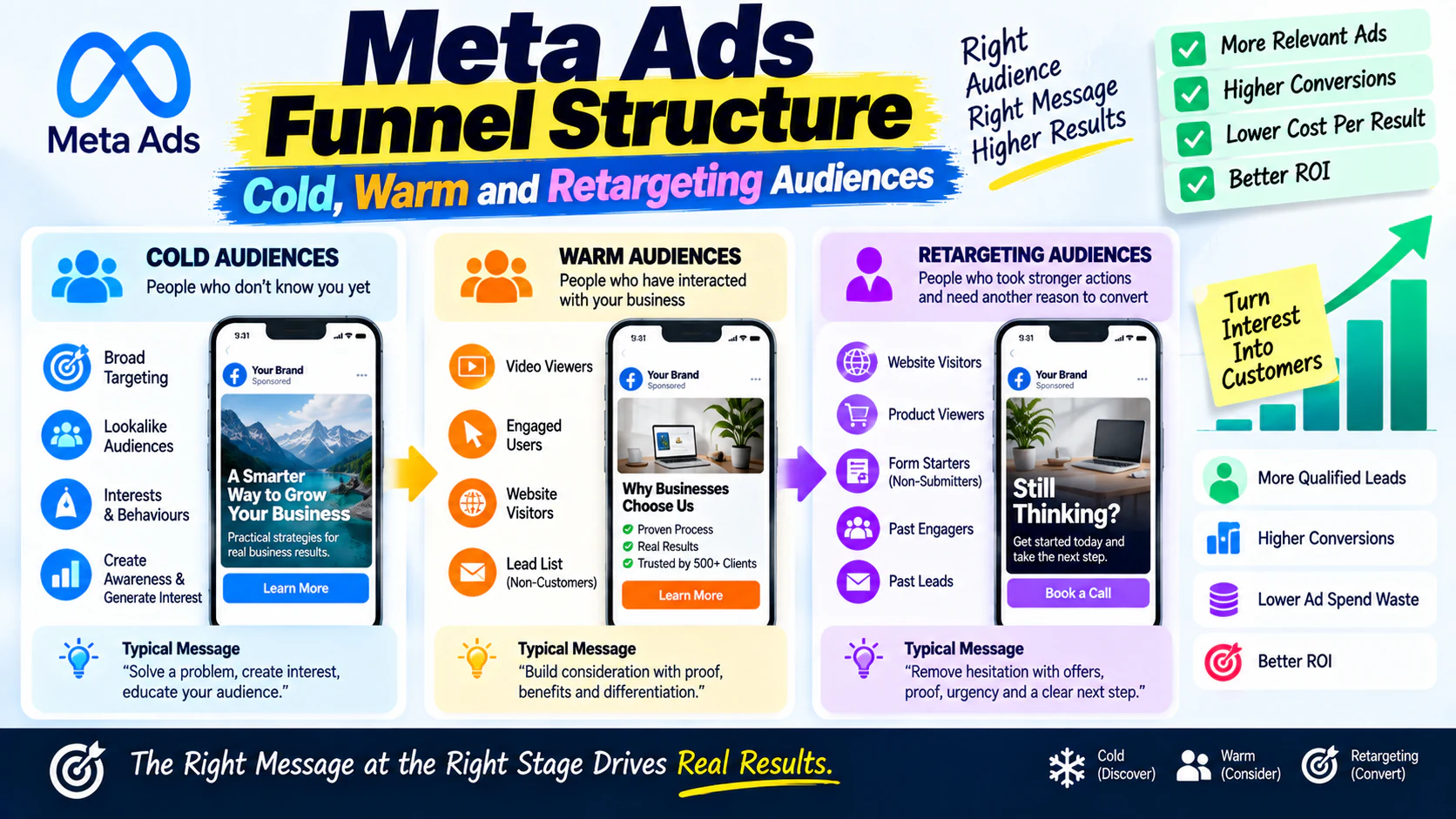
Running Meta Ads without a funnel is one of the easiest ways to make paid social look expensive.
You launch a campaign, target an audience, show an ad, send people to a landing page and wait for conversions.
Then the questions start:
The problem is often not the ad itself.
It is the relationship between the audience, message, offer and stage of awareness.
Someone who has never heard of your business should not necessarily see the same message as someone who visited your pricing page yesterday.
That is why a practical Meta Ads funnel structure separates audiences into different stages and gives each stage a different job.
In this guide, we’ll build that structure around three practical groups:
- Cold audiences — people who do not know you yet
- Warm audiences — people who have interacted with your business
- Retargeting audiences — people who have taken stronger actions and need another reason to convert
The goal is not to create three campaigns simply because every marketing funnel has three stages.
The goal is to make every rupee of paid social spend answer a specific business question.
What Is a Meta Ads Funnel Structure?
A Meta Ads funnel is a way of organizing paid campaigns according to how familiar a person is with your business.
A simple structure looks like this:
But the important part is what happens at each stage.
| Funnel stage | Audience | Main job | Typical message |
|---|---|---|---|
| Cold | New prospects | Create awareness and interest | Problem, opportunity, education |
| Warm | Engaged prospects | Build consideration | Proof, benefits, differentiation |
| Retargeting | High-intent visitors/leads | Remove hesitation | Offer, proof, urgency, next step |
The mistake is treating these as just audience labels.
Each stage should have a different communication objective.
For example:
A cold prospect may need to understand why the problem matters.
A warm prospect may need to understand why your approach is different.
A high-intent visitor may simply need enough confidence to take the next step.
That difference should influence your creative, copy, offer and landing-page experience.
Why the Cold-Warm-Retargeting Model Matters
Imagine a person searches Instagram and sees your ad.
They have never heard of your company.
Your ad says:
“Book a strategy call today.”
There is nothing inherently wrong with a strategy call.
But you are asking someone who has zero relationship with your brand to make a relatively high-commitment decision.
Now compare that with someone who:
- watched several of your videos,
- visited your website,
- read a service page,
- checked pricing,
- or submitted an enquiry but did not complete the next step.
The same CTA can make much more sense for them.
This is the fundamental principle:
Your funnel should therefore change the message as the user's familiarity increases.
Stage 1: Cold Audiences
Cold audiences are people who have little or no meaningful previous interaction with your business.
They may match your ideal customer profile, but they do not necessarily know:
- who you are,
- what you offer,
- why they need it,
- or why they should trust you.
That changes the job of your advertising.
The objective of cold traffic
Cold campaigns should primarily create relevance and curiosity.
You are answering:
For example, suppose you sell digital marketing services to local businesses.
A weak cold ad might say:
“We are a leading digital marketing agency. Contact us for the best marketing services.”
There is little reason to care.
A stronger cold message might address a recognisable business problem:
“Getting website traffic but very few enquiries? Your problem may not be traffic. It may be what happens after the click.”
Now the prospect has a reason to continue.
What Should Cold Ads Talk About?
Cold creative can focus on:
Problems
Identify a problem the audience already recognises.
Examples:
- High ad spend with low-quality leads
- Website traffic without enquiries
- Social media views without business results
- High cart abandonment
- Poor lead quality
Education
Teach something useful enough to earn attention.
For example:
Opportunities
Show what could improve.
For example:
Strong points of view
A clear opinion can differentiate your brand.
For example:
Cold Audience Targeting
Cold targeting should be built around your actual customer profile and Meta's available targeting options.
Depending on the business, this could involve:
- Broad targeting
- Relevant interests
- Demographic characteristics
- Lookalike audiences where appropriate
- Prospecting based on business or customer signals
But do not make the targeting structure unnecessarily complicated.
A common mistake is creating dozens of tiny cold audiences.
For example:
- Interest A
- Interest B
- Interest C
- Interest D
- Interest A + B
- Interest B + C
- Interest C + D
This can fragment budget and make learning harder.
Start with a small number of meaningful audience hypotheses.
Then use performance data to determine which ones deserve more attention.
Stage 2: Warm Audiences
Warm audiences already have some relationship with your business.
They may have:
- watched your video,
- engaged with your social content,
- visited your website,
- interacted with your Instagram or Facebook presence,
- clicked an ad,
- or consumed another piece of content.
They know more than a cold prospect.
But they may still not be ready to buy.
That means the message should change.
The objective of warm traffic
The warm stage is about moving someone from:
to:
This is where you introduce more proof and specificity.
What Should Warm Ads Talk About?
Warm audiences can receive content such as:
Case studies
Show what changed for a real client or business.
Instead of:
“We deliver performance marketing.”
Show:
“Here is how we diagnosed wasted paid traffic before increasing the campaign budget.”
Process
Explain how you work.
For example:
This reduces uncertainty.
Proof
Use relevant:
- testimonials,
- results,
- examples,
- screenshots where appropriate,
- before-and-after comparisons,
- client outcomes.
Differentiation
Explain why your approach is different.
For example:
“We don't optimise campaigns around clicks alone. We connect ad performance with landing-page behaviour and conversion quality.”
That gives a warm prospect something concrete to evaluate.
Stage 3: Retargeting
Retargeting is where many businesses make their biggest mistake.
They create one giant audience called:
Then show everyone the same advertisement.
But a person who visited your homepage for five seconds is not equivalent to someone who:
- visited your pricing page,
- viewed a service page multiple times,
- started a form,
- added a product to cart,
- or reached checkout.
Their intent is different.
Your retargeting structure should reflect that.
Segment Retargeting by Behaviour
Instead of asking:
ask:
For example:
| Behaviour | Likely intent | Better retargeting message |
|---|---|---|
| Homepage visit | Low | Education / proof |
| Service page visit | Medium | Service benefits / process |
| Pricing visit | Higher | Objection handling / proof |
| Form started | High | Reminder / friction reduction |
| Product viewed | Medium-high | Product proof / benefits |
| Cart initiated | High | Purchase reassurance |
| Existing customer | Different | Upsell / retention |
This is where a basic retargeting campaign becomes a real funnel.
Don't Retarget Everyone Forever
Retargeting windows should reflect the buying cycle.
A person deciding on a ₹2,000 product may need a different retargeting window from a company evaluating a ₹2 lakh marketing engagement.
Think about the time required to make the decision.
You can test different audience windows based on business behaviour, such as:
- recent visitors,
- 7-day high-intent visitors,
- 14-day engaged users,
- 30-day website visitors,
- longer consideration windows for higher-ticket offers.
The exact window should come from the buying cycle and performance data—not from a universal rule.
Your Meta Ads Funnel Should Not Be Just Three Campaigns
This is important.
A funnel is not automatically good because it contains:
The structure should reflect how people actually move toward conversion.
For example:
Cold campaign
Audience: New prospects Creative: Problem-focused video CTA: Learn more
Warm campaign
Audience: Engaged users Creative: Case study / educational content CTA: Explore the solution
High-intent retargeting
Audience: Service-page visitors or strong website actions Creative: Proof + objection handling CTA: Book consultation / Request quote
The campaign structure follows the customer journey.
How to Build the Funnel Step by Step
Define the conversion
Before creating audiences, decide what the funnel is trying to produce.
For a service business, that might be:
For e-commerce:
For SaaS:
Without a defined conversion path, audience segmentation becomes disconnected from business outcomes.
Map the audience stages
Create a simple awareness map.
Cold
Never meaningfully interacted with the brand.
Warm
Engaged with content, ads or social profiles.
Consideration
Visited important website pages or consumed deeper content.
High intent
Started a meaningful conversion action.
Existing customer
Already converted.
Now decide what each group should see.
Create an Exclusion Strategy
A good funnel is not only about deciding who gets an ad.
It is also about deciding who should not get that ad.
For example, your prospecting campaign should generally avoid unnecessarily spending on people who have already entered a more relevant retargeting pool.
Similarly, people who have already converted may need to be excluded from acquisition campaigns and moved into a customer or retention journey.
Think of exclusions as traffic control.
Without them, different campaigns can compete for the same people and muddy your reporting.
Match Creative to Awareness
Use a simple message ladder.
Cold
Warm
High intent
This prevents the common mistake of using bottom-funnel sales messages everywhere.
Match the Landing Page
The funnel should not stop at the advertisement.
If your ad says:
but the landing page says:
there is a messaging gap.
The landing page should continue the conversation started by the ad.
For example:
Ad: “Why are your Google Ads getting clicks but not customers?”
Landing page: “Find the conversion leaks between your ads, landing pages and sales process.”
That feels like one journey instead of two unrelated experiences.
Give Each Stage a Different KPI
Do not judge every funnel stage using the same metric.
For cold campaigns, you may care about:
- CTR
- thumb-stop or video engagement signals
- landing-page visits
- qualified traffic
- downstream conversions
For warm campaigns:
- landing-page engagement
- lead rate
- content engagement
- conversion rate
For retargeting:
- conversion rate
- cost per lead/purchase
- revenue
- qualified lead rate
- assisted conversion behaviour
The closer you get to the business outcome, the more important conversion quality becomes.
A Practical Meta Ads Funnel Example
Let's take a hypothetical B2B digital marketing agency.
Cold audience
Audience: New business prospects
Creative: “Your ads aren't necessarily the problem. Here's what to check before increasing your budget.”
Goal: Create interest.
Warm audience
Audience: People who engaged with content or visited the website
Creative: “5 conversion leaks we find during paid campaign audits.”
Goal: Demonstrate expertise.
Consideration audience
Audience: People who visited performance marketing or service pages
Creative: “See how our paid acquisition process connects campaigns, landing pages and conversion tracking.”
Goal: Build confidence.
High-intent retargeting
Audience: People who took stronger actions but did not convert
Creative: “Before you increase your ad budget, find out where your current spend is leaking.”
CTA: Request an audit.
This is much stronger than showing every visitor the same generic “Contact Us” advertisement.
What About Cold, Warm and Hot Audiences?
You will often hear another model:
The terminology varies.
The principle does not.
Instead of obsessing over the labels, define the actual behaviour.
For example:
Cold: No meaningful interaction.
Warm: Engaged with your brand.
Hot: Demonstrated strong commercial intent.
That is more useful than arguing about whether a particular audience should technically be called “warm” or “hot.”
Common Meta Ads Funnel Mistakes
Using one message for everyone
A first-time visitor and a returning high-intent prospect should not necessarily receive identical messaging.
Retargeting too broadly
“All website visitors” can hide major differences in intent.
No exclusions
Without exclusions, campaigns can overlap and repeatedly show irrelevant messages.
Sending every audience directly to the same page
Different stages may need different landing-page experiences or at least different sections and messaging.
Optimising for cheap clicks
A cheap click is not automatically valuable.
If the traffic does not produce qualified leads or purchases, lowering CPC can simply make an inefficient campaign look better.
Changing the funnel too frequently
If you constantly change:
- audience,
- creative,
- budget,
- offer,
- landing page,
- and conversion event
at the same time, you may not know what caused the result.
Build a testing process instead of continuously rebuilding the account.
How to Know Which Funnel Stage Is Broken
A useful diagnostic approach is to look at the journey sequentially.
Problem 1: Cold traffic is not engaging
Investigate:
- audience relevance,
- creative hook,
- message,
- offer,
- placement,
- frequency.
Problem 2: People engage but don't visit the site
Investigate:
- CTA,
- message-to-click motivation,
- offer clarity.
Problem 3: People visit but don't convert
Investigate:
- landing page,
- trust,
- offer,
- form friction,
- page speed,
- message match.
Problem 4: People convert but leads are poor
Investigate:
- targeting,
- qualification,
- offer positioning,
- form questions,
- sales process.
This is why a funnel is also a diagnostic framework.
It tells you where the customer journey is breaking.
Budget Allocation: Don't Divide It Blindly
A common mistake is saying:
There is no universal percentage that works for every account.
Your allocation depends on:
- audience size,
- buying cycle,
- traffic volume,
- conversion volume,
- customer value,
- campaign maturity,
- and how much demand already exists.
If your retargeting audience is tiny, giving it a huge budget will not magically create more high-intent prospects.
If your brand has substantial existing demand, underfunding retargeting can also leave easy conversions behind.
Budget should follow opportunity and economics, not a fashionable funnel ratio.
When a Simple Funnel Is Better
Not every business needs a complicated account structure.
A small business with limited traffic may be better served by:
rather than creating six campaigns and splitting a small budget across them.
Complexity should be earned by data.
If you have enough traffic and meaningful behavioural differences, introduce more segmentation.
If you don't, keep the structure simple.
A Simple Meta Ads Funnel Blueprint
Use this as a starting framework:
Campaign 1 — Prospecting
Audience: New potential customers Message: Problem + insight Creative: Video, carousel, static, educational content Destination: Relevant educational or commercial page
Campaign 2 — Engagement / Consideration
Audience: People who have engaged with your content or brand Message: Solution + proof Creative: Case studies, demonstrations, comparisons Destination: Service/product page
Campaign 3 — High-Intent Retargeting
Audience: Strong website or conversion behaviour Message: Objection handling + proof + offer Creative: Testimonials, FAQs, offer-focused creative Destination: Conversion-focused page
Campaign 4 — Customer/Retention
Audience: Existing customers Message: Cross-sell, upsell, retention or advocacy Destination: Relevant customer journey
This structure is more useful than blindly copying another company's Ads Manager.
Meta Ads Funnel Checklist
Before launching, check:
Audience
- Have cold and existing audiences been separated?
- Are important high-intent behaviours identified?
- Are unnecessary overlaps reduced?
- Are converted users excluded where appropriate?
Creative
- Does each stage have a different message?
- Does cold creative earn attention?
- Does warm creative build confidence?
- Does retargeting address objections?
Landing page
- Does the page match the ad?
- Is the offer clear?
- Is the CTA obvious?
- Is trust established quickly?
- Is the conversion process easy?
Measurement
- Are conversion events configured correctly?
- Are leads evaluated for quality?
- Are campaigns judged on business outcomes?
- Can you identify where users drop out?
Optimisation
- Are you testing meaningful variables?
- Are you avoiding unnecessary fragmentation?
- Are you giving campaigns enough data before making major decisions?
- Are you tracking what happens after the lead or purchase?
The Real Purpose of a Meta Ads Funnel
A Meta Ads funnel is not about making your Ads Manager look sophisticated.
It is about delivering the right message to the right level of intent.
Cold audiences need a reason to care.
Warm audiences need a reason to believe.
High-intent audiences need a reason to act.
If your campaigns understand that progression, your paid social strategy becomes much easier to diagnose and improve.
And when performance drops, you have a framework for finding the problem instead of simply increasing the budget or changing the ad.
