
Your Google Ads campaign is getting clicks.
The keywords look relevant.
The ads have a decent CTR.
But the conversion rate is disappointing.
So you start asking:
This is where many businesses make the wrong move.
They rewrite every ad.
Or they completely rebuild the landing page.
Or they increase the budget hoping more traffic will eventually produce more leads.
But if you don't know where the conversion funnel is breaking, you are making changes based on assumptions.
A low conversion rate can be caused by:
- Poor search intent
- Irrelevant traffic
- Weak ad messaging
- Ad-to-page mismatch
- Poor landing-page structure
- Weak offer
- Lack of trust
- Slow page speed
- Mobile UX problems
- Form friction
- Wrong audience
- Incorrect conversion tracking
The good news is that you can diagnose this systematically.
This guide shows you how.
First: What Does a “Low Conversion Rate” Actually Mean?
Conversion rate is usually calculated as:
For example:
If you receive:
- 500 clicks
- 10 conversions
Your conversion rate is:
But that number alone doesn't tell you whether the campaign is good or bad.
A 2% conversion rate could be:
- excellent for one business
- poor for another
- meaningless if the conversions are low quality
- artificially low because tracking is broken
You need to look beyond the percentage.
The real question is:
Are the clicks relevant, and does the post-click experience turn qualified visitors into valuable business actions?
The Most Important Diagnostic Question
Before changing anything, separate the funnel into two parts.
Before the Click
This includes:
After the Click
This includes:
This gives you a simple diagnostic model:
Your job is to determine which situation you have.
Check Whether the Traffic Is Actually Relevant
Don't start by redesigning the landing page.
First ask:
Review:
- Search terms
- Keywords
- Match types
- Locations
- Devices
- Audiences
- Campaign structure
Suppose you sell:
Your intended search might be:
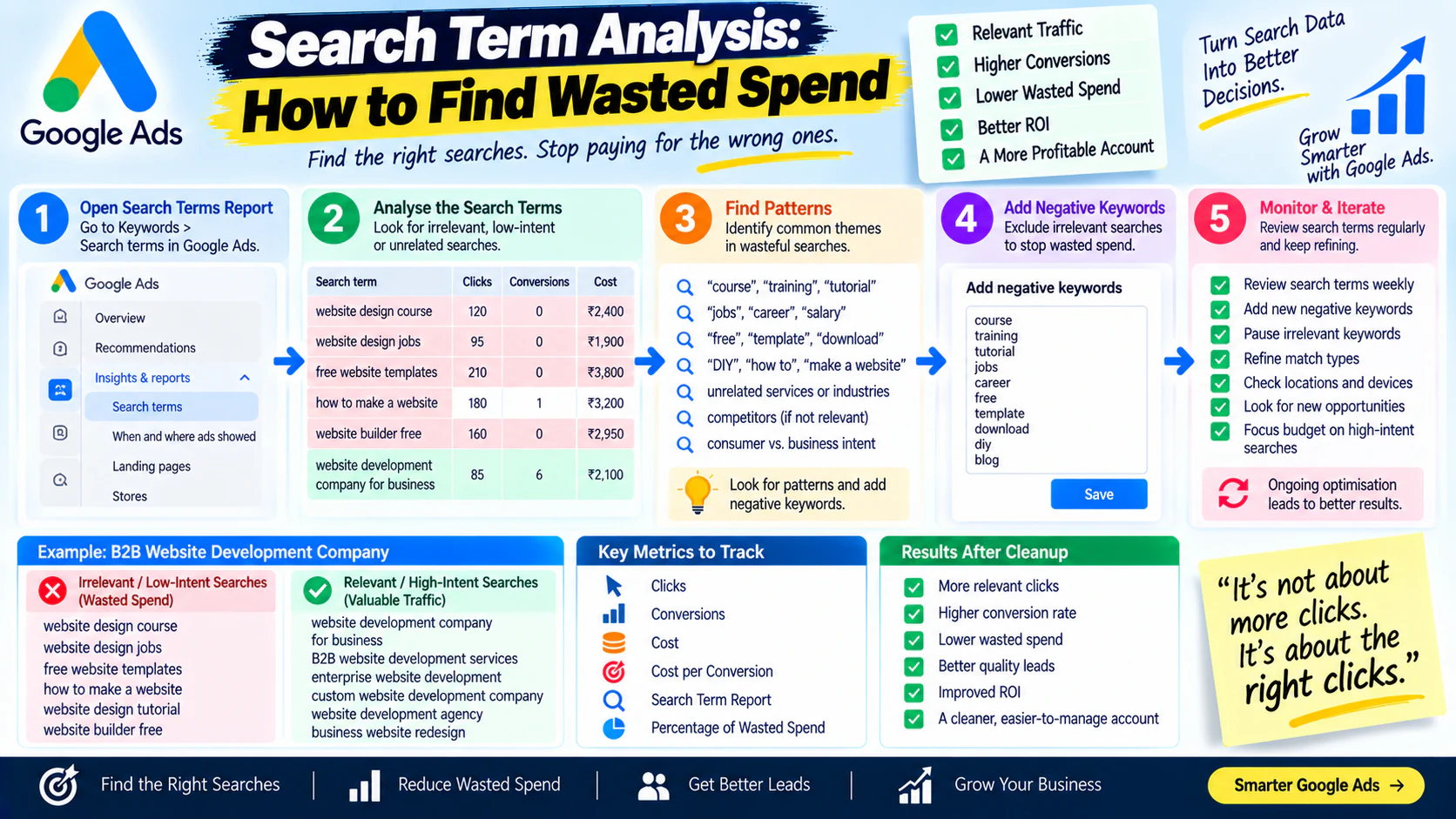
But the campaign could attract:
- website design course
- website design jobs
- free website templates
- how to make a website
- website design tutorial
- website builder free
Your landing page could be perfect.
It still won't convert well because the traffic isn't what you thought it was.
Diagnostic rule:
If search-term relevance is poor, fix the traffic before blaming the landing page.
Check Search Intent
Relevance and intent are not exactly the same.
A search can be related to your business but still have weak buying intent.
Compare:
with:
Both are relevant to a Google Ads agency.
But the second search is much closer to a commercial action.
Similarly:
and:
represent different levels of intent.
If your campaign is built around high-intent lead generation, a large amount of low-intent traffic can reduce the overall conversion rate.
Ask:
If the answer is often no, the problem may be targeting rather than the landing page.
Check Your Search Terms Before Editing Ads
Search terms provide one of the clearest signals about traffic quality.
Look for:
- irrelevant queries
- job searches
- course searches
- informational searches
- “free” searches
- unrelated products
- wrong locations
- consumer searches when you sell B2B
- low-value searches
For example:
If you advertise:
and receive clicks from:
your landing page is not necessarily the issue.
The campaign is attracting the wrong intent.
Fix:
before spending time redesigning the page.
Look at CTR and Conversion Rate Together
CTR can help you understand what happens before the click.
Conversion rate helps you understand what happens after the click.
Consider this example:
| Campaign | CTR | Conversion Rate |
|---|---|---|
| Campaign A | 1.5% | 6.5% |
| Campaign B | 7.8% | 0.8% |
Campaign B looks better if you only look at CTR.
But Campaign A is producing a much stronger post-click outcome.
This tells you something important:
An ad can be extremely attractive and still attract the wrong users.
Check the Ad-to-Landing-Page Match
This is one of the most common conversion problems.
Imagine the ad says:
Ad
The visitor clicks.
But the landing page headline says:
The page may be professionally designed.
But the visitor expected:
and received:
That's friction.
A stronger experience would be:
Ad
Landing Page
Supporting copy
Find technical, content and search visibility issues affecting your website.
CTA
The message should feel continuous from:
Check Whether the Landing Page Answers the Search
When someone clicks your ad, they should quickly understand:
- Where they are
- What you offer
- Who it is for
- Why it matters
- Why they should trust you
- What they should do next
If the visitor needs to scroll through half the page to understand the offer, you are creating unnecessary friction.
Your headline should make the value proposition obvious.
Weak:
Stronger:
Specificity usually gives the visitor more context.
Check the Landing Page Offer
A visitor may understand your service and still not convert.
Why?
Because there is no compelling reason to take action.
Compare:
with:
The second communicates:
- what happens
- how much commitment is involved
- what the visitor gets
The correct offer depends on the business.
Possible offers include:
- Free consultation
- Demo
- Quote
- Audit
- Assessment
- Trial
- Strategy session
- Product enquiry
- Callback
Your landing page needs a clear next step.
Check Your Landing Page Trust Signals
A visitor who doesn't know your company needs reasons to believe you can deliver.
Look for:
- Client logos
- Testimonials
- Reviews
- Case studies
- Results
- Certifications
- Industry experience
- Portfolio
- Guarantees where appropriate
- Clear company information
Don't simply write:
Show evidence.
Instead of making the visitor trust your claim, give them something they can evaluate.
Check the CTA
Your CTA should be:
Weak examples:
- Submit
- Click Here
- Send
- Contact
Better examples:
- Get My Free Audit
- Request a Quote
- Book a Consultation
- Get a Project Estimate
- Schedule a Demo
But don't obsess over button wording while ignoring bigger issues.
Changing:
won't rescue a landing page with irrelevant traffic and a weak offer.
Fix the biggest problem first.
Check the Form
Your form can silently destroy conversions.
Imagine a visitor wants a quick consultation.
The form asks for:
- Name
- Phone
- Company
- Industry
- Company size
- Website
- Monthly revenue
- Monthly marketing budget
- Number of employees
- Detailed requirement
- Preferred meeting date
That's a lot of commitment.
Ask only for information that is genuinely useful at that stage.
But don't blindly make every form shorter.
For high-value B2B services, additional qualification can be useful.
The correct balance is:
Check Mobile Conversion Experience
A landing page can look excellent on desktop and still perform badly on mobile.
Check the complete mobile journey.
Can the visitor:
- read the headline easily?
- understand the offer?
- see the CTA?
- tap the phone number?
- complete the form?
- use dropdowns?
- close popups?
- scroll without layout problems?
Don't judge mobile UX from a desktop browser window.
Actually test the page on a phone.
Check Page Speed
You are paying for every visitor.
If the landing page takes too long to load, some visitors will leave before they even see your offer.
Check:
- image size
- scripts
- third-party tools
- hosting
- page builders
- tracking scripts
- unnecessary animations
- mobile performance
If the page is slow, you have a technical conversion problem.
Check the Landing Page's First Screen
The visitor's first screen matters.
Before scrolling, they should generally see enough information to understand:
A useful first-screen structure is:
Headline
What you offer.
Supporting statement
Who it's for or what outcome it provides.
CTA
The next action.
Trust signal
A concise proof element.
For example:
Generate more qualified enquiries with structured PPC campaigns, search-term control and conversion-focused landing pages.
Trusted by growing businesses.
The exact copy will depend on the business, but the structure is straightforward.
Check Whether the Landing Page Is Too Generic
One of the biggest problems with paid traffic is sending every visitor to the same generic page.
Suppose you have campaigns for:
- SEO services
- Google Ads
- Social media marketing
- Website development
and all four campaigns land on:
The page may cover everything.
But it may not be the best conversion experience for any individual search.
A more relevant structure could be:
The more specific the page, the easier it can be to continue the visitor's original intent.
Check the Offer Against the Keyword
This is a subtle but important problem.
Suppose someone searches:
and your landing page immediately pushes:
The visitor may still be comparing options.
The page should answer their immediate concerns:
- What do you provide?
- Who is it for?
- How does the service work?
- What affects pricing?
- What results should they expect?
- Why choose you?
Don't force a visitor into an action that feels too large for their buying stage.
Check Conversion Tracking Before Making Conclusions
This step is non-negotiable.
You may think:
But the page may actually be producing leads that aren't being recorded.
Check:
- Form submission tracking
- Thank-you page tracking
- Call tracking
- Click tracking
- WhatsApp interactions where relevant
- Duplicate conversions
- Primary conversion actions
- Tag implementation
- Analytics-to-ad-platform consistency
If tracking is broken, optimization decisions become unreliable.
A Simple Diagnostic Matrix
Use this table to determine where the problem probably sits.
| Observation | Likely Problem |
|---|---|
| Low impressions | Targeting, keyword volume or budget |
| High impressions + low CTR | Ad relevance/messaging |
| High CTR + irrelevant searches | Targeting/search intent |
| High CTR + relevant traffic + low conversions | Landing page/offer |
| Good landing-page engagement + low leads | CTA/form/offer |
| Good leads + low sales | Sales process |
| No conversions anywhere | Tracking or major funnel issue |
| Good desktop + poor mobile | Mobile UX |
| High clicks from wrong locations | Location targeting |
| High spend on irrelevant queries | Search-term/negative keyword issue |
This is much more useful than simply asking:
How to Tell if Ads Are the Problem
Your ads are more likely to be the problem when:
- CTR is consistently weak
- ad relevance is poor
- messaging doesn't match search intent
- important keywords have weak ad coverage
- ads attract curiosity rather than buyers
- the offer isn't communicated clearly
- ad copy and keyword intent don't align
Example
Keyword:
Ad:
That's a messaging problem.
The searcher wants a service.
The ad sounds educational.
How to Tell if the Landing Page Is the Problem
Your landing page deserves more attention when:
- search terms are highly relevant
- traffic has strong commercial intent
- CTR is healthy
- visitors are reaching the page
- but very few take the desired action
For example:
That should make you investigate:
- headline
- message match
- offer
- CTA
- trust
- form
- mobile experience
- page speed
before simply adding more keywords.
How to Tell if Both Are the Problem
Sometimes the answer is:
For example:
The campaign attracts moderately relevant searches.
The ad uses generic messaging.
The landing page is generic.
The form has eight fields.
The business has no strong trust signals.
Changing only one component will probably not solve the problem.
In this situation, fix the funnel systematically.
The 3-Level Conversion Diagnosis
A useful way to structure the investigation is:
Level 1 — Traffic Quality
Check:
- keywords
- search terms
- intent
- location
- device
- audience
Level 2 — Message Match
Check:
- ad copy
- headline
- landing-page content
- offer
- keyword-to-page relevance
Level 3 — Conversion Friction
Check:
- CTA
- form
- trust
- page speed
- mobile UX
- navigation
- distractions
This gives you a logical order for optimization.
Don't Redesign the Landing Page Too Early
A complete redesign is expensive.
And sometimes unnecessary.
Imagine your campaign receives:
but 60% are irrelevant searches.
Redesigning the landing page won't solve the main problem.
First improve traffic quality.
Then evaluate the post-click experience.
This is why diagnosis should come before redesign.
A Practical Example
Imagine an agency spends:
on Google Ads.
The campaign receives:
and only:
The team assumes:
They investigate.
Finding 1
30% of clicks are from searches related to courses and jobs.
Action: Improve targeting and negative keywords.
Finding 2
The remaining traffic is highly relevant.
But the ad says:
The searcher was looking for:
Action: Improve ad messaging.
Finding 3
The landing page headline says:
Still too generic.
Action: Create stronger message match.
Finding 4
The form has nine fields.
Action: Reduce unnecessary friction.
Finding 5
Mobile users convert significantly less than desktop users.
Action: Fix mobile form and CTA experience.
The original problem wasn't simply:
It was a chain of smaller problems.
What Should You Fix First?
Use this priority order.
Priority 1 — Tracking
If measurement is broken, fix it immediately.
Priority 2 — Irrelevant Traffic
Stop paying for traffic that has no realistic business value.
Priority 3 — Search Intent
Make sure the campaign is reaching people with the right intent.
Priority 4 — Ad-to-Page Match
Make the promise consistent.
Priority 5 — Offer
Give visitors a clear reason to act.
Priority 6 — Landing Page
Improve:
- headline
- proof
- CTA
- structure
- content
Priority 7 — Conversion Friction
Fix:
- forms
- mobile UX
- page speed
- unnecessary distractions
Priority 8 — Testing
Once the fundamentals are fixed, start structured experiments.
A/B Testing: What Should You Test?
Don't change everything at once.
Test one meaningful variable at a time where practical.
Examples:
Headline
Version A: Digital Marketing Services
Version B: Performance Marketing for B2B Companies
CTA
Version A: Contact Us
Version B: Request a Strategy Call
Form
Version A: 8 fields
Version B: 4 fields
Offer
Version A: Contact our team
Version B: Get a free campaign assessment
The goal is not to make the page “look better.”
The goal is to determine what produces better business outcomes.
Don't Optimize for Conversion Rate Alone
Suppose Version A generates:
and Version B generates:
At first glance, Version A wins.
But what if:
while:
Then Version B may be the stronger business result.
Always connect:
not just:
Google Ads Conversion Rate Diagnosis Checklist
Before changing your campaign, answer these questions.
Traffic
- Are search terms relevant?
- Is search intent commercial enough?
- Are locations correct?
- Are devices performing differently?
- Are there obvious negative keywords missing?
Ads
- Does the ad match the keyword?
- Is the offer clear?
- Does the ad attract buyers rather than curiosity?
- Does the message match the landing page?
Landing Page
- Does the headline match the search?
- Is the value proposition obvious?
- Is the offer compelling?
- Is there enough trust?
- Is the CTA clear?
- Is the page mobile-friendly?
- Is it fast?
- Is the form reasonable?
- Are distractions minimized?
Measurement
- Are conversions tracked correctly?
- Are phone leads measured?
- Are forms working?
- Are duplicate conversions being counted?
Business
- Are leads qualified?
- Are sales following up?
- Are customers profitable?
The Bottom Line
A low Google Ads conversion rate doesn't automatically mean your ads are bad.
And it doesn't automatically mean your landing page is bad.
You need to identify where the funnel breaks.
Start with:
That process turns:
into a much more useful question:
And once you know that, you know what to fix.
