
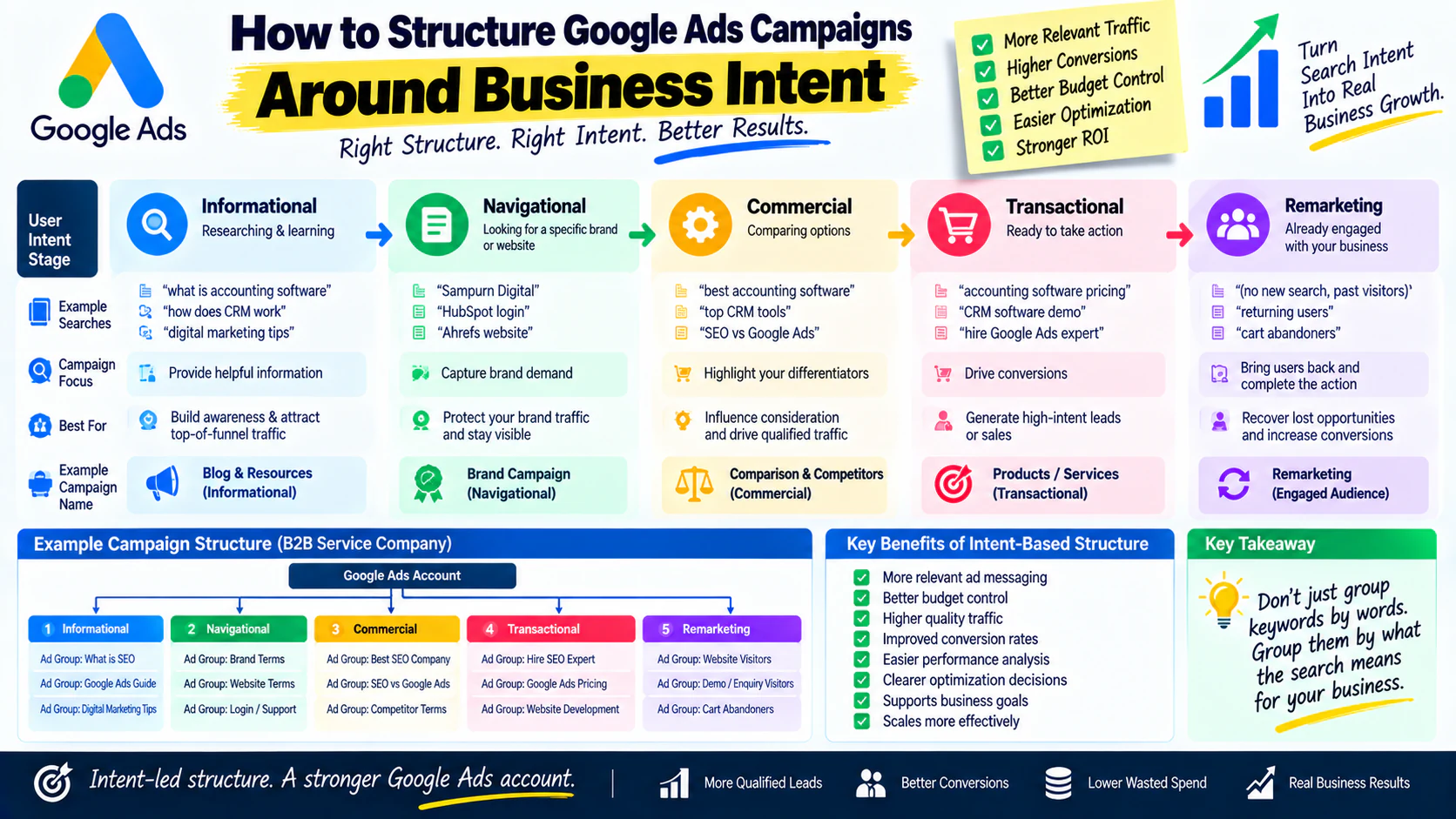
A Google Ads account can have the right keywords, good ads, and enough budget — and still become difficult to manage.
One common reason is campaign structure.
When unrelated searches, audiences, products, locations, and business goals are mixed together, the account starts making decisions at the wrong level.
A campaign built around “all keywords related to our service” may look organized inside Google Ads, but it does not necessarily reflect how people actually search or how the business makes money.
A better approach is to structure campaigns around business intent.
Instead of asking:
“How do I put these keywords into campaigns?”
Ask:
“What business action does this search represent?”
That shift can make campaign management, budgeting, ad messaging, landing-page alignment, and optimization much easier.
What Does Google Ads Campaign Structure by Search Intent Mean?
Google Ads campaign structure by search intent means grouping campaigns and ad groups based on the commercial meaning behind searches, rather than simply grouping keywords because they contain similar words.
For example, imagine a company selling accounting software.
These searches are not equally valuable:
- accounting software
- accounting software for small business
- best accounting software for small business
- accounting software pricing
- accounting software demo
- free accounting template
They may all relate to accounting, but they represent different levels of intent.
Someone searching “accounting software” may still be researching.
Someone searching “accounting software pricing” is much closer to evaluating a solution.
Someone searching “accounting software demo” may be ready to talk to a sales team.
If all of these searches are treated identically, the account loses useful business signals.
Why Campaign Structure Matters
Campaign structure determines where you can control important decisions.
At campaign level, you may control:
- Budget
- Location targeting
- Network settings
- Bidding approach
- Campaign-level exclusions
- Conversion goals
- Scheduling
- Other targeting and delivery settings
At ad-group or keyword level, you can control:
- Keyword themes
- Ad relevance
- Search-term relationships
- Landing-page alignment
- Messaging
This creates an important principle:
Put things together when they need the same business decision.
Put them into separate campaigns when they require different budgets, targeting, objectives, or optimization decisions.
That is more useful than creating dozens of tiny campaigns simply because the keywords look different.
The Biggest Mistake: Structuring Around Keywords Alone
Suppose a B2B company offers three services:
- SEO
- Google Ads management
- Website development
A basic structure might look like:
Ad groups:
- SEO
- Google Ads
- Website development
At first, this looks simple.
But what happens when the company wants:
- ₹1,00,000/month for Google Ads management
- ₹60,000/month for SEO
- ₹40,000/month for web development
Now the campaign structure is fighting the business strategy.
The business wants separate budget decisions, but the account structure has bundled everything together.
A stronger structure would usually separate the major business offerings where separate budget and performance control are required.
Start With Business Intent, Not Campaign Names
Before creating campaigns, map the searches to actual business intent.
A useful framework is:
| Intent Level | Example Search | What It Usually Means |
|---|---|---|
| Broad problem | how to get more website leads | Looking for information |
| Category research | lead generation agency | Exploring providers |
| Solution research | best lead generation agency | Comparing options |
| Commercial | lead generation agency pricing | Evaluating cost |
| High intent | lead generation agency near me | Looking for a provider |
| Brand | Sampurn Digital lead generation | Already knows the company |
The exact interpretation depends on the industry, but the principle remains:
Define the Business Goals First
Before building campaigns, answer five questions.
What are you selling?
For example:
- SEO services
- Google Ads management
- Website development
- Social media marketing
Which offerings deserve their own budget?
If SEO and Google Ads have completely different budgets, they should generally have separate campaign-level control.
Which customers are most valuable?
A company may serve:
- Startups
- Small businesses
- Enterprise companies
But that does not automatically mean each audience requires a separate campaign.
Separate them when there is a meaningful reason to control budget, targeting, messaging, or measurement differently.
Which locations matter?
A local business may need different targeting from a national or international business.
What counts as a conversion?
Examples:
- Lead form submission
- Phone call
- Demo request
- Purchase
- Appointment
- Qualified enquiry
Without this definition, campaign structure becomes disconnected from business outcomes.
Build an Intent Map
Now classify your keyword themes.
For example, suppose you sell web development services.
High-commercial-intent searches
- web development company
- website development agency
- hire web developer
- website development services
- web development company for business
Research-oriented searches
- website development cost
- how much does a website cost
- website development process
- custom website vs template
Informational searches
- what is web development
- how websites work
- website development basics
These should not automatically be treated as one commercial bucket.
The informational searches may be useful for content or a different campaign strategy, while commercial searches may deserve the primary paid acquisition budget.
Decide What Belongs at Campaign Level
This is one of the most important decisions in a Google Ads account.
A practical rule:
Create a separate campaign when you need separate control.
For example:
Campaign 1 — Google Ads Management
Budget: ₹50,000/month
Goal: Generate qualified service enquiries
Campaign 2 — SEO Services
Budget: ₹40,000/month
Goal: Generate qualified SEO enquiries
Campaign 3 — Website Development
Budget: ₹60,000/month
Goal: Generate web development enquiries
Now the business can answer:
- Which service gets the most budget?
- Which service generates the best leads?
- Where should budget be increased?
- Which campaign needs improvement?
That visibility is much harder when unrelated business lines are forced into one campaign.
Once campaigns represent meaningful business decisions, organize closely related search themes within them.
For example:
Ad Group: Google Ads Agency
Keywords could include closely related themes such as:
- google ads agency
- google ads management agency
- google ads management company
Another ad group could focus on:
With searches around:
- PPC management company
- PPC management agency
- PPC services
The objective is not to create an ad group for every individual keyword.
The objective is to create tight enough themes that the ad and landing page genuinely match the searches.
Match Search Intent With Ad Messaging
Your campaign structure should make it easier to write relevant ads.
Suppose someone searches:
A relevant ad could focus on:
- Google Ads management
- Campaign optimization
- Conversion tracking
- Performance reporting
Now imagine the same ad is being triggered by:
The messaging becomes much harder to make relevant.
That is a structural warning.
When very different search intents trigger the same messaging, your keyword grouping may be too broad.
Match Each Intent Group With the Right Landing Page
Campaign structure should eventually connect:
For example:
| Search Intent | Ad Message | Landing Page |
|---|---|---|
| Google Ads agency | Google Ads Management | PPC service page |
| Google Ads pricing | Transparent PPC planning | Pricing/service page |
| Google Ads audit | Google Ads Account Audit | Audit-focused page |
| General PPC information | Educational content | Relevant guide |
The landing page does not always need to be unique for every keyword.
But the page should satisfy the intent behind the traffic.
If a user searches for a specific commercial service and lands on a generic homepage, you are introducing unnecessary friction.
A Practical Google Ads Structure
For a service business, a structure could look like this:
Google Ads Account │ ├── Campaign: Google Ads Management │ ├── Ad Group: Google Ads Agency │ ├── Ad Group: PPC Management │ └── Ad Group: Google Ads Services │ ├── Campaign: SEO Services │ ├── Ad Group: SEO Agency │ ├── Ad Group: SEO Services │ └── Ad Group: Local SEO │ └── Campaign: Website Development ├── Ad Group: Web Development Company ├── Ad Group: Business Website └── Ad Group: Website Development Services
This is only a starting framework.
The right structure depends on:
- Account size
- Search volume
- Geographic targeting
- Budget
- Number of offerings
- Conversion volume
- Landing-page availability
- Business priorities
Don't Over-Segment the Account
Intent-based structure does not mean creating 100 campaigns.
Over-segmentation creates its own problems.
Imagine creating:
- Campaign for “Google Ads agency”
- Campaign for “Google Ads management”
- Campaign for “PPC agency”
- Campaign for “PPC management”
- Campaign for “Google Ads company”
If all of these have:
- the same location
- the same budget priority
- the same conversion goal
- the same landing page
- similar bidding requirements
then separating them may add management complexity without creating meaningful control.
A better question is:
What decision would become possible if I separated these keywords?
If the answer is “nothing important,” the separation may not be necessary.
Use Business Intent to Control Budget
One of the strongest reasons to structure campaigns around intent is budget allocation.
Suppose a business has ₹2,00,000/month.
Instead of distributing the budget evenly across every keyword theme, it can prioritize the searches closest to revenue.
Example:
| Campaign | Monthly Budget | Business Priority |
|---|---|---|
| High-intent service searches | ₹1,00,000 | Highest |
| Category/product searches | ₹50,000 | High |
| Competitor/alternative searches | ₹25,000 | Test |
| Experimental searches | ₹25,000 | Test |
The numbers are illustrative.
The important idea is:
Intent Is More Than “Informational vs Transactional”
A common mistake is using only broad intent labels.
For paid search, you can create a more useful commercial hierarchy.
Level 1: Problem
“I need more leads.”
Level 2: Category
“lead generation agency”
Level 3: Solution
“B2B lead generation services”
Level 4: Provider
“B2B lead generation company”
Level 5: Commercial evaluation
“B2B lead generation agency pricing”
Level 6: Action
“hire B2B lead generation agency”
These searches may belong to different parts of the customer's decision journey.
The right structure depends on whether those differences justify separate control.
How to Structure Campaigns Around Location Intent
Location can also represent a meaningful business decision.
Suppose a company serves:
- Ahmedabad
- Surat
- Vadodara
- Mumbai
If the business has different budgets, landing pages, offers, or sales priorities for those markets, location-based campaigns may make sense.
But if the company has one national strategy and sufficient conversion volume is not available at city level, excessive geographic segmentation may make the account unnecessarily fragmented.
Again:
How to Handle Brand and Non-Brand Intent
Brand and non-brand searches usually represent very different levels of familiarity.
For example:
- Sampurn Digital
- Sampurn Digital SEO
- Sampurn Digital Google Ads
- SEO agency
- Google Ads agency
- digital marketing company
Separating brand and non-brand traffic can make performance easier to understand because the underlying user intent is different.
Brand traffic may already have familiarity with the business.
Non-brand traffic generally requires the advertiser to win consideration.
That distinction matters when evaluating acquisition performance.
How Competitor Searches Fit Into the Structure
Competitor searches should be treated carefully.
For example:
- competitor name
- competitor alternative
- competitor pricing
- competitor vs your company
These searches may have different economics and messaging from generic category searches.
If competitor targeting is part of the strategy, keeping it separately measurable can help answer:
- Does it generate qualified leads?
- What does it cost?
- Does it convert differently?
- Is the traffic incremental?
- Is the strategy commercially worthwhile?
Do not create competitor campaigns simply because competitors exist.
Create them when there is a deliberate business reason to test that demand.
Search Terms Should Eventually Influence Structure
Campaign structure should not be a one-time exercise.
After campaigns run, inspect actual search terms.
You may discover that users are searching for:
- a service you did not explicitly plan for
- a specific product
- a specific industry
- pricing
- location
- competitor alternatives
- irrelevant informational topics
Those searches provide real evidence about demand.
For example:
You initially create:
After collecting search data, you discover strong commercial searches around:
If that theme has enough volume and represents a distinct business offering, it may deserve its own structure.
This is one reason account structure should evolve based on actual search behavior.
The Relationship Between Keywords and Search Terms
These are not the same thing.
Keyword: what you intentionally target.
Search term: what the user actually typed before triggering your ad.
Your keyword strategy creates the initial structure.
Your search-term data tells you whether reality matches your assumptions.
That means a strong optimization loop looks like:
This is much more useful than building the account once and never reconsidering its structure.
A Simple Intent-Based Campaign Planning Framework
Before launching a campaign, use this worksheet.
| Question | Your Answer |
|---|---|
| What business offer does this campaign represent? | |
| What type of customer is it targeting? | |
| What search intent are we targeting? | |
| What action should the user take? | |
| What budget should this campaign control? | |
| What location should it target? | |
| Which keywords belong here? | |
| Which keywords do not belong here? | |
| Which landing page will receive traffic? | |
| What counts as a qualified conversion? |
If you cannot answer these questions, the campaign may not be ready to launch.
7 Signs Your Google Ads Account Structure Needs Work
You cannot tell which business offering deserves more investment.
One campaign contains completely different search intents
Informational and high-commercial searches are being evaluated together.
Ads are too generic
The same messaging is being used for very different searches.
Landing pages don't match search themes
Users arrive on pages that don't directly address what they searched for.
Search terms repeatedly reveal new themes
Your current structure may not reflect actual demand.
You cannot explain campaign performance
If a campaign performs poorly, you cannot identify whether the problem is:
- audience
- search intent
- offer
- ad
- landing page
- budget
- tracking
Budget decisions are difficult
If you cannot move budget intelligently between business priorities, your structure may be limiting optimization.
A Better Way to Think About Google Ads Account Structure
Don't aim for:
Don't aim for:
Aim for:
Maximum useful control with minimum unnecessary complexity.
A strong account should allow you to answer questions such as:
- Which intent generates the best leads?
- Which service deserves more budget?
- Which search themes waste spend?
- Which landing pages convert?
- Which locations perform?
- Which campaigns should be scaled?
- Which searches should be excluded?
- Which new themes deserve their own structure?
If your structure helps you answer those questions, it is doing its job.
Example: Restructuring a Poor Account
Imagine this account:
Campaign: Digital Marketing
Ad Groups: \- SEO \- PPC \- Social Media \- Website \- Digital Marketing \- Online Marketing
The problem is not simply that there are too few campaigns.
The bigger problem is that several business decisions have been combined.
A better starting structure could be:
Campaign: SEO Services Campaign: Google Ads Management Campaign: Social Media Marketing Campaign: Website Development
Then organize each campaign around tightly related intent themes.
Now performance can be evaluated at the business-offer level.
From there, further segmentation should happen only when the data or business strategy justifies it.
How Search Intent and Landing Pages Work Together
Campaign structure cannot fix a poor landing page.
Suppose the search is:
The ad promises:
But the user lands on a generic homepage.
The campaign may be structurally correct, but the conversion journey is weak.
A useful chain is:
Every step should make sense as the next step.
For service businesses, this is especially important because the searcher is often evaluating trust, expertise, proof, pricing, process, and fit — not simply clicking a button.
Don't Forget Conversion Quality
A campaign can appear successful because it generates many conversions.
But are those conversions valuable?
For example:
Campaign A:
- 50 leads
- 5 qualified
- ₹1,000 cost per lead
Campaign B:
- 20 leads
- 10 qualified
- ₹2,000 cost per lead
Looking only at cost per lead makes Campaign A look better.
Looking at qualified opportunities changes the picture.
That is why business intent should eventually connect with business outcomes, not just Google Ads metrics.
The Final Campaign Structure Checklist
Before launching, check:
Business
- Each campaign has a clear business purpose.
- Budget priorities are defined.
- Conversion goals are clear.
- High-value offerings are identifiable.
Search intent
- Keywords represent the intended search behavior.
- Different commercial intents are not unnecessarily mixed.
- Informational searches are handled intentionally.
- Brand and non-brand traffic are understood separately.
Ads
- Ad messaging reflects the search theme.
- Headlines match the user's problem or desired solution.
- The offer is clear.
- The call to action matches the landing-page experience.
Landing pages
- Search intent matches the page.
- The page clearly communicates the offer.
- Proof and trust elements are present.
- The conversion action is obvious.
Measurement
- Primary conversions are defined.
- Lead quality can be evaluated.
- Search-term data will be reviewed.
- Campaign-level performance can inform budget decisions.
