
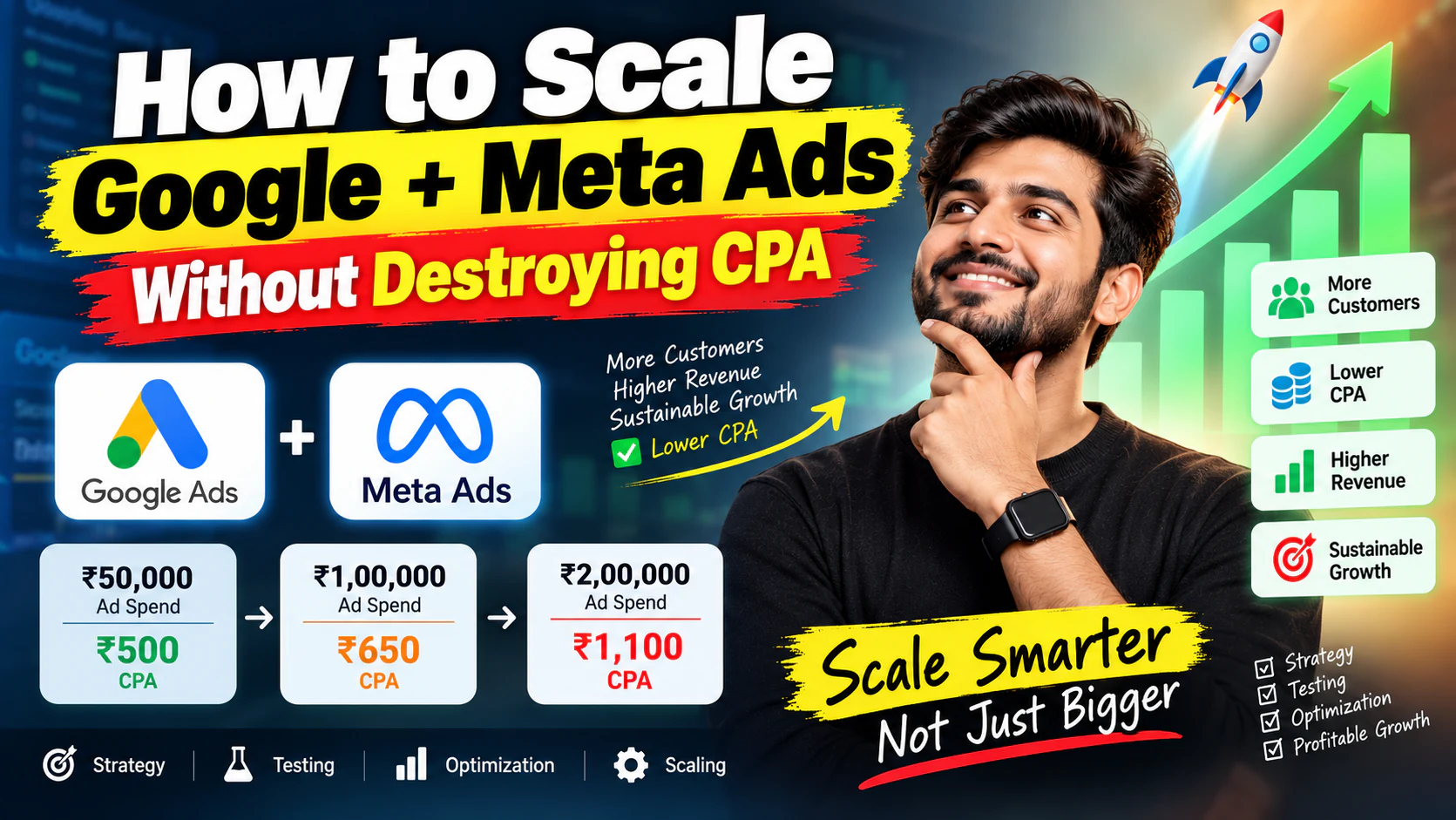
Scaling paid advertising is easy.
Scaling it without destroying your CPA is the difficult part.
A business can increase its ad budget from ₹50,000 to ₹1 lakh, then ₹2 lakh, and still discover that customer acquisition costs have doubled.
The problem usually isn't that Google Ads or Meta Ads "stopped working."
The problem is that the business tried to increase spend faster than the campaign could increase profitable demand.
For example:
- ₹50,000 spend → ₹500 CPA
- ₹1,00,000 spend → ₹650 CPA
- ₹2,00,000 spend → ₹1,100 CPA
Revenue may have increased.
But efficiency deteriorated dramatically.
This is why successful paid growth requires more than increasing budgets.
You need a system for:
This guide explains how to scale Google and Meta Ads while protecting CPA, identifying bottlenecks and knowing when to stop increasing spend.
What Does "Scaling Without Increasing CPA" Actually Mean?
It does not mean your CPA must remain exactly the same.
Some increase may be acceptable if additional spend generates valuable incremental customers.
The real objective is:
Increase customer volume while keeping acquisition economics within a commercially acceptable range.
Suppose your target CPA is ₹2,000.
Scenario A
₹1 lakh spend 50 customers ₹2,000 CPA
Scenario B
₹2 lakh spend 90 customers ₹2,222 CPA
CPA increased by 11%.
But customer volume increased by 80%.
That could still be excellent scaling.
Now consider:
Scenario C
₹2 lakh spend 55 customers ₹3,636 CPA
That's a very different situation.
The right question isn't:
It's:
Why CPA Usually Increases When You Scale
Paid platforms generally find the easiest opportunities first.
At a smaller budget, your campaigns may capture:
- high-intent searches
- highly responsive audiences
- strongest creatives
- best-performing placements
- most qualified prospects
As you increase spending, the platform has to find additional opportunities.
Those opportunities may be less efficient.
That can result in:
- higher CPC
- higher CPM
- lower CTR
- lower conversion rate
- weaker lead quality
- higher CPA
So scaling is fundamentally a marginal efficiency problem.
The first ₹50,000 may produce very different results from the next ₹50,000.
Before Scaling, Define Your Maximum Acceptable CPA
Never scale without knowing the economics.
Suppose:
Average customer revenue \= ₹20,000
Gross contribution after direct costs \= ₹8,000
Maximum sustainable CAC \= ₹4,000
Current CPA \= ₹2,500
You have a reasonable acquisition-cost buffer.
But if current CPA is already ₹3,800, aggressive scaling is much riskier.
Your target should be based on business economics—not what the advertising platform recommends.
CPA vs CAC: Don't Confuse Them
CPA can mean different things depending on what your conversion is.
For example:
or:
But for business decision-making, you may ultimately care about:
A campaign can have an excellent lead CPA but a poor customer CAC.
Example:
Campaign A
₹50,000 spend 100 leads CPA \= ₹500
30 qualified leads 5 customers
CAC \= ₹10,000
Campaign B
₹50,000 spend 60 leads CPA \= ₹833
30 qualified leads 10 customers
CAC \= ₹5,000
Campaign A appears cheaper.
Campaign B creates better economics.
This is why scaling should follow the complete funnel.
Make Sure the Existing Campaign Actually Works
Don't scale a campaign because:
- impressions are increasing
- clicks are increasing
- CTR is high
- the platform recommends more budget
- one ad is performing well
Look at meaningful business outcomes.
For lead generation:
For e-commerce:
If your campaign isn't consistently producing valuable outcomes, scaling usually magnifies the problem.
This is why diagnosing [why ads get clicks but not customers](https://chatgpt.com/blog/performance-marketing/why-your-ads-get-clicks-but-not-customers) should come before aggressive scaling.
Establish a Baseline
Before changing the budget, record your current performance.
For example:
| Metric | Current |
|---|---|
| Spend | ₹1,00,000 |
| Clicks | 2,000 |
| CPC | ₹50 |
| Leads | 100 |
| CPL | ₹1,000 |
| Qualified Leads | 40 |
| CPQL | ₹2,500 |
| Customers | 10 |
| CAC | ₹10,000 |
| Revenue | ₹3,00,000 |
| ROAS | 3x |
Now you have a baseline.
Without this baseline, you won't know whether scaling actually improved performance.
Identify Your Current Scaling Constraint
Before increasing budget, ask:
It could be:
- limited search demand
- limited audience size
- expensive clicks
- poor conversion rate
- weak creative
- poor landing page
- poor lead quality
- weak sales follow-up
- limited operational capacity
Increasing budget only solves a budget constraint.
It doesn't solve every other constraint.
Google Ads Scaling: Think About Demand Capacity
Google Ads is strongly connected to existing search demand.
Suppose your campaign targets:
There may only be a limited number of relevant searches each month.
If you increase the budget dramatically, Google cannot magically create thousands of additional high-intent searches.
You may instead see:
- broader queries
- higher CPCs
- lower-intent traffic
- additional locations
- weaker keyword coverage
Therefore, before scaling Google Ads, investigate the available demand.
Google Ads Scaling Levers
You can expand Google Ads through several controlled levers.
Increase budget
Useful when existing campaigns are budget constrained.
Expand keyword coverage
Add relevant high-intent opportunities.
Expand geographic coverage
Only when the business can serve those locations.
Add new service/product campaigns
Capture additional commercial demand.
Improve conversion rates
Get more conversions from the same traffic.
Improve search-term quality
Reduce wasted spend and redirect budget toward valuable demand.
Improve ad-to-landing-page alignment
Increase the percentage of clicks that become meaningful conversions.
The important point:
Sometimes the best way to scale is to make existing traffic more productive.
Meta Ads Scaling: Think About Audience + Creative Capacity
Meta operates differently.
Instead of relying primarily on people actively searching for a product or service, Meta can discover potential customers through audience and creative signals.
This creates significant scaling opportunities.
But it also creates different risks.
As spend increases, you may experience:
- audience saturation
- rising frequency
- increasing CPM
- creative fatigue
- declining CTR
- lower conversion rate
So Meta scaling often requires expanding both:
Meta Ads Scaling Levers
Consider:
Increase budget
The simplest scaling lever.
Expand audiences
Reach additional relevant prospects.
Introduce new creative concepts
Avoid repeatedly showing the same message.
Expand offers
Different audiences may respond to different value propositions.
Improve landing-page conversion
Turn more clicks into leads or purchases.
Build stronger retargeting
Recover users who already demonstrated intent.
Use organic winners
Strong organic content can provide useful creative ideas for paid campaigns.
This is where [turning organic social winners into paid ads](https://chatgpt.com/blog/social-media-marketing/how-to-turn-organic-social-winners-into-paid-ads) can support the scaling process.
The Biggest Difference Between Google and Meta Scaling
| Google Ads | Meta Ads |
|---|---|
| Captures existing demand | Creates/discovers demand |
| Search volume matters | Audience size matters |
| Keyword expansion matters | Creative expansion matters |
| Search terms are critical | Creative fatigue is critical |
| CPC is a major signal | CPM/frequency are useful signals |
| Demand ceiling can appear quickly | Audience saturation can appear gradually |
The platforms require different execution.
But the business objective remains the same:
Don't Increase Both Google and Meta Budgets at the Same Time
This is a common scaling mistake.
Suppose you currently spend:
Google \= ₹1 lakh Meta \= ₹1 lakh
You increase both to:
Google \= ₹2 lakh Meta \= ₹2 lakh
Now performance deteriorates.
Which channel caused it?
You don't know.
Instead, control the experiment.
For example:
Week 1
Increase Google.
Keep Meta stable.
Week 2
Evaluate.
Week 3
If Google remains healthy, consider another controlled increase.
Then evaluate Meta separately.
This makes diagnosis much easier.
Use a Budget Scaling Matrix
A simple framework:
| Campaign State | Action |
|---|---|
| Strong CPA + strong quality | Consider scaling |
| Strong CPA + limited volume | Expand demand |
| Weak CPA + strong quality | Optimize efficiency |
| Low CPA + poor quality | Fix targeting |
| Strong ROAS + low volume | Investigate capacity |
| Rising CPA + rising volume | Evaluate incremental economics |
| Rising CPA + falling volume | Stop scaling and diagnose |
| Tracking unreliable | Fix measurement first |
This prevents "increase budget" from becoming the default answer.
Scale in Stages
Instead of:
use a controlled progression.
For example:
Evaluate.
Then:
Evaluate.
Then:
Evaluate.
The exact percentages are less important than the principle:
What Should You Measure After Every Increase?
Track at least:
- spend
- impressions
- clicks
- CPC
- CTR
- conversions
- conversion rate
- CPL/CPA
- qualified leads
- CPQL
- customers
- CAC
- revenue
- ROAS
A proper [weekly paid ads performance dashboard](https://chatgpt.com/blog/performance-marketing/weekly-paid-ads-performance-dashboard-what-should-you-track) makes this comparison much easier.
Watch the Funnel, Not Just CPA
Suppose your CPA changes from:
₹1,000 → ₹1,200
At first glance, that's negative.
But suppose:
- qualified leads increased 70%
- customers increased 60%
- average order value increased 25%
- revenue increased 90%
The higher CPA may be perfectly acceptable.
Now consider:
₹1,000 → ₹800 CPA
Sounds excellent.
But qualified leads fall by 40%.
That's not necessarily an improvement.
This is why optimization needs to happen at the business-outcome level.
The Incremental CPA Test
One of the best ways to evaluate scaling is to separate existing spend from additional spend.
Suppose:
Before scaling
₹1,00,000 spend 50 customers
CPA \= ₹2,000
After scaling
₹1,50,000 total spend 70 customers
The additional spend was:
The additional customers were:
Incremental CPA:
Your total CPA is:
Both numbers matter.
But the incremental CPA tells you what the additional budget actually cost.
Why Incremental CPA Matters
Your historical CPA might be excellent.
But if every additional ₹1 lakh costs significantly more to acquire customers, scaling may eventually become uneconomical.
For example:
| Spend Increment | Additional Customers | Incremental CPA |
|---|---|---|
| First ₹50K | 30 | ₹1,667 |
| Next ₹50K | 20 | ₹2,500 |
| Next ₹50K | 12 | ₹4,167 |
| Next ₹50K | 5 | ₹10,000 |
The campaign becomes less efficient as you push further.
Your job is to identify where the economics stop making sense.
Don't Scale a Campaign That Has a Conversion Problem
Imagine:
10,000 clicks 500 leads
Conversion rate \= 5%
You increase spend.
Now:
20,000 clicks 700 leads
Conversion rate \= 3.5%
Traffic doubled.
Leads increased only 40%.
The problem may be:
- weaker traffic
- broader targeting
- weaker landing-page alignment
- lower-intent searches
- audience saturation
Before increasing spend further, investigate the conversion bottleneck.
Don't Scale a Campaign With a Lead-Quality Problem
Suppose:
Before
100 leads 40 qualified
After scaling
180 leads 45 qualified
Lead volume increased 80%.
Qualified leads increased only 12.5%.
The additional budget is producing mostly low-value enquiries.
This is often a sign that the campaign has reached the limit of its most valuable audience.
The answer may be:
- improve targeting
- refine messaging
- strengthen qualification
- adjust offers
- exclude poor audiences
- improve landing-page positioning
—not simply spend more.
Creative Scaling Is Part of Budget Scaling
You cannot expect a Meta campaign to scale indefinitely with one winning creative.
Imagine one ad has generated:
- 100 purchases
- strong CTR
- strong conversion rate
You increase the budget aggressively.
The same people start seeing the creative repeatedly.
Eventually:
The solution may not be reducing the budget.
It may be creating more winning creative variations.
Test:
- different hooks
- different opening visuals
- different customer problems
- different benefits
- different proof points
- different formats
- different offers
Scaling media without scaling creative capacity can create a bottleneck.
Landing Pages Become More Important as Spend Increases
Imagine your landing page converts 5% of paid visitors.
At ₹50,000 monthly spend, perhaps the inefficiency is manageable.
At ₹5 lakh monthly spend, that same conversion rate becomes much more expensive.
A small improvement can create significant impact.
For example:
5% conversion rate → 7%
That is a:
without buying additional traffic.
This is why paid scaling should be connected to conversion-focused web development rather than treated as a media-only problem.
Don't Ignore Sales Capacity
Suppose your advertising can generate:
300 leads/month.
Your sales team can effectively follow up with:
Doubling ad spend may create 500 leads.
But if half receive weak or delayed follow-up, marketing performance will appear to decline.
You might blame:
- Meta
- targeting
- creative
when the real constraint is sales capacity.
Before scaling, ask:
Build a Scaling Threshold
Instead of saying:
define measurable thresholds.
For example:
Scale if
- CPA ≤ ₹2,500
- qualified lead rate ≥ 30%
- CAC ≤ ₹5,000
- tracking accuracy is reliable
- sales capacity is available
Watch if
- CPA \= ₹2,500–₹3,000
- quality is slightly declining
- incremental CPA is rising
Stop scaling if
- CPA \> ₹3,000
- qualified lead rate drops significantly
- CAC exceeds target
- incremental revenue no longer justifies spend
Your actual thresholds should come from your business economics.
Use Three Scaling Modes
A useful framework is to classify scaling into three modes.
Mode 1: Vertical Scaling
Increase the budget on an existing campaign.
Example:
₹5,000/day → ₹6,000/day
Best when:
- campaign is stable
- demand exists
- quality is consistent
Mode 2: Horizontal Scaling
Expand into new opportunities.
Examples:
- new keywords
- new audiences
- new locations
- new products
- new services
- new creatives
Best when the current campaign is approaching a ceiling.
Mode 3: Funnel Scaling
Improve the system around the campaign.
Examples:
- landing page
- offer
- tracking
- qualification
- sales process
- remarketing
Best when traffic is available but conversion economics are limiting growth.
Strong scaling strategies usually combine all three.
A Practical Google + Meta Scaling Model
Suppose the business has a monthly paid media budget of ₹3 lakh.
Current split:
Google produces:
- 100 qualified leads
- 20 customers
Meta produces:
- 140 leads
- 35 qualified leads
- 7 customers
Google is generating fewer total leads but stronger intent.
Meta is generating broader volume.
Instead of simply adding ₹2 lakh to both platforms, you might:
- Identify additional Google search demand.
- Improve Meta creative variety.
- Retarget high-intent visitors.
- Improve landing-page conversion.
- Measure qualified leads and customers.
- Increase budgets gradually.
- Compare incremental CPA.
This is a scaling system—not just a budget increase.
When Should You Scale Google Ads?
Consider increasing Google Ads budget when:
- campaigns are consistently converting
- budget limitations are restricting delivery
- high-intent search demand remains
- CPA is within target
- lead quality is stable
- conversion tracking is reliable
- additional demand can be captured
Be cautious when:
- impression share is already high
- CPC is rapidly increasing
- search terms are deteriorating
- conversion rate is falling
- incremental CPA is becoming excessive
When Should You Scale Meta Ads?
Consider increasing Meta budget when:
- creative performance is stable
- audience capacity exists
- CPA is within target
- lead/customer quality is stable
- frequency is manageable
- additional creative variations are available
Be cautious when:
- frequency is rising quickly
- CTR is falling
- CPM is rising sharply
- conversion rate is declining
- lead quality is deteriorating
The Role of Retargeting in Scaling
Retargeting can help monetize demand that your prospecting campaigns have already created.
For example:
Cold Audience ↓ Meta / Google Prospecting ↓ Website Visit ↓ Product/Service Interest ↓ Retargeting ↓ Lead / Purchase
This is one reason scaling should be viewed across the entire funnel rather than campaign by campaign.
Don't Move Budget Based on Platform Metrics Alone
Google and Meta may both report conversions.
But those conversions may not tell the complete business story.
A campaign could report:
100 conversions.
Your CRM might show:
60 actual qualified enquiries.
Your sales team might identify:
15 opportunities.
And only:
5 customers.
The final business number matters.
If attribution is unclear, fix measurement before aggressively scaling.
How to Allocate Additional Budget
Suppose you have an additional:
Don't automatically divide it 50/50.
Instead ask:
Where is the next best rupee likely to produce value?
Potential answers:
- Google high-intent search
- Meta prospecting
- Meta retargeting
- new search campaigns
- creative testing
- landing-page improvements
- conversion optimization
Sometimes the best "scaling investment" isn't media spend at all.
A ₹20,000 landing-page improvement that increases conversion rate can outperform an additional ₹20,000 of traffic.
Scaling Requires a Feedback Loop
The process should look like this:
Measure ↓ Diagnose ↓ Identify Constraint ↓ Choose Scaling Lever ↓ Increase / Expand ↓ Measure Incremental Result ↓ Evaluate CPA + Quality + Revenue ↓ Scale Again or Correct
This is much safer than:
Good Results ↓ Increase Budget ↓ Good Results ↓ Increase Budget Again
A Weekly Scaling Review
Every week, review:
Budget
How much did we spend?
Volume
How many conversions/customers did we generate?
Efficiency
What happened to CPA/CAC?
Quality
Did lead/customer quality change?
Incremental economics
What did the additional spend generate?
Constraints
What is limiting the next stage of growth?
Actions
What should we change next?
Your weekly dashboard should make these decisions visible rather than forcing the team to manually reconstruct them.
A Complete Google + Meta Scaling Checklist
Before increasing spend:
Account
- Campaigns are structurally clean
- Tracking is working
- Conversion definitions are correct
- Budgets are aligned with business goals
Performance
- CPA/CAC is within target
- Conversion volume is consistent
- Lead quality is stable
- Revenue data is reliable
- Search demand exists
- Search terms are relevant
- CPC is manageable
- Additional keyword opportunities exist
Meta
- Audience size is sufficient
- Frequency is manageable
- Creative performance is stable
- New creative concepts are available
Funnel
- Landing page converts
- Offer is competitive
- Sales follow-up is fast
- Operations can handle additional demand
Scaling
- Scaling threshold is defined
- Incremental CPA is tracked
- Budget increase is controlled
- Review date is established
The Most Important Scaling Principle
If you increase the budget by 20%, monitor what happened.
If you increase it again, understand the previous result.
If CPA rises, identify why.
If quality falls, find the source.
If revenue increases faster than CPA, determine whether the economics justify continuing.
Scaling should create a learning loop.
Every increase should answer:
