
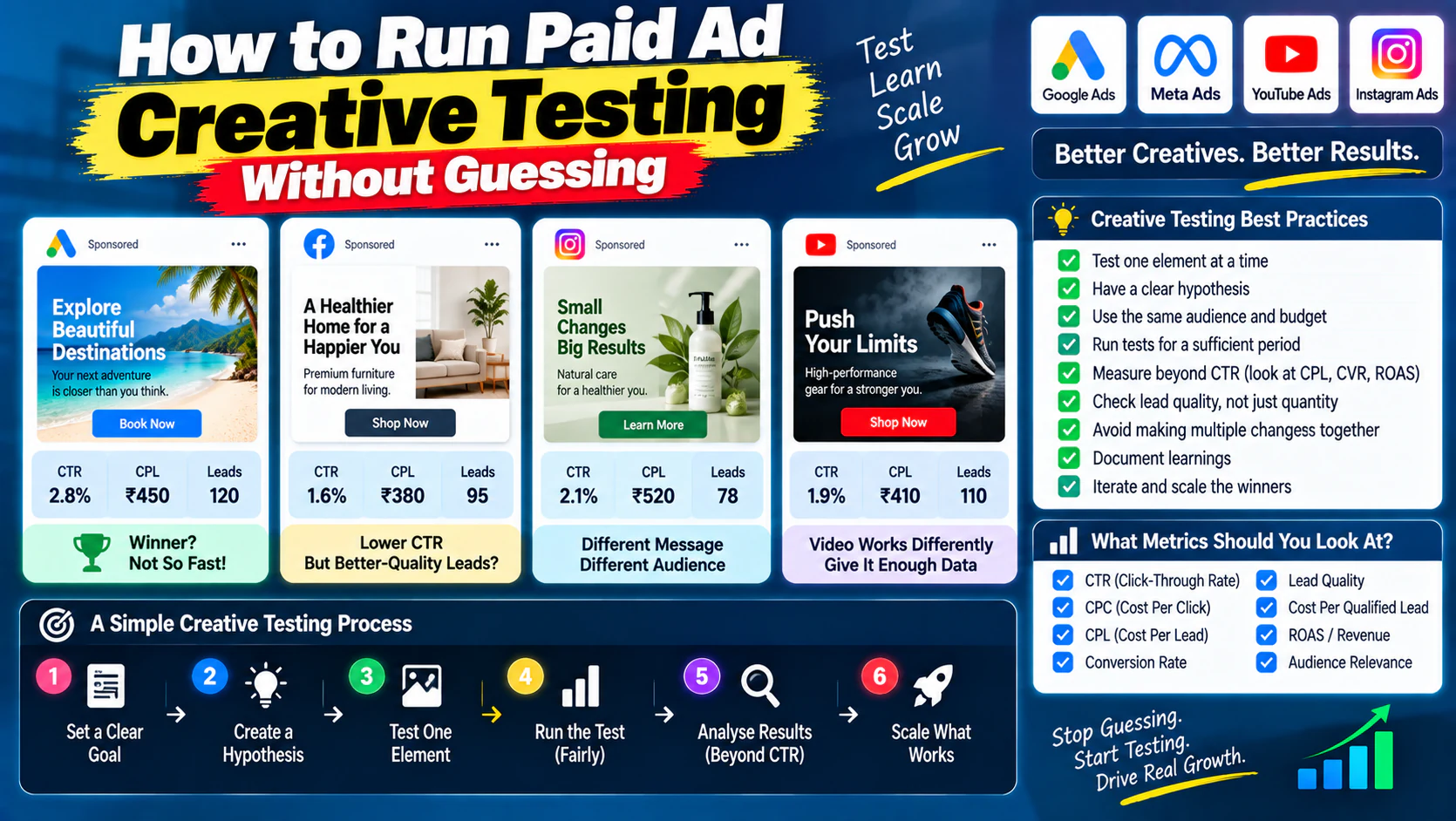
You launch two ads.
One gets a 2.8% click-through rate.
The other gets 1.6%.
So you pause the second one.
Seems logical.
But what if the second ad generated better-quality leads?
Or what if it had a lower CTR but a higher conversion rate?
Or what if both ads were changed at the same time, so you don't actually know what caused the difference?
This is where paid advertising creative testing often goes wrong.
Businesses test ads constantly, but many aren't really running experiments.
They are changing things and watching numbers move.
A proper paid ad creative testing framework gives every test a clear question, a controlled variable, a meaningful success metric, and a decision rule.
The goal isn't to find the ad with the highest CTR.
The goal is to discover which creative elements produce better business outcomes.
What Is Paid Ad Creative Testing?
Paid ad creative testing is the structured process of comparing different advertising messages, visuals, formats, hooks, offers, or calls to action to understand which creative approach performs better.
Depending on the platform, this can involve testing:
- Headlines
- Primary text
- Images
- Videos
- Hooks
- Offers
- Calls to action
- Product angles
- Benefits
- Proof points
- Formats
- Creative concepts
The important word is structured.
If five things change simultaneously, the result becomes difficult to interpret.
Why Most Ad Testing Doesn't Actually Teach You Much
Consider this test:
Ad A
- New headline
- New image
- New offer
- New CTA
Ad B
- Different headline
- Different image
- Different offer
- Different CTA
Ad A gets more conversions.
Which element won?
You don't know.
It could be:
- The headline
- The image
- The offer
- The CTA
- The combination
You learned that Ad A performed better.
You did not necessarily learn why.
That distinction matters because the purpose of testing is not just to identify a winner.
It is to generate insights you can reuse.
The Two Types of Creative Testing
A useful framework separates testing into two levels.
Concept Testing
You test completely different creative ideas.
For example:
Concept A
Focus on how the product makes the customer's life easier.
Concept B
Focus on financial benefit.
Concept C
Focus on the desired outcome.
This tells you which marketing angle resonates most.
Element Testing
Once you have a strong concept, test individual elements.
For example:
- Headline A vs headline B
- Image A vs image B
- CTA A vs CTA B
This helps you refine the winning concept.
A useful progression is:
Don't Start Testing Before Defining the Objective
Before creating variations, decide what you're trying to learn.
For example:
Bad test objective
“Let's test some new ads.”
Too vague.
Better objective
“Determine whether a cost-saving message produces more qualified leads than a productivity-focused message.”
Now the test has a clear question.
The Paid Creative Testing Framework
Use this seven-step process:
- Define the business question ↓
- Choose one variable ↓
- Create meaningful variations ↓
- Keep the audience and offer consistent ↓
- Run the test long enough to collect useful evidence ↓
- Evaluate the right business metric ↓
- Record the insight and apply it
This is the difference between testing and simply changing ads.
Define the Hypothesis
Every meaningful test should begin with a hypothesis.
A useful format is:
If we change X, we expect Y to improve because Z.
Example:
If we lead with a specific business outcome instead of a generic service description, we expect qualified lead rate to improve because the message will be more relevant to high-intent prospects.
Now you have something you can evaluate.
Examples of Good Creative Hypotheses
Hook hypothesis
“If we lead with the customer's biggest pain point, engagement will improve.”
Proof hypothesis
“If we include a specific result or proof point, qualified conversion rate will improve.”
Offer hypothesis
“If we make the initial offer more concrete, conversion rate will increase.”
Visual hypothesis
“If we show the product in use instead of using a generic stock image, engagement will improve.”
CTA hypothesis
“If we use a lower-friction CTA, more users will take the next step.”
Each hypothesis teaches you something.
Choose What to Test
There are many creative variables.
Don't test all of them simultaneously.
A practical testing hierarchy is:
Level 1 — Creative Concept
Test completely different ideas.
Example:
- Problem-focused
- Benefit-focused
- Proof-focused
Level 2 — Hook
Test how the creative gets attention.
Example:
- Question
- Statement
- Statistic
- Pain point
- Outcome
Level 3 — Message
Test the main promise.
Example:
- Save time
- Reduce cost
- Improve performance
Level 4 — Visual
Test:
- Product image
- Human image
- Demonstration
- Before/after
- Screenshot
- Graphic
Level 5 — CTA
Test:
- Learn More
- Get Started
- Book a Call
- Request a Quote
- Shop Now
The exact hierarchy depends on the platform and campaign objective.
Don't Change Everything at Once
Suppose you want to test two headlines.
Keep as much else consistent as practical.
Version A
Version B
If the rest of the creative remains substantially similar, the test provides a clearer comparison of the messaging angle.
Now compare that with:
Version A
- New headline
- New image
- New CTA
- New landing page
Version B
- Different headline
- Different video
- Different CTA
- Different landing page
If B wins, your conclusion is weak.
You changed too many variables.
Test the Right Thing for the Platform
Creative testing looks different across platforms.
Google Ads
For Search campaigns, creative testing can involve:
- Headlines
- Descriptions
- Offers
- Calls to action
- Messaging themes
- Value propositions
Search ads are constrained by the user's existing intent.
The creative often needs to answer:
Meta Ads
On Meta platforms, creative testing can involve much more visual variation:
- Video hooks
- First three seconds
- Images
- UGC-style content
- Demonstrations
- Carousels
- Copy
- Headlines
- Offers
The creative often has to generate or capture attention before the user has explicitly searched for the product.
That makes creative concept testing particularly important.
Creative Testing Is Not the Same as A/B Testing
These terms are often used interchangeably.
But they can represent different levels of rigor.
An A/B test generally compares two variants under a defined testing setup.
Creative testing can be broader.
You may test:
- Multiple concepts
- Multiple formats
- Multiple hooks
- Multiple messages
The important thing is not the label.
The important thing is whether the test produces a useful and interpretable decision.
What Metric Should You Use?
This is where many advertisers make a major mistake.
They optimize creative based on CTR alone.
CTR can be useful.
But it doesn't tell you whether the clicks are valuable.
Consider:
| Creative | CTR | Conversion Rate | Qualified Leads |
|---|---|---|---|
| Ad A | 3.8% | 2.0% | 4 |
| Ad B | 2.7% | 4.1% | 9 |
Ad A wins CTR.
Ad B produces more qualified leads.
If the business goal is lead generation, Ad B may be the more valuable creative.
Match the Metric to the Objective
Awareness
Possible metrics:
- Reach
- Video views
- Attention/engagement indicators
Traffic
Possible metrics:
- Click-through rate
- Cost per click
- Qualified traffic
Lead generation
Possible metrics:
- Conversion rate
- Cost per lead
- Qualified lead rate
- Cost per qualified lead
E-commerce
Possible metrics:
- Purchases
- Revenue
- ROAS
- Contribution margin
The metric should follow the business objective.
Don't Declare a Winner Too Quickly
One of the most common testing mistakes is:
“Ad B got two more conversions today. It's the winner.”
Small samples can fluctuate significantly.
Before making a major decision, consider:
- Spend
- Impressions
- Clicks
- Conversions
- Conversion value
- Traffic quality
- Test duration
- Business cycle
- Variability
There is no universal number of clicks or conversions that guarantees a valid test for every account.
The evidence needs to be strong enough for the decision you are making.
Don't Confuse Random Variation With an Insight
Suppose:
Day 1
Ad A: 5 conversions
Ad B: 3 conversions
Day 2
Ad A: 2 conversions
Ad B: 6 conversions
Day 3
Ad A: 4 conversions
Ad B: 3 conversions
The early lead doesn't necessarily mean anything.
Paid advertising performance naturally fluctuates.
A test should be evaluated over enough relevant data to reduce the risk of reacting to noise.
Control the Audience Before Judging Creative
If Ad A reaches one audience and Ad B reaches another, you're not simply testing creative.
You're testing:
For example:
Ad A
Warm audience
Ad B
Cold audience
If A converts better, you cannot conclude that its creative is better.
The audience itself may explain the difference.
Whenever possible, keep major non-creative variables consistent when the purpose is to isolate creative impact.
Control the Offer
Imagine:
Ad A
10% discount
Ad B
No discount
Ad A generates more purchases.
Did the creative win?
Maybe.
But the offer changed too.
You learned that the combination of creative and offer performed better.
That's still useful, but it is a different conclusion.
Be precise about what you actually tested.
Control the Landing Page
Creative performance doesn't happen in isolation.
A user may:
If Ad A sends users to Landing Page A and Ad B sends users to Landing Page B, you are testing multiple variables.
If your goal is specifically creative testing, keep the landing-page experience consistent where practical.
For broader campaign experiments, changing the full experience can also be valuable.
Just don't confuse the two.
Use a Creative Testing Matrix
A simple matrix can keep testing organized.
| Test | Variable | Version A | Version B | Primary Metric |
|---|---|---|---|---|
| 1 | Hook | Problem | Outcome | Qualified conversion |
| 2 | Headline | Cost saving | Time saving | Conversion rate |
| 3 | Visual | Product | Product in use | CPA |
| 4 | Proof | Testimonial | Case result | Qualified lead rate |
| 5 | CTA | Learn More | Get Started | Conversion rate |
Now your team knows exactly what each test is supposed to teach.
Build a Creative Testing Backlog
Don't wait until performance drops before thinking about new ideas.
Create a backlog.
Messaging ideas
- Lower cost
- Better quality
- Faster results
- Easier process
- More control
- Expert support
Creative formats
- Short video
- Product demonstration
- Customer testimonial
- Screenshot
- Before/after
- Founder explanation
Hooks
- Common mistake
- Customer problem
- Unexpected result
- Strong opinion
- Question
- Specific outcome
Proof
- Customer result
- Review
- Case study
- Data point
- Demonstration
Then prioritize the ideas that address the biggest current uncertainty.
Don't Just Test “Creative”
Test the Customer Insight Behind the Creative
A weak testing process asks:
“Which image performs better?”
A stronger process asks:
“Which customer motivation makes this audience more likely to act?”
For example, you may discover that:
is less important than:
for your target audience.
That is a valuable marketing insight.
It can influence:
- Ads
- Landing pages
- Website copy
- Sales messaging
- Organic content
- Offers
Now your testing program is generating insights for the broader business.
How to Test Hooks
For video and social creative, the opening seconds matter.
Suppose you have the same core video but three different openings.
Hook A — Problem
“Still wasting money on ads that don't convert?”
Hook B — Outcome
“Here's how businesses can reduce wasted ad spend.”
Hook C — Curiosity
“Your best-performing campaign may not be the one you think.”
Now you can learn which opening angle attracts stronger traffic.
But don't evaluate only the number of people who stop scrolling.
Track what happens after the click or engagement as well.
How to Test Headlines
For a service business:
Version A
Version B
The first is service-led.
The second is problem-led.
If B generates stronger qualified leads, you've learned something about the audience's motivation.
That insight can potentially be applied to other campaigns and landing pages.
How to Test Offers
An offer isn't necessarily a discount.
It can be:
- Audit
- Consultation
- Demo
- Free assessment
- Trial
- Guide
- Product bundle
- Limited availability
- Bonus
Test the reason to act, not only the wording of the CTA.
For example:
Offer A
“Request a consultation.”
Offer B
“Get a Google Ads account audit.”
The second offer may feel more concrete because the user knows what they will receive.
Test Proof, Not Just Claims
Consider these two messages:
Ad A
“Grow your business with better Google Ads.”
Ad B
“Identify wasted spend, conversion problems and campaign inefficiencies with a structured Google Ads audit.”
The second is more specific.
Where possible, strong advertising should move beyond vague claims and communicate something the customer can understand or verify.
Proof can include:
- Customer results
- Reviews
- Case studies
- Demonstrations
- Specific processes
- Relevant credentials
But proof should be genuine and accurately represented.
Use a Testing Scorecard
After each experiment, record:
| Field | Example |
|---|---|
| Test ID | CT-07 |
| Hypothesis | Outcome-focused message will improve qualified leads |
| Variable | Messaging angle |
| Audience | New prospects |
| Platform | Meta |
| Start date | — |
| End date | — |
| Spend | — |
| Impressions | — |
| Clicks | — |
| Conversions | — |
| Qualified conversions | — |
| Winner | — |
| Learning | — |
| Next test | — |
This prevents the team from forgetting what it learned.
The Most Important Field: Learning
Don't write:
Write:
That is an insight.
Now you can test it again.
Maybe on:
- Another audience
- Another format
- Another platform
- Another landing page
The goal is to turn individual tests into reusable knowledge.
What If the Test Is Inconclusive?
That's okay.
Not every test needs a winner.
You might conclude:
“There is insufficient evidence to prefer either creative.”
That's better than forcing a decision from weak data.
You can:
- Continue testing
- Create a stronger variation
- Test a different concept
- Increase the sample
- Move to another variable
An inconclusive test still tells you that the current hypothesis was not sufficiently proven.
What If Both Ads Perform Well?
That's also valuable.
You may have discovered that:
Now test them against a third concept.
For example:
- Problem-focused
- Outcome-focused
- Proof-focused
You are gradually mapping the audience's response.
What If Both Ads Perform Poorly?
Don't automatically create another headline.
Ask whether the problem is deeper.
Possible causes:
- Wrong audience
- Weak offer
- Poor positioning
- Low demand
- Bad landing page
- Weak product
- Poor search intent
- Incorrect campaign objective
Creative testing cannot fix every marketing problem.
Creative Testing Across Google and Meta
The platforms behave differently.
Google Ads
Users often arrive with existing intent.
Testing should focus heavily on:
- Relevance
- Value proposition
- Differentiation
- Offer
- Proof
- CTA
The user has already told you something through their search.
Your creative needs to respond to that intent.
Meta Ads
Users may not be actively searching for the product.
Creative often needs to create or capture attention.
Testing can therefore place more emphasis on:
- Hook
- Visual
- Story
- Problem recognition
- Demonstration
- Social proof
- Emotional motivation
This doesn't mean one platform is “better.”
It means the creative job is different.
A/B Testing Ads vs Landing Pages
Sometimes the bigger uncertainty isn't the ad.
It is the destination.
Suppose:
but
Creating 20 more ads may not solve the problem.
You may need to test the landing page.
Likewise, if:
but
the creative may deserve more attention.
This is why creative testing should be part of the larger paid acquisition optimization process.
A Practical Decision Tree
Use this when deciding what to test next.
Are enough relevant users reaching the ad? │ Yes ↓ Is the ad generating quality traffic? │ ┌─────┴─────┐ Yes No ↓ ↓ Is the landing Test page converting? creative/message │ ┌────┴────┐ Yes No ↓ ↓ Scale / Test refine landing page
The exact diagnostic process depends on the campaign, but the principle is important:
12 Paid Creative Testing Mistakes to Avoid
Testing without a hypothesis
You cannot clearly explain what you wanted to learn.
Changing multiple variables
The result becomes difficult to interpret.
Using CTR as the only success metric
Clicks are not customers.
Stopping tests too early
Small samples can produce misleading results.
Comparing different audiences
You may be testing audience quality instead of creative.
Changing the offer
You may no longer be testing creative alone.
Changing the landing page
Now multiple funnel variables have changed.
Running too many tests simultaneously
Your budget becomes fragmented.
Copying competitor creatives blindly
Their audience and economics may be different.
Testing tiny wording changes forever
Sometimes a bigger concept difference is more valuable.
Never documenting results
The same tests get repeated.
Optimizing for platform metrics instead of business outcomes
The ad that gets the cheapest click may not produce the best customer.
How Much Should You Test?
There is no universal number of creatives that every account needs.
The appropriate testing volume depends on:
- Budget
- Audience size
- Traffic volume
- Platform
- Conversion rate
- Creative fatigue
- Business objective
A small account with limited traffic may be better served by fewer, more meaningful experiments.
A large account may support a much more systematic creative testing program.
The objective is not to maximize the number of tests.
It is to maximize useful learning per unit of spend.
A Weekly Creative Testing Workflow
A practical operating rhythm could look like this:
Monday — Review
Identify:
- Winning creatives
- Declining creatives
- Fatigue
- Weak conversion paths
- New opportunities
Tuesday — Hypothesis
Choose the biggest uncertainty.
Wednesday — Build
Create controlled variations.
Thursday — Launch
Start the experiment.
Following days/weeks — Collect evidence
Avoid making premature decisions.
Review
Compare against the predefined metric.
Document
Record the result and learning.
Next test
Use the insight to create the next hypothesis.
This turns creative testing into a process rather than an emergency activity.
Build a Creative Learning Library
Over time, organize winning insights by:
Audience
- New prospects
- Returning users
- Existing customers
Message
- Price
- Quality
- Speed
- Convenience
- Trust
- Outcome
Format
- Video
- Image
- Carousel
- Search ad
Hook
- Problem
- Question
- Result
- Curiosity
Proof
- Review
- Case study
- Demonstration
- Data
Now the business develops its own creative knowledge base.
That is much more valuable than simply having a folder full of “winning ads.”
The Ultimate Creative Testing Framework
Use this sequence:
Identify the biggest uncertainty.
What don't you know?
Write the hypothesis.
What do you believe will happen?
Choose one major variable.
What are you actually testing?
Create meaningful variations.
Make the difference clear enough to teach you something.
Control other major variables.
Don't accidentally test audience, offer, landing page, and creative simultaneously.
Choose the right metric.
Measure what matters to the business.
Collect enough evidence.
Don't confuse noise with performance.
Record the learning.
Explain why the result matters.
Apply the insight.
Use it in the next experiment.
Repeat.
Testing becomes a compounding knowledge system.
