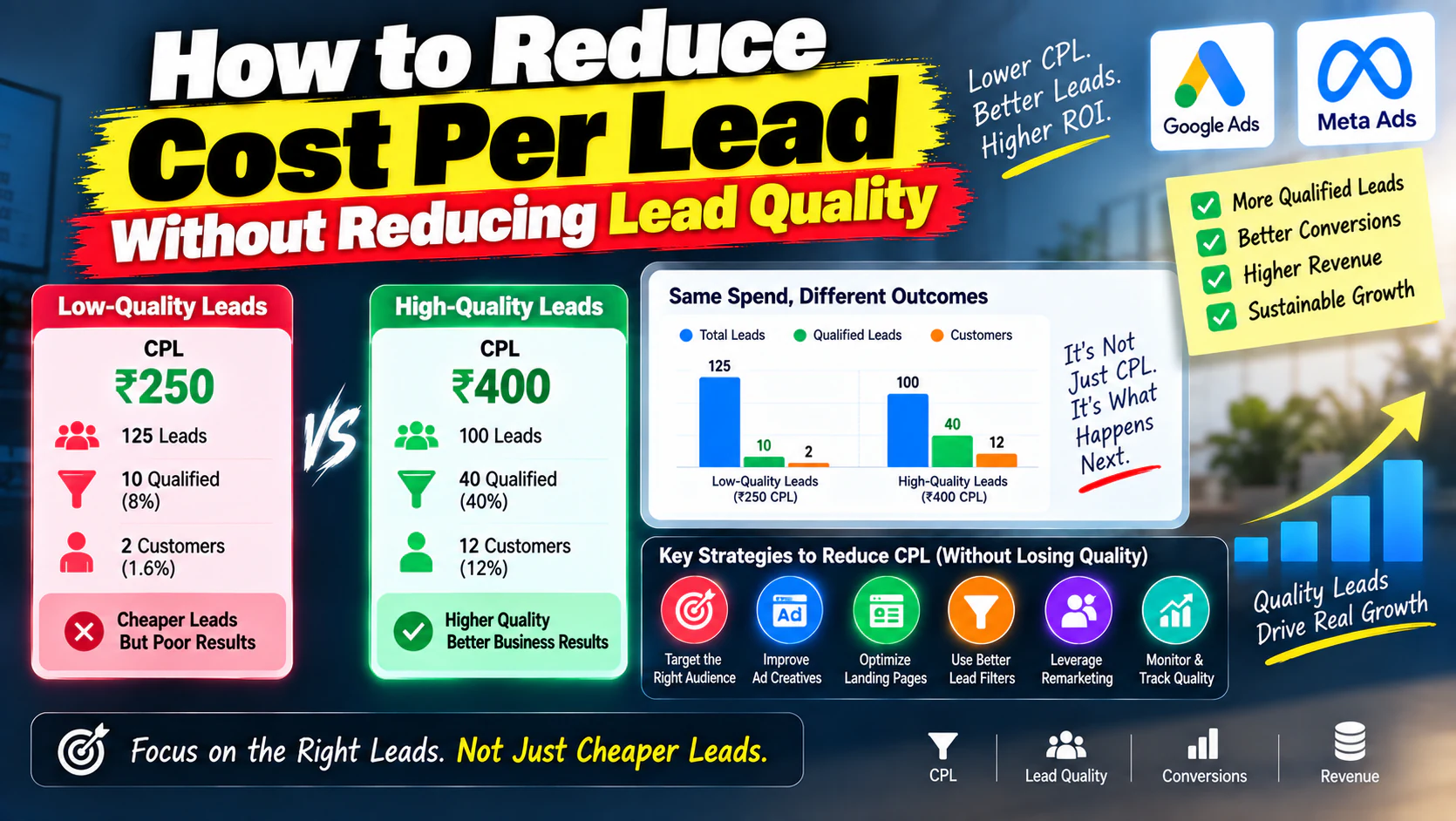
A lower cost per lead (CPL) looks good in a campaign report.
But if the cheaper leads are irrelevant, unqualified, unable to buy, or never respond to sales follow-up, you have not actually improved the campaign.
You have simply made bad leads cheaper.
The real performance marketing goal is different:
Reduce acquisition cost while protecting the quality of leads entering the sales pipeline.
That requires looking beyond CPC and CPL.
A campaign can generate leads at ₹400 each and outperform another campaign generating leads at ₹250 each if the ₹400 leads convert into customers at a much higher rate.
So instead of asking:
ask:
This article explains how to do exactly that.
What Is Cost Per Lead?
Cost per lead is the amount spent on advertising to generate one lead.
The basic formula is:
For example:
- Ad spend: ₹1,00,000
- Leads generated: 200
- CPL: ₹500
At first glance, ₹500 CPL may look efficient.
But suppose only 20 of those 200 leads are genuinely qualified.
Your effective cost per qualified lead is:
Now imagine another campaign:
- Spend: ₹1,00,000
- Leads: 125
- CPL: ₹800
- Qualified leads: 40
Its CPL is higher, but its qualified-lead acquisition cost is:
The second campaign is actually much stronger.
That is why CPL should never be optimized in isolation.
Why Reducing CPL Can Destroy Lead Quality
There are several easy ways to make CPL fall.
You can:
- broaden targeting
- use cheaper placements
- reduce audience restrictions
- optimize toward a less valuable conversion
- make the offer more generic
- reduce friction on the form
- target lower-intent searches
- increase automated bidding flexibility
- run aggressive lead-generation campaigns
These tactics can increase conversion volume.
But volume is not the same as business value.
Example
Imagine a real estate company running paid ads.
Campaign A:
- 100 leads
- ₹500 CPL
- 15 qualified leads
- 3 sales
Campaign B:
- 180 leads
- ₹278 CPL
- 8 qualified leads
- 1 sale
Campaign B appears better inside the advertising platform.
Campaign A is better for the business.
This is the central mistake behind many CPL optimization strategies:
The 7 Biggest Levers to Reduce CPL Without Lowering Lead Quality
If your goal is sustainable acquisition efficiency, focus on these seven areas.
- Search and audience intent
- Campaign and budget allocation
- Creative-to-audience fit
- Landing page conversion quality
- Lead-form friction
- Qualification and conversion tracking
- Sales feedback and campaign optimization
Let's break them down.
Improve Intent Before Trying to Lower CPC
One of the fastest ways to reduce wasted advertising spend is to improve the quality of the traffic entering the campaign.
For search campaigns, examine the actual queries generating clicks and conversions.
You may discover that your campaign is receiving traffic from searches that are:
- informational
- price-shopping
- job-related
- educational
- irrelevant to your service
- outside your geographic area
- looking for a different product
- too early in the buying journey
These clicks can inflate spend without producing meaningful opportunities.
Instead of immediately lowering bids, first ask:
Then:
- exclude irrelevant searches
- tighten keyword themes
- separate high-intent terms
- improve match between keyword and landing page
- create dedicated campaigns for valuable intent groups
For example, a software company may find a major difference between:
and
The second search contains significantly more commercial context.
A campaign built around intent rather than raw traffic can often improve both lead quality and acquisition efficiency.
Stop Giving Equal Budget to Unequal Campaigns
Not every campaign deserves the same budget.
A common mistake is dividing spend evenly across campaigns because they were all launched together.
Instead, evaluate campaigns based on business outcomes.
Create a simple performance table:
| Campaign | Spend | Leads | CPL | Qualified Leads | CPQL | Customers |
|---|---|---|---|---|---|---|
| Campaign A | ₹30K | 75 | ₹400 | 15 | ₹2,000 | 4 |
| Campaign B | ₹30K | 120 | ₹250 | 7 | ₹4,286 | 1 |
| Campaign C | ₹40K | 80 | ₹500 | 24 | ₹1,667 | 6 |
Campaign B has the lowest CPL.
But Campaign C produces the strongest qualified-lead economics.
The answer is not necessarily to kill Campaign B immediately.
Instead, investigate why its leads are cheaper but weaker.
Then shift incremental budget toward campaigns that consistently produce valuable pipeline.
Match Creative to the Audience's Actual Problem
Your ad does more than generate clicks.
It pre-qualifies the people who click.
If your message is too broad, you may attract everyone.
And when everyone clicks, nobody is properly qualified.
Weak message
Almost any business owner can relate to it.
That is precisely the problem.
More specific message
This message filters the audience.
Someone looking only for social media followers may ignore it.
A B2B company actively looking for lead generation may click.
That means your ad copy can function as a qualification mechanism.
A useful principle is:
Don't optimize your ads only to attract more people. Optimize them to attract the right people.
Fix the Landing Page Before Increasing Traffic
Sometimes CPL is high because the advertising campaign is doing its job — but the landing page is not.
Suppose:
- 1,000 visitors arrive
- 50 submit the form
- landing-page conversion rate \= 5%
If you improve the page to 7%, you generate 70 leads from the same traffic.
You have increased lead volume without increasing media spend.
That can reduce CPL substantially.
But there is an important warning:
A page can generate more leads by making the form extremely easy.
Those additional leads may be poor quality.
Instead, improve:
- message match
- offer clarity
- proof
- qualification information
- CTA relevance
- page speed
- form usability
- objection handling
- trust signals
Your landing page should make the right prospect think:
Not:
Add Enough Friction to Filter Bad Leads
More form fields usually create more friction.
But zero friction can create another problem: low-quality submissions.
The goal is not the shortest possible form.
The goal is the right amount of qualification.
Depending on the business, useful qualifying information may include:
- company size
- service required
- monthly marketing budget
- location
- project type
- expected timeline
- current website
- business category
For example, if a service costs ₹1 lakh and the prospect's budget is ₹5,000, generating that lead may not help the sales team.
A qualifying question can prevent wasted sales effort.
However, don't add ten unnecessary fields.
Use only information that helps determine whether the lead is commercially relevant.
Optimize for Qualified Leads, Not Just Form Submissions
This is one of the most important changes a performance marketing team can make.
Instead of measuring only:
measure:
For example:
| Stage | Number |
|---|---|
| Clicks | 2,000 |
| Leads | 200 |
| Qualified Leads | 60 |
| Sales Opportunities | 25 |
| Customers | 10 |
Now compare two campaigns.
Campaign A
200 leads → 30 qualified → 5 customers
Campaign B
120 leads → 48 qualified → 9 customers
Campaign A has the lower CPL.
Campaign B produces almost twice as many customers.
That means the optimization target should move downstream.
Give Sales Feedback to the Advertising Team
Marketing cannot accurately optimize lead quality if it never learns what happens after the lead is generated.
The advertising dashboard might tell you:
- 500 leads
- ₹350 CPL
- 12% conversion rate
Sales might tell you:
That information needs to flow back into campaign decisions.
Create a feedback loop:
Then classify leads.
For example:
A — High quality
Strong fit and sales-ready.
B — Potential
Good fit but requires nurturing.
C — Poor fit
Wrong company, budget, location, requirement, or intent.
D — Invalid
Spam, fake, duplicate, unreachable, etc.
Once you have this data, compare campaign performance based on lead quality.
The Metric You Should Watch Instead of CPL Alone
CPL is useful.
But for many businesses, Cost Per Qualified Lead (CPQL) is more meaningful.
The formula is:
Suppose:
Campaign A:
- Spend \= ₹60,000
- Leads \= 200
- Qualified leads \= 30
- CPL \= ₹300
- CPQL \= ₹2,000
Campaign B:
- Spend \= ₹60,000
- Leads \= 120
- Qualified leads \= 40
- CPL \= ₹500
- CPQL \= ₹1,500
Campaign B has a worse CPL.
But it has a better CPQL.
That is a much stronger signal.
For sales-led businesses, you can go even further:
or:
The further downstream your measurement goes, the closer you get to actual business economics.
How to Find Where Your CPL Is Being Wasted
Don't immediately change everything.
Diagnose the funnel first.
Use this sequence:
Check traffic quality
Are the clicks relevant?
Check conversion rate
Does the landing page convert relevant visitors?
Check lead quality
Are submissions commercially relevant?
Check qualification rate
What percentage become qualified?
Check sales conversion
How many qualified leads become opportunities or customers?
This gives you a much clearer picture.
A Simple CPL Diagnostic Framework
If CPC is high, investigate:
- keyword competition
- audience quality
- ad relevance
- targeting
- bidding
- account structure
If CPC is acceptable but CPL is high, investigate:
- landing-page conversion rate
- message match
- offer
- page UX
- CTA
- form experience
If CPL is low but lead quality is poor, investigate:
- targeting
- search terms
- audience expansion
- ad messaging
- qualification
- conversion definition
If lead quality is good but customers are still low, investigate:
- sales follow-up
- lead response time
- offer
- pricing
- sales process
- CRM stages
- attribution
This prevents the classic mistake of changing the ads when the real problem is somewhere else.
Don't Optimize Every Campaign the Same Way
Different campaign types require different optimization logic.
Search campaigns
Focus heavily on:
- search intent
- search terms
- keyword themes
- location
- ad relevance
- landing-page alignment
Meta campaigns
Focus more heavily on:
- creative
- audience signals
- offer
- hooks
- funnel stage
- lead qualification
Remarketing
Focus on:
- audience recency
- previous actions
- message sequencing
- objections
- offer progression
The cheapest lead source is not automatically the best source.
The best source is the one that produces the strongest qualified pipeline for the available spend.
5 Changes You Can Make This Week
If you want to reduce CPL without damaging quality, don't redesign the entire account at once.
Start with these five actions.
Export your last 30–90 days of lead data
Add:
- campaign
- ad set/ad group
- keyword or audience
- spend
- leads
- qualified leads
- opportunities
- customers
Calculate CPQL
Find campaigns that produce cheap leads but expensive qualified opportunities.
Identify your best lead sources
Look for the campaigns, audiences, searches and creatives producing the highest percentage of qualified leads.
Review your landing pages
Compare conversion rate, lead quality and message match.
Feed sales outcomes back into marketing
If possible, connect CRM outcomes to your advertising measurement so optimization can move beyond form submissions.
A Better Optimization Loop
The strongest paid acquisition systems do not optimize once.
They continuously learn.
A practical loop looks like this:
But each iteration should answer one specific question.
For example:
Test it.
Test it.
Test it.
This turns paid advertising from random tweaking into structured optimization.
The Real Goal: Lower Cost of Good Customers
The biggest mistake in CPL optimization is treating the lead as the final outcome.
It isn't.
For most businesses, the real journey is:
Every stage matters.
If you reduce CPL while damaging the next stage, the apparent improvement may actually hurt the business.
So before celebrating a 30% CPL reduction, ask:
- Did qualified-lead rate improve?
- Did sales acceptance improve?
- Did opportunity rate improve?
- Did customer acquisition cost improve?
- Did revenue improve?
If the answer is no, the cheaper CPL may be meaningless.