
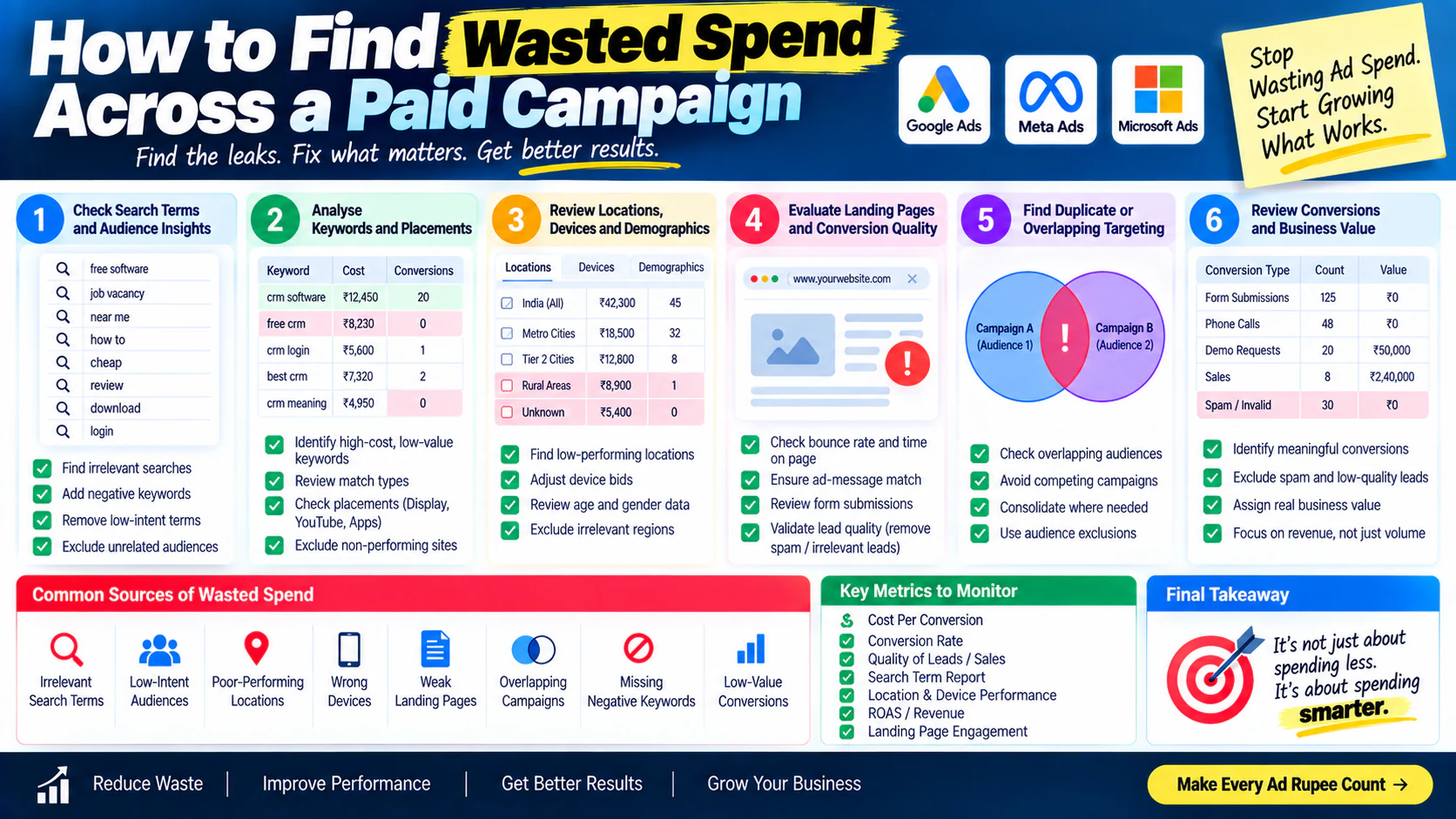
Your paid advertising campaign spent ₹1,00,000 this month.
The dashboard looks busy.
There are thousands of impressions.
Hundreds of clicks.
Maybe even some leads.
But when you look at the actual business results, you start wondering:
That's the real paid advertising problem.
Because wasted spend doesn't always look like an obvious mistake.
You can waste money on:
- irrelevant search terms
- low-intent traffic
- poor-performing locations
- expensive keywords
- weak landing pages
- duplicate targeting
- bad audience segments
- poor-quality leads
- campaigns that receive budget without producing enough value
- conversions that are being tracked but aren't meaningful
And the most dangerous part?
This guide gives you a practical framework to find that leakage before simply cutting your entire advertising budget.
What Is Wasted Ad Spend?
Wasted ad spend is money spent on advertising activity that does not contribute enough to your desired business outcome.
That doesn't always mean:
A campaign can generate conversions and still waste money.
For example:
You spend ₹50,000.
You generate 25 leads.
But 15 leads are:
- irrelevant
- outside your service area
- too small for your business
- looking for a free service
- spam
- not decision-makers
Technically, the campaign generated 25 conversions.
Commercially, it may have generated only 10 useful opportunities.
That's why wasted-spend analysis should go beyond the advertising platform's conversion count.
The Real Paid Advertising Funnel
Think about your campaign as:
Every stage can leak money.
Budget
Are you allocating money to the right campaigns?
Traffic
Are you paying for relevant people?
Leads
Are visitors taking meaningful actions?
Qualified Leads
Are those enquiries actually valuable?
Sales
Are opportunities becoming customers?
Revenue
Does the customer acquisition cost make business sense?
If you only look at:
you cannot see the complete picture.
The 7 Biggest Sources of Wasted Paid Ad Spend
Most wasted spend can usually be investigated through seven areas:
- Wrong traffic
- Wrong targeting
- Weak campaign structure
- Poor conversion experience
- Bad budget allocation
- Low-quality conversions
- Poor measurement
Let's break them down.
Wasted Spend From Irrelevant Search Terms
For search campaigns, this is one of the first places to investigate.
You may target:
but receive searches such as:
- SEO jobs
- SEO course
- SEO salary
- SEO tutorial
- free SEO tools
- SEO certification
If your business sells SEO services, these searches may consume money without producing customers.
The solution isn't necessarily to stop advertising.
It may be:
Review which queries are consuming the most money.
Then classify them.
Keep
Relevant and commercially valuable.
Expand
Strong searches that deserve dedicated targeting.
Exclude
Clearly irrelevant or commercially unsuitable.
Monitor
Relevant but not yet proven.
For a deeper search-term process, connect this analysis with PM-08: Search Term Analysis: How to Find Wasted Google Ads Spend.
Wasted Spend From Poor Search Intent
A search can be relevant but still have the wrong intent.
For example:
could mean:
- looking for inspiration
- learning website design
- comparing providers
- looking for a freelancer
- looking for an agency
- searching for a course
Compare that with:
The second search gives a much clearer commercial signal.
If your campaign is built to generate leads, paying heavily for low-intent traffic can reduce efficiency.
Ask:
Don't just ask:
Wasted Spend From Poor Keyword Selection
Keyword selection affects both traffic quality and economics.
Some keywords can have:
- high CPC
- high competition
- low intent
- low conversion rate
- poor lead quality
while more specific keywords can produce fewer clicks but better opportunities.
For example:
may generate much broader traffic than:
The more specific search may have lower volume.
But if it produces better customers, it can be more valuable.
The goal isn't maximum keyword volume.
Wasted Spend From Missing Negative Keywords
Negative keywords can prevent ads from appearing for searches that don't fit your campaign.
Common categories worth investigating include:
Employment
- jobs
- career
- salary
- vacancy
- internship
Education
- course
- training
- certification
- tutorial
- classes
Free/DIY
- free
- template
- download
- DIY
Unrelated intent
Any terms clearly unrelated to your actual product or service.
But don't blindly create a universal negative list.
For example:
A training company may want:
An agency may not.
Negative keyword decisions should always reflect the business model.
Wasted Spend From Poor Location Targeting
Location targeting is easy to overlook.
Suppose your company serves:
but your paid campaign attracts enquiries from locations you don't serve.
Those clicks still cost money.
Check:
- locations receiving spend
- locations producing leads
- locations producing qualified leads
- locations producing customers
- excluded areas
- serviceable areas
Create a simple comparison.
| Location | Spend | Leads | Qualified Leads |
|---|---|---|---|
| Ahmedabad | ₹25,000 | 18 | 10 |
| Surat | ₹15,000 | 11 | 7 |
| Vadodara | ₹10,000 | 5 | 3 |
| Outside service area | ₹8,000 | 7 | 0 |
The last row deserves immediate investigation.
Seven leads may sound good.
But if none can become customers, that ₹8,000 is effectively leakage.
Wasted Spend From Poor Device Performance
The same campaign can behave differently across:
- mobile
- desktop
- tablet
For example:
| Device | Spend | Leads | CPL |
|---|---|---|---|
| Mobile | ₹40,000 | 8 | ₹5,000 |
| Desktop | ₹25,000 | 15 | ₹1,667 |
| Tablet | ₹5,000 | 0 | — |
Don't immediately conclude:
First investigate why.
Possible reasons:
- slow mobile page
- poor form experience
- difficult navigation
- weak CTA visibility
- mobile-specific technical issue
Sometimes the waste is not the device.
It's the experience you're giving that device.
Wasted Spend From Audience Overlap
Paid campaigns can sometimes target overlapping audiences.
For example, you may have:
- prospecting campaign
- remarketing campaign
- customer campaign
- competitor campaign
with overlapping targeting.
If the same user qualifies for multiple campaigns, you need to understand how your structure and exclusions affect delivery and reporting.
Ask:
This is particularly important when running multiple channels and campaigns.
Wasted Spend From Duplicate Keywords or Intent
You may have multiple campaigns targeting essentially the same search intent.
For example:
Campaign A: Google Ads Agency
Campaign B: PPC Agency
Campaign C: Google Ads Management
If all three are competing for very similar traffic without a strategic reason, the account can become unnecessarily complicated.
The answer isn't always to merge campaigns.
Instead, understand:
- intent
- budget
- geography
- audience
- landing page
- messaging
- performance
Campaign structure should support decision-making.
Wasted Spend From Poor Campaign Structure
A poorly structured account can make budget leakage difficult to identify.
Imagine one campaign contains:
- brand keywords
- generic keywords
- competitor searches
- high-intent terms
- informational searches
Now you have one budget pool serving very different types of users.
A strong campaign may be easier to control when meaningful intent categories are separated.
For example:
The right structure depends on account size and volume.
Don't create 30 campaigns just because an account “should look organized.”
Wasted Spend From Poor Ad-to-Page Relevance
A user searches:
Your ad says:
They click.
The landing page says:
Nothing is technically broken.
But the journey is weak.
The user expected:
and received:
That mismatch can turn paid clicks into wasted spend.
A stronger journey is:
Search: Google Ads management agency
Ad: Google Ads Management for Growing Businesses
Landing Page: Google Ads Management Services
CTA: Request a Campaign Consultation
The message should remain consistent.
Wasted Spend From a Weak Landing Page
If you're paying for traffic, your landing page is part of your advertising investment.
A weak page can waste money through:
- unclear headline
- generic copy
- weak CTA
- slow loading
- poor mobile UX
- too many distractions
- weak trust signals
- difficult forms
- unclear offer
Imagine spending ₹1,00,000 to acquire traffic and sending all of it to a page that doesn't persuade visitors to act.
The problem isn't necessarily the media buying.
For a deeper breakdown, see WEB-14: Landing Page Anatomy: What Every High-Converting Page Needs.
Wasted Spend From Too Many Landing Pages—or None
There are two opposite problems.
Problem A: One Generic Page
Every campaign sends traffic to the homepage.
Problem B: Too Many Similar Pages
You create dozens of nearly identical pages with no meaningful differentiation.
The better approach is:
For example:
- Google Ads management
- SEO services
- Ecommerce website development
- B2B lead generation
Each page should answer the visitor's specific need.
Wasted Spend From Weak Offers
Sometimes the traffic is good.
The landing page is reasonable.
But nobody has a strong reason to act.
Compare:
with:
The second gives the visitor a clearer next step.
Depending on the business, the offer might be:
- consultation
- audit
- demo
- quote
- assessment
- trial
- product enquiry
The goal is to reduce the gap between:
and
Wasted Spend From Low-Quality Conversions
This is one of the most dangerous sources of hidden waste.
Your dashboard may show:
That sounds great.
But after sales reviews the leads:
- 20 are irrelevant
- 10 are outside the target geography
- 8 are too small
- 5 are students
- 4 are spam
- 3 are genuine opportunities
Now your 50 conversions become:
Your optimization strategy needs to reflect that difference.
Track:
not only:
Wasted Spend From Incorrect Conversion Tracking
Sometimes the opposite happens.
You actually receive good leads.
But Google Ads isn't measuring them properly.
Examples:
- phone calls aren't tracked
- form submissions don't fire correctly
- duplicate conversions are recorded
- old conversion actions remain active
- low-value actions are treated as primary conversions
- offline sales aren't connected to campaigns
Then your optimization decisions are based on inaccurate data.
Before concluding that a campaign is wasting money:
Wasted Spend From Optimizing the Wrong Conversion
Suppose your actual business goal is:
But the account optimizes toward:
You may get more button clicks.
That doesn't necessarily mean more customers.
Your advertising system should be aligned with the actions that matter commercially.
A useful hierarchy is:
The higher you move in this funnel, the more meaningful the data becomes.
Wasted Spend From Bad Budget Allocation
Imagine a monthly budget of:
You allocate:
- ₹25,000 to Campaign A
- ₹25,000 to Campaign B
- ₹25,000 to Campaign C
- ₹25,000 to Campaign D
That looks balanced.
But what if:
| Campaign | Spend | Qualified Leads |
|---|---|---|
| A | ₹25,000 | 14 |
| B | ₹25,000 | 9 |
| C | ₹25,000 | 2 |
| D | ₹25,000 | 0 |
Equal budget doesn't necessarily make sense.
Campaign D may need restructuring.
Campaign C may need investigation.
Campaign A may deserve more budget.
Wasted Spend From Scaling Too Early
A campaign produces a few conversions.
The business immediately doubles the budget.
Performance drops.
Why?
Because the original performance may not have been stable enough to support the increase.
Before scaling, ask:
- Is conversion tracking reliable?
- Is lead quality acceptable?
- Are results consistent?
- Is the campaign economically viable?
- Is there enough volume?
- Are search terms clean?
- Is the landing page converting?
Scaling a broken funnel simply creates a larger broken funnel.
Wasted Spend From Ignoring Customer Acquisition Cost
CPL is useful.
But it isn't the final metric.
Imagine:
That sounds affordable.
But if only 1 in 20 leads becomes a customer:
Now the business question changes.
Is ₹40,000 a profitable acquisition cost?
That depends on customer value and margin.
This is why paid advertising should ultimately be evaluated against:
not only CPC or CPL.
Wasted Spend From Ignoring Sales Follow-Up
A campaign can generate excellent leads and still appear to be underperforming.
Why?
The sales team doesn't respond quickly.
Or leads aren't followed up consistently.
For example:
The advertising may not be the biggest problem.
The leakage may be between:
Marketing and sales need to be evaluated as one acquisition system.
A Practical Paid Campaign Waste Audit
Use this process when reviewing an account.
Step 1 — Start With Total Spend
Record:
- total spend
- clicks
- impressions
- conversions
- revenue where available
Then break the numbers down.
Step 2 — Find the Biggest Spend Buckets
Sort by:
Look at:
- campaigns
- ad groups
- keywords
- search terms
- audiences
- locations
- devices
You are looking for areas consuming meaningful budget.
Step 3 — Compare Spend With Business Outcomes
Don't ask only:
Ask:
Compare:
- spend
- conversions
- qualified leads
- opportunities
- customers
- revenue
Step 4 — Identify the Largest Leaks
Look for:
High spend + zero meaningful results
Immediate investigation.
High spend + poor lead quality
Targeting problem.
Low spend + excellent results
Potential scaling opportunity.
High conversions + low sales
Lead-quality or sales problem.
High CTR + low conversions
Post-click problem or intent mismatch.
Use a Wasted Spend Score
For internal analysis, you can create a simple priority score.
For each segment, evaluate:
For example:
| Segment | Spend | Risk | Priority |
|---|---|---|---|
| Campaign A | ₹35,000 | Low | Monitor |
| Campaign B | ₹28,000 | High | Immediate |
| Search terms | ₹20,000 | High | Immediate |
| Mobile traffic | ₹12,000 | Medium | Investigate |
| Competitor campaign | ₹5,000 | Medium | Review |
This helps your team avoid spending three hours optimizing something that only consumed ₹500.
Don't Chase Every Small Waste
This is important.
If a search term spent:
without converting, it may not deserve immediate attention.
If a search category consumed:
with no qualified outcomes, it deserves attention.
Prioritize by:
not by how easy the change is.
How to Calculate Potential Savings
Suppose a campaign spends:
You identify:
- 10% irrelevant search spend
- 5% poor location spend
- 5% low-quality audience spend
Potential leakage:
Potential spend requiring investigation:
But don't assume all ₹40,000 can simply be removed.
Some of it may be recoverable through:
- better targeting
- stronger negatives
- improved landing pages
- better allocation
- improved conversion tracking
The goal is not to make the campaign spend as little as possible.
What to Fix First
Use this priority order.
Tracking Problems
Fix measurement immediately.
Obvious Irrelevant Traffic
Stop clearly wasted traffic.
High-Spend, Low-Value Segments
Investigate the biggest financial leaks.
Search Intent
Improve targeting.
Landing Page
Fix post-click conversion problems.
Budget Allocation
Move budget based on evidence.
Lead Quality
Connect advertising with sales outcomes.
Scaling
Only scale once the fundamentals are working.
What Not to Do
Don't Cut the Entire Budget
One bad campaign doesn't mean the entire paid strategy is broken.
Don't Pause Everything
You may destroy useful data and profitable traffic.
Don't Optimize Only for CPL
Cheap leads can be terrible leads.
Don't Optimize Only for CTR
Clicks don't equal customers.
Don't Create Hundreds of Negative Keywords Without Thinking
Over-filtering can remove valuable demand.
Don't Make Ten Changes at Once
You won't know what caused the result.
Don't Ignore the Website
Paid traffic still has to convert somewhere.
A Complete Wasted Spend Audit Checklist
Campaign Level
- Which campaigns consume the most budget?
- Which campaigns produce qualified leads?
- Which campaigns have poor economics?
- Is budget allocated according to performance?
Keyword Level
- Which keywords consume the most spend?
- Which keywords produce qualified leads?
- Which keywords have high CPC and weak outcomes?
- Are there duplicate or overlapping intents?
Search-Term Level
- Which searches are irrelevant?
- Which indicate job intent?
- Which indicate educational intent?
- Which indicate free/cheap intent?
- Which searches reveal new opportunities?
Audience Level
- Are audiences relevant?
- Are there overlaps?
- Are remarketing audiences being used correctly?
- Are low-value segments consuming budget?
Location Level
- Where is money being spent?
- Which locations generate qualified leads?
- Are non-serviceable locations receiving traffic?
Device Level
- Which devices convert?
- Is mobile UX creating problems?
- Are there technical issues?
Landing Page Level
- Does the page match the ad?
- Is the offer clear?
- Is the CTA visible?
- Is the form easy enough?
- Is the page fast?
- Does it work properly on mobile?
- Are trust signals present?
Measurement Level
- Are conversions tracked?
- Are duplicates being counted?
- Are primary conversions meaningful?
- Are offline sales connected where appropriate?
Business Level
- Are leads qualified?
- Are sales following up?
- What is the customer acquisition cost?
- What revenue does the campaign generate?
A Simple Monthly Waste Audit Template
At the end of every reporting period, create five columns:
| Area | Spend | Problem | Action | Expected Impact |
|---|---|---|---|---|
| Search terms | ₹18,000 | Irrelevant queries | Add negatives | Reduce waste |
| Location | ₹7,000 | Non-service area | Refine targeting | Improve lead quality |
| Campaign C | ₹25,000 | Poor qualified-lead rate | Restructure | Improve efficiency |
| Landing page | ₹40,000 traffic | Low CVR | Improve page | Increase conversions |
| Campaign A | ₹30,000 | Strong results | Test scale | Increase volume |
This transforms an account review from:
into:
The Best Way to Think About Wasted Spend
Don't ask:
Ask:
That difference matters.
A campaign spending ₹1,00,000 and generating ₹4,00,000 in profitable business is very different from a campaign spending ₹30,000 and generating nothing useful.
The objective is not minimum spend.
The objective is efficient acquisition.
