
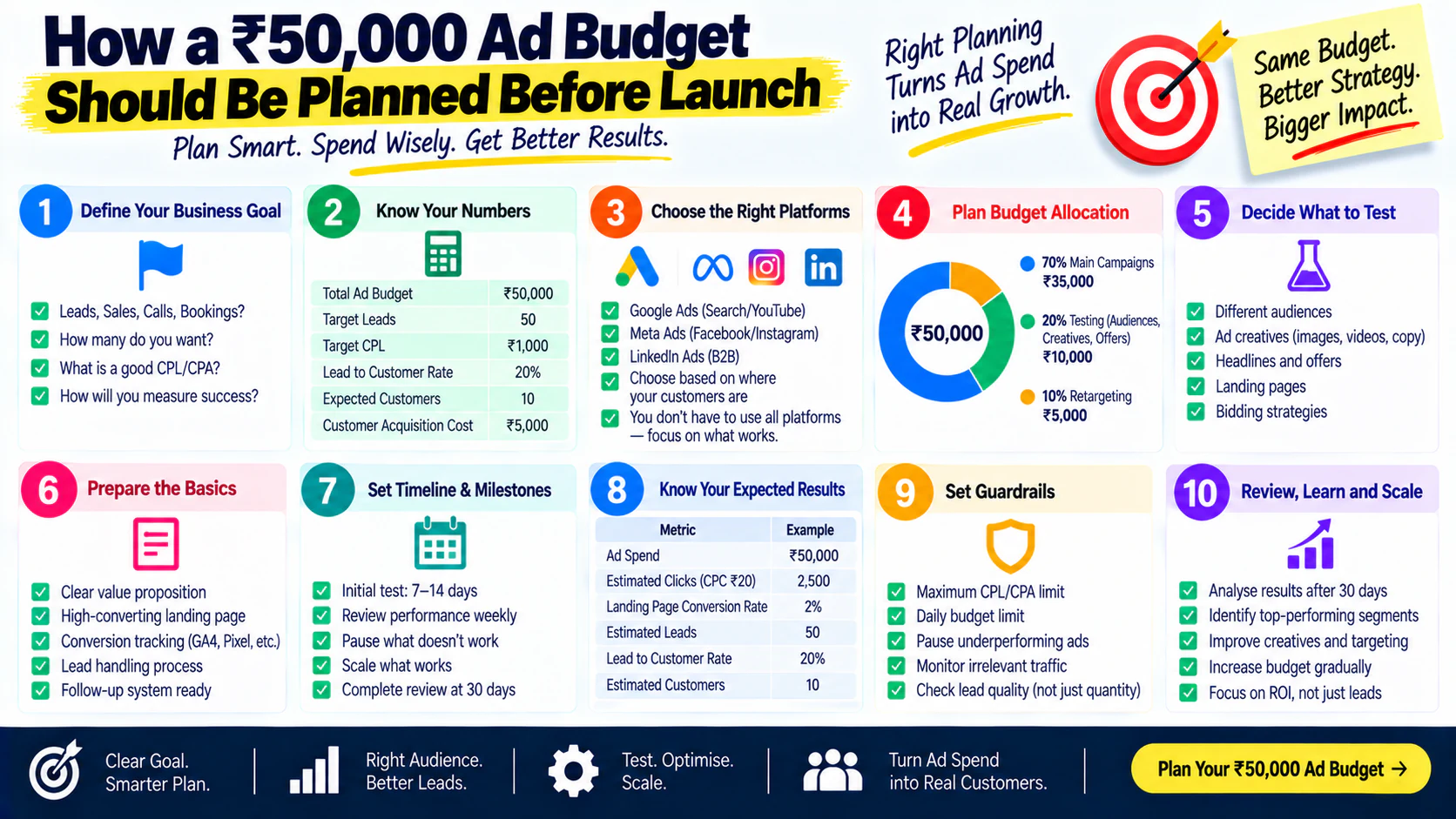
Spending ₹50,000 on ads sounds simple.
You create a campaign, put in ₹50,000, choose your audience, and start getting leads.
Except that is not how good paid advertising works.
A ₹50,000 budget can generate a meaningful number of leads and sales—or disappear quickly with very little to show for it.
The difference usually isn't the size of the budget.
It is how the budget is planned before the first rupee is spent.
If you are trying to understand how to plan a ₹50,000 ad budget, this guide gives you a practical framework for deciding where the money should go, what should be tested first, and how much you should actually expect from the campaign.
First: ₹50,000 Is Not Your Strategy
One of the biggest mistakes businesses make is treating the budget as the strategy.
For example:
"We have ₹50,000. Let's run Google Ads."
That doesn't answer the important questions:
- What are you trying to generate?
- Leads, purchases, calls, bookings or enquiries?
- Which products or services should receive the budget?
- Which platform should get the money?
- What is an acceptable cost per lead?
- How much can you afford to pay for a customer?
- What happens after someone clicks the ad?
- How much budget should go toward testing?
- When should you stop a campaign?
Before deciding the allocation, you need to understand the economics of the business.
Start With the Business Goal
Don't start with Google Ads, Meta Ads or campaign settings.
Start with the outcome.
Suppose a service business wants to spend ₹50,000 to generate enquiries.
Its target might look like:
| Metric | Example |
|---|---|
| Total ad budget | ₹50,000 |
| Target leads | 50 |
| Target CPL | ₹1,000 |
| Lead-to-customer rate | 20% |
| Expected customers | 10 |
| Customer acquisition cost | ₹5,000 |
Now the ₹50,000 budget has a purpose.
Without these numbers, the campaign can technically generate "results" while still losing money.
Calculate Your Target Cost Per Lead
Your target CPL should not be chosen because another business is getting leads at that price.
It should come from your business economics.
For example:
If your average customer generates ₹25,000 in gross profit and you are comfortable spending ₹5,000 to acquire that customer, your advertising model has room to work.
If only 10% of leads become customers:
So a campaign generating leads at ₹400 may be healthy.
A campaign generating leads at ₹1,200 may not be.
This is why CPL alone is not enough.
You need to connect:
Decide How Much of the ₹50,000 Is Actually Media Spend
Don't automatically assume the entire ₹50,000 should go directly into ad platforms.
Depending on the campaign, you may also need budget for:
- Landing page improvements
- Creative production
- Tracking setup
- Analytics
- Campaign testing
- Agency or management fees
- Remarketing assets
For example, if ₹50,000 is the total marketing budget rather than the media-only budget, you could structure it like this:
| Activity | Budget |
|---|---|
| Advertising media | ₹40,000 |
| Creative/testing | ₹5,000 |
| Landing page/CRO improvements | ₹3,000 |
| Tracking/measurement | ₹2,000 |
| Total | ₹50,000 |
The exact allocation will depend on the business.
The important point is this:
Don't Split ₹50,000 Across Too Many Platforms
A common mistake is trying to "be everywhere."
A business with ₹50,000 might decide:
- ₹15,000 Google
- ₹15,000 Meta
- ₹10,000 Instagram
- ₹5,000 LinkedIn
- ₹5,000 YouTube
Now every channel has a small budget.
The problem?
There may not be enough data in any one campaign to understand what is actually working.
With a limited budget, concentration is often more useful than spreading money thinly.
A better approach
Choose the platform based on how customers discover and evaluate your product.
For example:
Someone searching:
"best digital marketing agency for ecommerce"
is already expressing a need.
Compare that with someone scrolling Instagram who happens to see an agency advertisement.
Both can be valuable—but they represent different levels of intent.
Match the Budget to Customer Intent
This is where demand capture vs demand creation becomes important.
Search advertising is often stronger when people are already looking for a solution.
Social advertising can be powerful for creating awareness, building consideration and reaching audiences before they actively search.
So instead of asking:
"Should we use Google or Meta?"
Ask:
"Where is our customer in the buying journey?"
A practical structure could be:
If the customer is actively searching
Put more budget into high-intent search campaigns.
If the customer needs to discover the problem or product
Use social and content-led campaigns to create demand.
If both behaviors matter
Use both—but give each channel a specific job.
Build the ₹50,000 Budget Around Testing
Your first campaign should not be treated as a final campaign.
You are buying two things:
- Customers
- Data
That means part of the budget should help answer questions such as:
- Which audience responds?
- Which keyword converts?
- Which message gets attention?
- Which offer generates enquiries?
- Which landing page converts?
- Which creative produces qualified traffic?
For example:
| Phase | Budget | Purpose |
|---|---|---|
| Initial testing | ₹10,000 | Test audiences, keywords, creatives and offers |
| Optimization | ₹25,000 | Shift spend toward winners |
| Scaling/retargeting | ₹10,000 | Increase investment in proven opportunities |
| Reserve | ₹5,000 | React to performance and new opportunities |
| Total | ₹50,000 |
This is not a universal formula.
It is a framework.
Your actual split should depend on your sales cycle, platform, competition, conversion rate and historical data.
Don't Give Every Campaign the Same Budget
Suppose you have three services:
- Website development
- SEO
- Performance marketing
Don't automatically allocate ₹16,667 to each.
Instead, look at:
- Revenue potential
- Conversion rate
- Search demand
- Customer lifetime value
- Sales capacity
- Historical performance
- Competition
- Profit margin
If one service produces significantly more valuable customers, it may deserve more budget.
Example
You could start with:
| Service | Budget |
|---|---|
| High-value service | ₹25,000 |
| Medium-priority service | ₹15,000 |
| Experimental offer | ₹10,000 |
| Total | ₹50,000 |
The budget should follow business opportunity, not mathematical symmetry.
Leave Room for Retargeting
Not everyone converts on the first visit.
Someone might:
- Click your ad
- Read your service page
- Leave
- Compare competitors
- Return three days later
- Submit an enquiry
If all your budget goes toward cold acquisition, you may miss the opportunity to bring interested users back.
Retargeting can help reconnect with people who have already interacted with your business.
Depending on the campaign, a portion of the budget can be reserved for:
- Website visitors
- Engaged social users
- Video viewers
- Previous leads
- Product viewers
- Abandoned carts
The exact percentage should be based on audience size and campaign economics rather than a fixed rule.
Fix the Landing Page Before Increasing Ad Spend
Imagine this:
Your ad gets a 5% click-through rate.
The campaign sends relevant visitors to your website.
But the landing page has:
- No clear headline
- Too many services
- Weak proof
- No obvious CTA
- Slow loading
- Confusing navigation
- A long enquiry form
Increasing the ad budget won't solve the problem.
It will simply send more people into the same broken funnel.
Before increasing spend, check:
Landing page checklist
- Does the headline match the ad?
- Is the offer immediately clear?
- Is there one primary CTA?
- Is the page mobile-friendly?
- Is trust established quickly?
- Are testimonials or case studies visible?
- Is the form easy to complete?
- Can visitors understand what happens after submitting?
- Is conversion tracking working?
Your advertising budget and website conversion system need to work together.
Define Your Numbers Before Launch
Before spending ₹50,000, create a simple performance model.
For example:
Scenario
Budget: ₹50,000
Expected average CPC: ₹50
Estimated clicks:
If the landing page converts at 5%:
If 20% of leads become customers:
Estimated acquisition cost:
Now you can ask the important question:
If yes, the model may work.
If no, you need to improve the economics before scaling.
What If the Numbers Don't Work?
This is where many businesses make the wrong decision.
They see an expensive CPL and immediately say:
"We need cheaper leads."
Not necessarily.
There are several variables you can improve.
Variable 1: Reduce CPC
Improve:
- Keyword targeting
- Ad relevance
- Quality
- Audience selection
- Campaign structure
Variable 2: Increase conversion rate
Improve:
- Landing page
- Offer
- CTA
- Trust signals
- Page speed
- Form experience
Variable 3: Improve lead quality
Target better:
- Keywords
- Audiences
- Locations
- Demographics
- Intent signals
Variable 4: Improve sales conversion
Sometimes the advertising isn't the problem.
The sales team may be:
- Responding too slowly
- Following up inconsistently
- Talking to unqualified leads
- Failing to communicate value
- Not having a proper follow-up process
A ₹50,000 advertising budget should therefore be evaluated as part of the entire acquisition system.
A Practical ₹50,000 Planning Framework
Here's a simple framework you can use before launch.
Define the goal
Choose one primary outcome:
Don't try to optimize for everything at once.
Calculate the economics
Determine:
- Average order value
- Gross margin
- Target CAC
- Lead-to-customer rate
- Target CPL
Choose the primary channel
Ask:
Search?
Social?
Both?
Allocate a testing budget
Use the initial spend to identify:
- Winning audiences
- Winning keywords
- Winning creatives
- Winning offers
Protect conversion quality
Make sure:
- Landing pages work
- Tracking works
- Forms work
- Sales follow-up works
Shift budget based on evidence
Don't keep spending equally just because the original plan said so.
Move budget toward campaigns producing the best business outcomes.
Example: ₹50,000 Google Ads Budget
Let's say an Indian B2B service company wants leads.
A possible structure could be:
| Campaign Area | Starting Budget |
|---|---|
| High-intent search campaigns | ₹25,000 |
| Secondary search themes | ₹10,000 |
| Remarketing | ₹5,000 |
| Testing new keywords/offers | ₹5,000 |
| Performance reserve | ₹5,000 |
| Total | ₹50,000 |
Again, this is a planning example—not a fixed formula.
If high-intent search is clearly producing qualified customers, the business can shift more budget there.
If a campaign generates cheap clicks but poor leads, the answer may be to reduce or stop it.
Example: ₹50,000 Google + Meta Budget
Suppose the business needs both demand capture and demand creation.
A starting structure could look like:
| Channel | Role | Budget |
|---|---|---|
| Google Search | Capture existing demand | ₹25,000 |
| Meta Ads | Create demand | ₹12,000 |
| Remarketing | Re-engage visitors | ₹5,000 |
| Creative testing | Find winning messages | ₹5,000 |
| Reserve | Optimization | ₹3,000 |
| Total | ₹50,000 |
The important thing isn't the exact percentage.
It's that each rupee has a job.
How Long Should ₹50,000 Last?
There is no universal answer.
₹50,000 could be spent:
- In 10 days
- In 20 days
- Over a month
- Over several months
The right timeframe depends on:
- Search volume
- Competition
- Average CPC
- Sales cycle
- Conversion volume
- Campaign learning requirements
- Business capacity
For example, spending ₹5,000 per day may make sense for a business with strong demand and enough conversion volume.
For another business, it could be unnecessarily aggressive.
The objective should not be:
"Spend ₹50,000 as quickly as possible."
The objective should be:
"Use ₹50,000 to learn and acquire customers efficiently."
Don't Scale Just Because the Budget Is Available
Having ₹20,000 left in the account does not mean you should increase daily spend.
Scale when the campaign gives you evidence that additional spend can produce acceptable business results.
Look at:
- Cost per qualified lead
- Cost per customer
- Conversion rate
- Revenue
- ROAS where applicable
- Lead quality
- Search terms
- Audience performance
- Sales conversion
If the campaign is already inefficient at ₹2,000 per day, spending ₹5,000 per day won't magically make it efficient.
It usually makes the problem bigger.
Common ₹50,000 Ad Budget Mistakes
Mistake 1: Spending everything immediately
You learn too late that the targeting or offer was wrong.
Mistake 2: Splitting the budget across too many channels
Every channel receives too little data.
Mistake 3: Optimizing for clicks
Clicks don't pay your bills.
Customers do.
Mistake 4: Ignoring the landing page
A strong ad cannot compensate indefinitely for a weak conversion experience.
Mistake 5: Measuring only CPL
A cheap lead can still be a bad lead.
Mistake 6: Changing campaigns every few days
Constant changes make it difficult to understand what actually caused the result.
Mistake 7: Having no reserve budget
If one campaign clearly outperforms another, you need flexibility to move money toward it.
Mistake 8: Scaling before fixing conversion problems
More traffic doesn't fix a broken funnel.
The ₹50,000 Ad Budget Checklist
Before launching, make sure you can answer all of these:
Business
- What is the campaign goal?
- What is the average customer value?
- What is the acceptable CAC?
- What is the expected lead-to-customer rate?
Campaign
- Which platform will be used?
- Why was that platform selected?
- Which products/services will receive budget?
- What audiences or keywords will be tested?
Budget
- How much is initial testing?
- How much is reserved for winners?
- Is there a retargeting budget?
- Is there a reserve?
Conversion
- Where will users land?
- Is the landing page optimized?
- Is the CTA clear?
- Is the form working?
Measurement
- Are conversions tracked?
- Can qualified leads be identified?
- Can sales be connected back to campaigns?
- Is the reporting system ready?
If you cannot answer these questions, the campaign probably isn't ready for the full ₹50,000.
