
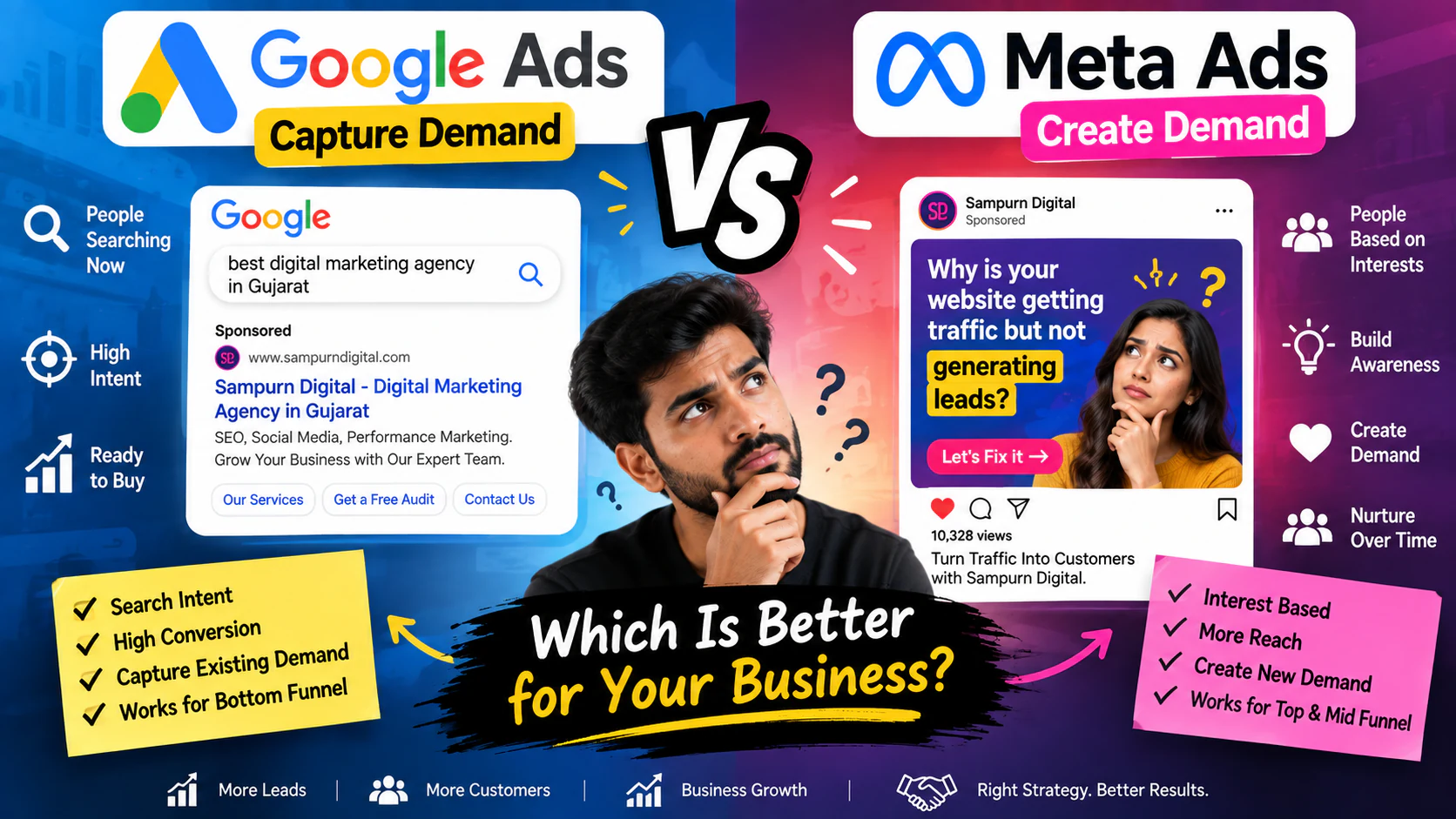
If you're planning to spend money on paid advertising, one question usually comes up first:
Should we invest in Google Ads or Meta Ads?
Both platforms can generate customers.
But they work very differently.
Google Ads can help you reach people who are already searching for a product, service or solution.
Meta Ads can help you reach people based on interests, behaviours, demographics and engagement — even when they aren't actively searching for what you sell.
So the answer isn't:
"Google Ads is better."
"Meta Ads is better."
The better question is:
Which platform is better suited to your customer journey, offer, buying intent and business objective?
This guide explains Google Ads vs Meta Ads for business, how the two platforms differ, when each makes sense, and how to decide where your paid advertising budget should go.
First: Don't Choose a Platform Just Because Everyone Else Uses It
A common mistake is choosing an advertising platform based on popularity.
You may hear:
"Everyone is running Facebook ads."
"Google Ads gives better leads."
Neither statement is universally true.
A platform's performance depends on:
- What you sell
- Who you sell to
- How customers discover you
- Search demand
- Purchase intent
- Sales cycle
- Average order value
- Customer acquisition cost
- Offer strength
- Landing-page quality
- Creative quality
- Tracking
- Follow-up process
For example, a person searching:
"best dental clinic near me"
has already demonstrated a strong level of intent.
That is very different from someone scrolling Instagram who happens to see an advertisement for a dental clinic.
Both audiences can become customers.
But they are at different stages of the decision-making process.
That's why understanding [which marketing channel should your business invest in first](https://www.sampurndigital.com/blog/digital-marketing/which-marketing-channel-should-your-business-invest-in-first) is an important first step.
Google Ads vs Meta Ads: The Fundamental Difference
The simplest way to understand the two platforms is:
Google Ads
Meta Ads
That creates two fundamentally different acquisition environments.
Google Ads = Demand Capture
Someone searches for:
They already have a problem.
They are actively looking for a solution.
Your advertisement can appear at the moment that demand exists.
The basic journey is:
Meta Ads = Demand Creation + Demand Capture
A person may not be searching for your service.
They may be:
- Watching Reels
- Scrolling Instagram
- Reading Facebook content
- Interacting with a creator
- Exploring interests
- Engaging with brands
Your advertisement interrupts that activity with a relevant message.
The journey might look like:
This distinction is one of the most important things to understand before comparing the two platforms.
Google Ads Is Strong When Search Intent Is High
Google Ads can be particularly useful when people actively search for what your business offers.
Examples:
- "digital marketing agency"
- "website development company"
- "best dentist near me"
- "buy running shoes"
- "accounting software for small business"
- "AC repair near me"
These searches communicate intent.
The person is not simply consuming content.
They are looking for something.
This can make Google Ads especially attractive for businesses with:
- Strong search demand
- Clear commercial keywords
- High-intent services
- Local demand
- Product searches
- Immediate customer needs
But high intent does not guarantee profitability.
You still need:
Meta Ads Is Strong When Audience Targeting and Creative Matter
Meta Ads can be powerful when your product or service can be presented visually or emotionally.
Examples include:
- Fashion
- Beauty
- Food
- Fitness
- Lifestyle products
- Consumer brands
- Courses
- Events
- New products
- Visual services
It can also work for B2B businesses, particularly when the targeting, creative and offer are strong.
The key difference is that you aren't necessarily waiting for someone to search.
You are reaching people who may be a good fit.
That means the creative becomes extremely important.
The advertisement needs to create enough interest for someone to stop scrolling.
Compare Customer Intent Before Comparing Platforms
Instead of asking:
"Which platform has cheaper clicks?"
Ask:
"Which platform reaches my customer at the right moment?"
Consider these two people.
Person A
Searches:
This person is actively researching providers.
Person B
Sees:
while scrolling Instagram.
Person B may not have been actively looking.
But the message might create interest.
The two platforms are therefore doing different jobs.
Google often captures existing demand.
Meta can create demand and then capture it through retargeting and follow-up.
Google Ads vs Meta Ads for Different Business Types
There is no universal winner.
But some patterns are useful.
| Business Type | Google Ads | Meta Ads |
|---|---|---|
| Local services | Strong | Useful |
| Emergency services | Very strong | Limited / supportive |
| E-commerce | Strong | Strong |
| Fashion | Useful | Very strong |
| B2B services | Often strong | Can support demand creation |
| Professional services | Strong | Useful |
| High-intent services | Very strong | Supportive |
| New consumer product | Useful | Often strong |
| Visual products | Strong | Very strong |
| Long sales-cycle business | Strong for intent | Useful for awareness + retargeting |
These aren't rules.
They're starting points.
Your own customer data should ultimately determine the allocation.
Google Ads Can Be Better for High-Intent Services
Imagine you run:
Someone searches:
"pest control company near me"
That search can be extremely valuable.
The person has a problem.
They are actively looking for a provider.
A Google Search campaign can put your business in front of them at exactly that moment.
Now compare that with showing the same service to someone casually scrolling Instagram.
The second audience may still become interested.
But the first audience has already expressed intent.
This is why search advertising can be particularly effective for services with immediate demand.
Meta Ads Can Be Better for Products People Discover Visually
Now imagine you sell:
A customer may not search for your brand.
They might discover your product through:
- Instagram Reels
- Influencer content
- Lifestyle creative
- Product demonstrations
- Customer-generated content
The visual presentation itself can create desire.
The journey becomes:
This is where Meta can become particularly powerful.
The platform isn't necessarily waiting for demand.
It is helping create it.
Search Demand Changes the Decision
Before choosing Google Ads, investigate whether people actually search for your offering.
Ask:
- Are customers searching for the service?
- What terms are they using?
- How commercial are those searches?
- How competitive are the keywords?
- Are searches happening consistently?
- Does search intent align with your offer?
If there is strong commercial search demand, Google deserves serious consideration.
If customers rarely search for the product because it is new or highly discovery-driven, Meta may deserve more attention.
This is where [SEO strategy and organic search for businesses](https://www.sampurndigital.com/blog/seo/how-seo-paid-ads-content-and-website-cro-work-together-as-one-growth-system) can also provide useful insight.
Your SEO research can reveal what customers actively search for.
Meta Ads Depends Heavily on Creative
Google Search ads are heavily influenced by:
- Keyword
- Search intent
- Ad copy
- Offer
- Landing page
Meta adds another major variable:
Your ad may need:
- Strong visual hook
- Clear problem
- Interesting opening
- Product demonstration
- Social proof
- Short-form video
- Strong headline
- Clear CTA
This means a business running Meta Ads should think like a content publisher as well as an advertiser.
A strong creative testing system becomes extremely important.
Google Ads Requires Strong Keyword Strategy
Google Ads can become expensive when keyword targeting is weak.
For example, a business may bid on broad searches that attract people who aren't suitable customers.
Suppose you sell:
You may not want to spend heavily on searches such as:
- accounting definition
- accounting course
- accounting jobs
- free accounting software
The search may contain a relevant word.
But the intent is wrong.
That is why keyword strategy matters.
The goal is not:
Get as many clicks as possible.
It is:
Capture searches that have a realistic path to business value.
Google Ads vs Meta Ads: Lead Quality Matters More Than Lead Volume
Suppose:
Google Ads
Meta Ads
Looking only at lead volume, Meta wins.
Looking at customers, Google wins.
That's why your comparison should go beyond:
- CPC
- CTR
- Leads
- Cost per lead
Track:
- Qualified leads
- Sales opportunities
- Customers
- Revenue
- Customer acquisition cost
- Return on ad spend
- Profitability
The platform producing the cheapest lead isn't necessarily producing the best business result.
Don't Compare CPCs Directly
Google Ads may have a higher CPC than Meta Ads.
That doesn't automatically mean Google is more expensive.
Imagine:
That sounds like Meta is five times cheaper.
But suppose:
The economics change completely.
Then add:
- Lead quality
- Sales conversion
- Average order value
- Customer lifetime value
The final comparison can look very different.
Always evaluate the full acquisition journey.
Your Landing Page Can Decide Which Platform Wins
This is one of the most overlooked factors.
You can run excellent advertising and still produce poor results if the landing page doesn't match the campaign.
Suppose your Google ad says:
"SEO Services for Small Businesses"
But the landing page simply says:
"Welcome to our website."
That's a major disconnect.
The same applies to Meta.
If your advertisement promises:
"Get a conversion-focused website for your business"
but the landing page provides a generic list of web development services, the visitor may leave.
This is why [lead-generation website architecture for service businesses](https://www.sampurndigital.com/blog/web-development/lead-generation-website-architecture-for-service-businesses) matters when evaluating paid advertising performance.
Google Ads and Meta Ads Can Work Together
You don't always need to choose one.
A strong paid acquisition system can use both.
For example:
This is an example of how paid channels can support one another.
For more context, see [why your ads get clicks but not customers](https://www.sampurndigital.com/blog/performance-marketing/why-your-ads-get-clicks-but-not-customers).
Use Google Ads When the Problem Is Already Being Searched
Google Ads is particularly attractive when:
Examples:
- Emergency plumbing
- Legal services
- Local medical services
- Accounting services
- Software solutions
- B2B services
- Home repair
- Professional services
In these situations, capturing existing intent can be extremely valuable.
Use Meta Ads When You Need to Create Demand
Meta can become more useful when:
This can work particularly well for:
- New products
- Lifestyle brands
- Visual products
- Consumer offers
- Events
- Courses
- Community-driven businesses
Match the Platform to Your Sales Cycle
Your sales cycle matters.
Short sales cycle
Google Search can be particularly powerful because the customer may search and convert quickly.
Example:
The customer may need a provider today.
Long sales cycle
You may need multiple touchpoints.
For example:
Meta can help create awareness.
Google can capture active research.
SEO can provide educational content.
Email and retargeting can support follow-up.
This is where integrated marketing becomes more useful than choosing one platform in isolation.
Consider the Nature of Your Offer
Ask:
Is the offer already understood?
If yes, Google Ads may capture existing demand effectively.
Is the offer new or unfamiliar?
Meta may help introduce and explain it.
Does the product need visual demonstration?
Meta may have an advantage.
Does the customer need detailed research?
Google Search combined with SEO/content can become valuable.
Is the purchase urgent?
Search intent can be particularly important.
Is the decision emotional or lifestyle-driven?
Visual creative and social proof can be powerful.
Budget Allocation Should Follow Evidence
Don't start by saying:
"We'll spend ₹50,000 on Google and ₹50,000 on Meta."
Instead, establish a testing budget.
For example:
Then compare:
- Cost per qualified lead
- Conversion rate
- Customer acquisition cost
- Revenue
- Lead quality
- Scalability
After collecting enough meaningful data, shift more budget toward the stronger opportunity.
For a more detailed approach, see [how a ₹50,000 ad budget should be planned before launch](https://www.sampurndigital.com/blog/performance-marketing/how-a-50000-ad-budget-should-be-planned-before-launch).
Don't Scale Before Fixing the Basics
Before increasing either Google or Meta spending, check:
Tracking
- Are conversions tracked correctly?
- Are duplicate conversions being recorded?
- Are important events configured?
Offer
- Is the offer compelling?
- Is the value proposition clear?
- Is there a reason to act?
Landing page
- Does the page match the advertisement?
- Is the CTA clear?
- Is there enough trust?
- Is the page mobile-friendly?
Follow-up
For lead-generation campaigns:
- How quickly are leads contacted?
- Are leads qualified?
- Are sales teams following up?
- Are leads being tracked through the pipeline?
If these foundations are weak, changing platforms may not solve the problem.
A Simple Google Ads vs Meta Ads Decision Framework
Use this framework before choosing.
Choose Google Ads first when:
- Customers actively search for your solution
- Search intent is commercially strong
- Your offer is easy to understand
- You need high-intent traffic
- Your service solves an immediate problem
- Search demand is sufficient
Consider Meta Ads first when:
- Your product is highly visual
- You need to create awareness
- Your audience can be clearly targeted
- Strong creative can demonstrate the value
- Your offer benefits from social proof
- Customers may not actively search for your product
Consider both when:
- You need awareness and demand capture
- Your customer journey has multiple stages
- You have enough budget for testing
- You can create platform-specific campaigns
- You have strong tracking and conversion infrastructure
Google Ads vs Meta Ads: Comparison Table
| Factor | Google Ads | Meta Ads |
|---|---|---|
| Primary strength | Demand capture | Demand creation + audience targeting |
| User intent | Often high | Often lower initially |
| Main targeting signal | Search/query | Audience/behaviour/interest |
| Creative importance | High | Very high |
| Best for | Existing demand | Awareness + discovery |
| Search demand required | Usually | No |
| Visual content importance | Moderate | High |
| Local services | Often excellent | Supportive |
| E-commerce | Strong | Strong |
| B2B | Often strong | Useful for awareness |
| Retargeting | Strong | Strong |
| Testing | Keywords, ads, offers | Audiences, creatives, offers |
| Main risk | Paying for irrelevant searches | Paying for low-intent traffic |
| Key metric | Qualified acquisition | Qualified acquisition |
The best platform is the one that produces valuable customers at sustainable economics.
Don't Judge a Platform After a Few Days
Another common mistake is making a major decision based on a tiny sample.
For example:
"Meta generated 30 leads and Google generated 10, so Meta is better."
That isn't enough information.
You need enough data to understand:
- Conversion quality
- Sales outcomes
- Customer value
- Acquisition cost
- Audience behaviour
- Creative performance
- Search-term quality
Short-term performance can be noisy.
Make decisions based on meaningful patterns rather than a handful of conversions.
Don't Copy the Same Campaign Across Both Platforms
Google and Meta should not be treated as identical advertising environments.
A Google campaign might focus on:
A Meta campaign might focus on:
The messaging may also differ.
"Looking for an SEO agency? Get a data-driven SEO strategy for your business."
Meta
"Your website gets traffic but still doesn't generate enough customers?"
Same underlying business problem.
Different communication style.
That is how platform-specific advertising should work.
What Should You Test First?
If you're uncertain which platform fits your business, test the fundamentals.
Google Ads
Test:
- High-intent keywords
- Match types
- Search themes
- Ad messaging
- Landing pages
- Offers
- Geographic targeting
Meta Ads
Test:
- Hooks
- Creative formats
- Audiences
- Videos
- Images
- Offers
- Landing pages
- Retargeting
Then compare business outcomes.
Don't test everything simultaneously.
A Practical Paid Advertising Decision Tree
Start here:
Do customers actively search for your product or service?
Is your offer visually compelling?
Is your sales cycle long?
Can you track qualified outcomes?
How to Decide Which Platform Deserves More Budget
After testing, create a simple comparison.
| Metric | Google Ads | Meta Ads |
|---|---|---|
| Spend | ₹50,000 | ₹50,000 |
| Clicks | 500 | 2,000 |
| Leads | 50 | 100 |
| Qualified Leads | 25 | 20 |
| Customers | 8 | 5 |
| Revenue | ₹2,40,000 | ₹1,50,000 |
| CAC | ₹6,250 | ₹10,000 |
In this example, Meta generated:
and
But Google generated:
and
So Google would deserve more attention despite having fewer clicks.
This illustrates why volume isn't the same as value.
What If Both Platforms Perform Well?
That's a good problem to have.
Don't necessarily choose one.
Instead, assign roles.
For example:
This creates a connected acquisition system.
