
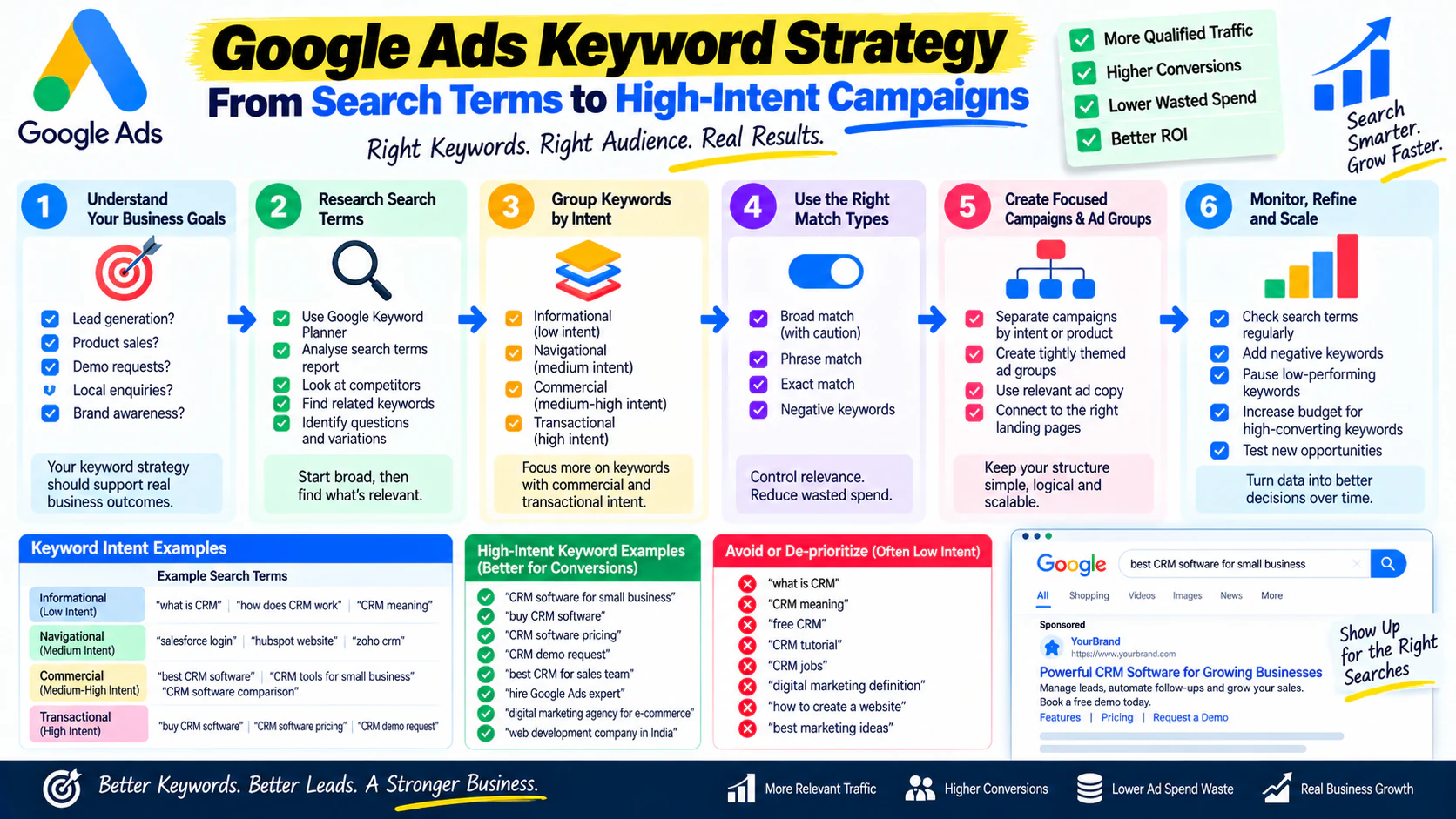
Most Google Ads accounts don't have a keyword problem.
They have a keyword prioritization problem.
An account can contain hundreds or thousands of keywords and still waste budget on searches that have little commercial value.
The mistake is usually simple:
For example, a company selling B2B software may target:
- software
- business software
- CRM software
- CRM
- sales software
These keywords may generate traffic.
But traffic is not the objective.
The real question is:
Which searches indicate that someone has a problem, needs a solution, and may actually be willing to buy?
That is where a strong Google Ads keyword strategy for high-intent searches becomes important.
Instead of starting with a giant keyword list, build the strategy from actual search behavior, business value, and conversion intent.
What Is a Google Ads Keyword Strategy?
A Google Ads keyword strategy is the process of deciding:
- What searches you want your ads to appear for
- Which searches are commercially valuable
- Which keyword themes should share a campaign or ad group
- Which searches should be excluded
- Which searches deserve more budget
- Which searches should lead to which landing pages
- How actual search-term data should influence future optimization
A strong strategy therefore goes beyond keyword research.
It connects:
Why Search Volume Is Not Enough
Search volume looks attractive because it is easy to understand.
Suppose you have two keywords:
| Keyword | Monthly Searches | Commercial Intent |
|---|---|---|
| digital marketing | 20,000 | Broad |
| digital marketing agency | 2,000 | Higher |
The first keyword may have ten times more searches.
But that does not mean it has ten times the business value.
Someone searching:
could be:
- A student
- A business owner
- A marketer
- Someone researching a definition
- Someone looking for a course
- Someone looking for an agency
Someone searching:
has already narrowed the problem considerably.
This is why keyword selection should consider intent and business value, not just volume.
The 5 Levels of Google Ads Keyword Intent
A practical way to classify keywords is to look at how close the searcher is to taking a commercial action.
Informational Intent
Examples:
- what is Google Ads
- how does PPC work
- how Google Ads bidding works
The user is learning.
These searches can be useful in an organic content strategy, but they are not automatically strong paid-search targets.
Problem-Aware Intent
Examples:
- Google Ads not generating leads
- PPC campaigns wasting money
- low conversion rate Google Ads
The user has identified a problem.
This can be valuable when the business specifically sells a solution to that problem.
Solution-Aware Intent
Examples:
- Google Ads management
- PPC optimization service
- Google Ads audit
The user understands that a solution exists and is looking for it.
This is often much more commercially useful.
Provider-Aware Intent
Examples:
- Google Ads agency
- PPC management company
- Google Ads consultant
The user is looking for someone who can provide the solution.
This is generally a strong commercial signal for service businesses.
Action / Purchase Intent
Examples:
- hire Google Ads agency
- Google Ads management pricing
- PPC agency quote
- Google Ads consultant near me
The searcher is moving toward an action.
These keywords often deserve close attention because they can be directly connected to lead generation.
High Intent Does Not Always Mean “Buy Now”
This distinction matters.
A keyword such as:
is commercially relevant, but the person may still be comparing providers.
A keyword such as:
signals a stronger action orientation.
So rather than thinking:
think:
Start Keyword Research With Your Business
Don't begin with Google's Keyword Planner and ask:
“What keywords can I target?”
Start with:
“What does the business actually want to sell?”
Create a list of:
Core services
For example:
- SEO
- Google Ads management
- Social media marketing
- Website development
Target customers
- Small businesses
- E-commerce brands
- B2B companies
- Local businesses
Locations
- Ahmedabad
- Mumbai
- Gujarat
- India
Commercial actions
- Request quote
- Book consultation
- Get audit
- Request demo
- Buy
- Call
This gives you the business vocabulary needed to build the keyword strategy.
Build Keyword Themes
Suppose the business sells Google Ads management.
Instead of starting with 500 individual keywords, begin with themes:
Agency
- Google Ads agency
- Google Ads agency India
- Google Ads management agency
Management
- Google Ads management
- PPC management
- Google Ads campaign management
Service
- Google Ads services
- PPC advertising services
- paid search management
Consultant
- Google Ads consultant
- PPC consultant
- Google Ads expert
Commercial
- Google Ads management pricing
- PPC agency pricing
- Google Ads audit
The themes help you understand the structure before getting lost in keyword variations.
Classify Every Keyword by Intent
Now take your keyword list and classify it.
For example:
| Keyword | Intent | Priority |
|---|---|---|
| what is PPC | Informational | Low |
| PPC benefits | Informational | Low |
| PPC management | Solution | High |
| PPC agency | Provider | Very High |
| PPC agency pricing | Commercial | Very High |
| hire PPC agency | Action | Very High |
| free PPC course | Learning | Exclude/Low |
This immediately gives you a more useful strategy than simply sorting keywords by search volume.
Use Search Terms as a Source of Truth
Keyword research tells you what you think people may search.
This makes search terms one of the most valuable inputs into your keyword strategy.
Imagine you target:
But actual search terms include:
- web development company for e-commerce
- Shopify development company
- WordPress development company
- web development company price
- web development course
- web developer jobs
Now you have several different intent categories.
Some may be valuable.
Some may require dedicated keyword groups.
Others should be excluded.
That is why keyword strategy should not end when campaigns launch.
The Keyword Strategy Feedback Loop
A strong account follows this cycle:
Keyword Research ↓ Keyword Selection ↓ Campaign Structure ↓ Ads ↓ Search Terms ↓ Conversion Data ↓ Keyword Expansion / Exclusion ↓ Better Campaign Structure
This creates a continuously improving system.
Separate High-Intent and Low-Intent Searches
Suppose you run ads for a Google Ads agency.
Your search-term report might reveal:
High intent
- Google Ads management company
- Google Ads agency
- PPC management agency
- hire Google Ads consultant
Medium intent
- Google Ads services
- PPC services
- Google Ads expert
Low intent
- how Google Ads works
- Google Ads tutorial
- Google Ads certification
- learn Google Ads
Clearly irrelevant
- Google Ads login
- Google Ads support
- Google Ads jobs
- Google Ads free course
This gives you three actions:
Build a Negative Keyword Strategy
A good keyword strategy is not only about deciding what to target.
It is also about deciding what not to pay for.
Common negative keyword categories can include:
Education
- course
- tutorial
- certification
- training
- learn
Employment
- jobs
- careers
- salary
- vacancy
Free intent
- free
- template
- download
Support/navigation
- login
- sign in
- customer support
But don't blindly add every word.
For example, “free consultation” may actually be valuable for a service business.
The context matters.
Negative keywords should be based on the actual business model and search behavior.
Prioritize Keywords by Business Value
A useful scoring framework is:
You don't need a complicated mathematical model.
A simple scoring system can work.
Rate each keyword from 1–5 on:
- Intent
- Relevance
- Commercial value
- Expected conversion potential
Then calculate a total score.
Example:
| Keyword | Intent | Relevance | Commercial Value | Total |
|---|---|---|---|---|
| Google Ads agency | 5 | 5 | 5 | 15 |
| Google Ads services | 4 | 5 | 4 | 13 |
| Google Ads tips | 2 | 4 | 2 | 8 |
| Google Ads tutorial | 1 | 3 | 1 | 5 |
This does not predict performance.
It simply helps prioritize research and testing.
Don't Ignore Long-Tail Keywords
High intent is often hidden inside longer searches.
For example:
is broad.
But:
contains additional information.
The searcher has specified:
- The category
- The provider type
- The industry
Similarly:
can communicate more business context than:
Long-tail keywords can therefore be valuable when they represent a clearly relevant commercial need.
But don't assume every long-tail keyword deserves a separate campaign.
The search volume and business value need to justify the additional structure.
Group Keywords by Meaning, Not Spelling
Consider:
- Google Ads agency
- Google Ads management agency
- Google Ads management company
- PPC agency
These keywords have different wording.
But the underlying intent may be similar.
The question is not:
“Do these keywords look different?”
The question is:
“Would I show essentially the same ad and send the user to the same landing page?”
If yes, they may belong in the same closely themed group.
Match Keyword Themes to Ads
A keyword group should make writing relevant ads easier.
For example:
Keyword theme
Google Ads Management
Searches
- Google Ads management
- Google Ads campaign management
- PPC campaign management
Ad message
Possible supporting messaging:
- Improve campaign efficiency
- Track meaningful conversions
- Reduce wasted ad spend
- Get performance-focused management
The structure creates a logical connection between the search and the ad.
Match Keywords to Landing Pages
The final destination matters as much as the keyword.
Suppose someone searches:
Sending them to a generic homepage creates friction.
A dedicated audit page could instead address:
- What the audit covers
- What problems are identified
- What the business receives
- How the audit works
- What happens afterward
- How to request one
Likewise, someone searching:
should ideally reach a page that clearly explains the management service.
The closer the match between intent and destination, the easier it becomes to build a coherent conversion journey.
The Keyword → Ad → Landing Page Framework
Use this simple table before launching:
| Keyword Theme | Search Intent | Ad Message | Landing Page |
|---|---|---|---|
| Google Ads agency | Provider | Google Ads Management | PPC service page |
| Google Ads audit | Solution | Audit Your Google Ads Account | Audit page |
| PPC pricing | Commercial | Understand PPC Investment | Pricing/service page |
| Google Ads consultant | Provider | Google Ads Consulting | Consulting page |
If the last two columns are difficult to define, the keyword theme may be too broad.
How to Decide Whether a Keyword Is Worth Testing
Ask seven questions.
Is the search relevant to what we sell?
If not, don't target it.
Does the search indicate a real business problem?
A strong problem can be commercially valuable.
Does the search suggest solution awareness?
This often increases commercial relevance.
Is the user looking for a provider?
For service businesses, this can be a strong signal.
Can we create a relevant ad?
If not, the keyword may be too broad.
Can we send the user to a relevant page?
If not, the conversion path may be weak.
Can we measure the resulting business outcome?
If you cannot evaluate the value of the traffic, optimization becomes harder.
Don't Choose Keywords Only Because Competitors Target Them
A competitor may target:
That does not mean you should.
They may have:
- A different business model
- A different budget
- A different customer base
- Different conversion economics
- Different geographic priorities
- Different landing pages
Competitor keyword lists can provide ideas.
They should not replace your own business and intent analysis.
How Match Types Fit Into the Strategy
Keyword intent comes first.
Match-type decisions come after that.
Think about them as separate questions.
Question 1:
Question 2:
Your strategy should not begin with:
“Which match type should I use?”
It should begin with:
“Which user intent is worth paying for?”
Once that is clear, match-type and targeting decisions can be made within the campaign strategy.
Use Conversion Data to Re-Rank Keywords
A keyword can look excellent before launch and disappoint after launch.
Another keyword can look average and become a top performer.
For example:
| Keyword | Clicks | Leads | Qualified Leads |
|---|---|---|---|
| Google Ads agency | 300 | 18 | 5 |
| PPC management | 200 | 15 | 8 |
| Google Ads consultant | 100 | 10 | 7 |
If you optimize only for clicks or raw leads, you may make the wrong decision.
Qualified lead data tells a different story.
The goal is not:
The goal is:
What If a Keyword Gets Clicks but No Conversions?
Don't immediately pause it.
First investigate:
Search relevance
Are the actual searches relevant?
Ad relevance
Does the ad promise what the user wants?
Landing page
Does the page answer the searcher's need?
Offer
Is there a compelling reason to enquire?
Tracking
Is the conversion actually being measured?
Lead quality
Are conversions happening but not becoming useful opportunities?
A keyword is only one part of the conversion system.
This is why keyword optimization should be connected to ad and landing-page analysis.
Build a Keyword Map Before Launch
A simple keyword map can prevent a messy account.
| Keyword Theme | Intent | Priority | Campaign | Ad Group | Landing Page | Negative Themes |
|---|---|---|---|---|---|---|
| Google Ads agency | Provider | High | Google Ads | Agency | PPC Service | Jobs |
| Google Ads management | Solution | High | Google Ads | Management | PPC Service | Course |
| Google Ads audit | Solution | High | Google Ads | Audit | Audit Page | Training |
| Google Ads pricing | Commercial | High | Google Ads | Pricing | Service/Pricing | Free course |
This document becomes the bridge between research and implementation.
A Practical Keyword Research Workflow
Use this process:
Step 1 — List business offerings
What do you actually sell?
Step 2 — List customer problems
What problems cause customers to look for your solution?
Step 3 — Generate keyword themes
Turn offerings and problems into search themes.
Step 4 — Expand the themes
Find variations, industries, locations, and commercial modifiers.
Step 5 — Classify intent
Separate informational, problem, solution, provider, and action-oriented searches.
Step 6 — Score business value
Prioritize relevance and commercial potential.
Step 7 — Review search terms
Use actual traffic data to identify new opportunities and waste.
Step 8 — Add negatives
Exclude irrelevant intent.
Step 9 — Build campaigns and ad groups
Group searches that can share meaningful business decisions, ads, and landing pages.
Step 10 — Optimize against conversions
Use business outcomes, not just keyword metrics.
Common Google Ads Keyword Strategy Mistakes
Mistake 1: Choosing keywords purely by volume
More searches do not automatically mean more customers.
Mistake 2: Targeting every keyword variation
Different wording does not always represent different intent.
Mistake 3: Ignoring search terms
Your keyword list is a hypothesis. Actual searches provide evidence.
Mistake 4: Using too few negative keywords
Irrelevant searches can quietly consume budget.
Mistake 5: Treating every conversion equally
A low-quality lead is not equivalent to a qualified sales opportunity.
Mistake 6: Sending every keyword to the homepage
The landing page should match the searcher's need.
Mistake 7: Over-segmenting
Too many tiny campaigns can make optimization unnecessarily difficult.
Mistake 8: Never updating the strategy
Search behavior changes. Business priorities change. Your keyword strategy should evolve too.
A High-Intent Keyword Checklist
Before adding a keyword, ask:
- Is it directly related to our offer?
- Does it represent a real customer need?
- Is the search commercially meaningful?
- Does the user appear to understand the solution?
- Is the user potentially evaluating providers?
- Can we write a highly relevant ad?
- Do we have a relevant landing page?
- Can we measure the resulting conversion?
- Do actual search terms support this theme?
- Is there enough business value to justify testing it?
If most answers are yes, the keyword deserves consideration.
Final Framework: From Search Terms to High-Intent Campaigns
A strong Google Ads keyword strategy can be summarized in eight steps:
Know what you want to sell.
Know why people search.
Don't start with isolated keywords.
Identify searches closer to commercial action.
Search volume is only one input.
Let actual user behavior improve your assumptions.
Make the journey logical.
Revenue and business value matter more than traffic alone.
