
Your Google Ads campaign is spending money.
Conversions are inconsistent.
CPL is increasing.
And the first thing someone suggests is:
"Let's change the campaign."
Maybe.
But before changing keywords, bidding strategies, budgets or targeting, there is a more important question:
A Google Ads account can look "active" while quietly losing money because of:
- Poor campaign structure
- Irrelevant search terms
- Weak conversion tracking
- Broad targeting
- Bad landing pages
- Budget being pushed toward the wrong campaigns
- Duplicate keywords
- Poor location settings
- Weak ad-to-page relevance
- Conversion actions that aren't actually valuable
Changing things without understanding the problem can make the account worse.
That's why a proper Google Ads account audit should come before major optimization.
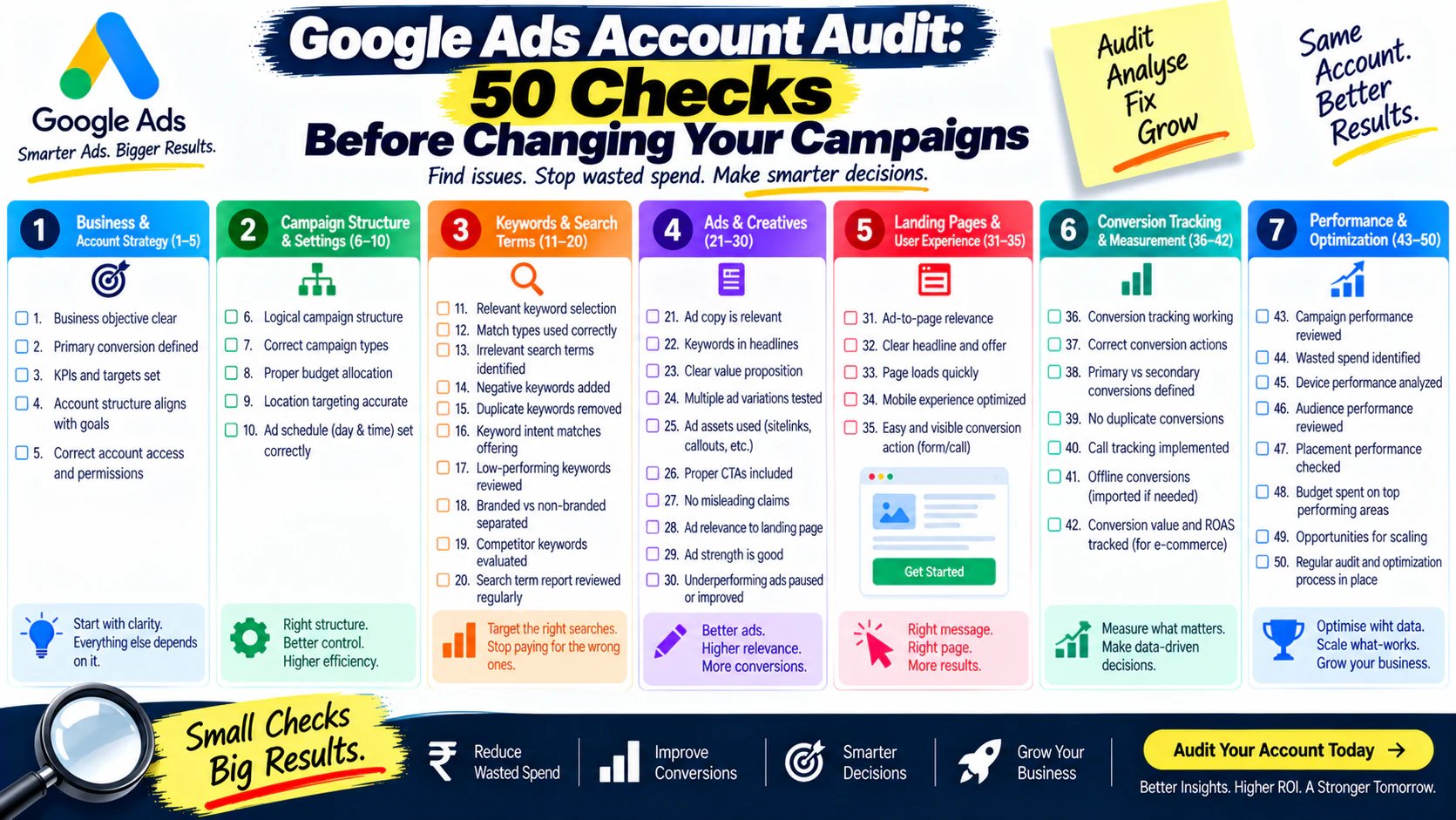
This guide gives you 50 practical checks to run before changing an existing Google Ads account.
What Is a Google Ads Account Audit?
A Google Ads account audit is a structured review of your advertising account to identify:
- Wasted spend
- Tracking problems
- Targeting issues
- Campaign structure problems
- Keyword problems
- Ad weaknesses
- Landing-page issues
- Budget inefficiencies
- Conversion problems
- Optimization opportunities
The goal isn't to change everything.
The goal is to answer:
What is actually wrong, what is working, and what should be changed first?
The 50-Point Google Ads Audit Checklist
Section 1: Business & Account Strategy
Is the business objective clear?
Before looking at campaign settings, establish what the business wants.
Is the goal:
- Leads?
- Sales?
- Calls?
- Bookings?
- Revenue?
- Store visits?
If the business objective isn't clear, campaign performance cannot be evaluated properly.
Is the primary conversion clearly defined?
Not every conversion should have equal importance.
For example:
- Purchase
- Qualified lead
- Demo booking
- Page view
- Brochure download
- Button click
Make sure the account distinguishes between meaningful business outcomes and micro-actions.
Does the campaign target a commercially valuable service or product?
High traffic does not automatically mean high business value.
Ask:
Which products or services actually make the business money?
Your advertising budget should reflect that priority.
Does the account have a clear target customer?
You should know:
- Who is buying?
- Where are they located?
- What problem are they solving?
- What triggers the purchase?
- What makes them choose one provider over another?
If targeting is disconnected from the actual customer, campaign optimization becomes guesswork.
Is the account aligned with the customer journey?
Not every searcher is ready to buy.
Someone searching:
"what is Google Ads?"
has a different intent from:
"Google Ads agency for ecommerce"
Your campaign structure and messaging should account for those differences.
Section 2: Conversion Tracking
This is one of the most important parts of the audit.
A campaign can appear profitable simply because the account is counting the wrong things.
Are conversions actually being recorded?
Submit a test lead or complete the relevant conversion yourself.
Confirm that it appears correctly.
Are the right conversion actions being tracked?
Check whether the account is tracking:
- Purchases
- Forms
- Calls
- Bookings
- Qualified leads
- Demo requests
rather than only superficial actions.
Are duplicate conversions being counted?
A single customer shouldn't accidentally become multiple conversions because several tracking mechanisms fire for the same action.
Are conversion values configured correctly?
For ecommerce or revenue-focused campaigns, check whether reported values reflect actual business values.
Are primary and secondary conversions configured correctly?
If every button click is treated as a primary conversion, optimization can move toward users who click rather than users who buy.
Does Google Ads data match your actual business data?
Compare platform conversions with:
- CRM leads
- Sales records
- Ecommerce orders
- Call logs
- Booking systems
Large discrepancies deserve investigation.
Can you identify qualified leads?
A form submission isn't necessarily a good lead.
If possible, connect advertising data with lead quality.
This allows you to distinguish:
Section 3: Campaign Structure
Are campaigns organized around meaningful business goals?
A campaign structure should help you control:
- Budget
- Targeting
- Locations
- Products
- Services
- Intent
Avoid creating unnecessary campaigns simply to make the account look sophisticated.
Is budget allocated according to performance?
Check whether the strongest opportunities have enough budget.
Also identify campaigns consuming budget without producing meaningful results.
Are campaign settings consistent with the strategy?
Review:
- Locations
- Languages
- Networks
- Devices
- Scheduling
- Bidding
- Conversion goals
Campaign settings should have a reason.
Are there unnecessary duplicate campaigns?
Duplicate campaigns can create:
- Internal competition
- Confusing reporting
- Budget fragmentation
- Difficult optimization
Every campaign should have a clear purpose.
Section 4: Keyword Audit
Are keywords aligned with search intent?
Don't evaluate keywords only by volume.
Ask:
Does this search indicate that someone could realistically become a customer?
Are broad and generic keywords consuming too much budget?
A generic keyword may generate large traffic while producing poor-quality enquiries.
Review whether broad targeting is justified by actual performance.
Are high-intent keywords receiving enough budget?
Check whether commercially valuable searches are being limited by budget while lower-value terms continue spending.
Are duplicate or overlapping keywords creating unnecessary complexity?
Look for keyword duplication and overlapping targeting that makes performance harder to understand.
Are match types being used intentionally?
Review whether keyword matching is appropriate for:
- Account size
- Search volume
- Intent
- Budget
- Conversion history
Don't use match types simply because they are available.
Are irrelevant keyword themes being excluded?
Look for searches involving:
- Jobs
- Courses
- Free resources
- Tutorials
- Definitions
- DIY searches
- Unrelated products
These can consume budget without producing customers.
Is there a negative keyword strategy?
Negative keywords should be treated as an ongoing optimization system, not a one-time list.
Have actual search terms been reviewed?
Don't assume the keyword list tells you what users are searching.
Review actual search terms.
They can reveal:
- New opportunities
- Irrelevant searches
- Unexpected intent
- Negative keywords
- New keyword themes
Section 5: Search Term Audit
Which search terms are spending money without converting?
Sort by spend.
Look for search terms that have consumed meaningful budget without producing valuable actions.
These deserve investigation.
Which search terms generate qualified leads?
Don't only look for conversions.
Look for quality.
A search term generating three high-value leads may be more valuable than one generating 20 poor leads.
Are search terms matching the landing page?
If someone searches:
"B2B SEO agency"
and lands on a generic digital marketing page, the experience may be weaker than sending them to a focused B2B SEO page.
Are new keyword opportunities hiding in the search terms?
Search-term reports can reveal phrases that deserve dedicated keyword targeting.
Are negative keywords being added based on actual evidence?
Don't add negatives randomly.
Use real search-term data to identify patterns of wasted spend.
Section 6: Ad Copy Audit
Does the ad clearly communicate the offer?
The visitor should quickly understand:
- What you're offering
- Who it's for
- Why it matters
- What to do next
Does the ad match search intent?
Someone searching for:
"hire Google Ads agency"
should see an ad focused on hiring an agency—not a generic educational message.
Does the ad make a specific promise?
Generic claims such as:
"Best quality service"
are difficult to believe.
Specific value propositions are usually more useful.
Are multiple messaging angles being tested?
Test different ideas around:
- Problem
- Outcome
- Proof
- Offer
- Differentiator
Don't rely on one message indefinitely.
Does the ad match the landing page?
The promise in the ad should be clearly reflected on the page.
This is known as message match.
Section 7: Landing Page Audit
Does the landing page match the campaign?
A campaign about a specific service should ideally send users to a page specifically relevant to that service.
Is the main value proposition immediately clear?
Within seconds, visitors should understand:
Is there a clear primary CTA?
Don't make visitors search for the next step.
The CTA should be obvious.
Examples:
- Book a consultation
- Request a quote
- Start a trial
- Buy now
- Get an audit
Is the page mobile-friendly?
Check the actual mobile experience.
Look at:
- Page speed
- Form usability
- Button size
- Content layout
- Navigation
- Pop-ups
Is the form creating unnecessary friction?
Ask only for information that serves a real purpose.
Too many fields can reduce conversion rates.
Is there enough trust?
Depending on the business, consider:
- Testimonials
- Reviews
- Case studies
- Client logos
- Certifications
- Guarantees
- Results
Does the page load properly?
A slow or broken landing page can waste paid traffic before users even have a chance to convert.
Section 8: Location, Device & Audience Audit
Are the right locations being targeted?
Review:
- Countries
- States
- Cities
- Service areas
- Excluded locations
A local business shouldn't accidentally pay for irrelevant traffic outside its service area.
Are location settings aligned with the business model?
If you only serve customers physically located in specific areas, make sure campaign targeting reflects that requirement.
Are device performance differences being monitored?
Compare:
- Mobile
- Desktop
- Tablet
Don't assume every device performs equally.
Are audience signals actually useful?
Review whether audiences are helping the campaign identify valuable users or simply adding unnecessary complexity.
Section 9: Budget & Performance Audit
Where is the money actually going?
Create a simple spend breakdown.
| Area | Spend | Conversions | Qualified Leads | Customers |
|---|---|---|---|---|
| Campaign A | ₹20,000 | 40 | 15 | 5 |
| Campaign B | ₹15,000 | 50 | 8 | 2 |
| Campaign C | ₹10,000 | 10 | 7 | 3 |
| Campaign D | ₹5,000 | 2 | 0 | 0 |
At first glance, Campaign B may look strongest because it has 50 conversions.
But Campaign C could be more valuable because its conversions are producing more customers.
Is budget being limited on strong campaigns?
A campaign can perform well but still lose opportunities because of insufficient budget.
Check whether strong campaigns are constrained while weak campaigns continue receiving spend.
Is poor performance caused by traffic or conversion?
Separate the funnel:
This helps identify where the actual problem exists.
Is there a clear optimization priority?
After completing the audit, don't create a 50-item action list and change everything simultaneously.
Prioritize.
A useful framework is:
Priority 1 — Tracking problems
Fix measurement before trusting the data.
Priority 2 — Major wasted spend
Stop obvious budget leakage.
Priority 3 — Conversion problems
Fix landing pages, forms and offers.
Priority 4 — Targeting problems
Improve keywords, search terms, locations and audiences.
Priority 5 — Creative improvements
Improve ads and messaging.
Priority 6 — Scaling
Only after the fundamentals are working.
How to Turn the Audit Into an Action Plan
The audit itself isn't the result.
The result is knowing what to do next.
Create a simple action table:
| Issue | Impact | Effort | Priority | Action |
|---|---|---|---|---|
| Wrong conversion tracking | High | Medium | 1 | Fix tracking |
| Irrelevant search terms | High | Low | 2 | Add negatives |
| Weak landing page | High | High | 3 | Improve page |
| Weak ad messaging | Medium | Low | 4 | Test new copy |
| Budget imbalance | Medium | Low | 5 | Reallocate budget |
This keeps optimization focused.
What You Should NOT Do After an Audit
A good audit doesn't mean you should immediately:
- Pause everything
- Rebuild every campaign
- Change every keyword
- Increase the budget
- Switch bidding strategies
- Create dozens of new campaigns
These changes can destroy useful historical data and make it difficult to determine what actually improved performance.
Instead:
Example: What a Real Audit Might Reveal
Imagine a business says:
"Google Ads isn't working. We spent ₹80,000 and got only 20 leads."
An inexperienced approach might be:
"Let's create new campaigns."
A proper audit might reveal:
- ₹15,000 spent on irrelevant searches
- 30% of reported conversions are micro-actions
- Mobile landing page has a broken form
- One high-intent campaign is budget-limited
- Sales team isn't following up quickly
- Several search terms should be negative keywords
Suddenly, the problem isn't simply:
The problem is a collection of fixable issues.
That's exactly why an account audit matters.
How Often Should You Audit a Google Ads Account?
There isn't one universal schedule.
A practical approach is:
Before major changes
Audit first.
When performance suddenly drops
Audit the relevant parts of the account.
Before increasing budget significantly
Audit tracking, conversion quality and campaign efficiency.
During ongoing optimization
Regularly review:
- Search terms
- Conversions
- Budget allocation
- Landing pages
- Lead quality
The deeper the account and the larger the spend, the more valuable structured audits become.
Google Ads Account Audit: Final Checklist
Before changing a campaign, ask:
- Is the business goal clear?
- Are primary conversions correct?
- Is conversion tracking working?
- Are duplicate conversions excluded?
- Are conversion values accurate?
- Can qualified leads be identified?
- Is campaign structure logical?
- Are budgets allocated intelligently?
- Are keywords relevant?
- Are match types intentional?
- Are negative keywords being used?
- Have search terms been reviewed?
- Is wasted spend identified?
- Are high-intent searches protected?
- Are ads relevant?
- Are different messages being tested?
- Does ad copy match the landing page?
- Is the landing page relevant?
- Is the CTA clear?
- Is the page mobile-friendly?
- Does the form work?
- Is there enough trust?
- Are locations correct?
- Are devices being evaluated?
- Are audiences useful?
- Is budget reaching the strongest opportunities?
- Are poor campaigns being identified?
- Are qualified leads being measured?
- Are customer outcomes being tracked?
- Is the biggest bottleneck known?
- Is there a prioritized action plan?
