
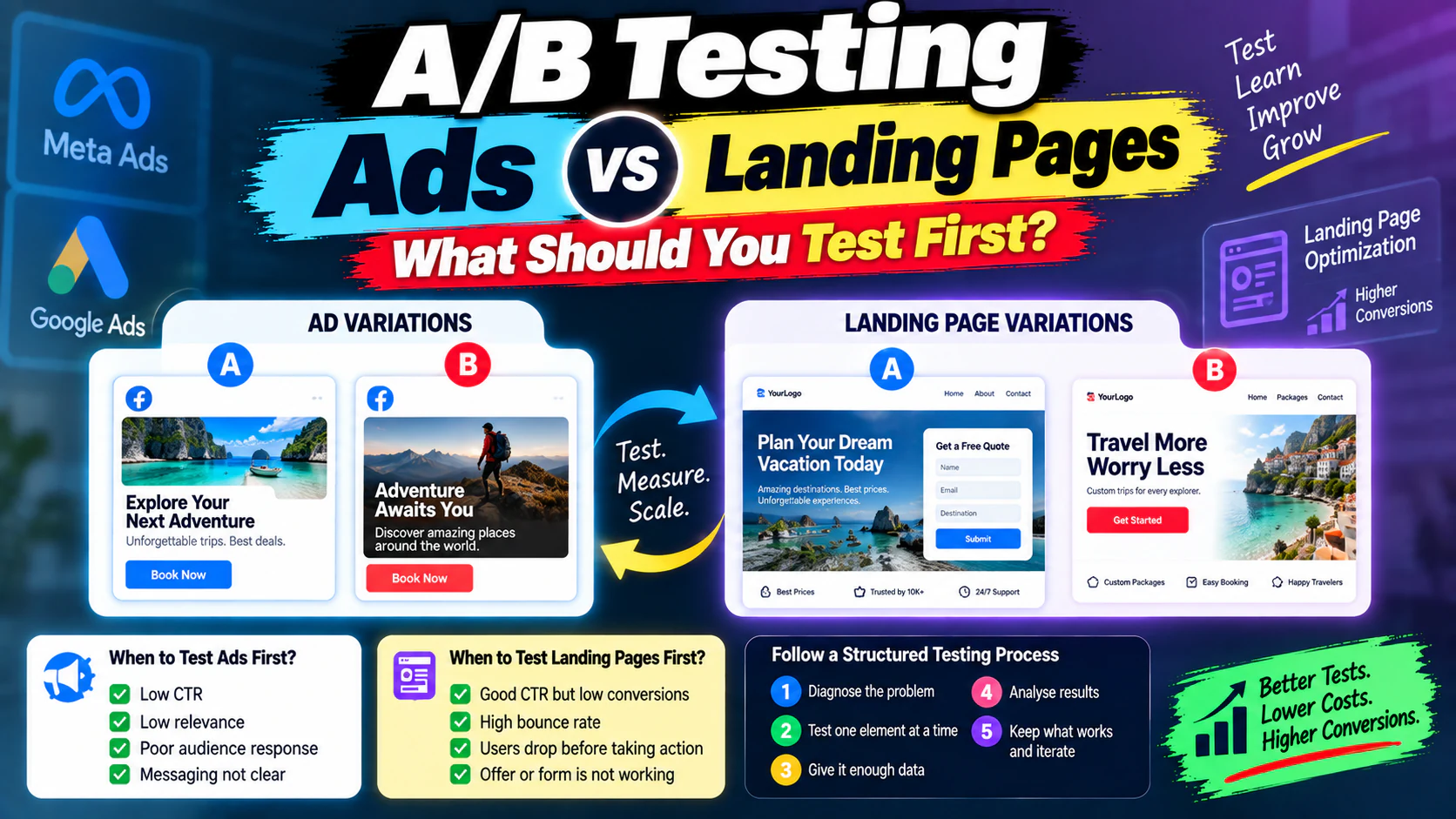
Your paid campaign is underperforming.
You have two obvious suspects:
So you change both.
New headline. New creative. New CTA. New landing-page layout. Maybe even a new offer.
Two weeks later, conversions improve.
Great.
But now you have a problem:
Was the new ad better?
Was the landing page better?
Did the combination work?
Did the audience change?
Or did performance improve for an entirely different reason?
That is the problem with unstructured PPC A/B testing.
You can make changes without actually learning anything.
When testing paid campaigns, the better question is not:
“What should we change?”
It is:
“Where is the biggest uncertainty in the conversion journey, and what test will reduce it?”
This guide explains how to decide whether to test the ad or the landing page first, how to structure the experiment, what metrics to watch, and how to avoid tests that produce misleading conclusions.
Ads vs Landing Pages: What Are You Actually Testing?
A paid acquisition journey can be simplified to:
Each stage has a different job.
The ad must:
- attract the right person,
- communicate relevance,
- create enough interest to earn the click.
The landing page must:
- continue the ad's promise,
- explain the offer,
- establish trust,
- remove objections,
- and make conversion easy.
So when conversions are weak, you first need to determine where the problem is occurring.
For example:
High impressions + low CTR
The problem may be the:
- audience,
- creative,
- headline,
- offer,
- positioning,
- or message.
Good CTR + poor landing-page engagement
The problem may be:
- message mismatch,
- weak page experience,
- slow loading,
- irrelevant content,
- or poor mobile UX.
Good traffic + low conversion rate
The landing page or offer deserves much more attention.
Good conversion rate + poor lead quality
The issue may be:
- targeting,
- qualification,
- offer positioning,
- or sales follow-up.
This is why testing should start with diagnosis, not preference.
The First Rule: Don't Test the Landing Page Just Because It Looks Old
A common marketing mistake is redesigning the landing page because:
“It doesn't look modern.”
A page can look outdated and still convert well.
Another page can look beautiful and generate poor-quality leads.
The question is not:
The question is:
A/B testing exists to answer that question.
When Should You Test the Ad First?
Test the ad first when the evidence suggests the problem occurs before the click.
Look for signals such as:
- Low CTR
- Weak engagement
- High CPC relative to comparable campaigns
- Poor relevance
- Creative fatigue
- Low-quality traffic
- Weak response to the offer
For example:
Suppose your campaign receives:
but only:
That's a 0.8% CTR.
If comparable campaigns or historical performance indicate that the audience should respond more strongly, the ad deserves investigation before you rebuild the landing page.
Why?
Because the landing page cannot fix a problem that occurs before the visitor arrives.
When Should You Test the Landing Page First?
Test the landing page when the ad is already doing its job.
Suppose you have:
- strong CTR,
- reasonable CPC,
- relevant traffic,
- but very few conversions.
Then changing the creative may not be your highest-leverage move.
The visitor is already clicking.
Now ask:
Check:
- landing-page conversion rate,
- CTA interaction,
- form starts,
- form completion,
- page speed,
- mobile experience,
- message match,
- offer clarity,
- trust signals,
- objection handling.
If traffic quality is reasonable but conversion is weak, the landing page is a logical testing priority.
A Simple Decision Framework
Use this sequence before starting a test.
Step 1 — Are people clicking?
Step 2 — Are visitors relevant?
Step 3 — Are visitors engaging with the page?
Step 4 — Are they converting?
This prevents random experimentation.
The Most Important Concept: Diagnose Before You Test
Before launching an A/B test, write down:
Then:
Then:
For example:
Weak hypothesis
“Let's make the landing page better.”
There is nothing measurable here.
Stronger hypothesis
“Visitors understand the service but hesitate because the page does not establish enough trust before asking for a consultation.”
Now you can test a specific change:
Version A: Current page
Version B: Add relevant case-study proof before the primary CTA.
That's a real experiment.
What Makes a Good A/B Test?
A good test has four parts:
One clear problem
Example:
One hypothesis
Example:
One meaningful change
Example:
One primary success metric
Example:
This makes the result easier to interpret.
What Should You Test in Ads?
Paid ad testing can cover many variables.
But don't change everything simultaneously.
Useful variables include:
Hook
Example:
vs
Creative Format
For example:
- Static image
- Video
- Carousel
- Product demonstration
- Testimonial creative
The format should be appropriate for the platform and offer.
Message Angle
You might test:
vs
vs
For example:
Problem angle: “Why your paid traffic isn't converting.”
Outcome angle: “Turn more paid visitors into qualified enquiries.”
Proof angle: “See how we identify conversion leaks in paid campaigns.”
Offer
For example:
vs
The offer itself can change the quality and quantity of response.
CTA
Examples:
- Learn More
- Get Started
- Request an Audit
- Book a Consultation
- Get a Quote
Don't assume the shortest CTA is automatically the best one.
What Should You Test on the Landing Page?
Landing-page tests should focus on elements that influence the visitor's decision.
Headline
Does the headline clearly communicate the problem or outcome?
Value proposition
Does the visitor understand why this offer is worth considering?
Proof
Would stronger evidence reduce uncertainty?
Offer
Is the offer compelling enough?
CTA
Does the CTA clearly communicate the next step?
Form
Is the form creating unnecessary friction?
Does information appear in the order the visitor needs it?
Objection handling
Are important concerns answered before the visitor reaches the decision?
Don't Test Tiny Changes First
Changing:
“Get Started”
to:
“Get Started Now”
may be worth testing eventually.
But if the page has:
- weak message match,
- no proof,
- unclear offer,
- poor mobile UX,
- and a confusing form,
the CTA wording is probably not your biggest problem.
Prioritise tests based on potential impact, not how easy the change is to make.
The Testing Priority Matrix
A useful way to prioritise experiments is:
| Test | Potential impact | Confidence | Effort | Priority |
|---|---|---|---|---|
| New landing-page offer | High | Medium | Medium | High |
| Stronger headline | High | High | Low | High |
| New testimonial placement | Medium | Medium | Low | Medium |
| CTA wording | Low-medium | Medium | Low | Medium |
| Button colour | Low | Low | Low | Low |
The point isn't to assign perfect scores.
The point is to prevent your team from spending three weeks debating a button colour while ignoring a weak offer.
A/B Testing Ads vs Landing Pages: A Practical Decision Table
| Situation | Test first |
|---|---|
| Very low CTR | Ad |
| High CPC caused by weak response | Ad |
| Strong CTR but poor conversion rate | Landing page |
| Strong traffic but weak engagement | Landing page/message match |
| Good conversion volume but poor lead quality | Audience/offer/qualification |
| Creative fatigue | Ad |
| High form abandonment | Landing page/form |
| Ad promise doesn't match page | Landing page + message match |
| New offer with no market response | Ad/offer |
| Strong ads and weak page | Landing page |
This isn't a mathematical rule.
It is a diagnostic starting point.
What If Both the Ad and Landing Page Look Bad?
Don't run a giant experiment where you replace everything.
Instead, establish a baseline.
Then prioritise the largest obvious problem.
For example:
Ad → Landing Page → Form
Suppose:
CTR: Strong Landing-page conversion: Weak
Test the landing page first.
After the page reaches a reasonable baseline, test creative.
This creates a learning sequence.
Why Changing Both at Once Is Dangerous
Imagine:
Original
Ad A + Landing Page A
produces:
Then you launch:
Ad B + Landing Page B
and get:
You know performance improved.
But you don't know:
- whether Ad B created the improvement,
- whether Landing Page B created it,
- whether both contributed,
- or whether one improved while the other became worse.
A cleaner sequence is:
Test 1
Ad A + Landing Page A
vs
Ad B + Landing Page A
Identify ad effect.
Test 2
Winning Ad + Landing Page A
vs
Winning Ad + Landing Page B
Identify landing-page effect.
This is much easier to interpret.
But What About Multivariate Testing?
Multivariate testing can test multiple variables simultaneously.
For example:
combined with:
combined with:
This can become powerful with enough traffic.
But it also requires substantially more data and careful experiment design.
For most businesses with modest paid traffic, a simpler A/B testing approach is easier to execute and interpret.
Don't choose complexity because it sounds advanced.
Choose it when the data supports it.
Don't Declare a Winner Too Early
One of the biggest A/B testing mistakes is stopping as soon as one version looks better.
For example:
Day 3
Version A: 8 conversions
Version B: 11 conversions
Not necessarily.
Small samples can produce large-looking percentage differences by chance.
You need enough data to make a reasonably reliable decision.
The appropriate amount depends on:
- baseline conversion rate,
- traffic volume,
- expected lift,
- business risk,
- and the testing method being used.
Avoid arbitrary rules like:
or:
There is no universal number.
Don't Optimise for the Wrong Metric
Suppose an ad generates:
and another generates:
300 clicks.
The first looks better.
But what if:
Ad A: 500 clicks → 5 qualified leads
Ad B: 300 clicks → 18 qualified leads
If you optimise only for CTR, you may choose the wrong ad.
This is why your testing metric should move closer to the actual business objective.
Depending on the funnel, that could be:
- Qualified leads
- Purchases
- Revenue
- Cost per qualified lead
- Customer acquisition cost
- Return on ad spend
Lead Quality Changes the Testing Decision
For lead-generation businesses, conversion volume alone can be misleading.
Imagine:
Landing Page A
100 leads
Landing Page B
70 leads
At first glance, A wins.
But after sales qualification:
Now B may be significantly more valuable.
Your A/B testing framework should therefore connect marketing metrics with sales outcomes whenever possible.
What If the Winning Version Has a Lower Conversion Rate?
This can happen.
Suppose:
Version A
10% conversion rate
Version B
8% conversion rate
But B produces significantly better customers.
If the objective is profitable customer acquisition, B may still be the better business decision.
A/B testing should optimise the business outcome, not the prettiest dashboard metric.
Don't Let Audience Changes Contaminate the Test
An experiment becomes difficult to interpret when you change too many variables outside the test.
For example:
- different audience,
- different budget,
- different placement,
- different campaign objective,
- different landing page,
- different creative.
Now your “A/B test” is actually a bundle of changes.
Keep the testing environment as controlled as practical.
Budget Changes Matter Too
Suppose Version A has been running with a small budget.
Version B launches with twice the spend.
Performance differences may partly reflect delivery behaviour rather than the creative or page change itself.
When comparing variants, pay attention to whether:
- traffic quality changed,
- audience composition changed,
- delivery changed,
- campaign structure changed,
- or budget changed significantly.
A clean test requires more than two URLs or two ad variations.
Build a Testing Sequence
Instead of testing randomly, create a hierarchy.
Round 1 — Diagnose the funnel
Find the biggest bottleneck.
Round 2 — Fix obvious friction
Address major relevance, offer or UX problems.
Round 3 — Test high-impact hypotheses
Examples:
- headline,
- offer,
- creative angle,
- proof,
- CTA,
- form.
Round 4 — Test refinements
Examples:
- CTA wording,
- section order,
- visual variations,
- secondary copy.
Round 5 — Scale winners
Move successful learnings into the broader campaign.
This turns A/B testing into a repeatable optimisation system.
A Practical Testing Backlog
Create a simple table:
| Test | Hypothesis | Variable | Metric | Priority | Status |
|---|---|---|---|---|---|
| A | Stronger problem headline increases relevance | Headline | Qualified CVR | High | Planned |
| B | Case study reduces hesitation | Proof | Qualified leads | High | Planned |
| C | Shorter form reduces abandonment | Form | Lead CVR | Medium | Planned |
| D | New creative angle improves traffic quality | Ad message | CPL + lead quality | High | Running |
| E | Stronger CTA improves action rate | CTA | Conversion rate | Medium | Backlog |
Now your optimisation process has memory.
You aren't repeatedly asking:
You already know.
A/B Testing Ads: What to Record
For every ad test, record:
- Audience
- Campaign
- Creative
- Hook
- Offer
- CTA
- Spend
- Impressions
- Clicks
- CTR
- CPC
- Conversions
- Cost per conversion
- Qualified conversions
- Revenue where applicable
- Test dates
- Final decision
The purpose isn't to create a giant spreadsheet nobody reads.
It is to create a learning library.
Over time, you should be able to answer:
A/B Testing Landing Pages: What to Record
For each page test:
- Traffic source
- Audience
- Page version
- Headline
- Offer
- CTA
- Form length
- Proof placement
- Visits
- CTA interactions
- Form starts
- Form completions
- Conversion rate
- Qualified conversion rate
- Revenue where applicable
- Test dates
- Decision
This makes future experiments much smarter.
What If the Test Is Inconclusive?
An inconclusive test is not necessarily a failure.
It can tell you:
For example, if changing the CTA wording produces almost no meaningful difference, stop spending excessive optimisation time on CTA wording.
Move to a bigger question:
An experiment can create value even when neither version becomes a clear winner.
The Difference Between A/B Testing and Continuous Optimisation
A/B testing is one tool.
Optimisation is the larger process.
A complete optimisation loop is:
If you only run tests but never document what you learned, you're leaving value behind.
When You Should Test Ads First
Use this checklist.
Test ads first when:
- CTR is weak.
- Creative fatigue is visible.
- The message isn't resonating.
- Traffic quality is poor.
- The offer isn't attracting the right people.
- Audience relevance is questionable.
- The landing page is already converting reasonably well.
When You Should Test Landing Pages First
Prioritise landing-page testing when:
- CTR is healthy.
- Traffic is relevant.
- CPC is acceptable.
- Visitors reach the page.
- Conversion rate is weak.
- Form abandonment is high.
- The page doesn't match the ad.
- The offer isn't clearly communicated.
- Trust is weak.
- Mobile UX creates friction.
When Neither Should Be Tested First
Sometimes the real problem is somewhere else.
For example:
Poor lead quality
Investigate:
- audience,
- targeting,
- keyword intent,
- qualification,
- offer positioning.
Poor sales performance
Investigate:
- lead follow-up,
- sales process,
- qualification,
- pricing,
- product-market fit.
Tracking problems
Fix measurement before making major optimisation decisions.
Otherwise, you may optimise against inaccurate data.
The Best Testing Order for Most Paid Campaigns
A practical sequence is:
Tracking
Can you trust the data?
Audience
Are you reaching the right people?
Offer
Is there a compelling reason to act?
Ad
Can you generate relevant attention and clicks?
Landing page
Can you turn relevant traffic into action?
Form / checkout
Can you remove unnecessary conversion friction?
Sales / post-conversion
Are those conversions producing business value?
This sequence prevents you from polishing low-impact elements while a fundamental problem remains unresolved.
A/B Testing Example
Imagine an agency running Google Ads.
Current funnel:
Results:
- 10,000 impressions
- 500 clicks
- 5% CTR
- 500 landing-page visits
- 20 leads
- 4% landing-page conversion rate
The ad is getting reasonable engagement.
The landing page converts only 4% of visitors.
Instead of immediately creating five new ads, the agency forms a hypothesis:
“The page explains the service but does not provide enough evidence to justify booking a consultation.”
They test:
Version A
Current page.
Version B
Adds:
- relevant case study,
- specific deliverables,
- client proof,
- clearer CTA.
Everything else remains as consistent as practical.
If B produces a meaningful improvement in qualified conversion rate, the team has learned something useful.
Now they can take that learning back into the advertising.
That is how testing becomes a feedback loop.
Your A/B Testing Decision Framework
Before every experiment, answer these seven questions:
Not “CTR is low.”
Instead:
Before the click?
After the click?
During conversion?
After lead submission?
What do we believe is causing it?
Ad?
Headline?
Offer?
Form?
Proof?
Prefer a metric close to business value.
Keep the environment controlled as much as practical.
This turns every experiment into reusable knowledge.
Final Answer: Ads or Landing Page First?
There is no universal answer.
The decision should come from the funnel data.
A useful rule is:
Fix the earliest meaningful bottleneck first.
If the ad is failing to generate relevant traffic, improve the ad.
If the ad is generating relevant traffic but the page fails to convert, improve the landing page.
If both are weak, don't change both blindly. Establish a baseline and work through the funnel in sequence.
The objective of A/B testing is not to produce more variations.
And the best paid campaigns are not the ones where the team changes something every week.
They are the ones where every change answers a question.
