
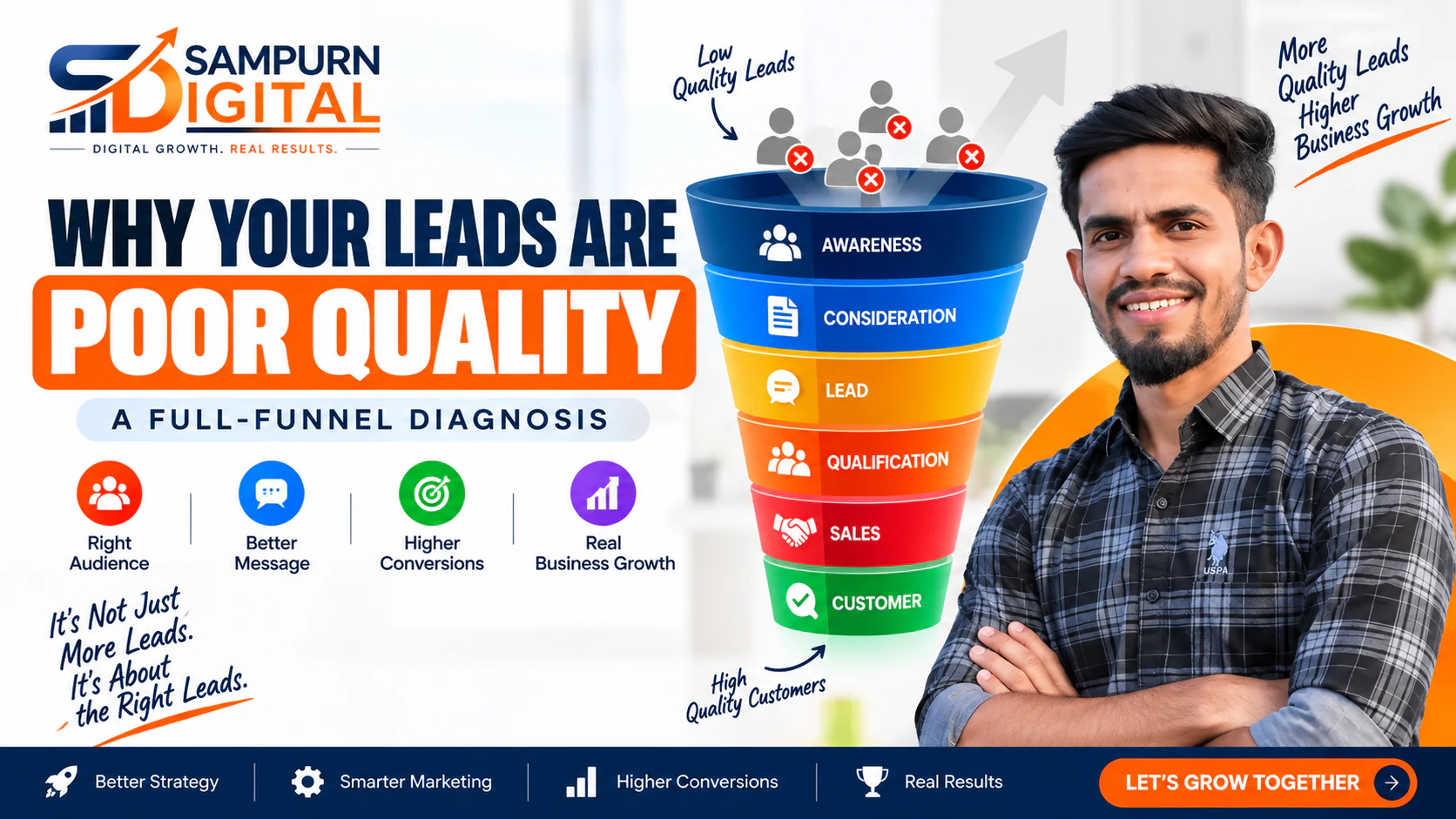
Getting more leads sounds like a good marketing result.
But what happens when your sales team keeps saying:
"These leads aren't good."
The problem may not be your sales team.
It may not even be your advertising.
A business can generate hundreds of leads and still struggle to acquire customers if the wrong people are entering the funnel, the offer attracts low-intent prospects, the landing page creates the wrong expectations, or the sales process isn't aligned with the leads being generated.
That's why fixing poor-quality leads requires more than changing an ad campaign.
You need to examine the entire journey:
This guide shows you how to diagnose where lead quality is actually breaking.
First: Don't Assume More Leads Will Solve the Problem
Suppose your business generates 500 leads per month.
Only 50 are considered genuinely qualified.
And only 10 become customers.
The obvious reaction might be:
"We need more leads."
So the marketing budget increases.
500 leads become 800.
But if the underlying problem hasn't changed, you may simply get:
That creates:
- More sales follow-up
- More wasted ad spend
- More time spent qualifying prospects
- Lower sales-team productivity
- Higher customer acquisition cost
- Frustration between marketing and sales
The better question is:
"Why are the wrong people entering our funnel?"
What Does "Poor-Quality Lead" Actually Mean?
A poor-quality lead isn't simply someone who doesn't buy.
A lead can be legitimate but still have low commercial value.
For example, a prospect may:
- Have no budget
- Need a completely different service
- Be outside your target geography
- Be looking only for free information
- Be too early in the buying journey
- Have unrealistic expectations
- Not have decision-making authority
- Need a product you don't offer
- Submit a form accidentally
- Be researching prices without purchase intent
This means lead quality should be evaluated against your ideal customer profile, not simply whether someone completed a form.
The Lead Quality Equation
A useful way to think about lead quality is:
If one of these factors is very weak, the lead may have limited commercial value.
Fit
Does the prospect match your target customer?
Intent
Are they actually interested in solving the problem?
Need
Does your product or service solve their specific problem?
Ability to Buy
Do they have the budget, authority and timing to move forward?
The goal isn't necessarily to maximize lead volume.
It's to maximize qualified opportunities.
Where Poor-Quality Leads Usually Come From
There are several points where lead quality can deteriorate.
Wrong Audience
Your marketing may be reaching people who were never good prospects.
For example:
A premium B2B service targets business decision-makers.
But the campaign reaches students, job seekers, freelancers or people looking for free resources.
The campaign may produce excellent engagement metrics.
But the leads will be poor.
Wrong Search Intent
Someone searching:
has a different level of buying intent from someone searching:
Both searches may generate traffic.
They shouldn't necessarily receive the same conversion strategy.
Misleading Messaging
Suppose an advertisement says:
"Get a complete marketing solution for ₹5,000."
But the landing page explains that the actual service starts at ₹50,000.
You may generate leads.
But the advertisement created the wrong expectation.
That's a message-to-offer mismatch.
Weak Qualification
If your form asks only:
- Name
- Phone
you may have no idea whether the person is actually a suitable prospect.
Additional qualification questions can sometimes improve lead quality by creating useful friction.
Wrong Offer
A free consultation, downloadable guide, discount or demo can attract very different types of people.
The offer itself influences who enters the funnel.
A Full-Funnel Lead Quality Diagnosis
Don't jump directly into your ad account.
Work through the funnel systematically.
Define What a Good Lead Looks Like
Before diagnosing poor leads, define the target.
Create an ideal customer profile around factors such as:
Business Fit
- Industry
- Business size
- Location
- Business model
- Revenue range
- Product or service type
Problem Fit
- What problem are they trying to solve?
- How urgent is the problem?
- Does your service actually solve it?
Commercial Fit
- Budget
- Decision-making authority
- Buying timeline
- Expected value
Intent
- Researching
- Comparing
- Planning
- Ready to purchase
Without this definition, "good lead" becomes subjective.
Compare Leads With Your Ideal Customer
Take your recent leads and categorize them.
For example:
| Lead Type | Number | Qualified? |
|---|---|---|
| Ideal customer | 35 | Yes |
| Wrong industry | 20 | No |
| Too-small budget | 30 | No |
| Outside service area | 10 | No |
| Research-only | 25 | No |
| High-intent prospect | 15 | Yes |
This can immediately reveal whether the problem is:
rather than simply "bad leads."
Identify Which Channel Produces the Problem
Don't evaluate all leads as one group.
Break them down by source.
For example:
| Channel | Leads | Qualified Leads | Quality |
|---|---|---|---|
| Organic Search | 80 | 40 | Strong |
| Google Ads | 120 | 35 | Medium |
| Meta Ads | 200 | 25 | Weak |
| Referral | 30 | 20 | Strong |
Now the problem becomes clearer.
Your business may not have a lead-generation problem.
It may have a channel-quality problem.
Audit Your Campaign Targeting
If poor-quality leads are coming primarily from paid campaigns, investigate targeting before simply reducing spend.
Check:
- Audience settings
- Location targeting
- Demographics
- Keywords
- Search terms
- Placements
- Interests
- Lookalike audiences
- Retargeting audiences
- Exclusions
- Campaign objectives
The objective is not to make the audience as large as possible.
It is to make it commercially relevant.
For paid traffic specifically, a useful next step is [performance marketing and paid acquisition for businesses](https://chatgpt.com/blog/performance-marketing/low-conversion-rate-in-google-ads-is-the-problem-ads-or-landing-page).
Audit Search Intent
If you're using search advertising or SEO, examine what people are actually searching for.
Different searches indicate different intent.
Informational
"how does SEO work"
Commercial Investigation
"best SEO agency for startups"
Transactional
"hire SEO agency"
These shouldn't necessarily be treated identically.
Your content, landing pages and offers should reflect the intent behind the search.
Check the Message Match
Compare these four elements:
They should tell a consistent story.
For example:
Ad:
"SEO for e-commerce businesses"
Landing page:
"Digital marketing services for every type of business"
Form:
"Request a free consultation"
The visitor may not know exactly what happens next.
A stronger journey would maintain the same positioning throughout.
Audit the Landing Page
Sometimes the marketing campaign is doing its job.
The landing page is the problem.
Check:
- Headline
- Offer clarity
- Audience relevance
- Benefits
- Proof
- Testimonials
- Case studies
- Pricing expectations
- CTA
- Form
- Mobile experience
- Page speed
- Trust signals
Your landing page should answer:
Examine the Offer
Your offer determines who responds.
For example:
Free consultation
May attract a broad range of prospects.
Detailed audit
May attract people actively investigating a problem.
Strategy session
May attract businesses already considering implementation.
Discount
May attract price-sensitive prospects.
There isn't one universally correct offer.
The important question is:
Does the offer attract the type of customer your business wants?
Review the Lead Form
Your form is part of your qualification system.
Depending on the business, useful questions might include:
- What service are you interested in?
- What is your monthly marketing budget?
- What is your biggest challenge?
- What is your website?
- How soon do you want to start?
- What type of business do you operate?
Don't add unnecessary questions simply to make the form longer.
Use questions that help you determine whether the prospect is relevant.
Check Lead Qualification
Marketing should not be judged only on the number of form submissions.
Create qualification stages.
For example:
This allows you to identify where quality is actually declining.
Check Sales Follow-Up
Sometimes marketing receives the blame for poor lead quality when the real problem occurs after the lead arrives.
Review:
- Response time
- Number of follow-ups
- Contact rate
- Qualification process
- Sales messaging
- Proposal process
- Objection handling
- CRM tracking
A good lead can become a lost opportunity because of poor follow-up.
Compare Lead Quality With Revenue
This is where the diagnosis becomes much more useful.
Don't stop at:
Ask:
For example:
| Channel | Leads | Customers | Revenue |
|---|---|---|---|
| SEO | 50 | 8 | ₹4,00,000 |
| Google Ads | 100 | 7 | ₹3,50,000 |
| Social | 200 | 4 | ₹1,20,000 |
| Referral | 30 | 6 | ₹3,00,000 |
Social media generated the most leads.
But SEO generated more customers and revenue.
This changes the budget conversation completely.
The Five Most Common Lead Quality Problems
If you're diagnosing your own funnel, start here.
Problem 1: The Audience Is Too Broad
High lead volume but low qualification rate.
Targeting is too broad.
Refine audience, location, keywords, exclusions and messaging.
Problem 2: The Offer Attracts the Wrong People
Many people respond, but few are commercially relevant.
The offer is too broad or attracts low-intent users.
Redesign the offer around a specific customer problem.
Problem 3: The Landing Page Creates Wrong Expectations
High conversion rate but poor lead quality.
The page makes the offer appear easier, cheaper or broader than it actually is.
Improve message consistency and qualification.
Problem 4: Lead Qualification Is Too Weak
Sales spends too much time filtering prospects.
The funnel collects contact details but little useful qualification information.
Introduce relevant qualification criteria.
Problem 5: Marketing and Sales Define "Qualified" Differently
Marketing says:
"We generated 300 leads."
Sales says:
"Only 30 were useful."
There is no shared definition of a qualified lead.
Create a common qualification framework.
A Better Lead Quality Measurement System
Track more than lead volume.
At minimum, measure:
Lead Volume
How many leads entered the funnel?
Qualification Rate
What percentage became qualified?
Sales Conversion Rate
What percentage of qualified leads became customers?
Customer Acquisition Cost
How much did it cost to acquire each customer?
Revenue Per Customer
How much revenue does the average acquired customer generate?
Customer Acquisition Cost by Channel
Which channels acquire customers efficiently?
This is why understanding [how to calculate customer acquisition cost across marketing channels](https://chatgpt.com/blog/digital-marketing/how-to-calculate-customer-acquisition-cost-across-marketing-channels) is important when evaluating lead quality.
Don't Optimize for Cheap Leads
One of the biggest mistakes businesses make is celebrating a falling cost per lead.
Imagine:
Campaign A
₹500 per lead
10% qualified
Campaign B
₹1,000 per lead
50% qualified
Campaign B appears more expensive.
But it may be substantially better for the business.
The real question is:
How much does it cost to generate a qualified opportunity or customer?
Not:
"How cheaply can we generate a form submission?"
Build a Lead Quality Score
For businesses with enough data, you can create a simple scoring model.
For example:
| Factor | Score |
|---|---|
| Correct industry | +20 |
| Target location | +15 |
| Suitable budget | +25 |
| Clear business need | +20 |
| Decision-maker | +10 |
| Immediate timeline | +10 |
Total:
Then define categories such as:
- 80–100 → High priority
- 60–79 → Qualified
- 40–59 → Nurture
- Below 40 → Low priority
The exact scoring system should reflect your business.
The purpose is consistency.
A Practical Full-Funnel Diagnosis Framework
If your leads are poor quality, follow this sequence.
Define Your Ideal Customer
Who should actually become a customer?
Segment Existing Leads
Separate good, average and poor leads.
Identify the Source
Which channel produces each lead?
Identify the Intent
Why did the person respond?
Review the Message
Does your marketing attract the right expectation?
Review the Landing Page
Does the page qualify and educate the visitor?
Review the Offer
Does the offer attract your ideal customer?
Review the Form
Does it collect enough useful information?
Review Sales Qualification
Are marketing and sales using the same definition?
Connect Leads to Revenue
Which channels actually produce customers and revenue?
Don't Change the Whole Funnel at Once
If your leads are poor quality, don't immediately:
- Change every advertisement
- Redesign the website
- Change the offer
- Stop SEO
- Stop social media
- Double the ad budget
- Replace your CRM
First identify the bottleneck.
For example:
The diagnosis should determine the action.
A Simple Lead Quality Audit Checklist
Use this checklist before changing your marketing strategy.
Audience
- Is the target customer clearly defined?
- Are campaigns reaching the right people?
- Are irrelevant audiences excluded?
- Is targeting based on data?
Intent
- Does the traffic have commercial relevance?
- Are keywords aligned with buying intent?
- Are informational and transactional visitors treated differently?
Messaging
- Does the ad accurately describe the offer?
- Does the landing page match the ad?
- Are expectations realistic?
- Is the value proposition clear?
Offer
- Does the offer attract the right customer?
- Is the offer aligned with buying stage?
- Does it create unnecessary low-intent responses?
Website
- Does the landing page clearly explain the service?
- Are trust signals present?
- Is the CTA clear?
- Is the page mobile-friendly?
Lead Form
- Are important qualification questions included?
- Is the form too easy to submit without context?
- Are form submissions being tracked correctly?
Sales
- Is follow-up happening quickly?
- Is qualification consistent?
- Does sales use the same definition of a qualified lead?
Measurement
- Can leads be connected to channels?
- Can qualified leads be identified?
- Can customers be identified?
- Can revenue be connected to acquisition sources?
Final Diagnosis: Poor Leads Usually Point to a Funnel Problem
If your business is receiving poor-quality leads, don't immediately conclude:
"Digital marketing doesn't work."
Marketing may be generating exactly what the system is asking it to generate.
If the targeting is broad, the offer is generic, the messaging is unclear and the qualification process is weak, the funnel can efficiently produce the wrong prospects.
The solution is to diagnose the complete journey.
Find where the quality drops.
Then fix that stage.
That is far more effective than simply trying to generate more leads.
And if your next question is whether the problem is coming from your advertising or your website, continue with [the guide to low conversion rates in Google Ads and whether the problem is ads or landing page](https://chatgpt.com/blog/performance-marketing/low-conversion-rate-in-google-ads-is-the-problem-ads-or-landing-page).
If the problem is your overall lead-generation infrastructure, explore [conversion-focused web development for lead generation](https://chatgpt.com/blog/web-development/lead-generation-website-architecture-for-service-businesses).
For a broader understanding of how all your channels should work together, see [how the complete digital growth funnel works](https://chatgpt.com/blog/digital-marketing/the-complete-digital-growth-funnel-from-first-click-to-customer).
