
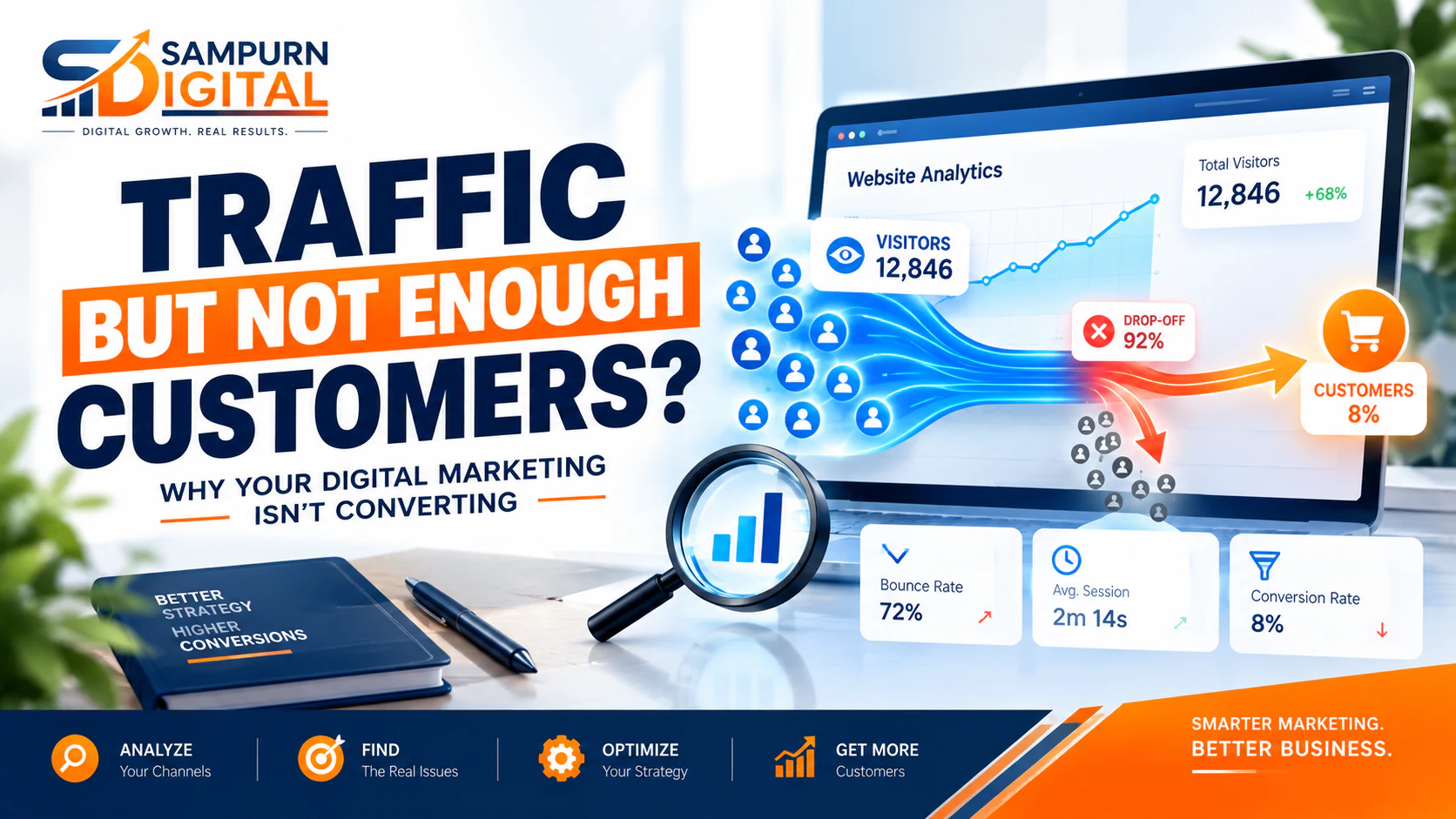
You are getting website traffic.
Your analytics dashboard shows visitors coming from Google, social media, paid campaigns, referrals, or other marketing channels.
But there is a problem.
You may be seeing thousands of website visits every month while leads remain low. Or your campaigns may generate clicks but very few enquiries. Your social media may get attention without producing meaningful business results.
This creates a frustrating question:
Why is your digital marketing getting traffic but not enough customers?
The answer is usually not that you simply need more traffic.
The real problem may be somewhere between the first click and the final conversion.
Digital marketing works as a connected system:
If one part of that system is weak, increasing traffic can simply increase the number of people who leave without buying.
This guide explains how to diagnose traffic but no sales, identify the real digital marketing conversion problems, and determine what should be fixed before increasing your marketing budget.
First: Don't Assume You Need More Traffic
When a business isn't generating enough customers, the first reaction is often:
"We need more visitors."
So the company may:
- Increase advertising spend
- Publish more social media content
- Target more keywords
- Start additional campaigns
- Increase Google Ads budgets
- Run more promotions
- Publish more blogs
But more traffic does not automatically mean more customers.
Imagine two businesses.
Business A
- 50,000 monthly visitors
- 500 leads
- 20 customers
Business B
- 8,000 monthly visitors
- 400 leads
- 60 customers
Business A gets significantly more traffic.
But Business B generates three times as many customers.
The difference is not traffic volume.
It is the quality of traffic and the effectiveness of the conversion system.
Before trying to generate more visitors, ask:
A simple digital marketing diagnosis looks like this:
If the business is getting traffic but not customers, you need to find the weak point.
The 8 Reasons Your Digital Marketing May Be Getting Traffic but Not Customers
Let's look at the most common reasons businesses get traffic without enough sales or leads.
You're Attracting the Wrong Traffic
The first question should be:
Traffic numbers can look impressive while business results remain poor.
For example, suppose you sell premium accounting services to established businesses.
You publish an article targeting:
"What is accounting?"
The article receives thousands of visitors.
But many of those visitors may be:
- Students
- Researchers
- People looking for basic definitions
- People outside your target market
- People with no immediate need for accounting services
The traffic is real.
But it may have little commercial value.
This is one of the most important reasons behind traffic but no sales.
Look beyond traffic volume
Evaluate:
- Where visitors come from
- Which keywords they use
- Which campaigns generate visits
- Which locations they come from
- Which devices they use
- Which landing pages they enter
- What actions they take
- Whether they become leads
- Whether those leads become customers
A website receiving 5,000 highly relevant visitors can outperform one receiving 50,000 irrelevant visitors.
Traffic quality matters more than traffic quantity
Ask:
"Would I actually want this visitor to become my customer?"
If the answer is frequently no, your acquisition strategy needs attention.
For businesses trying to decide where to invest next, our guide on [which marketing channel your business should invest in first](https://www.sampurndigital.com/blog/digital-marketing/how-to-choose-the-right-marketing-channel) can help connect channel selection with business goals.
Your Marketing Message Doesn't Match What People Want
Getting the right audience isn't enough.
Your message also needs to match their problem.
Imagine someone searches:
"digital marketing agency for e-commerce"
They are probably looking for a company that can help them grow their online store.
But your landing page starts with:
"Digital marketing is an important part of modern business."
That's generic.
The visitor already knows digital marketing matters.
They want to know:
- Can you solve my problem?
- Do you understand e-commerce?
- What exactly do you offer?
- What results can I expect?
- Why should I trust you?
- What should I do next?
When the marketing message doesn't match the visitor's expectations, people leave.
The message should connect three things
For example:
Your e-commerce store is getting traffic but sales are not growing.
We identify acquisition, landing-page and conversion bottlenecks.
Request a digital growth consultation.
This is much stronger than simply saying:
"We provide digital marketing services."
Your marketing needs to communicate why the visitor should continue.
Your Website Gets Visitors but Doesn't Convert Them
This is one of the biggest causes of digital marketing not generating customers.
You may have excellent:
- SEO
- Paid advertising
- Social media
- Content
- Email campaigns
But if the website experience is weak, those efforts can lose value after the click.
Imagine spending ₹50,000 on advertising and sending everyone to a page that:
- Loads slowly
- Looks outdated
- Has confusing navigation
- Doesn't clearly explain the offer
- Has too many distractions
- Doesn't establish trust
- Has no obvious CTA
- Doesn't work properly on mobile
The marketing campaign may be doing its job.
The website isn't.
This is why digital marketing and web development cannot always be treated as separate systems.
A conversion-focused website should make it easy for visitors to understand the offer and take the next step. For a deeper look at this connection, see [how conversion-focused web development works](https://www.sampurndigital.com/blog/web-development/lead-generation-website-architecture-for-service-businesses).
Your Call-to-Action Is Weak or Missing
A visitor can be interested in your product or service and still do nothing.
Why?
Because you haven't clearly told them what to do next.
Consider these two pages.
Learn more about our services.
Get a Free Digital Growth Consultation
The second CTA communicates:
- What happens next
- What the user gets
- Why they should click
Your CTA should match the visitor's stage in the buying journey.
Early-stage visitors may want:
- Learn more
- Read a guide
- See examples
- Understand pricing
Consideration-stage visitors may want:
- Compare options
- See case studies
- Review services
- Understand your process
High-intent visitors may want:
- Request a consultation
- Get a quote
- Book a call
- Start a project
One CTA doesn't necessarily work for everyone.
Your digital marketing system should give visitors a logical next step.
Your Marketing Channels Are Working in Isolation
Another common problem is that every marketing channel operates separately.
For example:
Publishes blogs.
Runs campaigns.
Creates Instagram content.
Maintains pages.
Follows up with leads.
But nobody connects the complete customer journey.
The result can look like this:
or:
or:
The individual channels may all appear active.
But the system is not connected.
A stronger approach is to think about the entire journey.
This is why businesses should understand [how customers move from search to social media to your website](https://www.sampurndigital.com/blog/digital-marketing/how-customers-move-from-search-to-social-media-to-your-website).
Each channel should support the next stage.
You're Measuring Traffic Instead of Business Outcomes
This is one of the most dangerous digital marketing mistakes.
Your monthly report says:
Website traffic increased 35%.
That sounds positive.
But what happened to:
- Leads?
- Qualified leads?
- Sales?
- Revenue?
- Customer acquisition cost?
- Conversion rate?
If traffic increased while customers stayed flat, you don't necessarily have a growth problem.
You may have a conversion problem.
Consider this example
Last month:
This month:
Traffic increased by 50%.
Customers increased by only 5%.
The important question isn't:
"How can we increase traffic again?"
It is:
"Why didn't the additional traffic produce proportional business results?"
Your reporting should connect marketing activity to commercial outcomes.
Track metrics such as:
- Qualified traffic
- Conversion rate
- Leads
- Qualified leads
- Customer acquisition cost
- Sales conversion rate
- Revenue
- Return on investment
- Customer lifetime value
Traffic is a diagnostic metric.
Your Lead Generation Process Has a Problem
Sometimes the website actually generates leads.
But the business still doesn't get enough customers.
That means the problem may exist after the conversion.
For example:
In this example, the website isn't necessarily the biggest problem.
The business may have problems with:
- Lead qualification
- Response time
- Sales follow-up
- Offer positioning
- Pricing
- Sales process
- Lead nurturing
- CRM management
- Customer objections
This is why digital marketing should not be evaluated only at the point where a form is submitted.
The real journey is:
If you stop measuring at "lead generated," you may miss the actual bottleneck.
You're Increasing Marketing Spend Before Fixing the Funnel
This is where many businesses lose money.
Suppose your current campaign generates:
You decide to double your advertising budget.
Now you generate:
That sounds good.
But if your sales process and conversion system are weak, doubling traffic simply doubles the amount of money entering the same inefficient funnel.
Before scaling acquisition, ask:
Is the audience right?
Is the offer compelling?
Is the landing page relevant?
Is the CTA clear?
Is the lead form working?
Are leads qualified?
Is sales follow-up fast enough?
Are customers profitable?
If the answer to several of these is no, increasing budget may not solve the problem.
First fix the system.
Then scale it.
A Practical Digital Marketing Diagnosis Framework
If a business told me:
"We're getting traffic, but we're not getting enough customers."
I wouldn't immediately recommend increasing the advertising budget.
I'd work through the funnel step by step.
Identify Where the Traffic Comes From
Break traffic down by channel.
For example:
| Channel | Traffic | Leads | Customers |
|---|---|---|---|
| Organic Search | 10,000 | 250 | 30 |
| Google Ads | 5,000 | 200 | 35 |
| Social Media | 8,000 | 80 | 8 |
| Referral | 2,000 | 100 | 20 |
Now the picture is very different.
Social media may generate substantial traffic but relatively few customers.
Google Ads may generate fewer visitors but significantly more customers.
This tells you that traffic volume alone isn't enough.
You need channel-level conversion data.
Evaluate Traffic Quality
For each channel, ask:
- Who is visiting?
- What did they search for?
- What campaign brought them?
- What page did they land on?
- How long did they engage?
- What action did they take?
- Did they become a lead?
- Did they eventually become a customer?
Don't judge a channel only by clicks.
Judge it by the quality of business outcomes it produces.
Check Landing Page Relevance
The visitor should immediately understand:
If an advertisement promises:
"Digital Marketing for Local Businesses"
but the landing page talks mainly about enterprise solutions, there is a disconnect.
The campaign and landing page need to work together.
Measure Conversion Rates
Calculate the conversion rate at each important stage.
For example:
Conversion rate:
Then:
Qualification rate:
Then:
Sales conversion:
Now you can see where the biggest loss occurs.
Without this breakdown, businesses often blame the wrong channel.
Diagnose the Biggest Bottleneck
Don't try to fix everything at once.
Instead, identify the largest constraint.
For example:
Problem A
High traffic + low conversion
Priority: Website and offer.
Problem B
Low traffic + high conversion
Priority: Acquisition.
Problem C
High leads + low sales
Priority: Lead qualification and sales process.
Problem D
High traffic + low-quality leads
Priority: Audience and targeting.
Problem E
Good leads + poor profitability
Priority: Offer economics and customer acquisition cost.
This turns digital marketing from a collection of activities into a measurable growth system.
Traffic → Lead → Customer: Find the Broken Step
A simple way to diagnose your marketing is to map the funnel.
Stage 1: Awareness
People discover your business.
Measure:
- Reach
- Impressions
- Search visibility
- Video views
- Brand searches
Stage 2: Acquisition
People visit your website.
Measure:
- Sessions
- Users
- Channel traffic
- Landing pages
- Campaign traffic
Stage 3: Engagement
People interact with your website.
Measure:
- Engagement
- Page views
- Key events
- Product/service page visits
- Content consumption
Stage 4: Conversion
People take the desired action.
Measure:
- Form submissions
- Calls
- Bookings
- Enquiries
- Purchases
Stage 5: Sales
Leads become customers.
Measure:
- Qualified leads
- Sales opportunities
- Closed deals
- Revenue
Stage 6: Retention
Customers continue buying.
Measure:
- Repeat purchases
- Retention
- Customer lifetime value
- Referrals
This gives you a much clearer picture than simply reporting monthly traffic.
How to Know Whether You Need More Traffic or Better Conversion
Use this simple framework.
High traffic + low conversion
You probably need to investigate:
- Offer
- Landing pages
- Messaging
- UX
- CTA
- Trust
- Audience quality
Low traffic + high conversion
Your conversion system may be working.
Your bigger problem may be:
- SEO
- Paid acquisition
- Social distribution
- Content
- Channel selection
High traffic + high leads + low sales
Look at:
- Lead quality
- Sales follow-up
- Qualification
- Pricing
- Offer
- Sales process
Low traffic + low conversion
You may have a full-funnel problem.
Start with the fundamentals instead of scaling one channel blindly.
For businesses still deciding where their marketing investment should go, [which marketing channel should your business invest in first](https://www.sampurndigital.com/blog/digital-marketing/which-marketing-channel-should-your-business-invest-in-first) is the logical next step.
Build a 90-Day Improvement Plan
Once you identify the bottleneck, create a structured improvement plan.
A simple approach is:
Days 1–30: Diagnose
Review:
- Analytics
- Search data
- Paid campaigns
- Landing pages
- Conversion tracking
- Lead quality
- Sales data
- Customer journey
The objective is to understand what is actually happening.
Days 31–60: Fix
Prioritize the biggest problems.
For example:
- Improve landing pages
- Fix conversion tracking
- Refine targeting
- Improve messaging
- Strengthen CTAs
- Remove wasted traffic
- Improve lead qualification
- Improve internal journeys
Don't change everything simultaneously.
Days 61–90: Improve and Scale
Once the major bottlenecks are fixed:
- Test new campaigns
- Improve winning channels
- Expand successful audiences
- Create better content
- Improve conversion rates
- Scale profitable acquisition
A structured [90-day digital marketing roadmap](https://www.sampurndigital.com/blog/digital-marketing/how-to-build-a-90-day-digital-marketing-roadmap) can help turn these activities into a measurable plan.
Use an Impact-versus-Effort Framework
Not every marketing problem deserves the same priority.
High impact / relatively low effort
Examples:
- Fixing broken forms
- Improving unclear CTAs
- Correcting conversion tracking
- Removing irrelevant ad targeting
- Improving obvious landing-page problems
- Fixing broken campaign links
High impact / higher effort
Examples:
- Rebuilding the website conversion journey
- Restructuring campaigns
- Developing a complete content strategy
- Reworking the offer
- Building a full-funnel acquisition system
- Connecting marketing and sales data
Lower priority
Examples:
- Minor design changes with no measurable impact
- Increasing posting frequency without a strategy
- Chasing vanity metrics
- Creating more content simply to stay busy
- Increasing ad spend before fixing conversion problems
The objective isn't to do more marketing.
Digital Marketing Should Work as One Growth System
A mature digital marketing strategy doesn't treat SEO, advertising, social media and web development as isolated activities.
Instead, they work together.
SEO
Captures relevant existing demand.
Paid Advertising
Can accelerate targeted acquisition.
Social Media
Builds attention, trust and demand.
Content
Educates prospects and supports decision-making.
Website
Converts visitors into leads or customers.
Analytics
Shows what is working and where the funnel is breaking.
This is why a business needs a connected digital growth strategy rather than simply "doing digital marketing."
For a broader view of how these systems should work together, start with [our guide to the digital growth funnel](https://www.sampurndigital.com/blog/digital-marketing/the-complete-digital-growth-funnel-from-first-click-to-customer).
You can also use our [digital marketing audit guide](https://www.sampurndigital.com/blog/digital-marketing/digital-marketing-audit-75-things-to-check-before-increasing-your-budget) to systematically review the current setup before increasing investment.
A Simple Digital Marketing Checklist
If you're getting traffic but not enough customers, review this checklist.
Traffic
- Are visitors actually part of your target audience?
- Which channels generate the most qualified traffic?
- Which campaigns generate customers rather than just clicks?
- Are you attracting relevant search queries?
- Are your paid audiences properly targeted?
Messaging
- Does the message match the visitor's intent?
- Is the value proposition clear?
- Does the page explain the actual problem being solved?
- Is the offer differentiated?
- Does the message match the advertisement or content that brought the visitor?
Website
- Does the landing page load quickly?
- Is the page easy to understand?
- Is the experience good on mobile?
- Is the CTA obvious?
- Is there enough trust?
- Are there unnecessary distractions?
- Does the page make the next step easy?
Conversion
- Are forms working?
- Are calls being tracked?
- Are conversions configured correctly?
- Are visitors reaching important conversion points?
- Are there unnecessary steps between visitor and enquiry?
Leads
- Are leads qualified?
- How quickly are leads contacted?
- Which campaigns produce qualified leads?
- Which leads become sales opportunities?
- Where are prospects dropping out?
Sales
- What percentage of qualified leads become customers?
- Which channels produce the highest-value customers?
- What is the average customer acquisition cost?
- What is the revenue generated from each channel?
Measurement
- Are traffic and conversion data connected?
- Are you tracking customers, not just leads?
- Can you identify revenue by channel?
- Are you comparing marketing cost with customer value?
Final Diagnosis: Traffic Is Only the Beginning
If your digital marketing is getting traffic but not enough customers, don't immediately conclude that you need:
You may need those things eventually.
But first find the bottleneck.
Your problem could be:
- You're attracting the wrong audience.
- Your marketing message doesn't match user intent.
- Your landing pages don't convert.
- Your CTA is unclear.
- Your channels aren't connected.
- Your traffic isn't commercially valuable.
- Your lead-generation process is weak.
- Your sales follow-up is inefficient.
- Your tracking doesn't connect marketing to revenue.
- You're scaling spend before fixing the funnel.
The right digital marketing strategy starts by asking:
"Where exactly is the customer journey breaking?"
Once you know that, your next action becomes much clearer.
You may need better traffic.
You may need better conversion.
You may need better leads.
You may need a stronger sales process.
Or you may need all of these systems to work together.
That is why successful digital marketing isn't simply about generating visitors.
It's about building a system where:
For businesses ready to review the complete system, [Explore Digital Marketing Services](https://www.sampurndigital.com/digital-marketing-services) can provide a structured path from diagnosis to implementation.
