
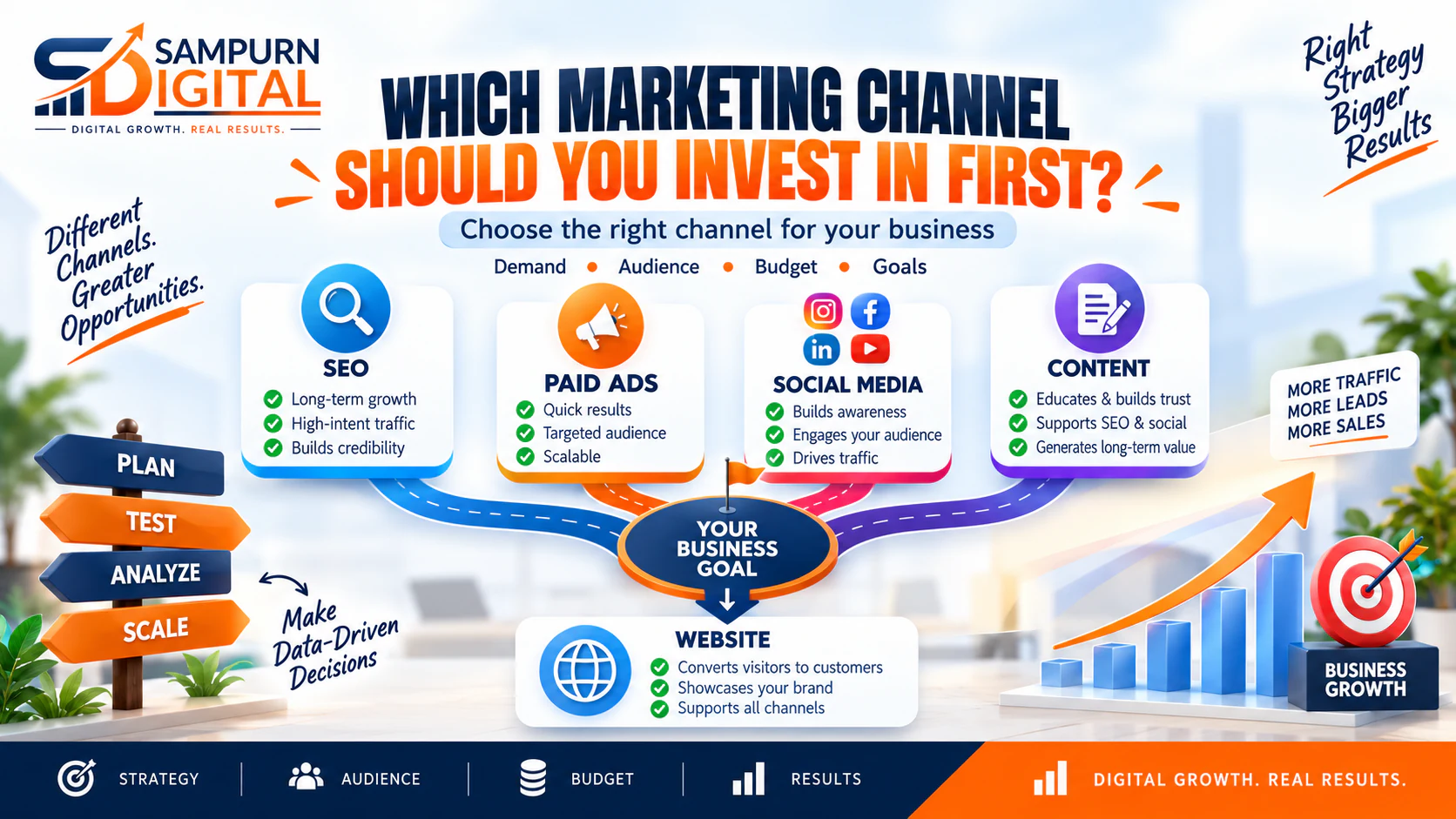
Your business needs more customers.
So you start looking at digital marketing.
Maybe someone tells you to invest in SEO.
Someone else recommends Google Ads.
Your social media manager says Instagram is the best opportunity.
Another agency tells you to start content marketing.
And suddenly you have a bigger question:
Which digital marketing channel should I use?
The problem is that there is no single channel that is automatically best for every business.
The right choice depends on your:
- Business model
- Customer journey
- Target audience
- Existing demand
- Sales cycle
- Budget
- Competition
- Website quality
- Conversion rate
- Growth objectives
- Ability to create and maintain content
- Expected customer value
A local service business may benefit from local SEO and search advertising.
An e-commerce brand may need a combination of SEO, Google Shopping, Meta Ads and social content.
A B2B company with a long sales cycle may need SEO, LinkedIn, educational content and lead nurturing.
The important question isn't:
"Which channel is the most popular?"
It is:
"Which channel has the strongest opportunity to solve our current business problem?"
This guide explains how to choose the right marketing channel for your business without simply following trends or copying what another company is doing.
First: Don't Choose a Channel Before Understanding the Customer
One of the biggest digital marketing mistakes is starting with the channel.
For example:
"We should start Instagram."
"Everyone is doing Google Ads."
"SEO is important, so let's publish blogs."
But the channel should come after understanding how customers discover, evaluate and buy from your business.
Start with the customer.
Ask:
What problem are they trying to solve?
Where do they look for information?
Are they actively searching for a solution?
Do they discover products through social media?
Do they compare providers before contacting someone?
How long does it take them to make a decision?
How much does one customer typically generate?
These questions change the answer.
A customer who searches:
"best digital marketing agency for e-commerce"
behaves differently from someone who discovers a digital marketing Reel while scrolling Instagram.
The first customer is actively looking.
The second may not have been looking at all.
That difference matters when deciding where to invest.
The 7 Factors That Should Determine Your Marketing Channel
There are seven important factors to evaluate before committing your budget.
Existing Customer Demand
The first question is:
If people are actively searching for your products or services, search-based channels can be attractive.
Examples include:
- SEO
- Google Search Ads
- Local SEO
- Google Business Profile visibility
- Product search
Imagine you run an emergency plumbing service.
Someone searching:
"emergency plumber near me"
already has a problem.
They aren't browsing for entertainment.
They want a solution.
Search can therefore capture existing demand.
Now imagine you sell a completely new type of product that customers don't know exists.
There may be very little search demand.
In that situation, relying entirely on SEO may limit growth.
You may need channels that create awareness first.
This is the fundamental difference between:
and
Demand creation.
Where Your Audience Actually Spends Attention
The second question is:
Where does your target audience spend time?
Not where you personally prefer to market.
Where your customers actually spend attention.
For example:
B2B decision-makers
May spend significant time on:
- Industry websites
- Professional communities
Younger consumer audiences
May spend more time on:
- YouTube
- TikTok
- Other visual platforms
Local customers
May frequently use:
- Google Search
- Maps
- Reviews
- Local directories
- Social media
The channel should follow the audience.
For businesses trying to determine which social platforms actually make sense, [how social media growth strategy works](https://www.sampurndigital.com/blog/social-media-marketing/how-to-choose-the-right-social-platforms-for-your-business) provides a more focused way to evaluate platform selection.
How Customers Make Buying Decisions
Not every product or service has the same buying journey.
Consider two examples.
Example A: Low-cost product
A customer sees an interesting product on social media.
They click.
They like it.
They buy.
The journey may take minutes.
Example B: High-value service
A business needs a marketing partner.
The decision-maker may:
- Search Google
- Visit multiple websites
- Read articles
- Compare agencies
- Check reviews
- Review case studies
- Speak with sales
- Discuss internally
- Request proposals
The journey may take weeks or months.
The second business needs a marketing system that supports consideration, not simply immediate clicks.
This is why understanding [the complete digital growth funnel from first click to customer](https://www.sampurndigital.com/blog/digital-marketing/the-complete-digital-growth-funnel-from-first-click-to-customer) is important before choosing individual channels.
Your Customer Acquisition Economics
A marketing channel can generate customers and still be a poor investment.
Why?
Because the economics may not work.
Suppose your average customer generates:
If a channel costs:
you have very little room left for:
- Operations
- Delivery
- Salaries
- Overheads
- Profit
Now imagine another channel acquires customers for:
That channel may be much more attractive even if it produces fewer customers.
This means channel selection should consider:
- Customer acquisition cost
- Average order value
- Customer lifetime value
- Gross margin
- Conversion rate
- Sales cycle
- Payback period
Don't ask only:
"How many leads can this channel generate?"
Ask:
"How profitable are the customers this channel generates?"
Your Budget and Time Horizon
Different channels behave differently over time.
SEO can require consistent investment before significant results accumulate.
Paid advertising can generate traffic much faster, but every additional click usually has a direct cost.
Social media can build awareness and trust over time, but organic reach isn't guaranteed.
Content marketing can create long-term assets but requires consistent production.
Your budget and expectations need to match the channel.
If you need immediate demand
Paid acquisition may deserve consideration.
If you want long-term organic growth
SEO may be more appropriate.
If you need to build awareness
Social media and content may be valuable.
If you need to improve existing traffic
Conversion optimization and website improvements may deserve priority.
The answer is often not "choose one forever."
It is:
Choose the right channel for the current stage of the business.
Your Existing Assets
Before investing in a new channel, look at what you already have.
You may already have:
- A strong website
- Existing organic rankings
- A large email list
- Social followers
- Customer reviews
- Existing content
- A CRM
- Customer data
- A strong brand
- Existing backlinks
- Product feeds
- Marketing analytics
These assets can influence the best next channel.
For example, a business with strong organic visibility but weak conversion may not need more traffic immediately.
It may need a better website.
A business with strong content but little distribution may need paid promotion.
A business with strong social engagement but no conversion path may need better website architecture.
Channel selection should therefore consider what already works.
Your Ability to Execute
A channel is only useful if your business can execute it properly.
SEO requires:
- Technical work
- Content
- Internal linking
- Authority development
- Ongoing optimization
Paid advertising requires:
- Campaign management
- Tracking
- Creative
- Landing pages
- Budget control
- Continuous testing
Social media requires:
- Content production
- Creative development
- Community management
- Platform knowledge
- Consistency
Email requires:
- Lists
- Segmentation
- Messaging
- Automation
- Deliverability
Choosing a channel without having the resources to execute it properly often produces disappointing results.
SEO vs PPC vs Social Media
One of the most common questions businesses ask is:
Should I invest in SEO, PPC or social media?
There isn't one universal answer.
Let's compare the basic role of each.
| Channel | Best For | Main Strength | Main Challenge |
|---|---|---|---|
| SEO | Existing search demand | Compounding organic visibility | Takes time |
| Google Ads | Immediate search demand | Fast acquisition | Ongoing ad cost |
| Social Media | Awareness and engagement | Audience attention | Conversion can vary |
| Content Marketing | Education and trust | Long-term authority | Requires consistency |
| Nurturing existing audience | Direct communication | Needs an audience | |
| CRO | Improving existing traffic | More value from current visitors | Requires enough traffic/data |
The goal isn't to declare a winner.
The goal is to identify which problem each channel solves.
When SEO Should Be Your First Priority
SEO can make sense when:
- People actively search for your services.
- Search demand is meaningful.
- Your website needs long-term organic growth.
- You can wait for results to compound.
- Competitors already receive organic traffic.
- Your content can answer important customer questions.
- Your business has strong customer lifetime value.
For example, a B2B service company may benefit from creating pages around:
- Core services
- Industry problems
- Comparisons
- Pricing questions
- Buying questions
- Educational resources
A well-planned SEO strategy can become an acquisition asset rather than a campaign that stops when the budget stops.
For businesses starting from scratch, [SEO strategy and organic search for businesses](https://www.sampurndigital.com/blog/seo/seo-strategy-for-a-new-business-what-should-you-do-in-the-first-90-days) provides a useful foundation.
When Paid Advertising Should Come First
Paid advertising can make sense when:
- You need traffic quickly.
- Search demand already exists.
- Your offer is proven.
- Your conversion tracking works.
- Your landing pages are ready.
- You can afford testing.
- Customer economics support the acquisition cost.
For example, a service business may run Google Search Ads for high-intent searches.
An e-commerce company may use paid shopping and social campaigns.
But paid advertising should not be treated as:
"Put money in and customers automatically appear."
You need:
If one of those stages is weak, performance suffers.
For a deeper comparison between major paid platforms, see [the performance marketing and paid acquisition guide](https://www.sampurndigital.com/blog/performance-marketing/google-ads-vs-meta-ads-which-is-better-for-your-business).
When Social Media Should Be Your First Priority
Social media can be particularly valuable when your product or service benefits from:
- Visual discovery
- Community
- Brand personality
- Creator influence
- Demonstrations
- Entertainment
- Education
- Social proof
Examples might include:
- Fashion
- Beauty
- Food
- Lifestyle products
- Consumer brands
- Personal brands
- Local businesses
But don't judge social media only by followers.
Measure:
- Relevant reach
- Engagement
- Website traffic
- Leads
- Sales
- Assisted conversions
- Customer acquisition
- Brand searches
A social channel can create demand even when the customer doesn't purchase immediately.
When Your Website Should Be the Priority
This is often overlooked.
Sometimes the answer isn't another marketing channel.
It's your website.
Imagine you're already getting:
but only:
Adding another traffic source may not solve the fundamental problem.
Improving the website could potentially create more value from the traffic you already have.
Review:
- Landing pages
- Navigation
- Page speed
- Mobile experience
- CTAs
- Forms
- Trust signals
- Service pages
- Product pages
- Checkout
- Conversion paths
For service businesses, [lead-generation website architecture](https://www.sampurndigital.com/blog/web-development/lead-generation-website-architecture-for-service-businesses) shows why the website should be treated as part of the acquisition system rather than simply a digital brochure.
The Channel Selection Framework
Instead of asking which channel is "best," score each option.
Use five questions.
Question 1: Is there customer demand?
Score from:
to
Question 2: Can we reach our audience?
to
Question 3: Can we execute it well?
to
Question 4: Can the economics work?
to
Question 5: Does it support our current goal?
to
Now create a simple table.
| Channel | Demand | Audience | Execution | Economics | Goal Fit | Total |
|---|---|---|---|---|---|---|
| SEO | 5 | 4 | 4 | 5 | 5 | 23 |
| Google Ads | 5 | 5 | 4 | 4 | 5 | 23 |
| Social Media | 3 | 5 | 5 | 3 | 4 | 20 |
| 2 | 3 | 4 | 5 | 3 | 17 |
The numbers are only examples.
Your business should create its own scores.
The exercise forces you to evaluate channels against your actual situation rather than marketing hype.
Don't Automatically Choose Only One Channel
Another important point:
Your best strategy may be a combination.
For example:
Local Service Business
E-commerce Brand
B2B Company
New Consumer Brand
The combination depends on the customer journey.
The channels should support each other.
For example:
This is why digital marketing should be viewed as a connected system rather than a competition between channels.
What If You Have a Limited Budget?
Small businesses often face a difficult choice.
They cannot invest heavily in everything.
In that situation, prioritize.
Protect the foundation
Make sure:
- Website works
- Analytics works
- Conversion tracking works
- Core pages exist
- Offer is clear
Capture existing demand
If people are actively searching for your solution, prioritize channels that capture that demand.
Build one scalable growth asset
This could be:
- SEO
- Content
- Social audience
Test before scaling
Don't commit your entire budget immediately.
Start with a controlled test.
Measure.
Learn.
Improve.
Then increase investment.
A Practical 90-Day Channel Selection Plan
Choosing a channel is only the beginning.
You also need a plan for testing it.
Days 1–30: Research and Setup
Review:
- Customer demand
- Competitors
- Search behavior
- Existing traffic
- Current conversion rates
- Website performance
- Customer economics
Then select one or two priority channels.
Days 31–60: Test
Launch focused activity.
For example:
- SEO content
- Search campaigns
- Social content
- Landing-page improvements
Measure the quality of results.
Don't judge a channel only by traffic.
Look for:
- Qualified visitors
- Leads
- Sales opportunities
- Customers
- Revenue
Days 61–90: Improve and Scale
Identify what worked.
Then:
- Increase investment in successful activities.
- Stop wasteful activities.
- Improve conversion rates.
- Expand winning audiences.
- Create supporting content.
- Connect channels together.
A structured [90-day digital marketing roadmap](https://www.sampurndigital.com/blog/digital-marketing/how-to-build-a-90-day-digital-marketing-roadmap) can help turn the selection into an actionable execution plan.
Common Channel Selection Mistakes
Avoid these mistakes.
Choosing a channel because competitors use it
Your competitor's business model may be completely different.
Choosing based on popularity
The most popular platform isn't necessarily the best acquisition channel for you.
Choosing based only on traffic
Traffic without customers doesn't create sustainable growth.
Choosing based only on short-term results
Some channels create immediate results while others build long-term assets.
Spreading the budget too thin
Trying five channels with insufficient budget or resources can make all five underperform.
Ignoring conversion
Even excellent acquisition becomes expensive if your website doesn't convert.
This connects directly to the problem discussed in [how to improve your digital marketing when you're getting traffic but not enough customers](https://www.sampurndigital.com/blog/digital-marketing/why-your-digital-marketing-is-getting-traffic-but-not-enough-customers).
Marketing Channel Selection Checklist
Before investing in a channel, ask:
Customer
- Who is our ideal customer?
- What problem are they solving?
- How do they discover solutions?
- How long is the buying cycle?
Demand
- Are people actively searching?
- Is demand growing?
- Is the market already competitive?
Channel
- Can we reach the audience?
- Does the channel fit our customer journey?
- Can we execute it properly?
Economics
- What is our average customer value?
- What CAC can we afford?
- What conversion rate do we need?
- How long can we wait for results?
Website
- Is our website ready?
- Are landing pages relevant?
- Are CTAs clear?
- Is conversion tracking working?
Measurement
- Can we track leads?
- Can we track customers?
- Can we connect revenue to the channel?
- Do we have enough data to make decisions?
Scaling
- What would make us increase investment?
- What would make us stop?
- What will we test next?
