
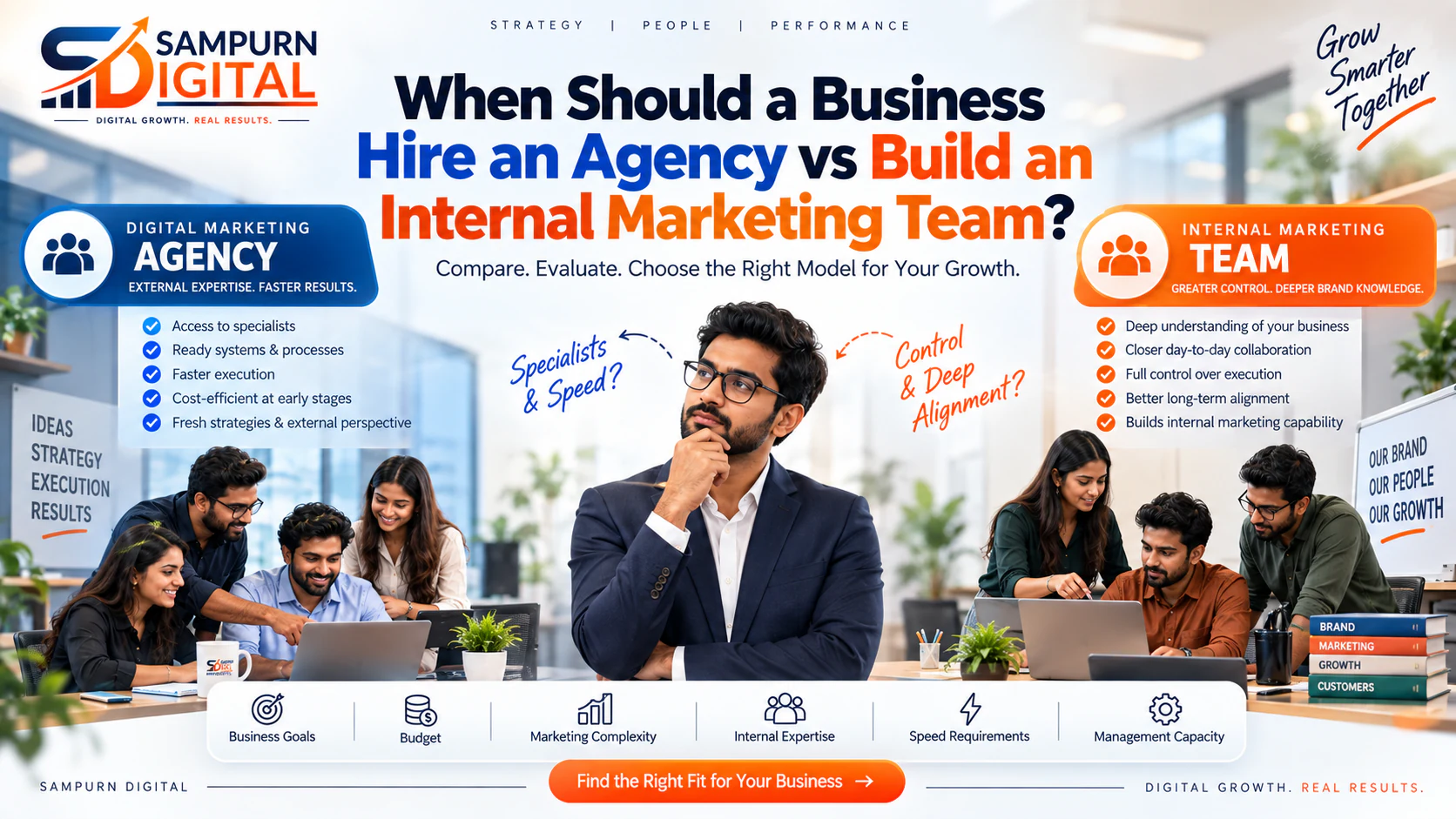
At some point, almost every growing business faces the same question:
“Should we hire a digital marketing agency or build an internal marketing team?”
There isn't one answer that works for every business.
An agency can give you access to specialists, systems and execution capacity without requiring you to hire an entire department.
An internal team can provide deeper business knowledge, tighter day-to-day collaboration and greater control over execution.
But choosing between the two shouldn't be based only on price.
The better question is:
“Which operating model gives our business the capabilities we need at our current stage of growth?”
That decision depends on your goals, budget, marketing complexity, internal expertise, speed requirements and ability to manage the function.
First: Don't Assume In-House Is Always Better
One of the most common assumptions is:
“If we hire our own marketing team, we'll have more control and therefore better results.”
Not necessarily.
An internal team may have excellent knowledge of the business but still lack specialists in:
- Technical SEO
- Paid advertising
- Conversion optimization
- Analytics
- Content strategy
- Creative testing
- Marketing attribution
- Web development
You may end up hiring several people before you have enough workload to justify them.
The opposite assumption can also be wrong.
Some businesses believe:
“An agency will handle everything, so we don't need anyone internally.”
That can create problems too.
Marketing works better when the business has someone who understands:
- Business objectives
- Products and services
- Customers
- Sales process
- Commercial priorities
- Brand positioning
The strongest model isn't always agency vs internal.
Sometimes it's internal ownership + external specialist execution.
Start With What Marketing Actually Needs to Accomplish
Before deciding who should execute your marketing, define what you need marketing to achieve.
Your requirements may include:
- Increasing organic traffic
- Generating qualified leads
- Scaling paid acquisition
- Improving website conversion
- Building social presence
- Creating content
- Launching campaigns
- Improving attribution
- Entering new markets
- Reducing customer acquisition cost
The more complex your requirements become, the more important the operating model becomes.
For example, a business running only one local lead-generation campaign may not need a large marketing department.
A company simultaneously managing:
has a very different capability requirement.
Understanding [SEO strategy and organic search for businesses](https://www.sampurndigital.com/blog/seo/how-seo-paid-ads-content-and-website-cro-work-together-as-one-growth-system) can help demonstrate how interconnected these functions become as marketing matures.
Understand the Difference Between an Agency and an Internal Team
At a high level:
An internal team gives you
- Dedicated employees
- Direct management
- Deep business context
- Day-to-day collaboration
- Greater control over priorities
- Long-term institutional knowledge
An agency can give you
- Multiple specialists
- Existing processes
- Broader experience
- Faster access to expertise
- Flexible capacity
- Cross-industry knowledge
- Strategic and execution support
Neither model is automatically superior.
The important question is whether the model matches your current requirements.
When an Internal Marketing Team Makes Sense
Building internally can make sense when marketing has become a substantial, ongoing business function.
You may be ready for an internal team when:
Marketing activity is continuous
You have campaigns, content, optimization and reporting happening every week.
You need close collaboration
Marketing decisions depend heavily on product, sales, customer support and operations.
You have enough workload
There is enough meaningful work to keep specialists productive.
You want strong internal ownership
The business wants marketing knowledge to remain deeply embedded within the organization.
You have management capacity
Someone internally can recruit, manage, review and develop the team.
This last point is often overlooked.
Hiring employees isn't just about paying salaries.
You also need to manage:
- Recruitment
- Training
- Performance
- Processes
- Tools
- Meetings
- Career development
- Specialist coordination
The internal team itself becomes an operational function that needs management.
When Hiring an Agency Makes More Sense
An agency can be particularly useful when you need expertise faster than you can build it internally.
This may happen when:
- You are launching a new business
- Your existing team lacks specialists
- You need an immediate SEO strategy
- Paid advertising requires advanced optimization
- Your website needs conversion improvements
- You need a structured marketing system
- You are entering a new channel
- You need strategic direction
- You want to accelerate execution
For example, hiring separate full-time specialists for SEO, paid media, content, social, analytics and CRO can become expensive and difficult to coordinate.
An agency can sometimes provide access to those capabilities through one operating relationship.
Compare the Total Cost — Not Just the Monthly Fee
This is where many agency vs in-house comparisons become misleading.
Suppose an agency charges:
It may be tempting to compare that with:
“I can hire one marketer for ₹60,000.”
But that isn't a complete comparison.
An internal employee may also require:
- Salary
- Benefits
- Recruitment
- Training
- Software
- Management
- Equipment
- Freelancers
- Specialist support
- Additional hires
And one employee may not provide all the capabilities you need.
Imagine you eventually need:
- SEO specialist
- Paid media specialist
- Content specialist
- Designer
- Developer
- Analytics specialist
The cost structure changes significantly.
The correct comparison is therefore:
Total cost of required capability
not:
Agency fee vs one employee salary
Think About the Skills You Actually Need
Create a capability matrix before making the decision.
| Capability | Required? | Internal Skill | External Support |
|---|---|---|---|
| SEO strategy | Yes | Strong / Weak | Available |
| Technical SEO | Yes | Strong / Weak | Available |
| Google Ads | Yes | Strong / Weak | Available |
| Meta Ads | Yes | Strong / Weak | Available |
| Content | Yes | Strong / Weak | Available |
| Social media | Yes | Strong / Weak | Available |
| CRO | Yes | Strong / Weak | Available |
| Analytics | Yes | Strong / Weak | Available |
| Web development | Sometimes | Strong / Weak | Available |
| Strategy | Yes | Strong / Weak | Available |
Then ask:
How many of these capabilities do we genuinely need every month?
If you need only a few, internal hiring may be easier.
If you need many specialist capabilities, external support may be more efficient.
Don't Hire Five Specialists When You Only Have One Problem
Another common mistake is overbuilding the team too early.
Suppose the business has one major issue:
You probably don't need to immediately hire:
- SEO manager
- Social media manager
- Content writer
- Paid media manager
- CRO specialist
- Web developer
First diagnose the problem.
Maybe the actual issue is:
- Poor targeting
- Weak offer
- Bad landing page
- Incorrect tracking
- Low-quality traffic
- Poor follow-up
This is why [your digital marketing is getting traffic but not enough customers best practices](https://www.sampurndigital.com/blog/digital-marketing/why-your-digital-marketing-is-getting-traffic-but-not-enough-customers) should be considered before deciding what people to hire.
Consider Your Business Stage
Your ideal model can change as the business grows.
Stage 1: Early business
You may need:
An agency or experienced consultant can provide capabilities without requiring a full department.
Stage 2: Growing business
You may need:
An internal marketing manager can own priorities while specialists support SEO, paid media, web or creative.
Stage 3: Established business
You may need:
The internal team owns strategy, brand and coordination while agencies provide advanced expertise or additional capacity.
Stage 4: Large-scale organization
You may have:
At this stage, agencies may be used for:
- Specialized projects
- New market launches
- Technical audits
- Advanced media buying
- Large website projects
- Strategic consulting
The question changes from:
“Agency or internal?”
to:
“Which capabilities should remain internal and which should be external?”
Consider Speed
Speed can be a major factor.
Building an internal team requires:
An experienced agency may already have:
- Specialists
- Processes
- Tools
- Reporting systems
- Campaign frameworks
- Audit methodologies
If the business needs to move quickly, this can matter.
However, speed should not come at the expense of quality.
The right agency still needs time to understand:
- Your business
- Customers
- Offer
- Competition
- Data
- Existing marketing
- Sales process
Consider How Much Management You Can Handle
Internal teams require management.
Ask:
- Who will manage the team?
- Who reviews performance?
- Who sets priorities?
- Who resolves disagreements?
- Who trains specialists?
- Who evaluates new hires?
- Who owns marketing strategy?
If nobody internally can manage marketing effectively, simply hiring more marketers may not solve the problem.
In that situation, an experienced external partner can sometimes provide both strategy and execution structure.
Consider How Much Business Knowledge Is Required
Internal teams have one major advantage:
They are exposed to:
- Customer conversations
- Sales objections
- Product changes
- Internal meetings
- Customer support issues
- Business priorities
That knowledge can make marketing more relevant.
However, agencies can build strong business knowledge when the relationship is structured correctly.
The solution is not necessarily choosing one side.
A strong hybrid model can combine:
This can be especially effective for businesses that have strong internal leadership but don't yet need a large marketing department.
Evaluate the Agency Before Hiring One
Not every agency operates the same way.
Before hiring an agency, ask:
Strategy
- Do they understand our business model?
- Can they explain why they recommend specific channels?
- Do they connect marketing with revenue?
Execution
- Who actually performs the work?
- Are specialists involved?
- What happens after onboarding?
Measurement
- What metrics will be tracked?
- How are leads and revenue measured?
- How often are results reviewed?
Communication
- Who is the point of contact?
- How often are meetings held?
- How are priorities managed?
Transparency
- Will we have access to accounts?
- Can we see campaign data?
- How are changes documented?
Commercial alignment
- Do they understand our customer acquisition economics?
- Are they optimizing for business outcomes or activity?
A good agency relationship should feel like an extension of the growth team, not a black box.
Know When an Agency Relationship Is Not Working
Hiring an agency doesn't guarantee success.
Warning signs include:
- Reports full of vanity metrics
- No connection to revenue
- Constant strategy changes without explanation
- Poor communication
- Generic recommendations
- Lack of transparency
- No clear priorities
- Little experimentation
- No understanding of the business
- Long periods without meaningful improvement
If you're experiencing these problems, the answer isn't always to immediately bring everything in-house.
First determine whether the problem is:
or
or
or
or
A weak marketing result doesn't automatically mean the operating model is wrong.
Know When an Internal Team Is Not Working Either
The same principle applies internally.
An internal team can also underperform because:
- Roles are unclear
- There are too few specialists
- Nobody owns strategy
- Marketing and sales aren't aligned
- Reporting is weak
- Priorities constantly change
- Team members are overloaded
- There is no testing process
- The website cannot support campaigns
- Leadership expects immediate results from long-term channels
The phrase:
“We should just build it internally.”
doesn't solve these problems automatically.
You still need the right:
The Hybrid Model Can Be the Most Practical
For many growing businesses, the best solution is neither fully internal nor fully outsourced.
Instead:
Internal team owns
- Business strategy
- Brand
- Customer knowledge
- Sales alignment
- Marketing priorities
- Internal coordination
External specialists support
- Technical SEO
- Paid advertising
- Advanced analytics
- CRO
- Web development
- Specialist content
- Strategic projects
This gives the company internal ownership while providing access to specialist capabilities.
The exact structure depends on business needs.
Use a Simple Decision Framework
Score your business across these areas.
| Question | Agency Lean | Internal Lean |
|---|---|---|
| Need specialist skills immediately? | ✓ | |
| Marketing workload is still unpredictable? | ✓ | |
| Need faster execution? | ✓ | |
| Don't have marketing management internally? | ✓ | |
| Need many specialist capabilities? | ✓ | |
| Marketing is a major daily function? | ✓ | |
| Have enough workload for full-time specialists? | ✓ | |
| Need deep internal collaboration? | ✓ | |
| Have strong marketing leadership? | ✓ | |
| Want long-term internal capability? | ✓ |
This isn't a mathematical formula.
It is a way to make the decision based on actual requirements rather than assumptions.
Don't Make the Decision Based Only on Price
A cheaper model isn't necessarily cheaper.
Consider:
A ₹60,000 employee who can solve only one part of the problem may be less valuable than a ₹1,50,000 external team that provides the capabilities needed to generate significantly more revenue.
Likewise, paying an agency ₹1,50,000 every month for work your internal team could efficiently handle may not make sense.
The correct comparison is always based on business value and required capability.
What Should a Growing Business Do First?
If you're unsure, don't immediately make a permanent decision.
Start with a capability audit.
Define your marketing goals
What must marketing achieve?
List required capabilities
SEO, paid media, social, content, web, CRO, analytics and strategy.
Identify existing internal strengths
What can your current team genuinely execute well?
Identify capability gaps
Where do you lack expertise, capacity or leadership?
Estimate internal cost
Calculate the actual cost of building the required team.
Compare external options
Evaluate agencies based on capability, transparency and business outcomes.
Choose the operating model
Select:
or
or
Review after a defined period
Your operating model doesn't have to remain permanent.
As the business grows, the right structure can change.
A Practical Agency vs In-House Checklist
Before making the decision, ask:
Business
- What are our most important growth goals?
- How much marketing work do we actually have?
- How quickly do we need results?
- How complex is our marketing system?
Internal capability
- Do we already have strong marketing leadership?
- Do we have specialists for our important channels?
- Can we recruit and retain the required talent?
- Can someone manage the team effectively?
Agency capability
- Does the agency understand our business?
- Do they have the specialists we need?
- Can they connect activity to revenue?
- Do we have transparent access to data and accounts?
- Is communication structured?
Financial
- Have we calculated the full cost of internal hiring?
- Have we compared capability rather than headcount?
- Can the chosen model scale with the business?
- Is the investment justified by expected business value?
Operating model
- Should strategy be internal?
- Which execution should be external?
- What needs daily internal ownership?
- What specialist work can be outsourced?
