
Most businesses don't have a marketing problem because they lack channels.
They have a marketing problem because their channels are operating separately.
SEO is working on organic traffic. Paid advertising is generating clicks. Social media is publishing content. The website team is improving pages. Analytics is collecting data.
But if these systems don't work together, growth becomes difficult to predict, measure and scale.
A business can generate thousands of visitors and still struggle to generate customers.
So the real question isn't:
"Which digital marketing channel should we use?"
It is:
"How do we build a digital growth operating system where every channel supports the same business outcome?"
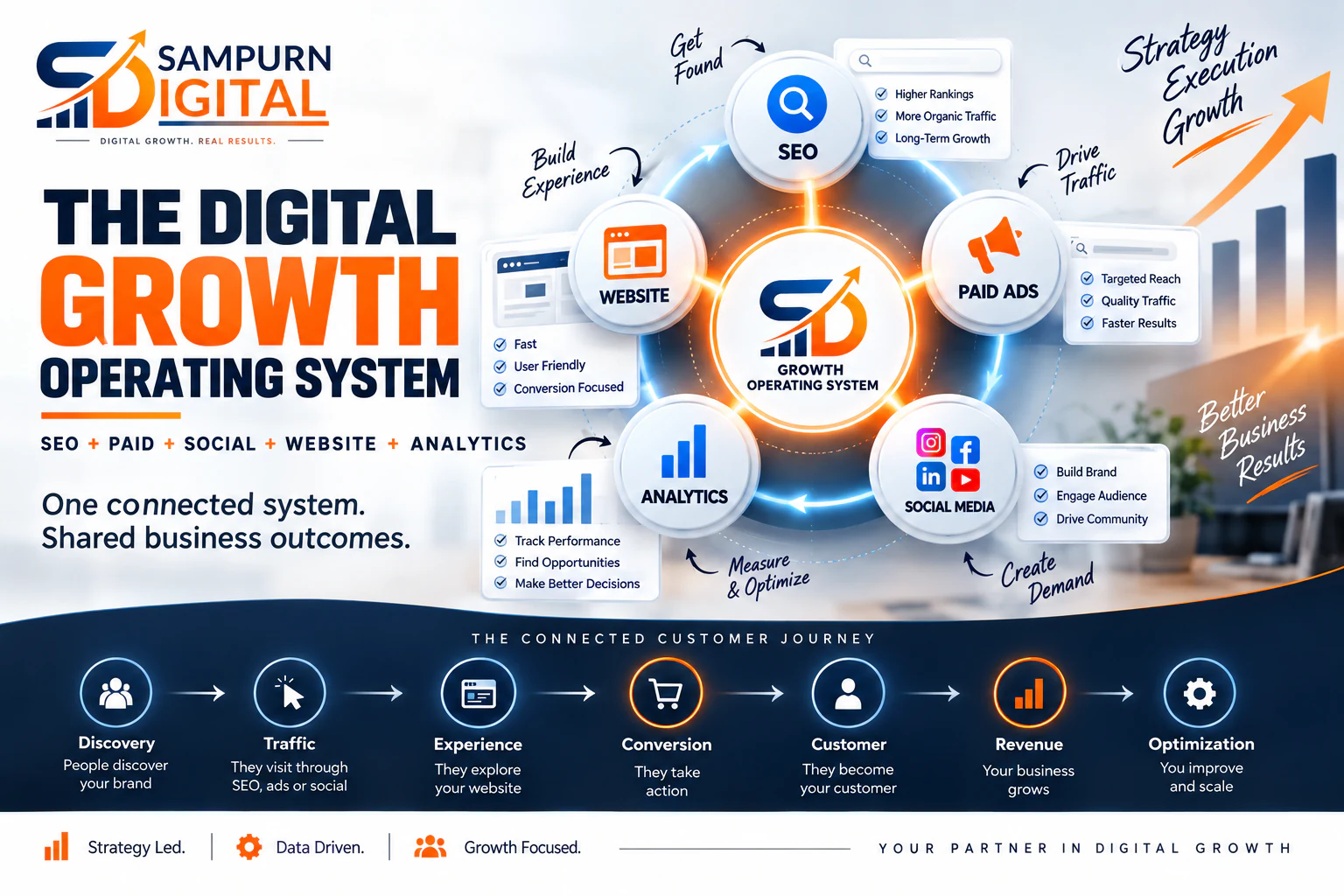
This guide explains how SEO, paid advertising, social media, website experience and analytics can work together as one connected growth system.
First: Don't Treat Digital Marketing as a Collection of Separate Channels
A common marketing setup looks like this:
Each team may perform well individually.
But the business still may not grow efficiently.
Why?
Because customers don't experience your marketing in departments.
A customer may:
- Discover your brand through Google.
- See your Instagram content.
- Click a paid advertisement later.
- Visit a service page.
- Leave without converting.
- Return through a remarketing campaign.
- Submit a form.
- Become a customer.
- Generate revenue that should be connected back to the original marketing journey.
That is a system.
Your marketing strategy should reflect that system.
A useful digital growth model is:
Every major marketing channel should contribute to one or more parts of this journey.
What Is a Digital Growth Operating System?
A digital growth operating system is the connected structure that coordinates:
- SEO
- Paid advertising
- Social media
- Website and landing pages
- Content
- Analytics
- Conversion optimization
- Customer acquisition
- Revenue measurement
The goal isn't to make every channel do the same thing.
The goal is to make every channel perform its role while sharing information with the others.
For example:
Now marketing becomes a feedback loop rather than a collection of activities.
The 5 Core Systems of Digital Growth
A practical digital growth operating system can be divided into five connected systems.
SEO Creates Sustainable Search Visibility
SEO helps your business become discoverable when customers actively search for problems, products, services or solutions.
But SEO should not be treated simply as:
Rankings + traffic \= success
The more useful model is:
SEO can help identify:
- What customers search for
- Which problems matter
- Which topics deserve content
- Which services have demand
- Which questions customers ask before buying
- Which pages need stronger visibility
That information is valuable beyond SEO.
Your paid campaigns can use it.
Your social content can use it.
Your website structure can use it.
Your sales team can use it.
Your broader growth strategy can use it.
For a deeper look at how organic search connects with paid campaigns, content and website CRO, see our guide to [SEO strategy and organic search for businesses](https://www.sampurndigital.com/blog/seo/how-seo-paid-ads-content-and-website-cro-work-together-as-one-growth-system).
Paid Advertising Captures and Creates Demand
Paid advertising provides something SEO often cannot provide immediately:
You can launch campaigns around:
- High-intent searches
- Product categories
- Services
- Offers
- Retargeting audiences
- Social audiences
- Promotional campaigns
- New market opportunities
But paid advertising becomes much more powerful when its data feeds the rest of the system.
For example, paid search data can reveal:
- High-converting search terms
- Weak keywords
- Strong offers
- Valuable audiences
- High-performing landing pages
- Customer acquisition costs
That information can influence SEO and website strategy.
Likewise, organic and social insights can influence paid creative.
The goal is not simply:
"Run more ads."
It is:
"Use paid acquisition as a measurable growth engine that produces useful learning."
Our [performance marketing and paid acquisition guide](https://www.sampurndigital.com/blog/performance-marketing/the-complete-paid-growth-system-ads-landing-pages-tracking-cro) goes deeper into how ads, landing pages, tracking and CRO work together.
Social Media Creates Attention and Trust
Social media often plays a different role from search.
Search usually captures existing intent.
Social can create or strengthen awareness.
Someone may not be searching for your company today.
But they may:
- Watch your Reel
- Read your post
- See a customer story
- Learn something useful
- Follow your account
- Visit your website later
- Search for your brand
- Eventually become a customer
That means social should not be judged only by:
- Followers
- Likes
- Views
- Comments
Those metrics can matter, but the bigger question is:
A strong social system can produce:
Social content can also provide creative insights for paid advertising.
The posts that generate strong engagement can become candidates for paid promotion.
The questions people repeatedly ask can become SEO content opportunities.
The objections people mention can improve website copy.
For more on connecting content, community, paid media and your website, see [how social media growth strategy works](https://www.sampurndigital.com/blog/social-media-marketing/the-complete-social-growth-system-content-community-paid-website).
The Website Is the Conversion Environment
Your marketing channels generate opportunities.
Your website has to handle them.
This is why the website should not be treated as a separate design project.
It is part of the growth system.
Imagine you have:
- Excellent SEO
- Strong paid campaigns
- Great social content
- High-quality traffic
But the website:
- Loads slowly
- Has confusing navigation
- Doesn't explain the offer
- Has weak trust signals
- Makes forms difficult to complete
- Has unclear calls to action
- Doesn't match the ad message
Your acquisition channels may look successful while revenue remains weak.
The website needs to connect:
Different pages can have different jobs.
For example:
This is why conversion-focused web development and CRO should be part of the overall marketing strategy.
See our guide to [conversion-focused web development and conversion optimization](https://www.sampurndigital.com/blog/web-development/the-revenue-ready-website-seo-ux-cro-analytics-performance).
Analytics Turns Activity Into Learning
Without measurement, marketing becomes a series of opinions.
Analytics should help answer:
- Where did visitors come from?
- Which channels generated qualified traffic?
- Which campaigns generated leads?
- Which pages converted?
- Which audiences converted?
- What did acquisition cost?
- Which channels influenced customers?
- Which activities generated revenue?
The purpose of analytics isn't to create a dashboard with dozens of numbers.
It is to create a feedback system.
For example:
Check landing page
Discover weak offer-message alignment
Improve landing page
Conversion rate increases
CPA decreases
Budget can potentially be scaled
That is analytics driving action.
How the Systems Connect
The five systems should not operate independently.
Think of them as a loop.
This creates a continuous growth loop.
The Digital Growth Funnel
Your operating system should connect channels to funnel stages.
| Funnel Stage | SEO | Paid | Social | Website | Analytics |
|---|---|---|---|---|---|
| Awareness | Informational content | Display/social campaigns | Organic content | Educational pages | Reach & engagement |
| Discovery | Search visibility | Search/social ads | Content discovery | Relevant landing pages | Traffic sources |
| Consideration | Commercial content | High-intent campaigns | Proof & education | Service/product pages | Engagement |
| Conversion | Commercial SEO | Conversion campaigns | Retargeting | Landing/contact pages | Leads/sales |
| Retention | Helpful resources | Remarketing | Community | Customer experience | LTV/repeat revenue |
The exact mix depends on the business.
The important principle is that each channel has a role in the customer journey.
Don't Make Every Channel Responsible for Everything
One of the easiest ways to create marketing chaos is to give every channel the same objective.
For example:
"SEO needs leads."
"Social needs leads."
"Paid needs leads."
"Website needs leads."
"Content needs leads."
The problem is that customers don't always convert immediately after interacting with a channel.
Instead, assign each system a primary role.
SEO
Primary role:
Paid
Primary role:
Social
Primary role:
Website
Primary role:
Analytics
Primary role:
This creates clearer accountability.
Build One Shared Customer Journey
Your teams should agree on what the customer journey actually looks like.
For example:
Now ask every team:
"Where does your work contribute to this journey?"
If a channel cannot answer that question, its role may not be clearly defined.
For a broader view of how customers move between channels, see [the digital growth funnel explained for businesses](https://www.sampurndigital.com/blog/digital-marketing/the-complete-digital-growth-funnel-from-first-click-to-customer).
Create a Shared Measurement Framework
One of the biggest problems in multi-channel marketing is that every team reports different metrics.
SEO might report:
Paid might report:
Social might report:
Website might report:
Management might ask:
"But are we making money?"
The solution is to create measurement layers.
Layer 1: Channel metrics
Examples:
- Impressions
- Clicks
- Reach
- Engagement
- CPC
- Rankings
- Sessions
These help diagnose channel performance.
Layer 2: Funnel metrics
Examples:
- Landing-page engagement
- Leads
- Add-to-carts
- Qualified leads
- Conversion rate
These show how traffic moves through the funnel.
Layer 3: Business metrics
Examples:
- Customers
- Revenue
- CAC
- LTV
- Profitability
- Pipeline value
These connect marketing activity to business outcomes.
The higher you move in the measurement system, the closer you get to the actual business objective.
Create a Single Source of Truth
Your growth team should agree on definitions.
For example:
Without shared definitions, teams can produce reports that are individually correct but collectively confusing.
A dashboard is useful only when everyone understands what the numbers mean.
Connect SEO and Paid Search Data
SEO and paid search can produce valuable information for each other.
Suppose paid campaigns identify a search term that consistently generates high-value customers.
That could become an SEO opportunity.
Likewise, an SEO page that generates strong qualified conversions can reveal a valuable topic or customer need.
You can then consider whether paid campaigns should accelerate that opportunity.
The relationship can look like:
and:
This is much more powerful than running SEO and PPC as isolated departments.
Connect Social Content With Paid Creative
Your organic social channels can become a testing environment.
Suppose you publish ten different creative concepts.
Two consistently generate strong engagement.
Instead of guessing which creative should receive advertising budget, those signals can inform paid testing.
The loop becomes:
The reverse can also happen.
Paid advertising may identify a message that converts particularly well.
That message can then influence:
- Social posts
- Website headlines
- Landing pages
- Email campaigns
- Content topics
Now creative learning travels between channels.
Connect SEO With Website CRO
SEO can bring the visitor.
CRO helps determine what happens next.
A page can rank well and still underperform commercially.
For example:
may be less valuable than:
This is why SEO should not stop at traffic.
Look at:
If a page receives substantial organic traffic but produces very few leads, investigate the page itself.
Check:
- Search intent
- Offer relevance
- Page structure
- Trust signals
- CTA placement
- Form friction
- Internal links
- Mobile experience
- Page speed
The objective is not simply more traffic.
It is more valuable outcomes from relevant traffic.
Build a Cross-Channel Feedback Loop
A mature growth system continuously transfers information between channels.
For example:
SEO learns:
Which topics generate demand.
Paid learns:
Which audiences and messages convert quickly.
Social learns:
Which ideas generate attention and engagement.
Website learns:
Where visitors hesitate or convert.
Analytics learns:
Which activities influence business outcomes.
Then those insights return to the entire system.
This creates:
That is the operating loop.
What a Weekly Digital Growth Review Should Look Like
You don't need a meeting where every department reads its own report.
Instead, organize the review around the customer journey.
Acquisition
Ask:
- Are we generating enough qualified traffic?
- Which channels are growing?
- Which channels are declining?
Engagement
Ask:
- Are visitors engaging with important pages?
- Which content is attracting attention?
- Are users reaching the right pages?
Conversion
Ask:
- Where are users dropping?
- Which pages convert?
- Which campaigns generate qualified leads?
Customer acquisition
Ask:
- What is CAC?
- Which channels generate valuable customers?
- Is lead quality changing?
Revenue
Ask:
- Which marketing activities generated revenue?
- What is the return on acquisition investment?
- Which opportunities should receive more budget?
Next actions
Choose a small number of high-impact improvements.
Don't turn the review into a list of 50 tasks.
Don't Scale a Broken System
This is one of the most important principles in digital growth.
Suppose your paid campaigns generate 1,000 leads.
But only 5% are qualified.
Increasing the budget may produce more leads.
But it may also produce more poor-quality leads.
Similarly:
Scaling should happen after the system demonstrates that it can convert traffic into valuable outcomes.
Before increasing acquisition, ask:
"Can the rest of the system handle additional demand efficiently?"
A Practical Digital Growth Operating System
A business can structure the system into six stages.
Stage 1: Strategy
Define:
- Business objectives
- Target customers
- Offers
- Revenue goals
- Priority markets
- Customer journey
Stage 2: Acquisition
Coordinate:
- SEO
- Paid advertising
- Social media
- Content
Stage 3: Experience
Optimize:
- Website
- Landing pages
- Messaging
- Navigation
- Trust signals
Stage 4: Conversion
Track:
- Leads
- Purchases
- Calls
- Forms
- Qualified opportunities
Stage 5: Measurement
Connect:
- Analytics
- CRM
- Advertising data
- Search data
- Revenue data
Stage 6: Optimization
Improve:
- Weak channels
- Weak pages
- Weak offers
- Weak campaigns
- Weak customer journeys
Then repeat.
A Simple Digital Growth Operating System Checklist
Strategy
- Is there a clearly defined business objective?
- Are priority customers defined?
- Are marketing goals connected to revenue?
- Are priority offers clear?
SEO
- Are valuable search opportunities identified?
- Are commercial pages optimized?
- Is content connected to customer journeys?
- Are SEO insights shared with other teams?
Paid
- Are campaigns connected to clear objectives?
- Are acquisition costs measured?
- Are landing pages aligned with ad messaging?
- Are campaign insights being shared?
Social
- Are content pillars connected to business goals?
- Are engagement signals being used?
- Are strong organic creatives tested through paid campaigns?
- Is social contributing to the broader customer journey?
Website
- Does each important page have a clear purpose?
- Do landing pages match acquisition sources?
- Are conversion paths easy to understand?
- Is the website technically and commercially ready?
Analytics
- Are channel and business metrics connected?
- Are conversions tracked correctly?
- Is revenue connected to acquisition?
- Does the team have consistent metric definitions?
Optimization
- Are bottlenecks identified before more budget is added?
- Are experiments prioritized by impact?
- Are learnings shared across channels?
- Is the system improving continuously?
Final Diagnosis: Digital Marketing Works Best as a System
The biggest digital marketing mistake is often not choosing the wrong channel.
It is managing the right channels separately.
SEO can generate demand capture.
Paid advertising can accelerate acquisition.
Social media can build attention and trust.
The website can convert qualified visitors.
Analytics can reveal what is working.
CRO can improve the weak points.
But the real advantage appears when these systems work together.
The model becomes:
So don't ask:
"Should we invest more in SEO?"
"Should we spend more on ads?"
"Should we post more on social media?"
Ask:
"Which part of our growth system is currently the biggest constraint?"
That question changes the strategy.
If acquisition is weak, improve demand generation.
If traffic is strong but conversion is weak, improve the website and offer.
If leads are increasing but revenue isn't, investigate lead quality and sales conversion.
If CAC is rising, identify where acquisition efficiency is deteriorating.
If channels are producing useful insights but teams aren't sharing them, fix the operating model.
The goal is not to make every channel bigger.
The goal is to make the entire system stronger.
And that is what turns digital marketing from a collection of activities into a digital growth operating system.
