
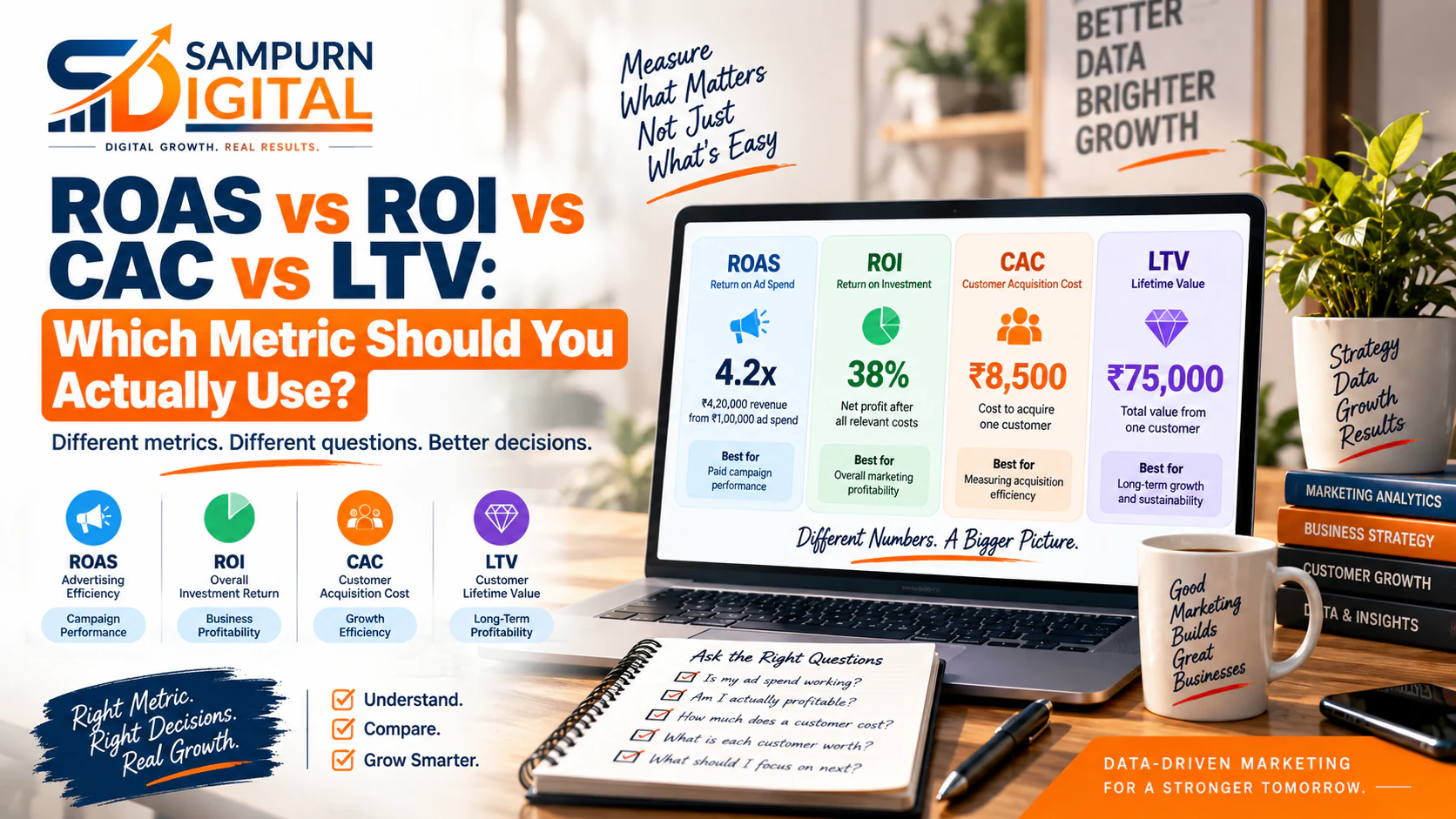
Marketing teams often have plenty of numbers.
ROAS is 4.2x.
ROI is 38%.
CAC is ₹8,500.
LTV is ₹75,000.
Everything looks measurable.
But then someone asks:
“Which number should we actually use to decide whether marketing is working?”
That is where things become confusing.
ROAS, ROI, CAC and LTV measure different parts of the business.
They answer different questions.
And using the wrong metric can lead to completely wrong decisions.
For example, a campaign can have a strong ROAS while producing customers with poor long-term value.
A channel can have a high CAC but still be highly profitable if customers stay longer and spend more.
A business can show positive campaign ROI while the overall acquisition economics remain weak.
The goal is therefore not to find one perfect marketing metric.
The goal is to understand which metric should be used for which decision.
First: Don't Treat ROAS, ROI, CAC and LTV as the Same Thing
These four metrics answer different questions.
ROAS
How much revenue did we generate relative to advertising spend?
ROI
Did the investment create a positive return after considering relevant costs?
CAC
How much does it cost us to acquire a customer?
LTV
How much value does a customer generate over their relationship with the business?
A simple way to think about them is:
Once you understand that distinction, choosing the right metric becomes much easier.
What Is ROAS?
ROAS means:
A simplified formula is:
For example:
₹4,00,000 attributed revenue ÷ ₹1,00,000 ad spend
\= 4x ROAS
That means the business generated ₹4 in attributed revenue for every ₹1 spent on advertising.
ROAS is particularly useful for evaluating paid advertising.
It can help answer:
Which campaign is generating more attributed revenue relative to its ad spend?
But ROAS has an important limitation.
If you spend ₹1,00,000 and generate ₹4,00,000 revenue, that does not automatically mean you made ₹3,00,000 profit.
You still need to consider:
- Product costs
- Agency costs
- Sales costs
- Discounts
- Fulfilment
- Returns
- Overhead
- Other operating expenses
So ROAS is useful—but it should not be treated as the complete picture of profitability.
What Is ROI?
ROI means:
The exact calculation can vary depending on what costs and returns your business includes.
A simplified formula is:
For example:
Investment \= ₹2,00,000
Return \= ₹3,00,000
ROI:
₹1,00,000 ÷ ₹2,00,000 × 100
\= 50%
ROI is broader than ROAS because it can consider more than advertising spend.
That makes ROI more useful when evaluating an entire investment rather than simply an advertising campaign.
For example, you might use ROI to evaluate:
- A marketing program
- A content initiative
- An SEO investment
- A campaign
- An agency engagement
- A new acquisition strategy
What Is CAC?
CAC means:
It measures how much the business spends to acquire a new customer.
A simplified formula is:
For example:
₹5,00,000 acquisition cost
÷
50 new customers
\=
CAC answers:
“How expensive is it for us to acquire a customer?”
This is often more useful than CPL.
A business may generate leads cheaply but struggle to turn those leads into customers.
That is why the progression should be:
The closer the metric gets to an actual customer, the more useful it can become for acquisition decisions.
What Is LTV?
LTV means:
It estimates the value a customer generates during their relationship with the business.
Depending on the business model, LTV may consider:
- Average purchase value
- Purchase frequency
- Customer lifespan
- Gross margin
- Repeat purchases
- Subscription revenue
For example:
Average order value \= ₹5,000
Average purchases \= 6
Simplified revenue-based LTV:
₹5,000 × 6
\= ₹30,000
But businesses should be careful about treating revenue-based LTV as profit.
A customer generating ₹30,000 in revenue does not necessarily produce ₹30,000 in economic value.
Margin matters.
Why CAC and LTV Should Be Viewed Together
CAC tells you:
What does it cost to acquire the customer?
LTV tells you:
How valuable is the customer?
Together, they help you understand acquisition economics.
For example:
Business A
CAC \= ₹10,000
LTV \= ₹12,000
The relationship may be weak.
Business B
CAC \= ₹10,000
LTV \= ₹60,000
The same acquisition cost could be highly attractive.
This is why a business should not automatically reject a marketing channel because its CAC looks high.
You need to understand the value of the customer being acquired.
ROAS Is Usually Best for Paid Campaign Decisions
Suppose you are comparing three paid campaigns:
| Campaign | Spend | Revenue | ROAS |
|---|---|---|---|
| Campaign A | ₹50,000 | ₹2,50,000 | 5x |
| Campaign B | ₹50,000 | ₹1,75,000 | 3.5x |
| Campaign C | ₹50,000 | ₹1,00,000 | 2x |
If your question is:
Which campaign generated more attributed revenue per advertising rupee?
ROAS is useful.
Campaign A is strongest based on this metric.
But if Campaign C generates customers with much higher repeat purchase value, the longer-term business picture could be different.
That is where LTV enters the analysis.
ROI Is Better for Broader Investment Decisions
Imagine you spend money on:
- Paid ads
- Creative production
- Agency fees
- Landing page development
- Analytics
- Sales support
If you evaluate only ad spend, you may calculate a strong ROAS.
But the actual investment is larger.
A broader ROI calculation can help you understand the economics of the entire initiative.
This makes ROI more appropriate for questions such as:
“Was this marketing program financially worthwhile?”
rather than simply:
“Did this advertising campaign generate revenue efficiently?”
CAC Is Useful for Comparing Acquisition Channels
Suppose:
| Channel | Spend | Customers | CAC |
|---|---|---|---|
| SEO | ₹2,00,000 | 20 | ₹10,000 |
| Paid Ads | ₹3,00,000 | 25 | ₹12,000 |
| Social | ₹1,00,000 | 5 | ₹20,000 |
| Referral | ₹80,000 | 16 | ₹5,000 |
CAC gives you a straightforward comparison.
But again, do not stop there.
The next question should be:
What kind of customers does each channel acquire?
If SEO customers have a much higher LTV than paid customers, equal CAC does not mean equal value.
LTV Helps You Understand How Much CAC You Can Afford
Suppose a customer generates:
over their relationship with your business.
You may be able to spend more to acquire that customer than a business whose customers generate only ₹10,000.
This gives you a more useful acquisition question:
How much can we economically afford to spend to acquire a customer of this type?
That is much stronger than choosing a universal CAC target without considering customer value.
Understand the Difference Between Revenue and Profit
This is where many marketing reports go wrong.
Imagine:
Ad spend \= ₹1,00,000
Attributed revenue \= ₹5,00,000
ROAS \= 5x
Looks excellent.
But suppose:
Product/service delivery costs \= ₹3,00,000
Other marketing costs \= ₹75,000
Sales and operating costs \= ₹75,000
Now the business economics look very different.
ROAS tells you:
“Advertising generated ₹5 for every ₹1 of ad spend.”
ROI asks a broader question:
“Did the overall investment produce enough return after relevant costs?”
Both can be useful.
They simply answer different questions.
Don't Compare ROAS Directly With CAC
ROAS and CAC use different units.
ROAS is a ratio:
CAC is a monetary amount:
You cannot simply say:
“4x is better than ₹8,000.”
Instead, use each metric for the decision it supports.
ROAS
Compare campaign advertising efficiency.
CAC
Compare customer acquisition cost.
LTV
Compare customer value.
ROI
Compare investment return.
Build a Metric Hierarchy
A useful hierarchy is:
Level 1: Activity
- Impressions
- Clicks
- Sessions
- Engagement
Level 2: Leads
- Leads
- CPL
- Qualified leads
Level 3: Customers
- Customers
- CAC
- Customer conversion rate
Level 4: Economics
- Revenue
- ROAS
- LTV
- ROI
- Profit contribution
The higher you move in this hierarchy, the closer the metric gets to actual business value.
That does not make activity metrics useless.
It simply means they should be interpreted in context.
Use Different Metrics for Different Business Models
There is no universal answer.
Ecommerce
Often useful:
- ROAS
- CAC
- AOV
- LTV
- Contribution margin
- Revenue
SaaS
Often useful:
- CAC
- LTV
- Retention
- Churn
- Payback period
- Revenue
Service Business
Often useful:
- Cost per qualified lead
- Cost per opportunity
- CAC
- Revenue per customer
- LTV
- Sales conversion rate
Local Business
Often useful:
- Cost per enquiry
- Qualified leads
- Customers
- CAC
- Revenue per customer
The right dashboard depends on the business model.
Understand LTV:CAC
One useful way to combine customer value and acquisition cost is the:
For example:
LTV \= ₹60,000
CAC \= ₹15,000
Ratio:
This means the estimated customer value is four times the acquisition cost.
But this ratio should be interpreted carefully.
The underlying LTV and CAC calculations need to be realistic.
If LTV is based on optimistic assumptions or CAC excludes important acquisition costs, the ratio can look better than the actual economics.
Add Payback Period When Cash Flow Matters
Two businesses can have the same LTV:CAC ratio but very different cash-flow situations.
Business A
Acquisition cost is recovered in 2 months.
Business B
Acquisition cost is recovered in 18 months.
The second business may have much greater working-capital pressure.
Payback period therefore becomes important for:
- SaaS
- Subscription businesses
- B2B businesses
- Businesses with recurring revenue
- High-ticket services
It answers:
How long does it take to recover the acquisition investment?
Use Attribution Carefully With ROAS
ROAS depends on attributed revenue.
That means attribution rules matter.
A customer may interact with:
before purchasing.
Depending on the measurement setup, paid advertising may receive the final conversion credit.
This can make one channel look stronger than it would under another attribution model.
For a deeper look at attribution, see [performance marketing and paid acquisition for businesses](https://chatgpt.com/blog/performance-marketing/paid-marketing-attribution-how-to-track-the-complete-conversion-journey).
Connect Metrics to the Full Funnel
A strong measurement system looks like:
Then evaluate:
- Traffic → conversion rate
- Lead → qualification rate
- Opportunity → customer rate
- Spend → CAC
- Revenue → ROAS
- Customer value → LTV
- Investment → ROI
This gives the business a much more complete picture.
Example: One Channel Can Look Good While the Business Performs Poorly
Imagine:
Paid Ads:
₹2,00,000 spend
₹10,00,000 attributed revenue
ROAS \= 5x
Looks excellent.
But:
- Average margin is low
- Refunds are high
- Customers rarely repeat
- Sales costs are high
The actual business return may be disappointing.
Now imagine another channel:
₹2,00,000 investment
₹6,00,000 initial revenue
ROAS appears lower.
But customers have:
- High margins
- Strong repeat purchases
- Long relationships
Its LTV may be much higher.
The second channel could therefore create more long-term value despite lower initial ROAS.
Know Which Metric to Use for Which Question
| Business Question | Primary Metric |
|---|---|
| Which ad generated revenue efficiently? | ROAS |
| What did the broader investment return? | ROI |
| How expensive is customer acquisition? | CAC |
| How valuable is the customer? | LTV |
| Can we afford this acquisition cost? | LTV + CAC |
| How quickly do we recover acquisition cost? | Payback Period |
| Which channel creates profitable customers? | CAC + LTV + Margin |
| Which campaign should we scale? | ROAS + CAC + quality |
| Is marketing profitable overall? | ROI + contribution/profit |
This is the simplest way to avoid metric confusion.
Don't Use One Metric as Your Entire Marketing Strategy
A business that focuses only on ROAS may:
- Cut brand-building activities
- Ignore organic search
- Undervalue content
- Over-invest in retargeting
- Optimize for short-term revenue
A business that focuses only on CAC may:
- Reject valuable high-LTV customers
- Prioritize cheap but low-quality leads
- Ignore customer value
A business that focuses only on LTV may:
- Use overly optimistic assumptions
- Ignore acquisition efficiency
- Wait too long to recover investment
The best decisions come from looking at the metrics together.
Build a Simple Business Economics Table
Use something like:
| Metric | Value |
|---|---|
| Marketing Spend | ₹3,00,000 |
| New Customers | 30 |
| CAC | ₹10,000 |
| Revenue | ₹12,00,000 |
| ROAS | 4x |
| Estimated LTV | ₹50,000 |
| LTV:CAC | 5:1 |
| Payback Period | 4 months |
Now the marketing team can discuss the business economics rather than isolated channel metrics.
Use Gross Margin Where Possible
Revenue-based calculations can be misleading.
Suppose:
Customer revenue \= ₹1,00,000
But delivery and product costs \= ₹70,000.
The business has only ₹30,000 before other costs.
If CAC is ₹25,000, the acquisition may look acceptable when viewed against revenue but much less attractive when viewed against contribution.
Therefore, businesses should consider margin when calculating customer economics.
Track Metrics by Customer Segment
Average numbers can hide important differences.
For example:
Enterprise Customers
CAC \= ₹50,000 LTV \= ₹5,00,000
Small Customers
CAC \= ₹10,000 LTV \= ₹25,000
The second segment looks cheaper to acquire.
But the first may generate significantly greater value.
Break down metrics by:
- Customer type
- Product
- Geography
- Industry
- Acquisition channel
- Campaign
- Customer cohort
This can reveal where your best customers actually come from.
Track Cohorts Instead of Only Averages
A customer acquired in January may behave differently from one acquired in June.
Cohort analysis can show:
- Retention
- Repeat purchases
- Revenue
- LTV development
- Payback
This becomes especially useful for businesses with recurring or repeat-purchase models.
Instead of asking:
“What's our average LTV?”
you can ask:
“How valuable are customers acquired through this channel over time?”
That is a much stronger question.
Create a Metric Review Process
A weekly marketing review can use:
Step 1
Check spend.
Step 2
Check leads.
Step 3
Check qualified leads.
Step 4
Check customers.
Step 5
Check CAC.
Step 6
Check revenue.
Step 7
Check ROAS where applicable.
Step 8
Check customer value trends.
Step 9
Identify major changes.
Step 10
Decide what to fix, test or scale.
For the broader measurement structure, use [a practical marketing dashboard guide](https://chatgpt.com/blog/digital-marketing/marketing-dashboard-what-should-a-business-track-every-week).
Don't Set Arbitrary Benchmarks
You may see advice such as:
“A 3x ROAS is good.”
“Your LTV should be three times CAC.”
These can be useful reference points.
But they are not universal laws.
The right target depends on:
- Gross margin
- Business model
- Sales cycle
- Cash flow
- Retention
- Customer value
- Operating costs
- Growth objectives
A 2x ROAS may be excellent for one business and unacceptable for another.
Context matters.
Build a Decision Framework
When evaluating a marketing channel, ask:
Question 1
Does it generate the right audience?
Question 2
Does it generate qualified leads?
Question 3
What is the CAC?
Question 4
What is the customer value?
Question 5
How quickly do we recover acquisition cost?
Question 6
What is the contribution after relevant costs?
Question 7
Can the channel scale?
Question 8
What role does the channel play in the overall customer journey?
This creates a much stronger decision system than focusing on one number.
ROAS vs ROI vs CAC vs LTV: The Quick Reference
Use ROAS when:
You want to evaluate advertising efficiency.
Use ROI when:
You want to evaluate the return from a broader investment.
Use CAC when:
You want to understand the cost of acquiring customers.
Use LTV when:
You want to understand the long-term value of customers.
Use LTV + CAC when:
You want to understand acquisition economics.
Use Payback Period when:
You need to understand how quickly acquisition costs are recovered.
Use all of them together when:
You are making major growth and budget decisions.
Don't Optimize the Metric Instead of the Business
This is the most important lesson.
If your team knows that the dashboard rewards:
they may pursue cheap leads.
If it rewards:
they may focus heavily on retargeting.
If it rewards:
they may prioritize quantity over quality.
If it rewards:
they may ignore long-term customer value.
Metrics influence behavior.
Therefore, your measurement system should reward the outcomes the business actually wants.
The goal is not:
Make the dashboard look good.
The goal is:
Make the business economics better.
Metric Selection Checklist
Before choosing your primary marketing metrics, confirm:
- The business objective is clear
- Revenue is being tracked
- Marketing spend is tracked
- Leads are tracked
- Qualified leads are tracked
- Customers are tracked
- CAC is understood
- ROAS is used where appropriate
- ROI is defined clearly
- LTV assumptions are documented
- Gross margin is considered
- Customer segments are considered
- Attribution limitations are understood
- Payback period is considered when relevant
- Short-term and long-term outcomes are separated
- Channel quality is measured
- Metrics are connected to business decisions
- The team is not optimizing a vanity metric
- Major budget decisions use multiple metrics
Final Diagnosis: There Is No Single "Best" Marketing Metric
ROAS, ROI, CAC and LTV are not competing metrics.
They are different lenses.
ROAS tells you how efficiently advertising generates attributed revenue.
ROI helps evaluate the return from a broader investment.
CAC tells you how expensive customer acquisition is.
LTV tells you how valuable those customers can become.
Together, they create a more complete picture:
The mistake is asking:
“Which metric should I use?”
The better question is:
“Which metric should I use for this decision?”
If you're optimizing a paid campaign, ROAS may be highly useful.
If you're evaluating overall marketing investment, ROI may matter more.
If you're comparing acquisition channels, CAC becomes important.
If you're deciding how much you can afford to spend to acquire a customer, LTV and CAC should be considered together.
And if you're making a major growth decision, you should look at the complete economic picture.
That is how businesses move from reporting marketing numbers to managing marketing economics.
