
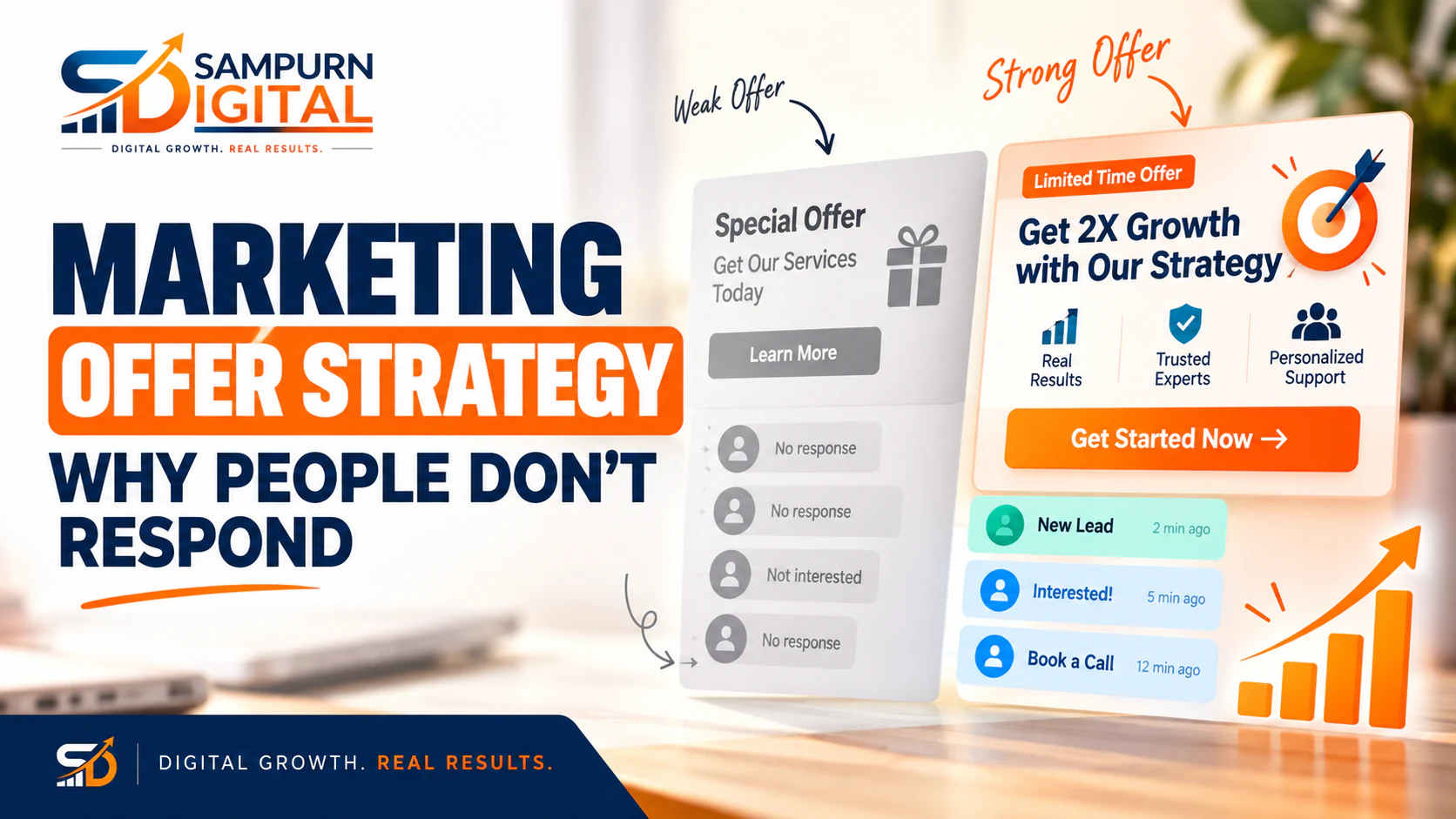
Your campaign can have good reach, strong creative and even plenty of clicks—and still generate almost no meaningful response.
The usual reaction is to blame the channel.
“Maybe Google Ads isn't working.”
“Maybe Instagram isn't reaching the right people.”
“Maybe we need more traffic.”
But sometimes the real problem is much simpler:
People do not respond to campaigns simply because they see them.
They respond when the offer is relevant to their problem, valuable enough to consider, believable enough to trust and easy enough to act on.
That is why marketing offer strategy for lead generation needs to be considered before increasing traffic or advertising spend.
This guide explains how to identify weak offers and build campaigns that give customers a real reason to respond.
First: Don't Assume the Problem Is Your Marketing Channel
When a campaign produces weak results, businesses often change the channel first.
They might:
- Increase the Google Ads budget
- Try Meta Ads
- Publish more social content
- Change keywords
- Redesign creatives
- Increase posting frequency
- Hire another agency
But if the underlying offer is weak, 0.................................................................................................channels may only create more expensive failure.
Imagine this offer:
“Contact us to learn more about our digital marketing services.”
There is nothing obviously wrong with it.
But there is also little reason for a potential customer to act immediately.
Now compare it with:
“Get a free digital growth consultation to identify where your website is losing qualified leads.”
The second offer creates:
- A specific outcome
- A clear reason to respond
- Relevance to a known problem
- Lower perceived risk
- A clearer next step
The difference is not necessarily the marketing channel.
It is the offer.
Understand What an Offer Actually Is
An offer is more than a discount.
For a business, an offer can include:
- Product
- Service
- Consultation
- Audit
- Demo
- Trial
- Free assessment
- Lead magnet
- Bundle
- Guarantee
- Bonus
- Special package
- Limited-time opportunity
Think of the offer as the answer to:
“What exactly are you giving the customer in exchange for taking the next step?”
For example:
Talk to our team.
Book a free 30-minute consultation to identify your biggest digital marketing growth opportunities.
The second tells the customer what they will receive.
Start With the Customer's Problem
A strong offer usually starts with a problem—not the company's service list.
Ask:
- What is the customer struggling with?
- What is costing them money?
- What are they frustrated about?
- What result do they want?
- What have they already tried?
- Why haven't they solved it yet?
For example:
“Our website gets visitors, but very few become leads.”
That is a stronger starting point than:
“We provide SEO, PPC, social media and web development.”
The first is customer-focused.
The second is company-focused.
If you're already experiencing traffic without enough customers, start by understanding [how to improve your digital marketing is getting traffic but not enough customers](https://chatgpt.com/blog/digital-marketing/why-your-digital-marketing-is-getting-traffic-but-not-enough-customers).
Match the Offer to the Customer's Awareness Level
Not every customer is ready for the same offer.
Someone discovering a problem for the first time may not be ready to book a sales call.
Someone actively comparing providers may be ready.
Consider four stages.
Problem Aware
The customer knows something is wrong.
Useful offers:
- Educational guide
- Checklist
- Diagnostic resource
- Free assessment
Solution Aware
The customer knows possible solutions exist.
Useful offers:
- Consultation
- Strategy session
- Audit
- Comparison guide
- Demo
Product or Service Aware
The customer understands the category and is evaluating providers.
Useful offers:
- Case study
- Proposal
- Consultation
- Product demo
- Service package
Ready to Buy
The customer has high intent.
Useful offers:
- Purchase
- Booking
- Quote
- Free trial
- Direct consultation
This is why a single offer should not necessarily be pushed to every audience.
Make the Value Obvious
The customer should understand the value without having to decode the campaign.
Ask:
What will the customer get?
Instead of:
“Get started with our marketing services.”
Try:
“Find the three biggest conversion problems limiting your website leads.”
The second is more concrete.
A useful value statement can follow this structure:
For example:
Get a clear digital marketing growth plan without committing to a long-term marketing package.
The exact wording depends on the business, but the principle is consistent:
Solve a Specific Problem Instead of Everything
One common offer mistake is trying to sell the entire company.
For example:
SEO + PPC + Social Media + Web Development + Content + Branding + Strategy + Analytics
This may describe everything the business can do.
But it does not necessarily create a compelling reason to respond.
A stronger campaign might focus on:
“Find out why your paid traffic isn't converting.”
That specific problem creates a much clearer entry point.
Once the customer enters the funnel, other services can become relevant later.
Reduce the Perceived Risk
People often hesitate because they do not know what happens after they respond.
Questions may include:
- Will someone pressure me to buy?
- How much will this cost?
- Is this actually useful?
- Will I waste my time?
- Can I trust this company?
- What happens after I submit the form?
Your offer should reduce uncertainty.
You can do this through:
- Clear expectations
- Transparent pricing where appropriate
- Free assessments
- Demonstrations
- Case studies
- Testimonials
- Guarantees where commercially appropriate
- Clear next steps
- Specific deliverables
For example:
“30-minute consultation”
is less ambiguous than:
“Talk to our experts.”
Build the Offer Around an Outcome
Customers usually do not want the service itself.
They want what the service helps them achieve.
A business may sell:
SEO services.
But the customer may want:
More qualified organic enquiries.
A business may sell:
Website development.
But the customer may want:
A website that converts visitors into leads.
A business may sell:
Paid advertising.
But the customer may want:
Predictable customer acquisition at a sustainable cost.
The offer should therefore communicate the outcome whenever possible.
Make the CTA Match the Offer
A common campaign mistake is using generic calls to action.
Examples:
- Learn More
- Submit
- Click Here
- Contact Us
These may be acceptable in some contexts, but stronger CTAs explain the next step.
For example:
- Get My Free Audit
- Book a Growth Consultation
- Request a Demo
- Get the Pricing Plan
- Download the Checklist
- Get Your Website Assessment
The CTA should answer:
“What happens if I click this?”
Make the Landing Page Continue the Offer
Your advertisement creates a promise.
Your landing page needs to continue that promise.
Imagine the ad says:
“Find out why your Google Ads generate clicks but few customers.”
The landing page should immediately reinforce:
“Diagnose the conversion problems behind your paid traffic.”
If the user clicks the ad and lands on a generic homepage, the campaign loses momentum.
The message becomes disconnected.
For campaigns where conversion matters, the offer and landing page should be designed together. The [landing page anatomy guide](https://chatgpt.com/blog/web-development/landing-page-anatomy-what-every-high-converting-page-needs) explains the key elements that support this transition.
Make the Offer Consistent Across Channels
A full campaign may appear on:
- Meta
- Organic search
- Website
- Retargeting
The presentation can change by channel.
The core offer should not become confusing.
For example:
Google Search
Free Digital Marketing Growth Consultation
Social
Not sure where your marketing funnel is losing customers?
Retargeting
Still trying to figure out why your website isn't converting?
Website
Identify the biggest opportunities in your digital growth funnel.
Different messages.
Same underlying proposition.
This consistency is especially important when customers move between channels.
Use Proof to Make the Offer Believable
A compelling offer still needs credibility.
Ask:
Why should someone believe this business can deliver the promised outcome?
Useful proof can include:
- Client results
- Case studies
- Testimonials
- Reviews
- Certifications
- Industry experience
- Portfolio examples
- Before-and-after results
- Data
- Process transparency
For example:
“Get a free conversion assessment”
becomes more credible when accompanied by evidence showing that the business has successfully improved conversion performance for similar companies.
Don't Confuse Discounts With Strong Offers
A discount can be an offer.
But it is not automatically a good offer.
For example:
“20% OFF\!”
may create attention.
But the customer still needs to care about the product.
A stronger approach is to combine:
Discounts can then become one component of the proposition rather than the entire strategy.
This is particularly important for service businesses, where constantly discounting can reduce perceived value.
Create Different Offers for Different Customer Problems
One business can have multiple offers.
For example, a digital marketing company could have:
SEO Problem
Free SEO opportunity assessment
Paid Advertising Problem
Paid campaign waste audit
Website Problem
Website conversion assessment
Lead Generation Problem
Digital growth consultation
The service provider remains the same.
The entry point changes according to the customer's problem.
This can make campaigns much more relevant.
Check Whether the Offer Fits the Traffic
Traffic quality matters.
Suppose you advertise:
Free enterprise SEO strategy consultation.
But the campaign targets broad searches from people looking for:
What is SEO?
The offer may be too advanced for that audience.
The reverse can also happen.
A customer searching:
SEO agency for ecommerce business
may be ready for a consultation, not a beginner's SEO guide.
This is why offer strategy must connect with the wider funnel.
If you need to understand how visitors move through different stages, use [a practical digital growth funnel guide](https://chatgpt.com/blog/digital-marketing/the-complete-digital-growth-funnel-from-first-click-to-customer).
Diagnose the Offer Before Changing the Channel
When a campaign underperforms, use this sequence:
Ask where the failure occurs.
Low impressions
Possible targeting or channel problem.
Impressions but low clicks
Possible creative or message problem.
Clicks but poor conversion
Possible offer, landing-page or intent problem.
Leads but poor quality
Possible audience, positioning or qualification problem.
Good leads but few sales
Possible sales process, pricing, trust or offer problem.
This prevents the business from changing the wrong variable.
Understand Offer-Market Fit
A good offer is not automatically good for every audience.
The offer must fit:
For example, a free audit may work well for a business actively evaluating its marketing.
It may not be the right offer for someone who is only learning what marketing means.
Similarly, a 30-minute strategy consultation may work for a high-value B2B service but be excessive for a low-cost consumer purchase.
The stronger the fit, the less pressure the campaign needs to create.
Test the Offer Before Testing Everything Else
Businesses often run complicated A/B tests on:
- Button colours
- Headlines
- Images
- Font sizes
- Ad placements
Those tests can matter.
But first ask a bigger question:
Is the offer itself attractive?
Test meaningful differences such as:
Offer A
Free consultation
Offer B
Free audit
Offer C
Free strategy plan
Offer D
Downloadable guide
Then measure:
- Conversion rate
- Lead quality
- Cost per qualified lead
- Sales conversion
- Revenue generated
The winning offer is not necessarily the one that produces the most leads.
It is the one that produces the best business outcome.
Connect the Offer to the Full Campaign
An offer should not exist separately from the campaign.
Think of the structure as:
If any part is disconnected, performance can suffer.
For example:
Audience: Business owners struggling with lead generation
Message: Your traffic isn't the problem—your funnel may be.
Offer: Free digital growth consultation
Landing page: Diagnose the biggest conversion opportunities
Conversion: Consultation booking
Now the campaign has a logical path.
Use the Offer as the Campaign's Strategic Anchor
Once the offer is clear, the rest of the campaign becomes easier to build.
SEO can create content that addresses the problem.
Paid advertising can capture high-intent demand.
Social media can explain the problem and demonstrate expertise.
The website can present the offer and convert visitors.
This is much stronger than asking each channel to “generate leads” independently.
If your campaign needs a broader channel strategy, review [which marketing channel should your business invest in first explained for businesses](https://chatgpt.com/blog/digital-marketing/which-marketing-channel-should-your-business-invest-in-first).
Don't Fix Everything at Once
If an offer is not converting, do not immediately change:
- Audience
- Offer
- Creative
- Landing page
- Budget
- Channel
- CTA
- Pricing
all at the same time.
You will lose the ability to understand what actually changed performance.
Instead prioritize.
Priority 1: Offer relevance
Does the audience actually want this?
Priority 2: Message
Is the value obvious?
Priority 3: Landing experience
Does the page continue the promise?
Priority 4: Trust
Does the customer have enough reason to believe you?
Priority 5: Conversion friction
Is taking action unnecessarily difficult?
Priority 6: Optimization
Only then move into smaller creative and UX improvements.
This creates cleaner learning.
Marketing Offer Strategy Checklist
Before launching or changing a campaign, ask:
- Is the customer problem clearly defined?
- Is the target audience specific?
- Is the offer relevant to that audience?
- Is the customer outcome clear?
- Is the value easy to understand?
- Does the offer match the customer's awareness level?
- Is the perceived risk low enough?
- Is the CTA specific?
- Does the landing page match the offer?
- Is the messaging consistent across channels?
- Is there enough trust or proof?
- Are we relying too heavily on discounts?
- Does the offer match the traffic intent?
- Are primary and secondary conversions defined?
- Are we measuring lead quality, not just lead volume?
- Can we test different offers without changing everything else?
If the answer to several of these questions is no, increasing traffic may not solve the problem.
Final Diagnosis: Sometimes the Campaign Doesn't Need More Traffic
When people do not respond to a campaign, the instinct is often to reach more people.
But more traffic does not automatically create more customers.
If the offer is:
- Too generic
- Too complicated
- Poorly matched to the audience
- Focused on the company instead of the customer
- Missing a clear benefit
- Too risky
- Disconnected from the landing page
- Presented to the wrong stage of the funnel
then additional traffic may simply produce more non-converting visitors.
A strong marketing offer strategy starts with a simple question:
Why would this specific customer want to take this specific action right now?
If the answer is clear, relevant and believable, your marketing channels have something valuable to distribute.
If the answer is weak, changing channels may only hide the real problem.
And when people are clicking but still not converting, the next diagnostic step is to examine whether the problem sits in the ad experience or the landing experience using [performance marketing and paid acquisition for businesses](https://chatgpt.com/blog/performance-marketing/low-conversion-rate-in-google-ads-is-the-problem-ads-or-landing-page).
